
Test 3 of 11 · 20 questions · Free 2026
UT Permit Practice Test 3
Jump to the test ↓A fixed 20 question set from the Utah bank with answers and plain English explanations. The real UT exam is 50 questions, 80 percent to pass; take the full length version on the main practice page.
Question 1 of 20 · 0 right so far
All 20 questions in test 3
Every question below comes from the Utah question bank on this page. Open a question to see the correct answer and the explanation. Nothing here is hidden behind a signup.
1. With no different speed posted and no additional hazard, how fast may you pass Utah school grounds during recess?
- No more than 25 mph
- No more than 20 mph
- No more than 30 mph
- No more than 35 mph
Show answer
No more than 20 mph. The school-ground rule allows 20 mph while passing during recess under the stated conditions. Choosing 25 mph would confuse the business or residential speed with the lower school speed. Children using the grounds during a break are a practical cue to check your speed before reaching the school frontage. Do not wait for a child to step into your lane before responding, and be ready to travel more slowly when an actual hazard makes that necessary.
Study this in the handbook: Speed Limits and the Basic Speed Law
2. A 19-year-old drives in Utah with measurable alcohol in their body and receives a first Not-a-Drop offense. How long are driving privileges denied?
- For 30 days
- For 90 days
- For six months
- For eighteen months
Show answer
For six months. A first Not-a-Drop offense brings a six-month denial of all driving privileges for someone under 21 who drives with measurable alcohol. The 90-day choice understates that period; this rule is not a short warning suspension. In a situation involving a 19-year-old leaving a party, the useful cues are the driver’s age and the presence of alcohol, rather than whether the person appears drunk. Plan transportation that does not put that person behind the wheel.
Study this in the handbook: Under 21 and the Not-a-Drop Act
3. How long do alcohol and drug related violations, suspensions and revocations stay on a Utah driving record?
- Three years
- 10 years
- Five years
- They are removed at reinstatement
Show answer
10 years. Utah's driving record shows moving violation convictions and suspensions within the past three years, but all alcohol and drug related violations, suspensions and revocations remain for 10 years. So three years is the general window, not the alcohol one, and five years is not listed. Reinstating a license does not erase the record. That 10 year window also matches the look back for repeat Not-a-Drop offenses.
Study this in the handbook: Renewal, Phone Laws and the Point System
4. For a Utah driver under 21, how many points within three years lead to a hearing?
- 70 points or more
- 200 points or more
- 12 points or more
- 150 points or more
Show answer
70 points or more. Utah sets a much lower threshold for younger drivers: under 21, acquiring 70 points or more within three years brings a hearing. The 200 point figure is for drivers over 21. Twelve and 150 are not Utah thresholds. Because single moving violations carry dozens of points each in Utah, a young driver can reach 70 with only a couple of tickets.
Study this in the handbook: Renewal, Phone Laws and the Point System
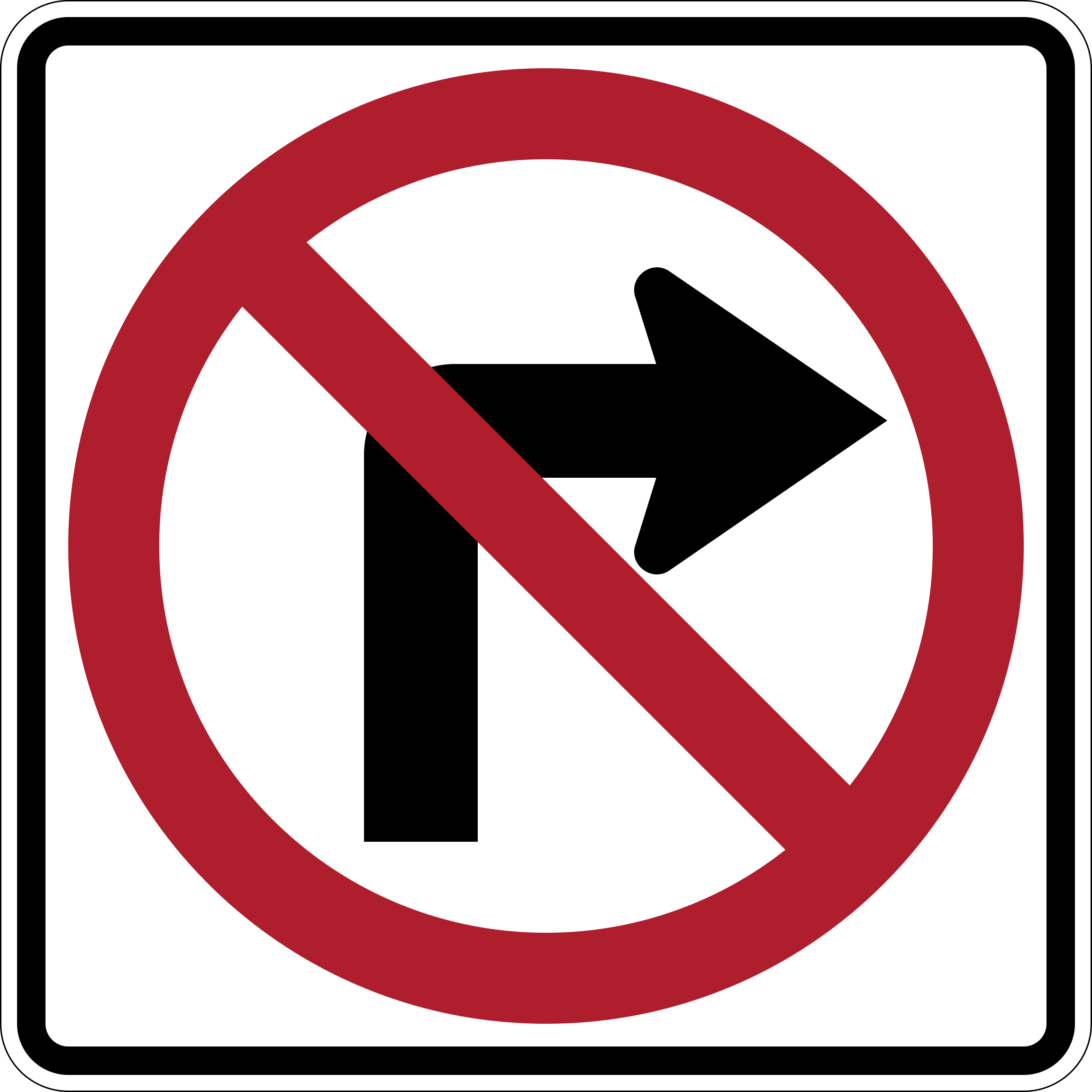
5. A NO RIGHT TURN sign is posted beside a red traffic light. Does stopping first authorize a right turn?
- Yes, if no pedestrian is in the crosswalk
- Yes, once the wheels have completely stopped
- No, a posted restriction prevents that turn
- Yes, because the turn restriction applies only when the light is green
Show answer
No, a posted restriction prevents that turn. A right turn on red is allowed after a complete stop only when signs do not prohibit it. The posted no-right-turn restriction removes that permission at this location. An empty crosswalk does not override the sign. Before making a red-light turn, look beside the signal for turn restrictions as well as checking traffic; the signal color alone cannot tell you whether that particular maneuver is permitted.
Study this in the handbook: Regulatory, Guide and Route Signs
6. You are following another car at night in Utah with your high beams on. When must you dim them?
- When you are within 300 feet of the vehicle ahead
- Only when the driver ahead adjusts the mirror
- Never, high beams are always allowed when following
- When you are within 1,000 feet
Show answer
When you are within 300 feet of the vehicle ahead. High beams fill the mirrors of the car ahead and blind its driver, so the handbook requires you to dim your lights when you are within 300 feet of the vehicle ahead of you. One thousand feet is more than the rule requires, waiting for the driver to react means you have already dazzled them, and high beams are never unrestricted when following. The oncoming rule is separate: dim before you are within 500 feet of an approaching car.
Study this in the handbook: Night Driving, Weather, Floods and Skids
7. When driving at night in Utah, what does the handbook tell you to ensure about your vehicle's lights?
- That only the parking lights are on
- That the high beams stay on at all times
- That the headlights and taillights are illuminated
- That the interior lights are on
Show answer
That the headlights and taillights are illuminated. At night the distance you can see is limited, so the handbook first tells you to ensure the headlights and taillights of the vehicle are illuminated. Headlights let you see the road ahead, and taillights let drivers behind you see you. Parking lights are not what the handbook names, high beams must be dimmed within 500 feet of an oncoming car and within 300 feet of a car you are following, and interior lights are not what the handbook asks you to check. Turn the headlights on from sunset to sunrise and whenever people and vehicles are not clearly visible at 1,000 feet.
Study this in the handbook: Night Driving, Weather, Floods and Skids
8. According to the Utah handbook, how are railroad crossings controlled?
- They are never controlled
- Only by traffic lights
- Only by painted lines
- By flashing signals, gates, a watchman, or stop signs
Show answer
By flashing signals, gates, a watchman, or stop signs. Railroad crossings use several kinds of control, and the handbook lists them: flashing signals, gates, a watchman, or stop signs. Whichever control is present, stop more than 15 feet but not more than 50 feet from the nearest rail, and continue only when it is safe and the control permits it. If there is a gate, wait for it to be raised. At a crossing marked only by a stop sign, look and listen both ways before continuing. Ordinary traffic lights and painted lines alone are not how crossings are controlled. Never drive around a lowered gate.
Study this in the handbook: Railroad Crossings
9. A school bus flashes alternating red lights on a four-lane Utah road with no median. Which traffic must stop?
- Only vehicles immediately behind the bus
- Only vehicles in the bus's lane
- Traffic traveling in both directions
- Only vehicles approaching the front of the bus
Show answer
Traffic traveling in both directions. On a four-lane roadway without a median, Utah requires traffic in both directions to stop for the school bus's flashing red signals. The number of lanes alone does not create the exemption associated with a divided highway. The choice limiting stopping to vehicles behind the bus overlooks the absence of a separating median. Check the roadway layout as you approach, and remain alert for children even when they are not yet visible near the bus.
Study this in the handbook: Emergency Vehicles, Move Over and School Buses
10. A Utah driver's DUI plea is held in abeyance by the court. How is it treated if the driver is later charged again?
- It is erased and never counts
- It counts only in another state
- It becomes a felony automatically
- It is considered a prior offense in combination with later offenses
Show answer
It is considered a prior offense in combination with later offenses. A plea in abeyance does not appear on the regular driving record unless the driver holds a CDL or was in a commercial vehicle, and it does not suspend a regular license. However, the abeyance is considered a prior offense in combination with subsequent offenses. So it is not erased, it is not limited to other states, and it does not by itself make the case a felony. It also disqualifies CDL privileges.
Study this in the handbook: Alcohol, Drugs and the 0.05 Limit
11. Where does the Utah handbook tell a pedestrian to walk when there are no sidewalks?
- On the left shoulder, as far from the edge of the roadway as possible, facing traffic
- On the right shoulder, with traffic
- In the center of the lane
- Pedestrians may not walk on roads without sidewalks
Show answer
On the left shoulder, as far from the edge of the roadway as possible, facing traffic. Pedestrians must use sidewalks where they exist. If there are no sidewalks, the handbook says to walk or jog on the left shoulder as far away as possible from the edge of the roadway, which puts oncoming traffic in the walker's view. Where neither a sidewalk nor a shoulder is available, walk as near as possible to the outside edge of the roadway. Drivers should expect walkers on rural shoulders and give them room.
Study this in the handbook: Speed Limits and the Basic Speed Law
12. When exiting a perpendicular or angle parking space in Utah, what should you do first?
- Back out quickly to claim the lane
- Check for traffic in all directions
- Sound the horn and reverse
- Rely on the backup camera alone
Show answer
Check for traffic in all directions. Backing out of an angled or perpendicular space is a blind maneuver into a lane where cars and pedestrians move unpredictably, so the handbook says to check for traffic in all directions first. Backing quickly, trusting only a camera that shows a narrow view, or honking and reversing all replace looking with hope. Check mirrors, the camera, and over both shoulders, then back out slowly and stop if anything moves.
Study this in the handbook: Lane Changes, Passing, Turns and U-Turns
13. Where does the Utah handbook say to come to a complete stop when stopping at an intersection?
- Behind any stop signs, signals, sidewalks, or stop lines
- Inside the crosswalk, for a better view of cross traffic
- Just past the stop line, where the cross street is visible
- At the edge of the intersection, with the front bumper over the line
Show answer
Behind any stop signs, signals, sidewalks, or stop lines. The handbook gives one rule for stopping at an intersection: come to a complete stop behind any stop signs, signals, sidewalks, or stop lines. Elsewhere it adds that you must not stop over a marked stop line, pedestrian crosswalk, or sidewalk, and must not stop in the intersection. Rolling into the crosswalk or past the line for a better view puts the car where pedestrians and cross traffic need to be. Stop fully behind the line first; then, if your view is blocked, move forward carefully and look both ways before entering.
Study this in the handbook: Intersections and Right of Way
14. What is the top cause of crashes for Utah drivers under 20, according to the handbook's statistics?
- Disregarding traffic signals
- Wrong side or wrong way driving
- Following too closely
- Improper backing
Show answer
Following too closely. The handbook's teenage driver crash table for ages 15 to 19 lists following too closely as the leading cause at 17 percent, followed by failing to yield right of way, failing to keep in the proper lane, unsafe lane changes, and disregarding traffic signals. Disregarding signals is on the list but ranks last, and wrong side or wrong way driving and improper backing are not in the teen top five at all. The lesson for a new driver is simple: follow the two-second rule the handbook teaches and increase the gap in bad weather or poor visibility.
15. When may a person drive a farm tractor or road roller on a Utah highway without a driver license?
- When driving it in conjunction with a construction or agricultural activity
- Never
- Only on roads posted under 25 mph
- Only with a farm permit issued by the county
Show answer
When driving it in conjunction with a construction or agricultural activity. Utah does not require a driver license to drive road rollers, road machinery, or farm tractors on its highways when the person is driving the vehicle in conjunction with a construction or agricultural activity. The exemption is tied to the work being done, not to the road's speed limit, and no county permit is involved. Other drivers should expect these slow moving vehicles on rural highways and pass only where it is safe.
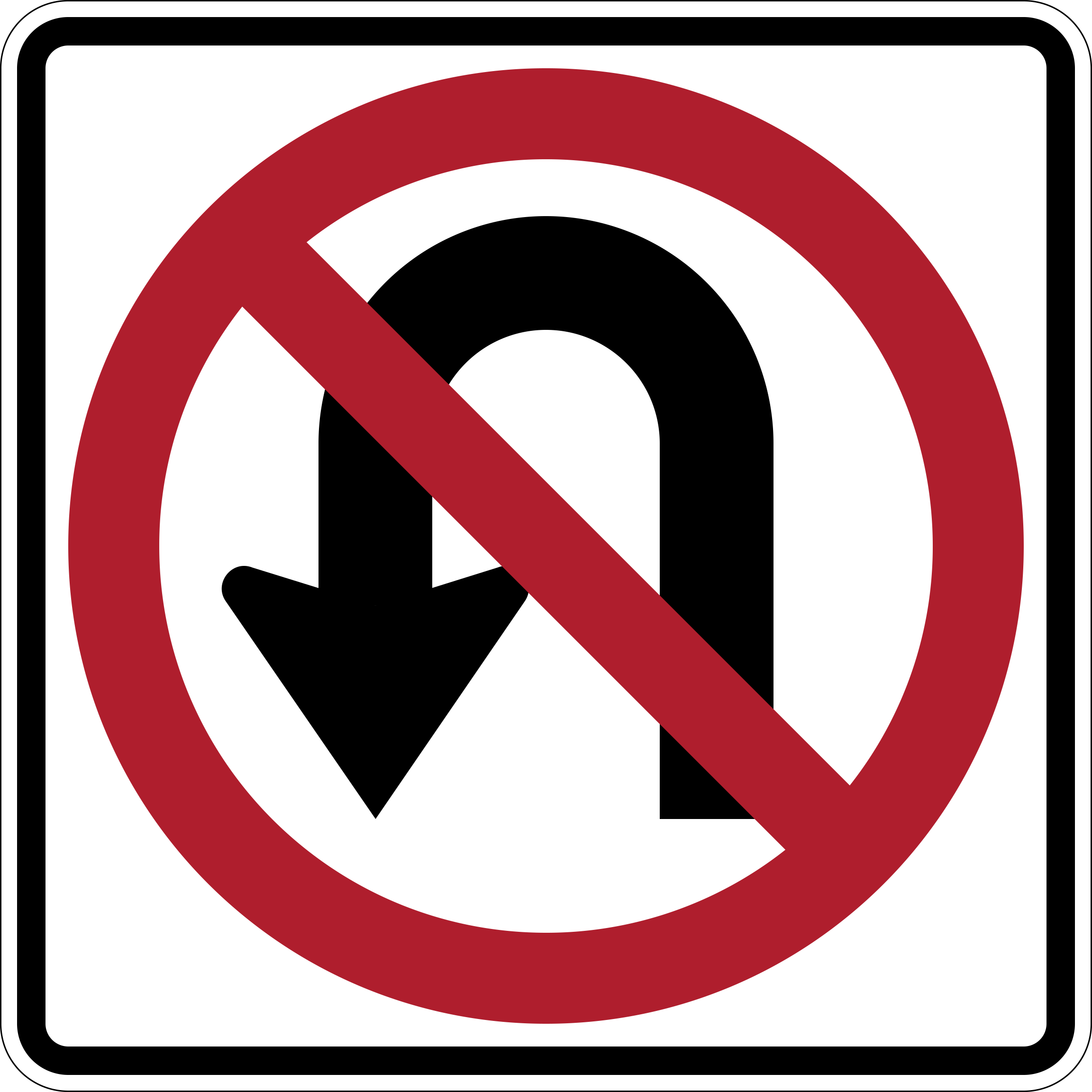
16. The road is wide and empty, but this NO U-TURN sign faces you. May you reverse direction here?
- Yes, because there is room to complete the maneuver
- Yes, after signaling for two seconds
- No, unless you first stop beside the center line
- No, the posted prohibition still applies
Show answer
No, the posted prohibition still applies. A traffic control device prohibiting a U-turn remains controlling even when the roadway is wide and no other vehicles are visible. Enough turning space addresses only the physical maneuver; it does not cancel a posted restriction. Stopping at the center line also cannot create permission. The crossed-out U-shaped arrow is the cue to continue toward another lawful place to change direction, keeping your route decision separate from whether the car could physically make the turn.
Study this in the handbook: Lane Changes, Passing, Turns and U-Turns
17. After a breakdown, how far behind your vehicle should emergency flares or triangles be placed?
- 20 to 30 feet
- Immediately against the rear bumper
- 500 to 600 feet
- 200 to 300 feet
Show answer
200 to 300 feet. Place emergency flares or triangles 200 to 300 feet behind the disabled vehicle to give approaching motorists time to slow or change lanes. A warning tucked against the rear bumper becomes visible too close to the obstruction to serve that purpose well. First get the vehicle off the roadway and away from traffic. Think of the warning devices as advance notice for a driver approaching from behind, rather than a marker only for your parking position.
Study this in the handbook: Vehicle Emergencies
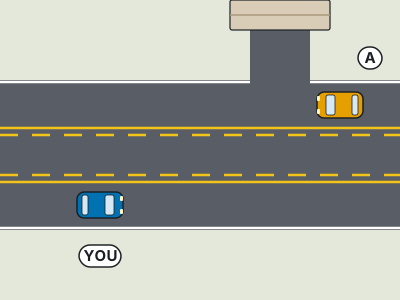
18. On a Utah street with a shared center left turn lane, how should you begin a left turn?
- Turn directly from the through lane without entering the center lane
- Signal left, check mirrors and your left blind spot, then steer smoothly into the shared lane
- Use the center lane to pass slower traffic first
- Stop in the through lane and wait for a gap
Show answer
Signal left, check mirrors and your left blind spot, then steer smoothly into the shared lane. Many Utah streets have a shared left turn lane in the middle of the roadway, and the handbook asks drivers to use caution when turning left from it. The handbook says to check your mirrors and the vehicles ahead, signal left, check your left blind spot, and steer smoothly into the shared left turn lane, then make the turn when traffic is clear. Turning from the through lane or stopping in it blocks traffic behind you, and passing slower traffic first is not part of the left turn procedure the handbook gives.
Study this in the handbook: Pavement Markings and Special Lanes
19. Why are stop lines at Utah intersections set back from the crossing?
- To make the intersection look wider
- To keep cars away from the traffic signal poles
- To mark where pedestrians must stand
- To give larger vehicles more turning space
Show answer
To give larger vehicles more turning space. A truck or bus turning into your street swings wide, and a car stopped too close to the corner gets clipped. The handbook says stop lines at intersections are designed to give larger vehicles more turning space. They are not about signal poles, pedestrian positions, or appearance. Stop with your front bumper behind the line, even when it seems far back, so the turning vehicle has the room the line was painted to provide.
Study this in the handbook: Railroad Crossings
20. Near a merge warning sign, you are entering a lane occupied by an approaching vehicle close enough to be a hazard. Who yields?

- The continuing driver, because the merge is signed
- You, as the driver entering the continuing lane
- The driver who reached the merge point last, regardless of lane
- The continuing driver, if you signal first
Show answer
You, as the driver entering the continuing lane. The driver entering a continuing lane must give way to vehicles in it that are close enough to present an immediate threat. A merge warning sign alerts traffic to the meeting of streams but does not transfer priority to the entering vehicle. Signaling first also does not reserve a gap. Watch the approaching vehicle’s position and closing speed, and adjust your approach until you can enter without requiring that driver to take evasive action.
Study this in the handbook: Pavement Markings and Special Lanes
QualitySpace is expanding to Utah
We are a California-based independent insurance brokerage working on licensing in more states. We cannot help with Utah insurance yet. Leave your email and we will let you know when we can.
Every question is written from the official Utah Driver Handbook. Need paper? Printable UT practice test with answer key.
Last verified 2026-10-05. How we check every question · Study all 220 as flashcards
Frequently asked questions
How many questions are on this Utah practice test?
This fixed set has 20 questions. It is test 3 of 11 from the 220 question Utah bank. The real UT exam asks 50 questions and you need 40 correct.
What is the passing score for the real Utah test?
You must pass with a score of 80% or better That figure comes from the official Utah source cited on the DMV facts page.
How does this fixed test relate to the full Utah bank?
Each numbered test is a fixed set of questions in a fixed order, so you can retake the same test later and compare. Every test mixes road signs and the other topics in about the same proportion as the full bank. Tests 1 to 11 together cover every question in the Utah bank once. The full practice page mixes the whole bank at random.
Last verified 2026-10-05. See the Utah DMV facts page for sourced state details.