
Test 2 of 11 · 20 questions · Free 2026
UT Permit Practice Test 2
Jump to the test ↓A fixed 20 question set from the Utah bank with answers and plain English explanations. The real UT exam is 50 questions, 80 percent to pass; take the full length version on the main practice page.
Question 1 of 20 · 0 right so far
All 20 questions in test 2
Every question below comes from the Utah question bank on this page. Open a question to see the correct answer and the explanation. Nothing here is hidden behind a signup.
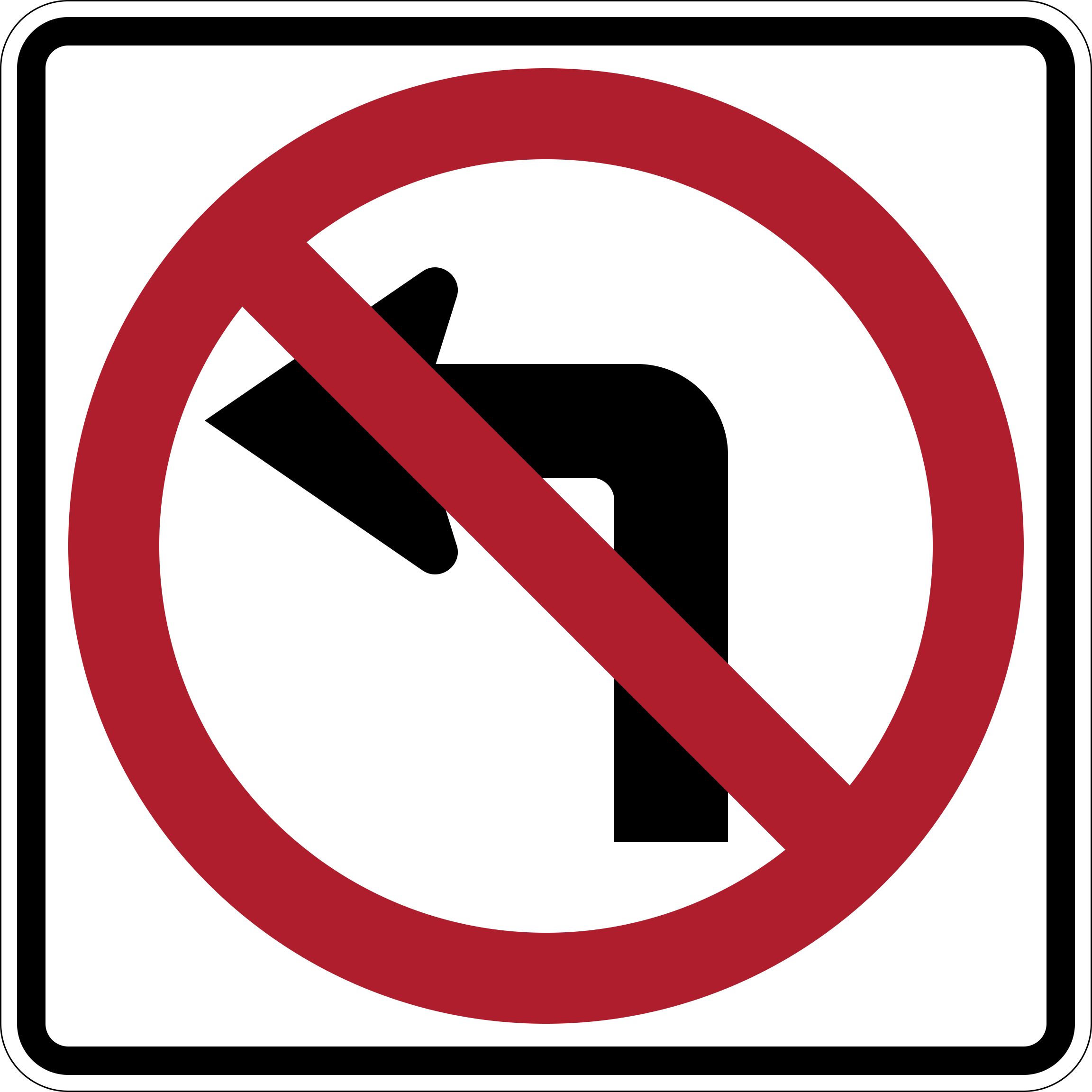
1. How does the red slash change the meaning of the left-turn arrow on this sign?
- It reserves left turns for the next green light
- It makes left turns optional
- It warns that left turns require a lower speed
- It prohibits the illustrated left turn
Show answer
It prohibits the illustrated left turn. A red circle and slash across a movement symbol mean that movement is prohibited. Here, the crossed arrow depicts a left turn, so it does not become an optional or advisory maneuver. The suggestion that a green light automatically permits the turn overlooks the separate posted restriction. Read the arrow’s shape and the slash together as you approach the junction, and choose a permitted route before moving into a lane intended for turning.
Study this in the handbook: Regulatory, Guide and Route Signs
2. This STOP AHEAD sign gives you advance notice of a required stop. How should you prepare?

- Coast through if the intersecting street appears empty
- Wait until your front bumper reaches the stop sign to brake
- Begin braking well before the stopping point
- Brake abruptly at the crosswalk to minimize slowing time
Show answer
Begin braking well before the stopping point. Advance warning lets you begin a controlled approach before the actual stop. Starting the braking process early helps avoid a sudden jerk and gives you time to locate the stop line or crossing. Waiting until the bumper reaches the stop sign can leave too little room for a smooth stop, especially if you are traveling quickly. The small stop symbol on the yellow warning sign is a cue to ease into braking and identify where you must halt.
3. According to the Utah handbook, what does a driver reduce by leaving a few minutes early?
- Fuel consumption only
- The need to wear a safety belt
- The need to check mirrors
- The urge to speed, beat traffic signals, or do anything that results in a citation or crash
Show answer
The urge to speed, beat traffic signals, or do anything that results in a citation or crash. Many risky habits come from running late. The handbook says that if you leave a few minutes early you will not feel the need to speed, beat traffic signals, or do anything else that results in a citation or a traffic accident. Fuel use is not what the handbook ties to leaving early, and no schedule changes the belt or mirror rules. Building a margin into the trip removes the pressure to rush that the handbook describes.
4. A car is coming toward you at night in Utah with your high beams on. When must you dim them?
- Before you get within 500 feet of the oncoming car
- Within 100 feet of the oncoming car
- Only if the other driver flashes first
- Only on divided highways
Show answer
Before you get within 500 feet of the oncoming car. High beams blind the driver coming toward you, so the handbook requires you to dim your lights before you are within 500 feet of an oncoming car. Waiting until 100 feet, or until the other driver flashes, means you have already dazzled them, and the rule applies on every road, not just divided highways. If an oncoming driver fails to dim, look toward the right edge of the road to keep your bearings, and remember the separate rule for following: dim within 300 feet of the vehicle ahead.
Study this in the handbook: Night Driving, Weather, Floods and Skids
5. What do orange diamond or rectangular signs with black letters warn Utah drivers about?
- School crossings
- Work zones and people working on or near the road
- Railroad crossings
- Scenic areas
Show answer
Work zones and people working on or near the road. The handbook describes work zone signs as diamond or rectangular and orange with black letters or symbols, and says they warn you of work zones and of people working on or near the road. It adds that highway work zones are easily recognized by orange signs, other orange traffic control devices, flashing lights on equipment, and workers in highly visible clothing. A railroad advance warning is a round yellow sign, not an orange one. When orange signs appear, slow down, watch for workers and equipment, and be ready to stop.
Study this in the handbook: Regulatory, Guide and Route Signs
6. What does the Utah handbook say to always carry when driving in the desert?
- A spare battery for your phone only
- Enough water for you and your passengers to survive if the vehicle breaks down
- Extra sunglasses
- A road map only
Show answer
Enough water for you and your passengers to survive if the vehicle breaks down. Desert roads can leave you far from help in extreme heat, so the handbook says to always carry enough water for you and your passengers to survive if your vehicle breaks down, and to make sure you have enough gas and water whenever you leave the freeways. A phone battery, sunglasses, or a map do not keep you alive if you are stranded. Top up fuel at every opportunity and never let the water run low.
Study this in the handbook: Distractions, Fatigue, Animals and Mountain Roads
7. What does the Utah handbook tell you to do if a short term signal in a work zone shows red?
- Proceed slowly through the signal
- Drive around the signal on the shoulder
- Sound the horn and wait for a flagger
- Stop at the white line if there is one, and be ready to stop quickly in work zones
Show answer
Stop at the white line if there is one, and be ready to stop quickly in work zones. The handbook says that if there is a short term signal, stop at the white line if there is one, and it adds the general rule to slow down in work zones and be ready to stop quickly. Creeping through, using the shoulder, or honking for a flagger are not options. Wait for the green and follow any flagger's directions. Once the signal turns green, watch for workers and equipment as you pass through the narrowed area.
Study this in the handbook: Warning, Railroad and Work Zone Signs
8. What headlight range must every Utah vehicle except a motorcycle provide on high and low beams?
- One headlight of any color
- At least two white headlights shining 350 feet on high and 100 feet on low beams
- Two headlights shining 100 feet on high and 50 feet on low beams
- Blue or amber headlights for visibility
Show answer
At least two white headlights shining 350 feet on high and 100 feet on low beams. Headlights are equipment the law specifies. The Utah handbook says all vehicles except motorcycles must have at least two operational headlights, one on each side, that are white in color and can shine 350 feet on high beams and 100 feet on low beams. It also says all vehicles must have a high-beam indicator light. A single light of any color, a shorter range on either setting, or a blue or amber beam does not meet that standard.
9. What is the minimum distance from a crosswalk at which a Utah driver may park?
- 20 feet
- 10 feet
- 100 feet
- 5 feet
Show answer
20 feet. A car parked next to a crosswalk hides pedestrians from drivers and drivers from pedestrians. Utah's parking rules therefore prohibit parking on a crosswalk or within 20 feet of one, so 20 feet is the minimum clearance. Five feet and 10 feet are inside the prohibited zone, and 100 feet is more than the rule requires. Find a space that leaves the crossing and the sight lines clear, and remember the separate limits near hydrants, stop signs, and railroad tracks.
10. In Utah, smoking in a vehicle while transporting children of what age is an infraction?
- Children 15 years of age or younger
- Children under 5 only
- Children under 12 only
- It is not an offense in Utah
Show answer
Children 15 years of age or younger. The handbook says it is an infraction to be stopped for smoking in a vehicle while transporting children 15 years of age or younger. The rule is not limited to children under 5 or under 12, and it is a real offense, not only advice. It appears in the handbook's section on protection of children, alongside the car seat rules that keep young passengers restrained in the back seat.
Study this in the handbook: Seat Belts, Car Seats and Air Bags
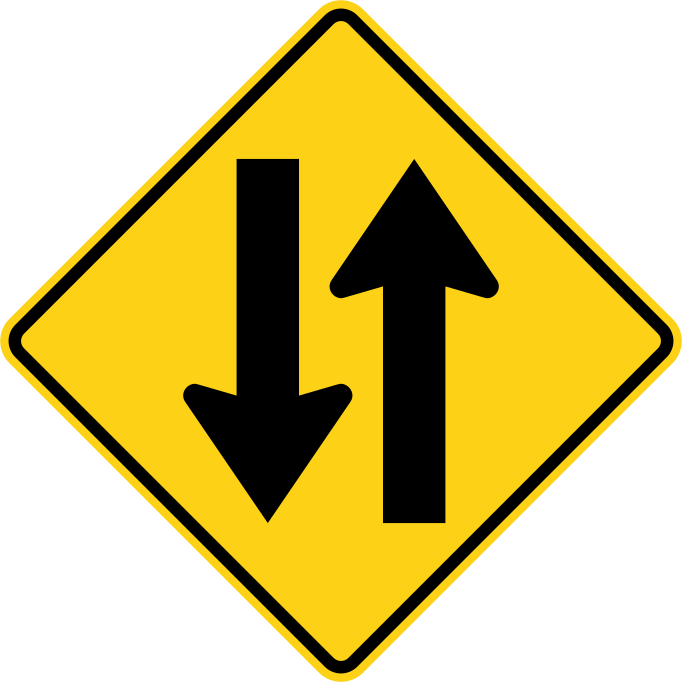
11. After this two-way traffic warning, you pass another vehicle. How far from oncoming vehicles must you be when returning to the right-hand lane?
- At least 50 feet
- At least 100 feet
- At least 200 feet
- At least 150 feet
Show answer
At least 200 feet. Return to the right-hand lane with no less than 200 feet separating you from oncoming vehicles. A 100-foot margin is only half the distance specified for completing the pass. The opposing arrows remind you that the approaching lane carries traffic toward you, so judge the available distance before moving out. If you cannot finish the maneuver with the required clearance, remain behind the slower vehicle rather than relying on an approaching driver to make room.
Study this in the handbook: Lane Changes, Passing, Turns and U-Turns
12. On a Utah residential street with no posted limit or special hazards, what speed is permitted?
- A maximum of 25 mph
- A maximum of 15 mph
- A maximum of 35 mph
- A maximum of 55 mph
Show answer
A maximum of 25 mph. Utah permits 25 mph in a business or residential area when no sign sets another limit and no special hazard requires a reduction. The 35 mph option would exceed that unposted residential limit, even on a straight street with little traffic. Look for homes, driveways, and neighborhood activity as cues that you are in a residential setting. Continue watching for posted signs and reduce speed further when visibility or nearby people make 25 mph unsafe.
Study this in the handbook: Speed Limits and the Basic Speed Law
13. Besides vehicles with two or more persons, which vehicles may also use a Utah express lane free of charge?
- Single occupant vehicles without a toll pass
- Trucks over 26,000 pounds
- Motorcycles, buses, and vehicles with a registered clean fuel vehicle decal
- Only emergency vehicles
Show answer
Motorcycles, buses, and vehicles with a registered clean fuel vehicle decal. Express lanes charge single occupant cars a toll, but the handbook lists motorcycles, buses, and vehicles with a registered clean fuel vehicle decal, the C decal, as able to use the express lane free of charge in addition to vehicles carrying two or more persons. A single occupant car without a pass still owes the toll, heavy trucks are not granted free use, and emergency vehicles are not the only exception. Check the overhead signs for the current occupancy and toll rules before you cross the double white lines into the lane.
Study this in the handbook: Pavement Markings and Special Lanes
14. How should a Utah driver signal before making a U-turn?
- Use the hazard flashers
- No signal is needed for a U-turn
- Signal in the direction you are going to initiate the U-turn
- Flash the high beams
Show answer
Signal in the direction you are going to initiate the U-turn. A U-turn begins as a left turn, and drivers behind and ahead of you need to know it is coming. The handbook says to signal in the direction you are going to initiate the U-turn, which is left, before you begin. Hazard flashers and headlight flashes are not turn signals, and the handbook does not exempt U-turns from signaling. Signal, check mirrors and the blind spot, and make the turn only where the road is wide enough and the way is clear.
Study this in the handbook: Lane Changes, Passing, Turns and U-Turns
15. A 17 year old in Utah is convicted in court of possessing alcohol for the first time. What license action does the handbook describe?
- A warning only
- Suspension for one year
- Suspension for 90 days
- Revocation until age 25
Show answer
Suspension for one year. An individual between 13 and 20 convicted of possession or consumption of alcohol, or of being in a bar underage, has the license suspended for one year on a first offense and two years on a second or subsequent offense, as ordered by the court. A warning and 90 days understate it, and age 25 is not a cutoff. For a person under 16, the suspension extends one to two years from the 16th birthday.
Study this in the handbook: Alcohol, Drugs and the 0.05 Limit
16. After a Utah crash with no injuries, at what level of total property damage must you notify law enforcement immediately?
- Any damage at all
- $500
- $1,000
- $2,500
Show answer
$2,500. You must call law enforcement (911) immediately when a crash causes injury, death, or at least $2,500 in total property damage, whether or not another driver was involved. Smaller amounts do not trigger the immediate report requirement, so $500 and $1,000 are wrong, and any damage at all is too broad. For a property damage only crash, the handbook allows moving the vehicle out of the travel lanes to a safe nearby spot.
Study this in the handbook: Crashes and Insurance
17. What license action can a Utah court order on a first conviction that carries a road rage enhancement?
- Suspension for one year
- A 30 day suspension
- No license action; only a fine
- A lifetime revocation
Show answer
Suspension for one year. Utah defines road rage as a criminal offense by a driver, in response to a roadway incident, with intent to endanger or intimidate someone in another vehicle. The court may order the license suspended for one year on the first conviction. Thirty days and fine only choices understate it, and a first offense does not bring lifetime revocation. Two road rage enhanced citations in one year lead to mandatory revocation.
Study this in the handbook: Distractions, Fatigue, Animals and Mountain Roads
18. If a Utah court orders a license suspension for a 15-year-old convicted of possessing alcohol, when does the suspension run?
- Only from the 16th birthday for six months
- From conviction, ending automatically on the 16th birthday
- From conviction and for one to two years beyond the 16th birthday
- Only from the 18th birthday for one year
Show answer
From conviction and for one to two years beyond the 16th birthday. The suspension begins on the conviction date and extends one to two years from the person’s 16th birthday. It does not disappear when the person becomes old enough to obtain a license. The choice ending it automatically at 16 therefore misses the continued restriction after that birthday. For a 15-year-old with a court-ordered suspension, mark both the conviction date and the 16th birthday when understanding the timeline; the court order controls the applicable duration described here.
Study this in the handbook: Alcohol, Drugs and the 0.05 Limit
19. A Utah driver 21 or older is convicted of a second DUI. How long is the license suspended?
- 120 days
- Two years
- 30 days
- Six months
Show answer
Two years. For a driver 21 and older, a first DUI brings a 120 day suspension and a second or subsequent offense brings two years. So 120 days is only the first offense figure, and 30 days and six months are not the Utah periods. A second DUI also triggers a two year ignition interlock restriction and is a mandatory revocation offense under Section 13.
Study this in the handbook: Alcohol, Drugs and the 0.05 Limit
20. How many hours of practice driving must a Utah driver education student complete with a parent or legal guardian, and how many after sunset?
- 20 hours, including 5 after sunset
- 50 hours, including 10 after sunset
- 30 hours, all in daylight
- 40 hours, including 10 after sunset
Show answer
40 hours, including 10 after sunset. In addition to the classroom and behind the wheel portions of driver education, a Utah student must complete 40 hours of driving with a parent or legal guardian, and 10 of those hours must be after sunset. Fifty hours with ten at night and twenty hours with five at night do not match Utah's figures, and an all daylight schedule skips the required night driving. Keep a log that separates the after sunset hours from the total so both parts of the requirement can be shown.
Study this in the handbook: Driver Education and Learner Permits
QualitySpace is expanding to Utah
We are a California-based independent insurance brokerage working on licensing in more states. We cannot help with Utah insurance yet. Leave your email and we will let you know when we can.
Every question is written from the official Utah Driver Handbook. Need paper? Printable UT practice test with answer key.
Last verified 2026-10-05. How we check every question · Study all 220 as flashcards
Frequently asked questions
How many questions are on this Utah practice test?
This fixed set has 20 questions. It is test 2 of 11 from the 220 question Utah bank. The real UT exam asks 50 questions and you need 40 correct.
What is the passing score for the real Utah test?
You must pass with a score of 80% or better That figure comes from the official Utah source cited on the DMV facts page.
How does this fixed test relate to the full Utah bank?
Each numbered test is a fixed set of questions in a fixed order, so you can retake the same test later and compare. Every test mixes road signs and the other topics in about the same proportion as the full bank. Tests 1 to 11 together cover every question in the Utah bank once. The full practice page mixes the whole bank at random.
Last verified 2026-10-05. See the Utah DMV facts page for sourced state details.