
Test 4 of 11 · 20 questions · Free 2026
UT Permit Practice Test 4
Jump to the test ↓A fixed 20 question set from the Utah bank with answers and plain English explanations. The real UT exam is 50 questions, 80 percent to pass; take the full length version on the main practice page.
Question 1 of 20 · 0 right so far
All 20 questions in test 4
Every question below comes from the Utah question bank on this page. Open a question to see the correct answer and the explanation. Nothing here is hidden behind a signup.
1. After a DUI impound in Utah, which costs does the handbook identify for the vehicle owner?
- Towing, storage charges, and administrative costs
- Towing and driver license reinstatement fees only
- Only a towing charge, with free storage
- Only the traffic fine, with no impound charges
Show answer
Towing, storage charges, and administrative costs. The owner must pay towing, storage charges, and administrative costs to recover a DUI-impounded vehicle, along with meeting the release requirements. Assuming storage is free leaves out a cost specifically identified in the handbook. The DMV notice tells the owner what must be done to obtain release. Read that notice promptly and distinguish the costs of recovering the vehicle from any separate traffic case or driver license reinstatement process.
Study this in the handbook: DUI Penalties, Refusal and Ignition Interlock
2. A vehicle with priority is approaching the junction marked by this triangular sign. What should you do?
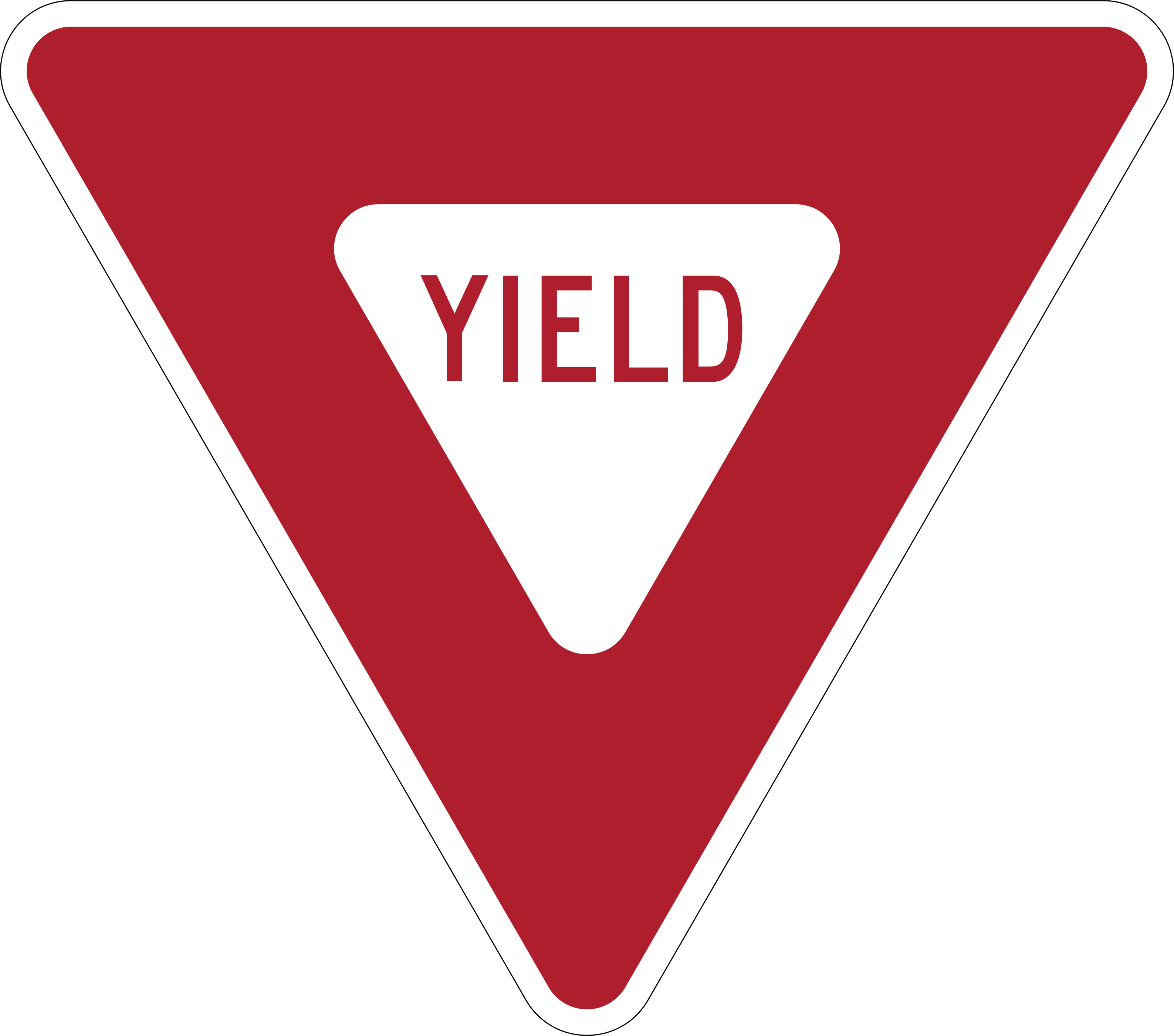
- Reduce speed and let the vehicle with priority proceed
- Enter first if your vehicle is closer to the sign
- Maintain speed because only an octagon controls priority
- Require the approaching driver to stop for you
Show answer
Reduce speed and let the vehicle with priority proceed. The yield sign requires a reduction in speed and giving way to traffic that has priority. Being closer to the sign does not transfer that priority to you. Look for an adequate opening before entering, and stop if the approaching vehicle makes entry unsafe. The inverted triangle is your cue to assess the traffic flow early, leaving enough distance to slow smoothly instead of forcing another driver to brake when you pull out.
Study this in the handbook: Regulatory, Guide and Route Signs
3. On a Utah divided highway with four or more lanes and a median, a school bus stops with red lights flashing on the other side. What must you do?
- Stop, because all traffic must stop
- Stop only if children are visible
- Proceed with caution; only vehicles behind the bus must stop
- Stop until the bus turns off its engine
Show answer
Proceed with caution; only vehicles behind the bus must stop. On a divided highway with four or more lanes and a median, only vehicles in the lanes behind the school bus must stop; opposite direction traffic does not. On a two lane road or a four lane road without a median, traffic in both directions stops. Stopping only when children are visible is not the rule, and the engine is not the signal. Even when not required to stop, slow down and watch for children.
Study this in the handbook: Emergency Vehicles, Move Over and School Buses
4. How close to a fire hydrant may you park in Utah?
- 5 feet
- 10 feet
- No closer than 15 feet
- 25 feet
Show answer
No closer than 15 feet. Utah prohibits parking within 15 feet of a fire hydrant, so 15 feet is the closest legal spot. Five and ten feet are inside the prohibited zone. Twenty five feet is more than required, though it is legal. Other Utah distances to keep straight: 20 feet from a crosswalk, 30 feet from a stop sign, yield sign, beacon or signal, and 50 feet from the nearest rail of a railroad crossing.
5. A newly licensed 16 year old in Utah wants to drive friends to school. What passenger rule applies at first?
- Up to two friends are allowed
- Only immediate family members, until six months from the issue date
- Any passengers, as long as all wear belts
- No passengers at all for one year
Show answer
Only immediate family members, until six months from the issue date. For a new license (not a permit), Utah allows only immediate family members in the vehicle until six months from the issue date. Friends therefore cannot ride along during that period, whatever their number or whether they buckle up. The rule does not bar every passenger for a year; family members are allowed and the limit ends at six months. Once six months have passed from the issue date, the family only limit ends.
6. Which pair of BAC figures does Utah’s handbook give for the general limit and the CDL limit, respectively?
- 0.10 BAC and 0.05 BAC
- 0.08 BAC and 0.04 BAC
- 0.05 BAC and 0.08 BAC
- 0.05 BAC and 0.04 BAC
Show answer
0.05 BAC and 0.04 BAC. The handbook identifies 0.05 BAC for the general rule and 0.04 for CDL. Using 0.08 for the first figure would miss Utah’s lower alcohol limit, even though that number may sound familiar. When studying the two figures, connect the smaller one with CDL rather than reversing their order. Neither figure is a target for drinking before driving: the same section also prohibits operating a vehicle when impairment makes driving unsafe below the numerical limit.
Study this in the handbook: Alcohol, Drugs and the 0.05 Limit
7. Traffic on a Utah freeway is moving faster than the posted limit. What restriction still governs your speed?
- You may exceed the sign by 5 mph to keep up
- You may not exceed the posted limit to match traffic
- You may exceed the limit while approaching an exit
- You may use the speed of the fastest lane
Show answer
You may not exceed the posted limit to match traffic. Keeping a similar speed to nearby freeway traffic can help traffic move smoothly, but Utah does not allow that advice to override the posted limit. Adding 5 mph to keep up would still put you above the legal maximum. Use the speed-limit sign and your speedometer together as a check when surrounding drivers are moving quickly. Choose a lawful speed that also fits conditions, and plan lane changes without racing to match a speeding vehicle.
Study this in the handbook: Freeway Driving and Work Zone Speeds
8. You enter a Utah work zone at night but see no workers. How should you adjust your driving?
- Resume normal highway speed as soon as workers disappear
- Accelerate through narrow lanes to shorten exposure
- Slow down despite the absence of workers
- Reduce following distance to keep traffic together
Show answer
Slow down despite the absence of workers. Work zones call for slowing down even when no workers are present. Narrow lanes and rough pavement can remain hazardous after a crew leaves, so an empty-looking site is not a reason to resume ordinary highway speed. Increasing speed through a constricted lane reduces the time available to react to its edges or surface changes. Orange signs, barrels, and changed lane widths are useful cues that the work zone still demands caution at night.
Study this in the handbook: Renewal, Phone Laws and the Point System
9. What happens to speeding fines in a Utah work zone?
- They are reduced when no machinery occupies the lane
- They remain the same as on every other road
- They are replaced by a written warning for a first offense
- They are doubled
Show answer
They are doubled. Speeding fines are doubled in a work zone. The handbook does not offer a reduced fine merely because machinery is outside the travel lane, as one choice proposes. Orange signs are a cue to identify the work area, read its traffic instructions, and adjust your speed. Workers, surface changes, and moving equipment can require quick responses, so leave enough space to stop instead of tailgating the vehicle in front of you.
Study this in the handbook: Warning, Railroad and Work Zone Signs
10. A flashing yellow turn arrow faces you while oncoming vehicles have green. How should you turn?
- Wait for every signal at the intersection to become red
- Turn immediately because an arrow guarantees a protected movement
- Yield to oncoming traffic and pedestrians, then turn cautiously when clear
- Treat oncoming vehicles as required to stop for your turn
Show answer
Yield to oncoming traffic and pedestrians, then turn cautiously when clear. A flashing yellow arrow allows the turn after you yield to oncoming traffic and pedestrians. It does not provide a protected movement, so assuming the arrow makes opposing vehicles stop can place you directly in their path. The flashing display is your cue to judge an available gap and check the crosswalk before steering across. Oncoming drivers have a green signal and may continue through while you are waiting to turn.
Study this in the handbook: Regulatory, Guide and Route Signs
11. A lane-ends warning leads into a congested construction merge. What merging method does Utah describe?

- Use both lanes to the merge point, then alternate into one lane
- Let the continuing lane pass until the ending lane is empty
- Have every driver leave the ending lane as soon as its sign appears
- Have all vehicles in the ending lane enter before the continuing lane moves
Show answer
Use both lanes to the merge point, then alternate into one lane. For a congested merge point such as construction, Utah describes using both available lanes to the merge and then taking alternating turns into the single lane. Sending every driver out of the ending lane immediately is different from that zipper method. Giving an entire lane uninterrupted priority also defeats the alternating pattern. The queue where two streams become one is the cue to cooperate with the adjacent driver and take a turn rather than blocking the other stream.
Study this in the handbook: Pavement Markings and Special Lanes
12. Which description matches the warning-sign design shown with this winding-road symbol?

- A blue rectangle with white service lettering
- A white rectangle carrying a parking restriction
- A green rectangle displaying a route destination
- A yellow diamond with a black symbol
Show answer
A yellow diamond with a black symbol. Warning signs are usually yellow diamonds with black lettering or symbols. The winding arrow appears within that familiar warning design, giving you notice to examine the roadway ahead. A white parking-restriction rectangle belongs to a different kind of message and does not describe the pictured sign. Notice both the outside shape and the contrasting black symbol when recognizing a warning, rather than relying on the arrow alone.
Study this in the handbook: Regulatory, Guide and Route Signs
13. What penalties does Utah list for not remaining at the scene of a crash you are involved in?
- A $50 fine
- Only points on your record
- A written warning
- Suspension or revocation for up to one year, up to one year in jail, a fine up to $2,500, or both
Show answer
Suspension or revocation for up to one year, up to one year in jail, a fine up to $2,500, or both. The handbook says you may be penalized severely for leaving the scene: the license may be suspended or revoked for up to one year, and you may receive up to one year in jail, a fine of up to $2,500, or both. A $50 fine, points only, or a warning all understate it. Failing to stop at an injury crash is a third-degree felony, and drivers must give reasonable help to anyone injured.
Study this in the handbook: Crashes and Insurance
14. What is the Utah handbook's advice for dealing with a distraction or problem while driving?
- Handle it at the next red light
- Slow down and deal with it while driving
- Immediately pull over to the side of the roadway and take care of it
- Ignore it until you reach your destination
Show answer
Immediately pull over to the side of the roadway and take care of it. A distraction is anything that takes your mind or body away from driving, and the handbook's answer is not to manage it at the wheel. If you have a problem or there is a distraction, immediately pull over to the side of the roadway and take care of it. A red light is not a safe place to look away, dealing with it while moving is the distraction itself, and ignoring a real problem lets it grow. Set navigation, phones and loose items before you leave.
Study this in the handbook: Distractions, Fatigue, Animals and Mountain Roads
15. Who in a Utah vehicle must have a fastened safety belt or child seat?
- Only the driver
- Only front seat occupants
- Only passengers under 18
- Everyone in the vehicle
Show answer
Everyone in the vehicle. Utah's safety belt rule applies to every occupant. The handbook says everyone in your vehicle must have a fastened safety belt or child seat. Children aged eight and under must be properly secured in an approved child safety seat unless they are 57 inches tall, and older children must be restrained by an appropriate device or a safety belt. Driver only, front seat only, and under 18 only are all narrower than the law. Belts cut deaths and serious injuries in crashes, and the driver is responsible for making sure young passengers are buckled correctly.
Study this in the handbook: Seat Belts, Car Seats and Air Bags
16. What does the Utah handbook say about turning while backing?
- Look only backward
- Make quick checks to the front and sides
- Steer with one finger
- Accelerate to finish the turn faster
Show answer
Make quick checks to the front and sides. The Utah handbook's backing steps say to back slowly, because it is hard to steer while backing, and to steer in the direction you want the rear of the vehicle to move. If turning while backing, make quick checks to the front and sides, and keep looking to the rear until you are stopped. Looking only backward skips those checks, accelerating goes against backing slowly, and the handbook says to grasp the steering wheel with your left hand, not one finger.
Study this in the handbook: Lane Changes, Passing, Turns and U-Turns
17. When is a Utah driver allowed to drive faster than the posted speed limit?
- Never; you may not legally exceed the posted limit
- When traffic around you is going faster
- When you are late for work
- When the road is empty
Show answer
Never; you may not legally exceed the posted limit. The Utah handbook says you should generally drive at a speed similar to that of other cars around you, but you may not legally drive faster than the posted speed limit, and this also applies to getting off the freeway. Keeping up with faster traffic, being late, or an empty road are not legal exceptions. The handbook also tells drivers to reduce speed when needed for weather, road, and other traffic conditions, and lists too fast for conditions among the top five causes of Utah crashes.
Study this in the handbook: Pavement Markings and Special Lanes
18. A front tire blows out while you are driving in Utah. Which way will the vehicle pull?
- Hard toward the blown tire
- Straight ahead with no change
- Away from the blown tire
- Toward the center of the road regardless of side
Show answer
Hard toward the blown tire. The handbook warns that when a front tire blows out, the vehicle will pull hard toward the blown tire. Knowing that lets you grip the wheel firmly and keep control instead of being surprised by it. It does not pull away from the failed tire, it will not track straight, and the direction depends on which tire failed, not on the road. Do not slam on the brakes; take your foot off the gas, steer straight, allow the vehicle to slow down, and pull off the road in a safe and level spot.
Study this in the handbook: Vehicle Emergencies
19. Your view is blocked at a Utah crosswalk. What does the handbook tell you to do?
- Sound the horn and proceed
- Move forward carefully and look both ways before entering the intersection
- Reverse to get a wider view
- Proceed at normal speed since pedestrians will wait
Show answer
Move forward carefully and look both ways before entering the intersection. A parked truck or a hedge can hide a pedestrian who is already stepping into the crosswalk. The handbook says that if your view is blocked at a crosswalk, move forward carefully and look both ways before entering the intersection. Honking, backing up in traffic, or assuming pedestrians will wait all trade a careful look for a guess. Creep forward until you can see the whole crosswalk, then go only when it is clear.
20. Utah was the first state to adopt which blood alcohol concentration limit?
- .08
- .05
- .10
- .02
Show answer
.05. In December 2018 Utah became the first state in the country to have a blood alcohol concentration limit of .05, according to the history timeline in the handbook. Its alcohol section states the current rule plainly: a driver over 0.05 BAC, or 0.04 for a CDL holder, violates the law. The handbook also says impairment starts with the first drink, so the safe choice is not to drive after drinking.
QualitySpace is expanding to Utah
We are a California-based independent insurance brokerage working on licensing in more states. We cannot help with Utah insurance yet. Leave your email and we will let you know when we can.
Every question is written from the official Utah Driver Handbook. Need paper? Printable UT practice test with answer key.
Last verified 2026-10-05. How we check every question · Study all 220 as flashcards
Frequently asked questions
How many questions are on this Utah practice test?
This fixed set has 20 questions. It is test 4 of 11 from the 220 question Utah bank. The real UT exam asks 50 questions and you need 40 correct.
What is the passing score for the real Utah test?
You must pass with a score of 80% or better That figure comes from the official Utah source cited on the DMV facts page.
How does this fixed test relate to the full Utah bank?
Each numbered test is a fixed set of questions in a fixed order, so you can retake the same test later and compare. Every test mixes road signs and the other topics in about the same proportion as the full bank. Tests 1 to 11 together cover every question in the Utah bank once. The full practice page mixes the whole bank at random.
Last verified 2026-10-05. See the Utah DMV facts page for sourced state details.