
Test 5 of 11 · 20 questions · Free 2026
UT Permit Practice Test 5
Jump to the test ↓A fixed 20 question set from the Utah bank with answers and plain English explanations. The real UT exam is 50 questions, 80 percent to pass; take the full length version on the main practice page.
Question 1 of 20 · 0 right so far
All 20 questions in test 5
Every question below comes from the Utah question bank on this page. Open a question to see the correct answer and the explanation. Nothing here is hidden behind a signup.
1. How should a Utah driver adjust the outside mirrors to reduce blind spots?
- Set them to show the side of your car clearly
- Point them at the rear bumper
- Set them so you can barely see the sides of your own vehicle, giving a wide view
- Fold them in to reduce glare
Show answer
Set them so you can barely see the sides of your own vehicle, giving a wide view. The handbook says to adjust the outside mirrors so you can barely see the left and right sides of your vehicle, which turns the rest of the glass into a wide view of the adjacent lanes and shrinks the blind spot. Showing the car clearly, aiming at the bumper, or folding the mirrors in all reduce what you can see. Even with good mirrors, the handbook still says to look over the proper shoulder before making lane changes.
Study this in the handbook: Seat Belts, Car Seats and Air Bags
2. Before opening the door of your car parked along a street, what should you check for?
- Bicyclists approaching from the sides and rear
- Only traffic in the rearview mirror, not the sides
- Only vehicles approaching from directly ahead
- Only whether the car behind you has moved
Show answer
Bicyclists approaching from the sides and rear. Look to the sides and behind for bicyclists before opening a vehicle door on the street. Checking only forward misses riders approaching alongside the parked car from the rear. A cyclist can be close to your door even when no motor vehicle is immediately behind you. Use the moment before reaching for the door handle to check the space a rider will pass through, and wait if opening the door would obstruct that path.
Study this in the handbook: Pedestrians, Bicycles and Motorcycles
3. When does the Utah handbook say to use a three point turn?
- Only if the road is too narrow for a U-turn
- Whenever you want to reverse direction
- Only on freeways
- Only at night
Show answer
Only if the road is too narrow for a U-turn. The three point turn is the fallback, not the preferred maneuver. The handbook says to use it only if the road is too narrow for a U-turn. The handbook separately says not to back up on a freeway or interstate, and nothing in the rule depends on time of day. Choose a spot with good visibility, signal, and check traffic before each of the three movements.
Study this in the handbook: Lane Changes, Passing, Turns and U-Turns
4. Before backing out of a parking space, why should you check behind the vehicle before getting in?
- Looking through the rear window always reveals small objects hidden by the rear bumper
- A walk-around is necessary only when the vehicle has no backup camera
- Children or small objects may be invisible from the driver seat
- Looking behind the vehicle replaces all checks during backing
Show answer
Children or small objects may be invisible from the driver seat. A walk-around check can reveal a child or small object hidden from your seated view. That check belongs before entering the vehicle, when you can inspect the space immediately behind it directly. It does not replace watching while reversing, as one choice suggests; conditions can change after you get inside. A low toy near the rear bumper is a concrete reminder of how much a seated driver may be unable to see.
Study this in the handbook: Lane Changes, Passing, Turns and U-Turns
5. A 19 year old in Utah refuses the chemical test after a DUI arrest for the first time. What revocation applies?
- 18 months
- Six months
- Two years or until 21, whichever is longer
- No revocation because the driver is under 21
Show answer
Two years or until 21, whichever is longer. For a driver under 21, a first refusal brings revocation for two years or until age 21, whichever is longer. Eighteen months is the first refusal period for drivers 21 and older, and six months is the Not-a-Drop denial for measurable alcohol. Being under 21 makes the penalty harsher, not lighter. A second refusal under 21 brings 36 months or until 21, whichever is longer.
Study this in the handbook: DUI Penalties, Refusal and Ignition Interlock
6. At a congested Utah merge point such as a construction zone, how does the handbook say drivers should merge?
- Merge as early as possible into the open lane
- Use both lanes to the merge point, then alternate into the single lane
- The lane that ends must stop and wait for a gap
- Faster vehicles go first
Show answer
Use both lanes to the merge point, then alternate into the single lane. Utah describes zipper merging for congested merge points like construction zones. Use both lanes of traffic until the vehicles reach the merge point, and once they reach it, alternate, yielding the right-of-way into the single traffic lane. Merging as early as possible is not the method the handbook describes, and no lane has to stop and wait. The handbook adds that a violation of this section is an infraction, so taking turns at the merge point is the law as well as the courteous choice.
Study this in the handbook: Lane Changes, Passing, Turns and U-Turns
7. A Utah driver over 21 builds up points. At what total within three years is the driver called to a hearing?
- 70 points
- 100 points
- 200 or more points
- 500 points
Show answer
200 or more points. Drivers over 21 who reach 200 or more points within three years are asked to appear for a hearing, where they may get probation, a defensive driving course, or a denial or suspension of one month to one year. Seventy points is the threshold for drivers under 21, and 100 and 500 are not Utah thresholds. Utah point values are large, so a few moving violations add up quickly toward that total.
Study this in the handbook: Renewal, Phone Laws and the Point System
8. At this no-passing-zone sign, may you use the shoulder to get around a slower vehicle?
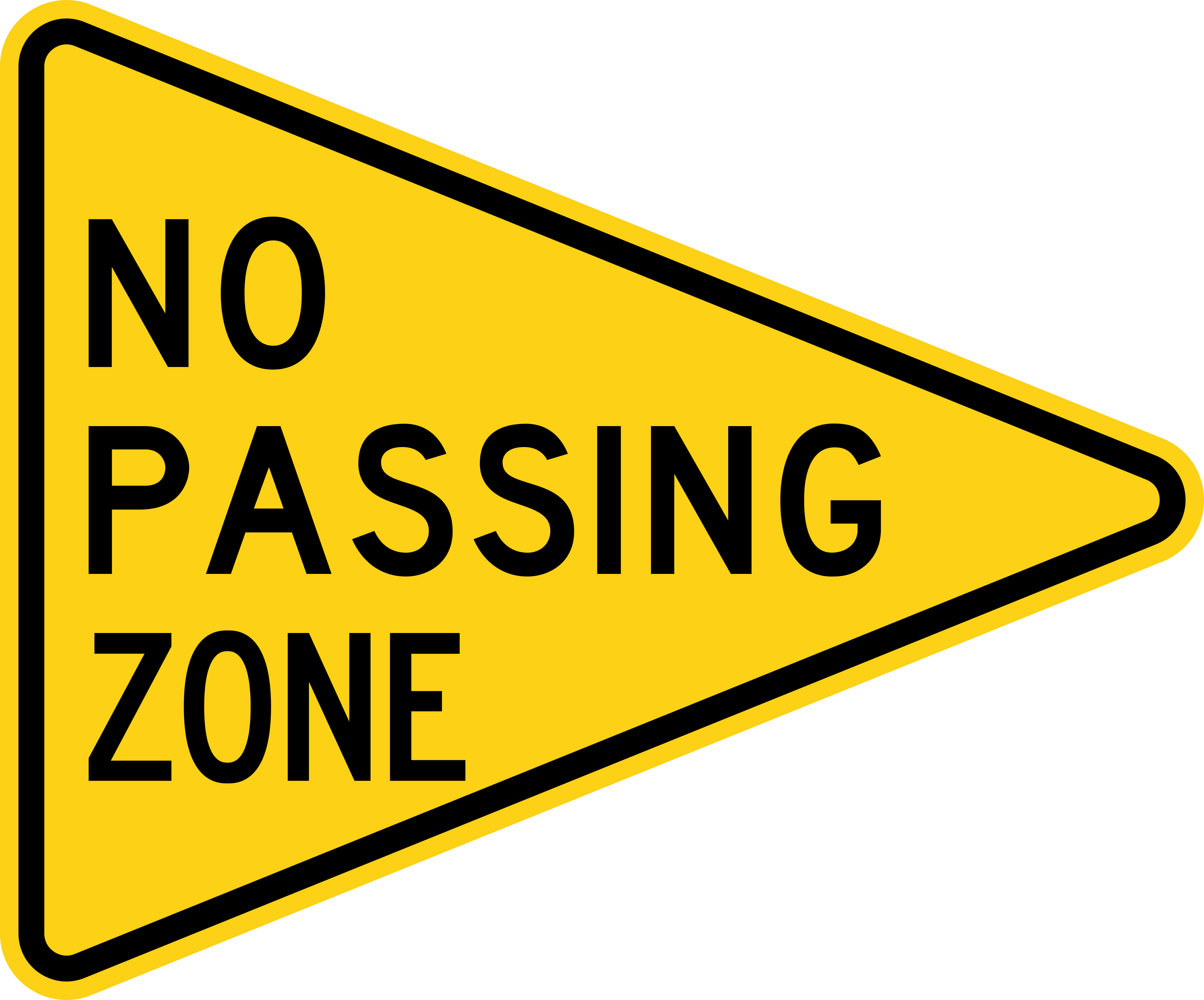
- No, the shoulder must not be used for passing
- Yes, if the shoulder is paved as wide as a lane
- Yes, after sounding the horn to warn the slower driver
- Yes, if no oncoming vehicle is visible
Show answer
No, the shoulder must not be used for passing. Utah prohibits passing on the shoulder. A paved shoulder that looks wide enough for your vehicle does not create an extra passing lane or an exception to a no-passing restriction. Stay behind the slower vehicle until a lawful opportunity becomes available. The pennant and its wording are a useful cue to abandon an intended overtake, not to look for a way around the restriction at the edge of the pavement.
Study this in the handbook: Lane Changes, Passing, Turns and U-Turns
9. What preparation does this round yellow RXR sign call for?

- Look for a roadway roundabout and choose an exit
- Accelerate to reach the tracks before a train
- Stop only after driving past the nearest rail
- Slow down, look, and listen for rail traffic
Show answer
Slow down, look, and listen for rail traffic. The yellow circle with an X and RR warns of a railroad crossing and calls for slowing, looking, and listening for a train or railroad vehicle. A roundabout interpretation overlooks the railroad letters and cross symbol. Begin checking before reaching the tracks so you have time to stop if necessary. The advance sign is the cue to shift attention toward the crossing and avoid assuming that a quiet approach means no rail traffic is coming.
Study this in the handbook: Regulatory, Guide and Route Signs
10. Rain makes the road unsafe at the 50 mph limit shown. How should you respond?
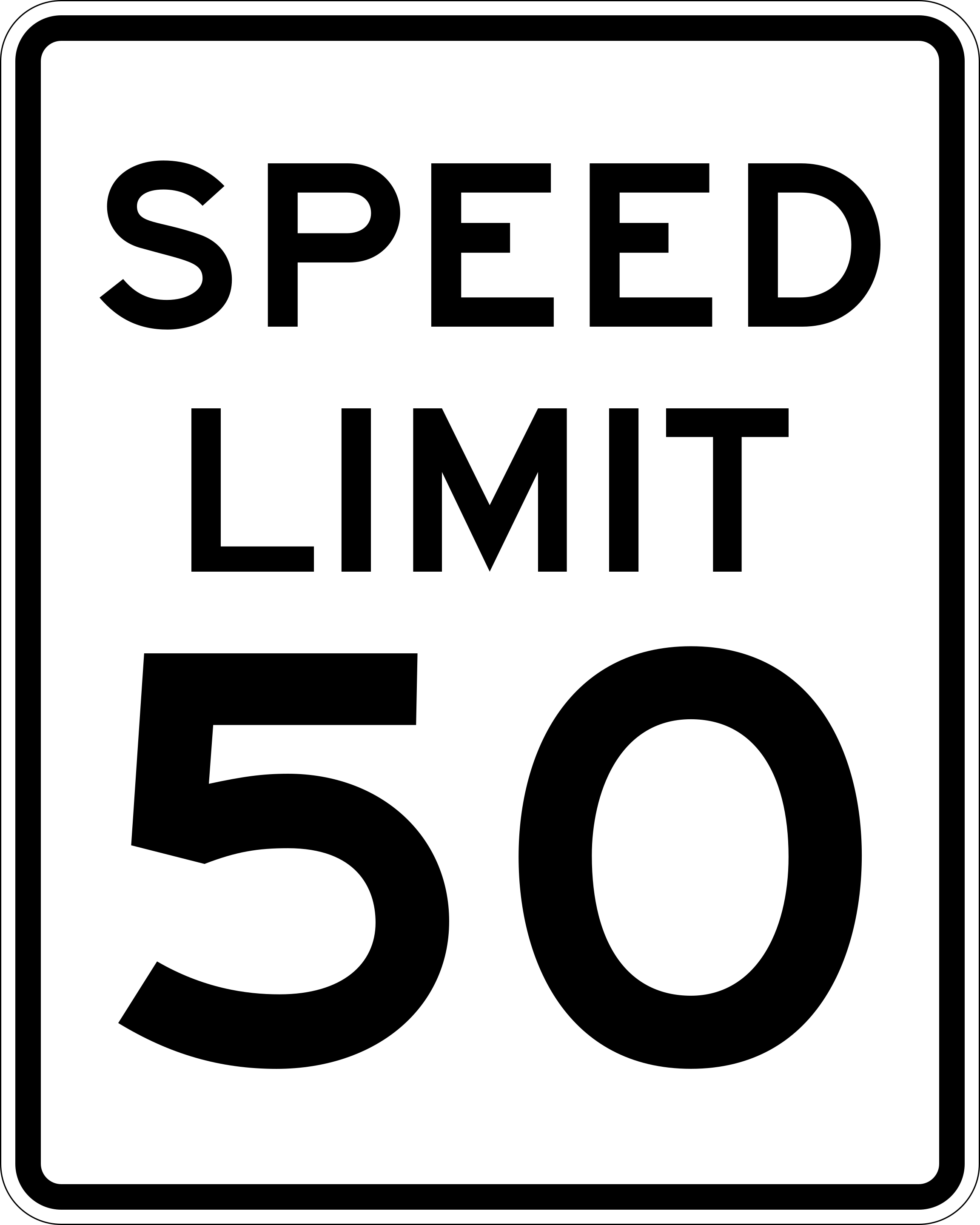
- Lower your speed to suit the conditions
- Keep 50 mph because the sign sets the required speed
- Match surrounding traffic even if it is exceeding 50 mph
- Keep 50 mph until another sign gives a lower number
Show answer
Lower your speed to suit the conditions. A speed-limit sign does not require you to maintain its number when weather makes that speed unsafe. Utah’s basic speed rule limits travel to a reasonable and prudent pace for the conditions you actually face. Waiting for another sign to lower the number ignores the changing road surface and visibility. Water on the pavement and reduced sight distance are cues to adjust now, even though the white regulatory sign still displays 50 mph.
Study this in the handbook: Pavement Markings and Special Lanes
11. According to the Utah handbook, fines for illegally passing a stopped school bus can reach how much?
- $100
- $500
- $1,000
- $3,000
Show answer
$3,000. The handbook says fines can run up to $3,000 for illegally passing a school bus, and a conviction usually raises insurance rates. The lower amounts understate the penalty. School bus drivers may report vehicles that pass improperly, and the report may be sent to local police for investigation, so a violation can be caught even when no officer is present.
Study this in the handbook: Emergency Vehicles, Move Over and School Buses
12. How can a Utah driver have a seat belt citation fine waived?
- By paying within 10 days
- By completing an online 30-minute safety belt safety course
- By showing the belt was worn after the stop
- Fines can never be waived
Show answer
By completing an online 30-minute safety belt safety course. Utah allows the seat belt fine to be waived when the person completes an online, 30-minute safety belt safety course. Paying quickly does not waive a fine, and buckling up after the stop does not undo the violation that the officer already saw. Saying fines can never be waived contradicts the handbook. Remember that each unrestrained passenger can bring a separate citation, so a car with several unbelted riders can produce several fines at once.
Study this in the handbook: Seat Belts, Car Seats and Air Bags
13. A Utah fire station entrance is signposted. On the opposite side of the road, how far from the entrance must you stay when parking?
- 20 feet
- 75 feet
- 50 feet
- No limit applies across the road
Show answer
75 feet. Utah bars parking within 20 feet of the driveway entrance to any fire station, and when signs are posted you may not park on the opposite side of the road within 75 feet of the fire station entrance. Twenty feet is the distance from the driveway entrance itself, 50 feet is the railroad crossing rule, and the opposite side does have a limit when signs are posted. The same handbook list also bars parking within 15 feet of a fire hydrant.
14. How close to a railroad crossing may a Utah driver park?
- Not on the track or within 50 feet of the nearest rail
- Anywhere, as long as the gates are up
- Within 10 feet of the rail
- Not on the track or within 25 feet of the nearest rail
Show answer
Not on the track or within 50 feet of the nearest rail. Utah includes railroad crossings in its list of places where you are not allowed to park. The handbook bars parking on any railroad track or within 50 feet of the nearest rail of a railroad crossing. Raised gates do not change the rule, and both 10 feet and 25 feet are inside the 50 foot limit the handbook sets. Find a legal space well clear of the rails and remember the separate limits near hydrants, crosswalks, and stop signs.
Study this in the handbook: Railroad Crossings
15. May a Utah driver change lanes while driving through an intersection?
- Yes, if you signal first
- Yes, if no one is behind you
- Only when turning left
- No; wait until you have completely cleared the intersection
Show answer
No; wait until you have completely cleared the intersection. Intersections are where paths cross, and a lane change inside one adds a sideways move that other drivers cannot predict. The handbook says never to attempt a lane change while driving through an intersection and to wait until you have completely cleared it before moving to a different lane. Signaling and an empty mirror do not make it legal, and a left turn is not an exception. Pick your lane before the intersection and hold it through.
Study this in the handbook: Pavement Markings and Special Lanes
16. What shape and colors do Utah warning signs usually use?
- Round and red with white letters
- Rectangular and blue with white symbols
- Pentagon shaped and green
- Diamond shaped and yellow with black lettering or symbols
Show answer
Diamond shaped and yellow with black lettering or symbols. Warning signs alert you to a hazard or a change in the road ahead, and the handbook says they are usually diamond shaped and yellow with black lettering or symbols. Learning that combination helps you recognize a warning from a distance before you can read it. A round red sign does not match the warning design the handbook describes, and the handbook lists green, brown, or blue rectangles as guide signs. When you see the yellow diamond, ease off the accelerator and look for the specific condition the symbol names.
Study this in the handbook: Warning, Railroad and Work Zone Signs
17. Who may ride in the vehicle during a Utah driving skills test?
- The applicant, examiner, and a parent
- The applicant and examiner only
- The applicant, examiner, and driving instructor
- The applicant, examiner, and an adult interpreter
Show answer
The applicant and examiner only. The driving skills test permits only the applicant and examiner in the vehicle. A parent may be involved in practice and licensing preparation, but that does not create a seat for the parent during the examination. Before arriving, plan where anyone accompanying you will wait while the test takes place. The two-person occupancy rule applies to the test itself, regardless of who helped you learn or brought the vehicle to the appointment.
Study this in the handbook: Knowledge, Traffic Safety and Skills Tests
18. A 30-year-old Utah driver wants to connect a phone call while driving. What method does the handbook allow?
- Typing the number on the phone keypad
- Selecting digits manually if traffic is light
- Entering the number while holding the phone below the window
- Using voice commands to connect the call
Show answer
Using voice commands to connect the call. For drivers over 18, Utah permits talking on a handheld wireless communication device while driving when voice commands connect the call. Manually typing a number is not made acceptable by light traffic. The important distinction is how the call is connected, not how low the phone is held. Set up voice operation before the trip so placing a call does not require looking down and entering digits while the vehicle is moving.
Study this in the handbook: Renewal, Phone Laws and the Point System
19. A Utah driver has a BAC below 0.05 but is impaired enough to operate a vehicle unsafely. Is driving still a violation?
- No, a BAC below 0.05 always permits driving
- Yes, unsafe impairment can violate the law below the BAC limit
- Yes, but only if the driver holds a CDL
- No, unless the driver causes a collision
Show answer
Yes, unsafe impairment can violate the law below the BAC limit. Utah prohibits driving when impairment makes vehicle operation unsafe, including when the measured BAC is below the legal limit. Treating every reading below 0.05 as permission to drive ignores this separate impairment condition. A driver who cannot judge gaps or react reliably after drinking should arrange another ride rather than rely on a number. The practical cue is the inability to drive safely; a collision does not have to occur before the conduct can violate the law.
Study this in the handbook: Alcohol, Drugs and the 0.05 Limit
20. After an earlier Not-a-Drop denial, an 18-year-old commits another offense within 10 years. Which period applies under Utah’s repeat-offense rule?
- Six months from the new offense
- Two years or until age 21, whichever is shorter
- Two years or until age 21, whichever is longer
- One year regardless of age
Show answer
Two years or until age 21, whichever is longer. Utah compares a two-year loss of privileges with the time remaining until the person reaches 21 and uses whichever is longer. For an 18-year-old, reaching 21 can take longer than two years, so selecting the shorter period reverses the rule. The prior denial within ten years is the cue that this is a repeat case. Do not apply the six-month first-offense period simply because the latest incident involved only a small measurable amount of alcohol.
Study this in the handbook: Under 21 and the Not-a-Drop Act
QualitySpace is expanding to Utah
We are a California-based independent insurance brokerage working on licensing in more states. We cannot help with Utah insurance yet. Leave your email and we will let you know when we can.
Every question is written from the official Utah Driver Handbook. Need paper? Printable UT practice test with answer key.
Last verified 2026-10-05. How we check every question · Study all 220 as flashcards
Frequently asked questions
How many questions are on this Utah practice test?
This fixed set has 20 questions. It is test 5 of 11 from the 220 question Utah bank. The real UT exam asks 50 questions and you need 40 correct.
What is the passing score for the real Utah test?
You must pass with a score of 80% or better That figure comes from the official Utah source cited on the DMV facts page.
How does this fixed test relate to the full Utah bank?
Each numbered test is a fixed set of questions in a fixed order, so you can retake the same test later and compare. Every test mixes road signs and the other topics in about the same proportion as the full bank. Tests 1 to 11 together cover every question in the Utah bank once. The full practice page mixes the whole bank at random.
Last verified 2026-10-05. See the Utah DMV facts page for sourced state details.