
Key points
Give at least 3 feet when passing any bicyclist or vulnerable user of the highway.
Source: Handbook p. 75
“Utah law requires a minimum of three feet of distance from any bicyclist or vulnerable user of the highway you are passing.”
Utah Driver Handbook, Handbook p. 75Dim your headlights within 500 feet when approaching or overtaking bicyclists at night.
Source: Handbook p. 75
“Dim your headlights within 500 feet when approaching or overtaking bicyclists at night.”
Utah Driver Handbook, Handbook p. 75Check for bicyclists to the sides and rear before opening your door when parked on the street.
Source: Handbook p. 75
“When parking on the street, check to the sides and rear for bicyclists before opening your vehicle door.”
Utah Driver Handbook, Handbook p. 75Stay stopped until a pedestrian has crossed at least your half of the road, even outside a crosswalk.
Source: Handbook p. 82
“Vehicles must remain stopped until the pedestrian has crossed at least the driver’s half of the road even if they are not in a marked or unmarked crosswalk.”
Utah Driver Handbook, Handbook p. 82Come to a complete stop for a pedestrian with a guide dog or white cane.
Source: Handbook p. 82
“When a pedestrian is crossing a street with a guide dog or carrying a white cane, you must come to a complete stop.”
Utah Driver Handbook, Handbook p. 82Never pass a vehicle stopped at a crosswalk; people may be crossing that you cannot see.
Source: Handbook p. 83
“Never pass vehicles stopped at a crosswalk; there may be people crossing that you can’t see.”
Utah Driver Handbook, Handbook p. 83When following a motorcycle, stay at least 2 seconds back, and more when the road is wet.
Source: Handbook p. 81
“When following a motorcycle, stay at least two seconds back. When it is wet on the roadway increase this distance.”
Utah Driver Handbook, Handbook p. 81One condition for legal motorcycle lane filtering is a roadway with a speed limit of 45 mph or less, or an off ramp.
Source: Handbook p. 82
“The individual is on a roadway with a speed limit of 45 miles per hour or less or an off-ramp.”
Utah Driver Handbook, Handbook p. 82
Numbers to know
| Number | What it means | Manual |
|---|---|---|
| 3 feet | minimum passing distance for vulnerable users | Handbook p. 75 |
| 500 feet | dim headlights for bicyclists at night | Handbook p. 75 |
| 2 seconds | minimum following distance behind a motorcycle | Handbook p. 81 |
| 45 mph | highest speed limit of a roadway where lane filtering can be legal | Handbook p. 82 |
| 15 mph | maximum motorcycle speed while filtering | Handbook p. 82 |
Recognize these signs

Pedestrian crossing 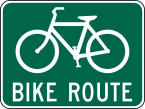
Bicycle route
3 questions from the Utah practice test
1. While passing a bicyclist in Utah, what minimum separation must your vehicle provide?
- Three feet from the bicyclist
- Two feet when traveling below 25 mph
- Half the width of the bicycle lane
- One foot if you sound the horn
Show answer
Three feet from the bicyclist. Utah requires at least three feet between your passing vehicle and a bicyclist or other vulnerable highway user. A lower driving speed does not reduce that minimum to two feet. Judge the gap from the person you are overtaking, not just from a painted lane boundary. If a cyclist is riding near the edge of a bike lane, account for that position before beginning the pass and allow additional space when possible.
2. How should a Utah driver pass a bicyclist on the road?
- Pass at full speed to minimize time beside them
- Slow down and give the bicyclist as much space as possible
- Pass within a foot to avoid crossing the center line
- Sound the horn continuously while passing
Show answer
Slow down and give the bicyclist as much space as possible. The handbook says to slow down when passing bicyclists and give them as much space as possible. Speeding past, honking, or squeezing by within a foot all ignore that instruction, and Utah law also requires at least three feet when passing a bicyclist. Wait for a safe gap, move fully over, and do not cut back in until you are well ahead of the rider.
3. Before opening the door of your car parked along a street, what should you check for?
- Bicyclists approaching from the sides and rear
- Only traffic in the rearview mirror, not the sides
- Only vehicles approaching from directly ahead
- Only whether the car behind you has moved
Show answer
Bicyclists approaching from the sides and rear. Look to the sides and behind for bicyclists before opening a vehicle door on the street. Checking only forward misses riders approaching alongside the parked car from the rear. A cyclist can be close to your door even when no motor vehicle is immediately behind you. Use the moment before reaching for the door handle to check the space a rider will pass through, and wait if opening the door would obstruct that path.
Practice this topic
Lock it in with safe driving questions from the free Utah practice test. Every answer comes with a plain English explanation.
Source: the Utah Driver Handbook, Section 14: Sharing the Road. This lesson is a plain English summary, not the law itself; where it differs, the manual and the statute govern. Last checked 2026-09-27.