
Key points
Stop more than 15 feet but not more than 50 feet from the nearest rail.
Source: Handbook p. 35
“Stop more than 15 feet (but not more than 50 feet) away from the nearest rail until it is safe to continue.”
Utah Driver Handbook, Handbook p. 35Do not park within 50 feet of a railroad crossing unless signs allow it.
Source: Handbook p. 86
“Do not park closer than 50 feet from a railroad crossing unless signs indicate that you may or it is allowed by local law.”
Utah Driver Handbook, Handbook p. 86If lights are flashing you must stop and may not proceed while they flash.
Source: Handbook p. 86
“If lights are flashing, you must come to a complete stop. You may not proceed while the lights are flashing.”
Utah Driver Handbook, Handbook p. 86If you think the lights are broken, you may cross after stopping only with a clear view of 1 mile each way.
Source: Handbook p. 86
“you may drive through the railroad crossing only if you have a clear line of sight of at least one mile down the tracks in both directions”
Utah Driver Handbook, Handbook p. 86Never drive through, around or under a crossing gate that is down or moving.
Source: Handbook p. 86
“You may not drive through, around, or under any crossing gate or barrier at a railroad crossing while they are down or being opened or closed.”
Utah Driver Handbook, Handbook p. 86Never pass a car going your direction at a railroad crossing.
Source: Handbook p. 86
“Never pass a car that is going your direction at a railroad crossing.”
Utah Driver Handbook, Handbook p. 86A 100 car freight train at 55 mph needs more than a mile to stop.
Source: Handbook p. 88
“a 100-car freight train traveling at 55 mph will need more than a mile to stop”
Utah Driver Handbook, Handbook p. 88A train may extend 3 feet or more outside the rails.
Source: Handbook p. 88
“A train may extend three feet or more outside the steel rail”
Utah Driver Handbook, Handbook p. 88
Numbers to know
| Number | What it means | Manual |
|---|---|---|
| 15 to 50 feet | stopping zone from the nearest rail | Handbook p. 35 |
| 50 feet | no parking distance from a crossing | Handbook p. 86 |
| 1 mile | clear view needed to cross past malfunctioning lights | Handbook p. 86 |
| 100 cars / 55 mph | train that needs more than a mile to stop | Handbook p. 88 |
| 3 feet | how far a train may extend outside the rails | Handbook p. 88 |
Recognize these signs

Railroad crossing ahead 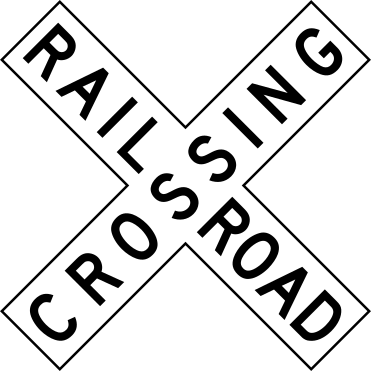
Railroad crossbuck
3 questions from the Utah practice test
1. What does a white X shaped sign reading Railroad Crossing tell a Utah driver?
- A train may be coming; stop behind the stop line or before the intersection
- Trains always yield to cars
- The crossing is abandoned
- You may cross without looking if no train is visible
Show answer
A train may be coming; stop behind the stop line or before the intersection. The crossbuck is the sign at the tracks themselves. The handbook says the white X shaped Railroad Crossing sign cautions that a train or railroad vehicle is coming and that you must stop behind the stop line or before the intersection when required. Trains never yield, the crossbuck does not mean the line is abandoned, and a train hidden by a curve can arrive in seconds. Look and listen both ways, and never stop on the tracks.
2. How close to a railroad crossing may a Utah driver park?
- Not on the track or within 50 feet of the nearest rail
- Anywhere, as long as the gates are up
- Within 10 feet of the rail
- Not on the track or within 25 feet of the nearest rail
Show answer
Not on the track or within 50 feet of the nearest rail. Utah includes railroad crossings in its list of places where you are not allowed to park. The handbook bars parking on any railroad track or within 50 feet of the nearest rail of a railroad crossing. Raised gates do not change the rule, and both 10 feet and 25 feet are inside the 50 foot limit the handbook sets. Find a legal space well clear of the rails and remember the separate limits near hydrants, crosswalks, and stop signs.
3. Why are stop lines at Utah intersections set back from the crossing?
- To make the intersection look wider
- To keep cars away from the traffic signal poles
- To mark where pedestrians must stand
- To give larger vehicles more turning space
Show answer
To give larger vehicles more turning space. A truck or bus turning into your street swings wide, and a car stopped too close to the corner gets clipped. The handbook says stop lines at intersections are designed to give larger vehicles more turning space. They are not about signal poles, pedestrian positions, or appearance. Stop with your front bumper behind the line, even when it seems far back, so the turning vehicle has the room the line was painted to provide.
Practice this topic
Lock it in with emergencies questions from the free Utah practice test. Every answer comes with a plain English explanation.
Source: the Utah Driver Handbook, Sections 8 and 14: Trains and Railroad Crossings. This lesson is a plain English summary, not the law itself; where it differs, the manual and the statute govern. Last checked 2026-09-27.