
Test 1 of 11 · 20 questions · Free 2026
UT Permit Practice Test 1
Jump to the test ↓A fixed 20 question set from the Utah bank with answers and plain English explanations. The real UT exam is 50 questions, 80 percent to pass; take the full length version on the main practice page.
Question 1 of 20 · 0 right so far
All 20 questions in test 1
Every question below comes from the Utah question bank on this page. Open a question to see the correct answer and the explanation. Nothing here is hidden behind a signup.
1. What does a flashing yellow traffic light mean in Utah?
- Stop and wait for green
- Stop, then proceed as at a stop sign
- Slow down and proceed with caution
- The signal is broken; ignore it
Show answer
Slow down and proceed with caution. A flashing yellow light is a caution signal. You do not have to stop, but the handbook says to slow down, proceed with caution, and be prepared to stop for any traffic. Waiting for green is not the instruction, the stop then proceed rule belongs to flashing red, and the handbook treats flashing yellow as a working caution signal. Cover the brake and look both ways for traffic entering the intersection.
Study this in the handbook: Traffic Signals and Arrows
2. In which direction does traffic flow through a Utah roundabout?
- Clockwise
- Counterclockwise
- Either direction, depending on the lane
- Clockwise in the inside lane and counterclockwise in the outside lane
Show answer
Counterclockwise. The Utah handbook defines a roundabout as a circular intersection that flows counterclockwise. Entering by turning right and circling to the left keeps every vehicle moving the same way around the island. Clockwise travel would put you head on with circulating traffic, and no lane reverses the direction, whether inside or outside. Slow on the approach, yield to traffic already circulating, and exit to the right at your street.
3. In a Utah school zone, when are children considered present so that the slower speed limit applies?
- Only when a crossing guard is standing in the road
- Only during the lunch hour
- When the school zone lights are flashing
- Only when you can actually see children on the sidewalk
Show answer
When the school zone lights are flashing. Utah says children are present when the school zone lights are flashing, and you must obey the slower posted limit whether or not you can see a child. The flashing beacons are the legal trigger, so an empty sidewalk is not a reason to keep normal speed. The reduced limit also applies during the recess and opening or closing periods that the speed section describes, so the lights are not the only time to slow down. Watch for the beacons well ahead of the zone, slow before you reach the sign, and stay at the reduced speed until you pass the end of the zone.
Study this in the handbook: Speed Limits and the Basic Speed Law
4. An ambulance approaches behind you with its emergency lights operating. Where should you wait for it to pass?
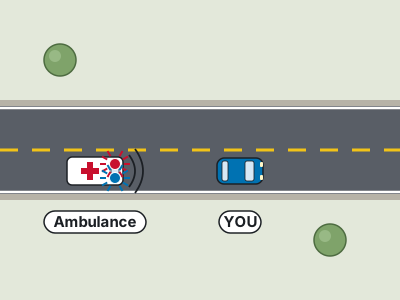
- Stopped at the right side of the road
- Moving slowly along the center line
- Stopped in the leftmost travel lane
- On the shoulder only after the ambulance overtakes you
Show answer
Stopped at the right side of the road. An approaching ambulance using emergency warning devices requires you to yield promptly, move to the right side, and stop until it passes. Merely creeping along the center line leaves your vehicle moving in an area the ambulance may need. Waiting until it overtakes you also delays the required response. Flashing emergency lights in your rearview mirror are the cue to check the space to your right and make room without competing for the roadway.
Study this in the handbook: Emergency Vehicles, Move Over and School Buses
5. What does this yellow warning sign with arrows splitting around a median tell you?

- A lane ends ahead
- A divided highway begins ahead
- A side road enters ahead
- Two-way traffic begins ahead
Show answer
A divided highway begins ahead. Like other warning signs, this yellow diamond tells you of possible danger ahead. The handbook lists separate Divided Highway Begins and Divided Highway Ends signs. This sign, with the arrows splitting around a median, tells you that a divided highway begins ahead, so a median will separate you from traffic going the other way. Keep to the right of the median. Lane Ends and Side Road Ahead are separate warning signs with different meanings.
Study this in the handbook: Regulatory, Guide and Route Signs
6. At a single-point urban interchange, what danger do WRONG WAY signs on the ramps help drivers avoid?
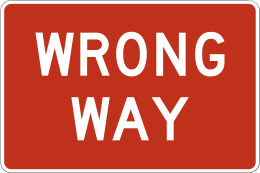
- Taking a ramp with a lower speed limit
- Entering a ramp against its traffic flow
- Leaving the freeway at a signalized exit
- Using a ramp that crosses above the freeway
Show answer
Entering a ramp against its traffic flow. Wrong way signs identify the risk of entering a ramp against traffic at a single-point urban interchange. These layouts place several ramp movements near one another, so selecting an opening simply because it is nearby can put you in opposing traffic. A signalized exit is not itself the danger described by the sign. Watch the ramp signs and lane guidance together before committing to a turn, especially when the interchange layout is unfamiliar.
Study this in the handbook: Freeway Driving and Work Zone Speeds
7. A driver who was 20 when arrested is convicted of a first DUI in Utah. How long must the driver use an ignition interlock device?
- 18 months
- Six months
- No interlock for a first DUI
- Three years
Show answer
Three years. After a first DUI, Utah automatically restricts the driver to a vehicle with an ignition interlock device for 18 months, or three years if the driver was under 21 when arrested. At 20 the longer period applies, so 18 months is the adult figure. Six months is not the Utah period, and a first DUI does carry an interlock requirement. Removing the device early re-suspends the driving privilege.
Study this in the handbook: DUI Penalties, Refusal and Ignition Interlock
8. Under Utah's car seat guidance, once a child has outgrown the rear facing stage, until when must the child ride forward facing with a harness in the back seat?
- Until age 2 and 20 pounds
- Until at least four years of age and 40 pounds, or longer if the seat allows
- Until age 8 regardless of size
- Until the child can see out the window
Show answer
Until at least four years of age and 40 pounds, or longer if the seat allows. After the rear facing stage, which lasts until at least age two and 30 pounds, a Utah child must ride forward facing with a harness in the back seat until at least four years of age and 40 pounds, or longer if the seat allows. From about four and 40 pounds a booster seat is used until the belt fits and the child is 57 inches tall. Age 2 and 20 pounds is too early, age 8 is the booster range, and window height is not a standard.
Study this in the handbook: Seat Belts, Car Seats and Air Bags
9. A Utah driver whose license was suspended for DUI is caught driving. What maximum fine and jail term does the handbook list?
- $100 and 10 days
- $10,000 and five years
- $250 and 30 days
- $1,000 and up to six months
Show answer
$1,000 and up to six months. When the original suspension or revocation is alcohol related, the fine for driving anyway may be up to $1,000 with up to six months in jail. The other pairs do not match the handbook. The vehicle may also be impounded when the suspension was for DUI, drug metabolite, automobile homicide, alcohol-restricted violations, or test refusal, and the original suspension time is added again.
Study this in the handbook: Renewal, Phone Laws and the Point System
10. An 18 year old in Utah wants a first Class D license. What learner permit holding period applies?
- Six months, the same as a 16 year old
- One full year
- 90 days, with no driver education needed
- No holding period, but an approved driver education course must be completed
Show answer
No holding period, but an approved driver education course must be completed. Utah sets holding periods by age. At 18 there is no holding period, but the applicant must complete an approved driver education course. Six months applies to 16 and 17 year olds, and 90 days applies to applicants 19 or older who do not complete driver education. A full year is not a Utah holding period for any age group.
Study this in the handbook: Driver Education and Learner Permits
11. A roadway ahead is covered by floodwater that looks shallow. What should you do?
- Cross quickly to avoid stalling in the water
- Follow a larger vehicle through its wheel tracks
- Turn around and choose another route
- Drive along the road edge to test the water depth
Show answer
Turn around and choose another route. Turn away from a flooded road and find another route. Water that appears shallow can conceal a dip or a washed-out road surface, so following a larger vehicle through its tracks is not a dependable way to judge safety. The visible water across your intended path is the cue to change your route before entering it. If another route is unavailable, the handbook advises moving to higher ground and waiting for the water to subside.
Study this in the handbook: Renewal, Phone Laws and the Point System
12. What must a Utah driver complete after a conviction for violating the move over law?
- A two-hour online class within 30 days
- A new road test within six months
- An eight-hour course before the next license renewal
- A four hour live classroom defensive driving course within 90 days
Show answer
A four hour live classroom defensive driving course within 90 days. A move over conviction requires a four hour defensive driving course in a live classroom, completed within 90 days of conviction. An online class lasting two hours misses both the required format and duration. Use the conviction date to identify the deadline and arrange the required class promptly. The handbook also specifies a 90-day license suspension for failing to attend, so this requirement is separate from simply paying a ticket.
Study this in the handbook: Emergency Vehicles, Move Over and School Buses
13. At about what speed does the Utah handbook say a car may begin to hydroplane on a wet road?
- Over 70 mph
- Any speed above 10 mph
- Over 35 mph
- Only above 55 mph
Show answer
Over 35 mph. Hydroplaning occurs when your front tires ride on water instead of the road, and the handbook says a car may start to hydroplane at speeds over 35 mph. As you go faster the problem worsens and you lose control of your steering, which is why a wet road calls for slowing down. The other numbers are either too high or too low to match the handbook. If you do skid, slowly take your foot off the gas pedal, do not slam on your brakes, and straighten out your wheels once the car regains traction.
Study this in the handbook: Night Driving, Weather, Floods and Skids
14. What does a white X shaped sign reading Railroad Crossing tell a Utah driver?
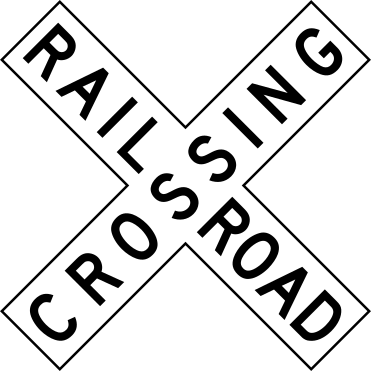
- A train may be coming; stop behind the stop line or before the intersection
- Trains always yield to cars
- The crossing is abandoned
- You may cross without looking if no train is visible
Show answer
A train may be coming; stop behind the stop line or before the intersection. The crossbuck is the sign at the tracks themselves. The handbook says the white X shaped Railroad Crossing sign cautions that a train or railroad vehicle is coming and that you must stop behind the stop line or before the intersection when required. Trains never yield, the crossbuck does not mean the line is abandoned, and a train hidden by a curve can arrive in seconds. Look and listen both ways, and never stop on the tracks.
Study this in the handbook: Railroad Crossings
15. When no sign is posted and no special hazard exists, which speeds does the Utah handbook list for rural interstate highways?
- 55 mph only
- 65, 70, 75 or 80 mph
- 85 mph
- 60 mph
Show answer
65, 70, 75 or 80 mph. Utah's speed list gives 65, 70, 75 or 80 mph on rural interstate highways, with transition zones marked by pavement markings and signs. Fifty five mph is listed for major highways as posted, and 85 and 60 are not in the handbook. The basic speed law still applies: never drive faster than is reasonable and prudent for existing conditions, even under the posted limit.
Study this in the handbook: Pavement Markings and Special Lanes
16. When parking on a downhill grade next to a curb in Utah, how should you position the front wheels?
- Turn the wheel away from the curb
- Turn the wheel toward the curb so the front tire touches it
- Keep the wheels straight
- It does not matter if the parking brake is set
Show answer
Turn the wheel toward the curb so the front tire touches it. On a downhill grade the curb is your backstop. The handbook says to turn your wheel toward the curb so the front tire touches it, which secures the vehicle position so a car that starts to roll is held by the curb instead of drifting into traffic. Turning away from the curb is the handbook step for parking uphill, straight wheels do not use the curb at all, and the handbook lists the wheel position as a step in addition to the parking brake, not instead of it. Put the car in park and set the parking brake as well.
17. Can taking just one alcoholic drink affect a person’s ability to drive, according to Utah’s handbook?
- No, impairment starts only after two drinks
- No, if the drink is consumed with a meal
- Only if the drink is combined with a prescription drug
- Yes, impairment starts with the first drink
Show answer
Yes, impairment starts with the first drink. Alcohol can affect driving ability beginning with the first drink. Waiting until a second drink to consider impairment leaves out the effect that may already be present after one. A small serving count therefore should not be used as reassurance before taking the driver’s seat. If you are deciding how to get home after a drink with dinner, arrange transportation with a sober driver. The practical decision is to avoid driving after alcohol rather than trying to detect impairment yourself.
Study this in the handbook: Alcohol, Drugs and the 0.05 Limit
18. When you believe another Utah driver should yield, what approach does the handbook advise?
- Enter confidently so the other driver recognizes your priority
- Use the horn to establish your right-of-way
- Assess the situation for safety instead of assuming priority
- Accelerate before the other driver can move
Show answer
Assess the situation for safety instead of assuming priority. Utah’s guidance is to examine the situation and think about safety rather than assume you have priority. Entering confidently just to make another driver yield can create a conflict if that driver has not seen you or does not stop. Watch the other vehicle’s movement, especially when it continues rolling toward the intersection. Even where a rule requires the other person to wait, leave yourself time and space to avoid a collision if that person fails to yield.
Study this in the handbook: Intersections and Right of Way
19. How does the Utah handbook describe skipping the safety belt because you are only going to the store?
- A poor excuse, and dangerous
- Legal as long as you stay under 25 mph
- Fine if you sit in the back seat
- Acceptable for trips under one mile
Show answer
A poor excuse, and dangerous. The handbook notes that three out of four crashes resulting in death are within 25 miles of home, and it calls not using a safety belt because you are just going to the store a poor excuse and dangerous. There is no short trip, low speed, or back seat exception in Utah law; everyone in the vehicle must be belted on every trip. Buckle up before you move the car, every time.
Study this in the handbook: Seat Belts, Car Seats and Air Bags
20. Why does the Utah handbook tell you to slow down for animals standing near the roadway?
- They may bolt or change direction at the last minute, and other animals may follow
- Animals never enter the roadway in daylight
- So you can photograph them safely
- They will always move away from the road
Show answer
They may bolt or change direction at the last minute, and other animals may follow. An animal standing calmly at the edge of the road is not a settled situation. The handbook warns that animals may bolt or change direction at the last minute and that other animals may follow the first one. Assuming they will move away, that they stay off the road in daylight, or slowing to take pictures all misjudge the risk. Reduce speed, cover the brake, and be ready for the animal to step into your lane.
Study this in the handbook: Distractions, Fatigue, Animals and Mountain Roads
Every question is written from the official Utah Driver Handbook. Need paper? Printable UT practice test with answer key.
Last verified 2026-10-05. How we check every question · Study all 220 as flashcards
Frequently asked questions
How many questions are on this Utah practice test?
This fixed set has 20 questions. It is test 1 of 11 from the 220 question Utah bank. The real UT exam asks 50 questions and you need 40 correct.
What is the passing score for the real Utah test?
You must pass with a score of 80% or better That figure comes from the official Utah source cited on the DMV facts page.
How does this fixed test relate to the full Utah bank?
Each numbered test is a fixed set of questions in a fixed order, so you can retake the same test later and compare. Every test mixes road signs and the other topics in about the same proportion as the full bank. Tests 1 to 11 together cover every question in the Utah bank once. The full practice page mixes the whole bank at random.
Last verified 2026-10-05. See the Utah DMV facts page for sourced state details.