
Test 9 of 11 · 20 questions · Free 2026
UT Permit Practice Test 9
Jump to the test ↓A fixed 20 question set from the Utah bank with answers and plain English explanations. The real UT exam is 50 questions, 80 percent to pass; take the full length version on the main practice page.
Question 1 of 20 · 0 right so far
All 20 questions in test 9
Every question below comes from the Utah question bank on this page. Open a question to see the correct answer and the explanation. Nothing here is hidden behind a signup.
1. What can happen to a Utah driver caught driving while the license is suspended?
- Up to 90 days in jail, a fine, and the suspension lengthened by the original period
- Only a $25 fine
- The suspension ends early
- Nothing if the suspension was for unpaid fines
Show answer
Up to 90 days in jail, a fine, and the suspension lengthened by the original period. Driving on a denied, suspended or revoked license can bring 90 days in jail and a fine, and the original suspension period is added again; a three month suspension becomes six. A $25 fine understates it, the suspension grows rather than ends, and the reason for the suspension does not excuse driving. If the suspension was alcohol related, the fine may reach $1,000 with up to six months in jail.
Study this in the handbook: Renewal, Phone Laws and the Point System
2. What ignition interlock restriction follows an automobile homicide conviction in Utah?
- Two years
- Three years
- 10 years
- 18 months
Show answer
10 years. Automobile homicide carries a 10 year ignition interlock restriction, and felony DUI carries three years. A second DUI or a refusal revocation brings two years, and a first adult DUI brings 18 months. Automobile homicide also results in lifetime alcohol-restricted status and a mandatory license revocation, so the interlock period is only one of several consequences. Driving without the device while restricted can lead to impoundment.
Study this in the handbook: DUI Penalties, Refusal and Ignition Interlock
3. A 16 year old in Utah has a driver license (not a permit). During which hours is the teen restricted from driving without a qualifying exception?
- 12 a.m. to 5 a.m.
- 10 p.m. to 6 a.m.
- 9 p.m. to 5 a.m.
- 11 p.m. to 6 a.m.
Show answer
12 a.m. to 5 a.m.. Utah's youthful driver table lists a nighttime restriction from 12 a.m. to 5 a.m. for a 16 year old license holder. Exceptions include riding with a licensed driver 21 or older in the front seat, an agricultural assignment, driving to or from work or a school sponsored activity, and emergencies. The 10 p.m., 9 p.m. and 11 p.m. windows are not the hours Utah lists. The table lists no nighttime restriction for the permit stage.
4. To prevent the heat buildup that can cause a tire fire, what does the Utah handbook say you should never do for an extended period of time?
- Drive with a spare tire that is smaller than the other tires
- Drive with the high beam indicator light on
- Drive on a soft or flat tire or with a brake that is dragging
- Drive with the cruise control engaged
Show answer
Drive on a soft or flat tire or with a brake that is dragging. The handbook tire fire section says never to drive for an extended period of time on a soft or flat tire or with a brake that is dragging, because these situations can result in heat buildup and cause a tire fire. It also says to check tires and brakes frequently for unusual heat, to change any tire that is soft or flat, and to always release the parking brake before moving the vehicle. A compact spare, a lit high beam indicator, and cruise control are not the conditions this warning names.
5. At a yield sign, what is required when another vehicle has the right-of-way?
- Maintain speed because yield signs warn only of road shape
- Slow down and allow the vehicle with priority to proceed
- Yield only if the other vehicle has already entered the intersection
- Always make a complete stop, even when no conflicting traffic is present
Show answer
Slow down and allow the vehicle with priority to proceed. A yield sign directs you to reduce speed and give way to traffic that has priority. Holding your speed on the theory that the sign only describes road shape would disregard that duty to give way. Check the approaching traffic and allow enough room for the priority vehicle to pass without being forced to brake or swerve. An occupied approach at the yield point is the cue to wait until you can enter safely.
Study this in the handbook: Regulatory, Guide and Route Signs
6. How should a Utah driver pass a bicyclist on the road?
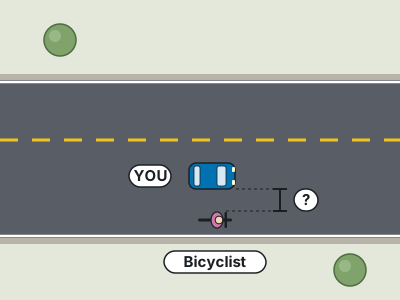
- Pass at full speed to minimize time beside them
- Slow down and give the bicyclist as much space as possible
- Pass within a foot to avoid crossing the center line
- Sound the horn continuously while passing
Show answer
Slow down and give the bicyclist as much space as possible. The handbook says to slow down when passing bicyclists and give them as much space as possible. Speeding past, honking, or squeezing by within a foot all ignore that instruction, and Utah law also requires at least three feet when passing a bicyclist. Wait for a safe gap, move fully over, and do not cut back in until you are well ahead of the rider.
Study this in the handbook: Pedestrians, Bicycles and Motorcycles
7. Where can a Utah applicant take the Traffic Safety and Trends Exam, and how often may it be attempted before licensing?
- At a driving school, once per enrollment
- On the Driver License Division website, three attempts total
- At a testing office, twice per day only
- On the Driver License Division website, as often as necessary
Show answer
On the Driver License Division website, as often as necessary. The Traffic Safety and Trends Exam is offered only on the Driver License Division website, with as many attempts as necessary before licensing. A three-attempt cap would confuse this exam with the separate fee-based attempt rules for the written knowledge test. If an applicant misses a trends question while studying at home, another attempt is allowed. Use the exam name on the website to ensure you are completing the additional requirement rather than an unrelated practice quiz.
Study this in the handbook: Knowledge, Traffic Safety and Skills Tests
8. A Utah driver age 25 refuses the officer-designated chemical tests for the first time. What license revocation period is stated?
- Revocation lasting 18 months
- Revocation lasting six months
- Revocation lasting 120 days
- Revocation lasting 36 months
Show answer
Revocation lasting 18 months. For a driver in this adult age group, refusing the required chemical tests results in an 18-month revocation for the first offense. The 36-month period belongs to second or subsequent refusals, so it would overstate the first-offense period here. Notice the words refusal and first when separating this rule from DUI conviction suspensions. During a stop, the officer’s selection of tests is the relevant requirement; a driver cannot avoid the refusal consequence by simply declining those tests.
Study this in the handbook: DUI Penalties, Refusal and Ignition Interlock
9. Which Utah alcohol-related conviction results in a lifetime alcohol-restricted status?
- Automobile homicide or felony DUI
- Every first chemical test refusal
- Every first DUI conviction
- Any first underage possession conviction
Show answer
Automobile homicide or felony DUI. Automobile homicide and felony DUI carry lifetime alcohol-restricted status. A first DUI is not automatically assigned that lifetime category simply because it involves alcohol. Other alcohol actions can produce restrictions lasting a specified number of years. The key cue here is the conviction category, especially the word felony. Alcohol-restricted status addresses alcohol in the body while driving, so it should not be confused with the separate duration of an ignition interlock device requirement.
Study this in the handbook: DUI Penalties, Refusal and Ignition Interlock
10. Why is black ice especially dangerous, according to the Utah handbook?
- It only forms at midday
- It only forms on bridges
- It is thicker than regular ice
- It is hard to see and looks more like a wet spot than ice
Show answer
It is hard to see and looks more like a wet spot than ice. The Utah handbook says Utah has a particular problem with black ice, which is difficult to see on the roadway and appears more like a wet spot than a patch of ice, and that many crashes occur each year from skids caused by it. Nothing in the handbook limits black ice to bridges or to midday, and it does not describe thickness as the hazard. Its advice is to keep a skid from happening by slowing to a speed at which you can control the car.
Study this in the handbook: Night Driving, Weather, Floods and Skids
11. Beyond this railroad crossbuck, traffic is backed up across the tracks. Where should you wait?
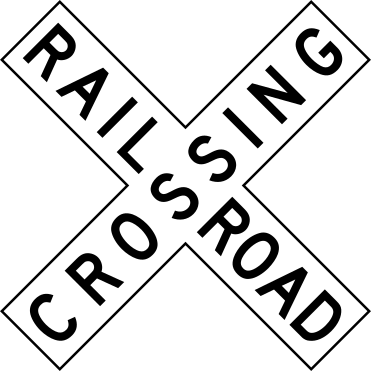
- On the first rail until the line moves
- Between the rails if the crossing lights are off
- Immediately behind the last car even if it leaves you on the tracks
- At the stop line before the tracks
Show answer
At the stop line before the tracks. Wait before the tracks when traffic or a signal prevents you from continuing across. A crossbuck alerts you to the railroad crossing, but an absence of flashing lights does not make the rails a safe waiting area. Following the last car too closely could leave your vehicle trapped when the queue stops. Use the stop line and the available space beyond the tracks as cues, and cross only when you can clear the railroad area.
Study this in the handbook: Regulatory, Guide and Route Signs
12. What do the yellow background and diamond shape of this curve sign tell you about the road ahead?

- A mandatory turn must be made at the next junction
- A route number changes at the curve
- A possible danger is ahead
- A service station is located around the bend
Show answer
A possible danger is ahead. Yellow diamond signs warn about possible dangers ahead. On this sign, the curved arrow identifies the road’s upcoming bend, giving you time to adjust your approach. Treating it as a mandatory intersection turn confuses a warning about the road’s path with a direction to leave your current route. The combination of the yellow diamond and bent arrow is the cue to look farther into the curve and prepare before reaching the change in alignment.
Study this in the handbook: Regulatory, Guide and Route Signs
13. What does the Utah handbook say about the rights of motorcyclists?
- They must always yield to cars
- They may use sidewalks when traffic is heavy
- They have the same rights and responsibilities as other drivers
- They have fewer rights because they are smaller
Show answer
They have the same rights and responsibilities as other drivers. A motorcycle is a vehicle, and the Utah handbook states that motorcyclists have the same rights and responsibilities as other drivers. It tells drivers to give motorcycles an entire lane and not to share it, because motorcycles need space to react to other traffic. Motorcyclists do not yield by default, and size does not reduce their rights. When following a motorcycle, stay at least two seconds back, and before turning left be alert for motorcycles, as the handbook advises.
Study this in the handbook: Pedestrians, Bicycles and Motorcycles
14. A police officer tells you to stop although the intersection signal is green. Which instruction controls?
- The green light, until it changes to yellow
- The officer directing you to stop
- The movement of vehicles in the next lane
- The officer, but only after the signal turns red
Show answer
The officer directing you to stop. Follow the officer directing traffic, including an instruction to stop while a signal shows green. The green-light choice ignores the handbook rule that an officer can override the normal signal indication at an intersection. Watch the person giving directions as well as the light, and respond to the instruction addressed to your approach. A raised hand stopping your lane is a concrete cue to wait even if neighboring traffic is moving.
Study this in the handbook: Regulatory, Guide and Route Signs
15. According to the Utah handbook, what is the first step in safely backing your vehicle?
- Turn on the hazard lights
- Check behind the vehicle before you get in
- Sound the horn twice
- Open the driver's door and lean out
Show answer
Check behind the vehicle before you get in. Small children and objects behind a car are invisible from the driver's seat, so the handbook's first step for backing is to check behind the vehicle before you get in. Hazard lights, horn taps, and leaning out the door do not show you what is behind the bumper. After the walk around, apply the brake, shift to reverse, look over your shoulder, and back slowly, making quick checks to the front and sides if you are turning.
Study this in the handbook: Lane Changes, Passing, Turns and U-Turns
16. On a narrow Utah road with an obstructed view, what should you do when approaching a sharp curve?
- Speed up to get through the curve quickly
- Drive in the center of the road for a better view
- Flash your high beams instead of using the horn
- Sound the horn to warn drivers you cannot see
Show answer
Sound the horn to warn drivers you cannot see. When a sharp curve on a narrow road hides oncoming traffic, the handbook tells you to sound the horn as you approach so a driver you cannot see knows you are coming. Speeding into a blind curve and drifting to the center both put you in the path of that unseen vehicle, and flashing high beams is not the warning the handbook names for this spot. Slow down, stay to the right, and use the horn where the view is obstructed.
Study this in the handbook: Distractions, Fatigue, Animals and Mountain Roads
17. A police officer directs you to stop at a Utah intersection while your signal is green. What must you do?
- Stop as the officer directs
- Stop only if cross traffic has a green signal too
- Proceed slowly while signaling to the officer
- Continue because the green signal has priority
Show answer
Stop as the officer directs. An officer's traffic direction takes precedence over the signal display. A green light does not authorize continuing when the officer tells you to stop, even if cross traffic appears stationary. Look for an officer managing the intersection during a crash, road closure, or signal problem, and follow that person's directions. Waiting for a second signal condition would delay compliance with the instruction that already controls your movement through the intersection.
Study this in the handbook: Regulatory, Guide and Route Signs
18. At a Utah railroad crossbuck, you see a train approaching but no lowered gate. What should you do?
- Cross first because the gate is not down
- Yield to the train and be prepared to stop
- Stop only if the train sounds its horn
- Proceed if another car crosses ahead of you
Show answer
Yield to the train and be prepared to stop. Train traffic must be yielded to, and a driver approaching a crossbuck must be prepared to stop when a train is coming. The absence of a lowered gate is not permission to cross ahead of it. Look along the tracks for an approaching train instead of using a gate as your only cue. Following another car across is also unsafe reasoning because the remaining time changes as the train approaches; make your own observation and wait when necessary.
19. Which special hazards does the Utah handbook list as times when the law requires you to slow down?
- Only construction zones
- Only when a police officer is present
- People walking beside the road, heavy traffic, or dangerous road conditions
- Only at railroad crossings
Show answer
People walking beside the road, heavy traffic, or dangerous road conditions. Beyond the posted limits, the handbook says there are times when the law requires you to slow down, and among them are special hazards such as people walking beside the road, heavy traffic, or dangerous road conditions. Work zones and railroad crossings are also on that list, and none of the times depends on an officer being present, so no single item is the only one. The basic speed law is broader than any one situation: the lawful speed is always the one that is reasonable and prudent for the existing conditions.
Study this in the handbook: Traffic Signals and Arrows
20. When a Utah driver exits a parallel parking space, what is the first step?
- Open the door to look back
- Turn the wheel fully and accelerate
- Sound the horn
- Check traffic and apply the brake
Show answer
Check traffic and apply the brake. Leaving a parallel space means entering a moving lane from a standstill, so the handbook's first step is to check traffic and apply the brake before you do anything else. Cranking the wheel and accelerating, honking, or opening the door into traffic all skip the look that keeps you from pulling out in front of a car or a bicyclist. The handbook then says to shift to reverse and back up close to the car behind, check for traffic and signal, move forward slowly, and enter the lane once you clear the rear bumper of the vehicle ahead.
QualitySpace is expanding to Utah
We are a California-based independent insurance brokerage working on licensing in more states. We cannot help with Utah insurance yet. Leave your email and we will let you know when we can.
Every question is written from the official Utah Driver Handbook. Need paper? Printable UT practice test with answer key.
Last verified 2026-10-05. How we check every question · Study all 220 as flashcards
Frequently asked questions
How many questions are on this Utah practice test?
This fixed set has 20 questions. It is test 9 of 11 from the 220 question Utah bank. The real UT exam asks 50 questions and you need 40 correct.
What is the passing score for the real Utah test?
You must pass with a score of 80% or better That figure comes from the official Utah source cited on the DMV facts page.
How does this fixed test relate to the full Utah bank?
Each numbered test is a fixed set of questions in a fixed order, so you can retake the same test later and compare. Every test mixes road signs and the other topics in about the same proportion as the full bank. Tests 1 to 11 together cover every question in the Utah bank once. The full practice page mixes the whole bank at random.
Last verified 2026-10-05. See the Utah DMV facts page for sourced state details.