
Test 4 of 25 · 20 questions · Free 2026
NJ Permit Practice Test 4
Jump to the test ↓A fixed 20 question set from the New Jersey bank with answers and plain English explanations. The real NJ exam is 50 questions, 80 percent to pass; take the full length version on the main practice page.
Talk to Kevin
714-666-6669Call now →California policies handled directly by Kevin Vu (CDI #4037122). New Jersey and Pennsylvania policies handled in cooperation with licensed partner producer Sean Vu (Allstate). QualitySpace Insurance Agency does not bind coverage in NJ or PA directly.
Question 1 of 20 · 0 right so far
All 20 questions in test 4
Every question below comes from the New Jersey question bank on this page. Open a question to see the correct answer and the explanation. Nothing here is hidden behind a signup.
1. A New Jersey probationary driver under 21 has a job that starts at 4:30 a.m. What makes driving to work during the restricted hours lawful?
- A parent's spoken permission
- Carrying a signed certification from the employer on business letterhead
- Nothing, because the hours rule has no exceptions
- Displaying an extra pair of GDL decals
Show answer
Carrying a signed certification from the employer on business letterhead. New Jersey allows an exemption from the 11:01 p.m. to 5:00 a.m. restriction when a permit or probationary driver under 21 must drive for employment or religion. The driver carries a legible certification on the letterhead of the employer or religious institution, signed by the certifying official and listing that person's name, title, address, and phone number. A parent saying yes is not proof. The belief that no exception exists is wrong because this one is written into the rules. Extra decals do nothing for the hours limit.
Study this in the handbook: Permits and the Graduated Driver License
2. What is New Jersey's speed limit on rural roads where no limit is posted?
- 35 mph
- 50 mph
- 55 mph
- 65 mph
Show answer
50 mph. New Jersey's speed table sets 50 mph for non-posted rural roadways. The other numbers belong to other road types: 25 mph for school zones and business or residential districts, 35 mph for suburban business and residential districts, 55 mph for certain state highways and interstates, and 65 mph only on certain interstates where posted. A driver on an unposted country road who assumes 55 mph is over the limit. The limit is a maximum; weather and traffic may call for less.
Study this in the handbook: Speed limits and safe speed
3. What does New Jersey law require for trash or debris carried in a vehicle?
- There is no requirement
- It must be in the trunk
- It must weigh under 50 pounds
- It must be covered to keep it from littering the roadway
Show answer
It must be covered to keep it from littering the roadway. All trash, debris or rubbish carried in a vehicle must be covered to keep it from littering the roadway, under N.J.S.A. 39:4-63 and 39:4-64. Throwing litter from a vehicle is a violation, and if the vehicle is moving when litter is thrown the motorist may lose his or her license. The rule is about covering the load; it does not name the trunk or set a weight limit.
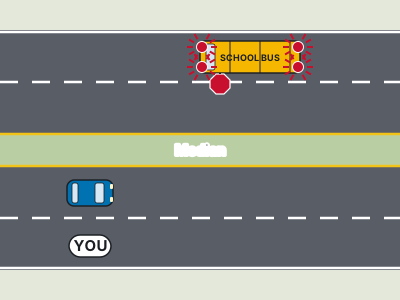
4. A school bus stops on the opposite side of a dual-lane highway, separated by a safety island or raised median. What should a New Jersey driver do?
- Stop 25 feet behind the bus
- Slow to 10 mph
- Continue at the posted speed without checking
- Pass the bus at 35 mph if no children are visible
Show answer
Slow to 10 mph. On a dual-lane highway, a driver on the far side of a safety island or raised median should slow to 10 mph when a school bus has stopped. The 25-foot stop rule applies to the other roadway situations described in the manual. The physical median is the important cue: a raised separation changes the response from stopping to a very slow approach.
Study this in the handbook: School buses, railroad crossings and highway ramps
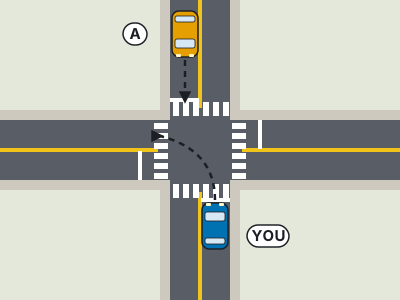
5. While turning left at a New Jersey intersection, what must a driver do before crossing the opposing lane?
- Turn first because a green signal gives absolute priority
- Wait only for a police officer’s hand signal
- Yield to oncoming traffic and stop for pedestrians in the crosswalk
- Yield to vehicles behind the turning car
Show answer
Yield to oncoming traffic and stop for pedestrians in the crosswalk. A left turn crosses the path of approaching vehicles and may also cross a pedestrian route. New Jersey therefore requires the turning motorist to yield to oncoming traffic and stop for pedestrians within the crosswalk. A green light authorizes movement only after those conflicts are cleared; it is not a guarantee that the turn can begin immediately. Before steering left, check the opposing lane, the crossing area, and the space into which the vehicle will travel.
Study this in the handbook: Right of way, intersections and passing
6. Before opening the driver-side door after parking on a New Jersey street, what should the motorist check?
- Only the fuel gauge and parking meter
- The rear seat before checking outside
- Traffic, bicycles, and mopeds approaching the door area
- Whether the vehicle is more than six inches from the curb
Show answer
Traffic, bicycles, and mopeds approaching the door area. A parked vehicle’s door can enter the path of a cyclist, moped, or passing vehicle. New Jersey’s parking guidance tells the motorist to check traffic and those smaller road users before opening the driver-side door. The curb-distance option concerns where the vehicle is parked, not whether the door can be opened safely. Use the mirrors, look over the shoulder, and choose the curbside exit for passengers when that is safer.
Study this in the handbook: Where not to park, headlights and phones
7. A yellow five-sided sign appears near a New Jersey roadway. What does it identify?

- A railroad crossing itself
- A school zone or school crossing
- A no-passing zone
- A temporary construction detour
Show answer
A school zone or school crossing. The five-sided pentagon is reserved for school signs. It alerts the motorist to a school zone or school crossing, where children may be present and careful speed control is essential. Railroad signs use an X or a round yellow advance-warning shape, while no-passing signs use a yellow pennant. The pentagon’s unusual five-sided outline is the fastest way to separate a school warning from the other yellow sign families.
Study this in the handbook: Road sign shapes and colors
8. When testing your brakes, within what distance should you be able to stop from 20 mph?
- Within 5 feet
- Within 25 feet
- Within 75 feet
- Within 100 feet
Show answer
Within 25 feet. The New Jersey manual gives a simple brake check: a motorist should be able to stop within 25 feet at 20 mph. You can test this in an empty parking lot, using chalk marks to see whether the vehicle stops within that distance. If the vehicle pulls to one side, the pedal feels wrong, or the brakes squeal or grind, have them checked. Five feet is unrealistic, while 75 or 100 feet would signal brakes in poor condition rather than a passing test.
Study this in the handbook: Seat belts, child seats and vehicle control
9. Above what BAC will a New Jersey ignition interlock device keep the vehicle from starting?
- 0.01%
- 0.08%
- 0.15%
- 0.05%
Show answer
0.05%. An ignition interlock has a built-in breathalyzer wired to the vehicle, and in New Jersey it blocks the engine from starting if the driver's BAC is over 0.05%. That is lower than the 0.08% adult DUI limit, so a driver who is under the legal limit can still be locked out. The 0.01% figure is the limit for drivers under 21, not the device setting. The 0.15% figure is a BAC band used after a DUI to set longer interlock periods, not the level the device checks for.
Study this in the handbook: DUI, breath test refusal and interlock penalties
10. A New Jersey driver is convicted of a second DUI. How long must an ignition interlock remain after driving privileges are restored?
- Two to four years, on top of the suspension period
- Three months
- Seven months to one year
- Ten years
Show answer
Two to four years, on top of the suspension period. For a second or subsequent DUI, or a second refusal offense, New Jersey requires the interlock during the suspension and then for two to four years after restoration. The shorter periods belong to first offenses: three months for a BAC from 0.08% to below 0.10%, and seven months to one year for 0.10% to below 0.15%. Ten years is the window for counting a later offense as a second one, not an interlock period. A second DUI within that window also brings a suspension of one to two years.
Study this in the handbook: DUI, breath test refusal and interlock penalties
11. When a bus is pulling back into traffic from a stop in New Jersey, what should surrounding motorists do?
- Force the bus onto the shoulder
- Accelerate to pass before the bus moves
- Yield to the bus as it re-enters the flow
- Yield only if the bus is a school bus
Show answer
Yield to the bus as it re-enters the flow. The manual includes buses among roadway users that receive yielding consideration when re-entering the flow of traffic. Accelerating to beat the bus or forcing it toward the shoulder creates the conflict the rule is meant to prevent. The instruction is not limited to school buses. Watch for a bus beginning its departure, ease off the accelerator, and leave room for it to join the lane.
Study this in the handbook: Pedestrians, cyclists, trucks and trains
12. What minimum eyesight standard is listed for a New Jersey basic license applicant?
- 20/20 vision without glasses
- 20/40 vision only in the weaker eye
- 20/50 vision with or without corrective lenses
- 20/80 vision with no corrective option
Show answer
20/50 vision with or without corrective lenses. For a basic license, the eyesight table lists 20/50 vision with or without corrective lenses. The 20/40 figure belongs to CDL applicants in both eyes, so importing it answers a different applicant category. New Jersey also gives a special instruction when sight exists in only one eye, but that does not make this an uncorrected-only test. Applicants who need lenses may use them during the screening.
Study this in the handbook: The knowledge test and road test
13. On a New Jersey road, both center lines are broken. When may a driver pass?
- Passing is forbidden in both directions
- Only the vehicle on the shoulder may pass
- Passing is allowed only after a police signal
- Passing is allowed on either side when it is safe
Show answer
Passing is allowed on either side when it is safe. Both broken center lines permit passing from either direction when the roadway is clear and the maneuver can be completed safely. The ban on both directions changes the marking meaning, while using the shoulder is unlawful and a police signal is not part of the rule. Check for oncoming traffic and finish the maneuver before the markings become solid again.
Study this in the handbook: Speed limits and safe speed
14. What do white special markings alert a New Jersey motorist to?
- Special conditions such as STOP AHEAD, SCHOOL, and R X R
- A required commercial vehicle inspection
- Only a permanent no-parking zone
- A guaranteed green traffic signal
Show answer
Special conditions such as STOP AHEAD, SCHOOL, and R X R. White special markings alert motorists to conditions such as STOP AHEAD, SCHOOL, and R X R. They provide an advance cue on or near the roadway and are different from a permanent parking restriction or an inspection notice. A STOP AHEAD marking works as a warning: prepare for the actual control farther ahead rather than stopping wherever the words first appear. A warning cannot guarantee a green signal, so continue scanning for the sign, line, or device that governs the upcoming location.
Study this in the handbook: Pedestrians, cyclists, trucks and trains
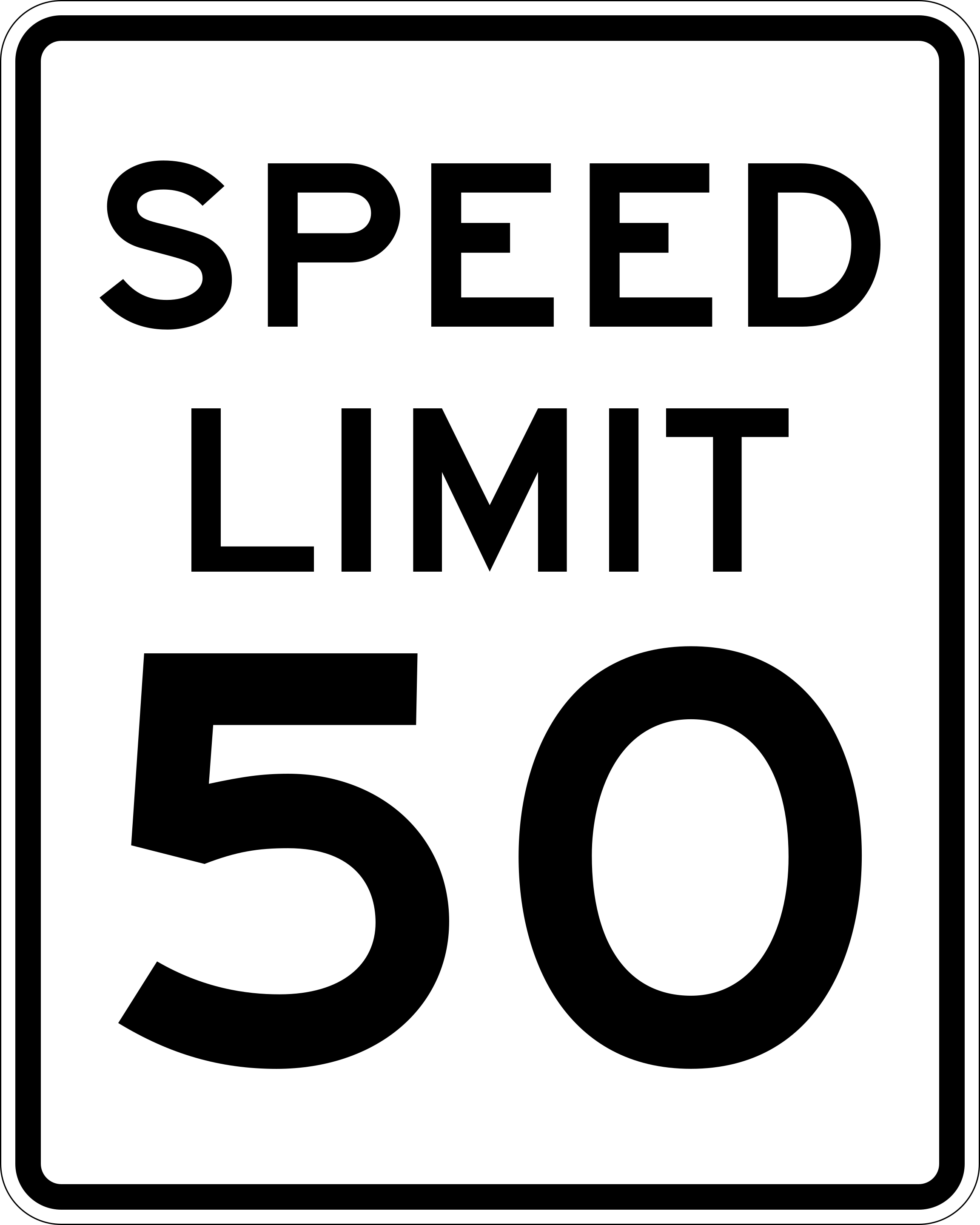
15. What category does the white vertical SPEED LIMIT sign belong to?
- A regulatory sign controlling speed
- A scenic-guidance sign for recreation
- A temporary construction warning
- A motorist-service information sign
Show answer
A regulatory sign controlling speed. A white vertical rectangle is classified as a regulatory sign, including speed signs. Therefore the pictured SPEED LIMIT sign communicates a legal speed control rather than scenic guidance, construction activity, or a service facility. Brown, orange, and blue serve those other categories. The visual cue is the tall white rectangle with black regulatory wording, which signals a rule governing traffic speed or movement.
Study this in the handbook: Road sign shapes and colors
16. Which locations does the manual list as examples of road hazards that warning signs may identify?
- Only parking lots and driveways
- Gas stations, rest areas, and hospitals
- Hills, dips, narrow bridges, bumps, and railroad tracks
- Traffic lights, stop signs, and toll booths
Show answer
Hills, dips, narrow bridges, bumps, and railroad tracks. The manual lists hills, dips, narrow bridges, bumps, and railroad tracks as examples of road hazards. These conditions can be difficult to see or judge early, which is why a driver should watch for warning signs and adjust speed and attention. The other choices name facilities or traffic controls, not the group of hazards stated in this passage. Scan the roadway ahead, expect conditions to change, and be ready to slow before reaching a crest, dip, bridge, bump, or crossing.
17. What qualifications must an adult supervising a New Jersey permit holder meet?
- At least 21, with a valid New Jersey license and three years of driving experience
- At least 18, with any valid license
- At least 21, with one year of driving experience
- At least 25, with five years of driving experience
Show answer
At least 21, with a valid New Jersey license and three years of driving experience. The supervising adult must be at least 21 years old, hold a valid New Jersey driver license, and have a minimum of three years of driving experience. The 18-year-old option fails both the age and license requirements. One year is too little experience, while the 25-and-five-years option is stricter than the manual and is not the stated standard. Before practice begins, verify all three qualifications together.
Study this in the handbook: Permits and the Graduated Driver License
18. What penalty can obtaining a New Jersey driver license illegally bring?
- A $25 fee
- A warning
- Only license cancellation
- A fine up to $500 and/or imprisonment
Show answer
A fine up to $500 and/or imprisonment. Altering a driver license or presenting an altered license can mean loss of driving privileges, a fine up to $1,000 and/or imprisonment, and obtaining a driver license illegally may result in a fine up to $500 and/or imprisonment. Neither offense is treated as a paperwork error. Licenses for motorists under 21 are printed vertically, and all driver licenses are valid for four years.
19. What legal status do road markings have in New Jersey?
- They have the same force of law as signs or traffic signals
- They apply only to commercial vehicles
- They are suggestions that may be ignored when traffic is light
- They are advisory unless a police officer is present
Show answer
They have the same force of law as signs or traffic signals. New Jersey gives road markings the same force of law as signs or traffic signals. That means a driver must obey a marked restriction or direction even when no officer is nearby. Light traffic does not turn a solid line into a suggestion, and the rule applies to ordinary motorists as well as commercial drivers. Treat lane lines, arrows, and other pavement markings with the same care you give a posted sign or a signal light.
Study this in the handbook: Traffic signals and road markings
20. Your conventional brakes suddenly fail on a New Jersey road. Which response follows the manual?
- Press the accelerator to reach a safer shoulder faster
- Turn off the engine and lock the steering wheel
- Use the parking brake fully without holding its release
- Shift to a lower gear and pump the brake pedal rapidly
Show answer
Shift to a lower gear and pump the brake pedal rapidly. A conventional brake failure calls for several coordinated actions. Shift to a lower gear, then pump the brake pedal fast and hard several times to try to build pressure. If braking still does not return, use the parking brake while holding its release, which lets you ease off if the rear wheels lock. The choice that jumps straight to a fully applied parking brake removes that control. Keep looking for a safe place off the roadway while the vehicle slows.
Study this in the handbook: Vehicle emergencies and what to do after a crash
Insurance in New Jersey
New Jersey policies are handled in cooperation with licensed partner producer Sean Vu. QualitySpace Insurance Agency does not bind coverage in New Jersey directly. Contact us and we will route you to the right person.
Every question is written from the official New Jersey Driver Manual. Need paper? Printable NJ practice test with answer key.
Last verified 2026-10-12. How we check every question · Study all 500 as flashcards
Frequently asked questions
How many questions are on this New Jersey practice test?
This fixed set has 20 questions. It is test 4 of 25 from the 500 question New Jersey bank. The real NJ exam asks 50 questions and you need 40 correct.
What is the passing score for the real New Jersey test?
80 percent, or 40 of the 50 questions, must have correct answers That figure comes from the official New Jersey source cited on the DMV facts page.
How does this fixed test relate to the full New Jersey bank?
Each numbered test is a fixed set of questions in a fixed order, so you can retake the same test later and compare. Every test mixes road signs and the other topics in about the same proportion as the full bank. Tests 1 to 25 together cover every question in the New Jersey bank once. The full practice page mixes the whole bank at random.
Last verified 2026-10-12. See the New Jersey DMV facts page for sourced state details.
Return to the full New Jersey practice test · Study road signs