
Test 11 of 25 · 20 questions · Free 2026
NJ Permit Practice Test 11
Jump to the test ↓A fixed 20 question set from the New Jersey bank with answers and plain English explanations. The real NJ exam is 50 questions, 80 percent to pass; take the full length version on the main practice page.
Talk to Kevin
714-666-6669Call now →California policies handled directly by Kevin Vu (CDI #4037122). New Jersey and Pennsylvania policies handled in cooperation with licensed partner producer Sean Vu (Allstate). QualitySpace Insurance Agency does not bind coverage in NJ or PA directly.
Question 1 of 20 · 0 right so far
All 20 questions in test 11
Every question below comes from the New Jersey question bank on this page. Open a question to see the correct answer and the explanation. Nothing here is hidden behind a signup.
1. Is it lawful in New Jersey to drive across private property to bypass a traffic signal or stop sign?
- Yes, whenever the property entrance is open to the public
- Yes, but only if the driver activates hazard lights
- No, unless the maneuver is made after midnight
- No, using public or private property to avoid the control is a motor-vehicle violation
Show answer
No, using public or private property to avoid the control is a motor-vehicle violation. New Jersey specifically treats operating a vehicle on public or private property to avoid a traffic-control signal or sign as a moving violation. The property’s open entrance and the time of day do not turn the shortcut into a legal maneuver. Hazard lights announce a vehicle but do not authorize bypassing the control. If a signal is red, remain in the roadway and wait for the lawful movement instead of cutting through a lot.
Study this in the handbook: Right of way, intersections and passing
2. On a two-lane road, a school bus ahead has flashing red lights. How far away must approaching motorists stop?
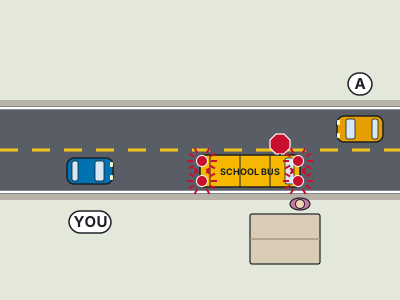
- At least 10 feet
- At least 50 feet
- At least 25 feet
- Only after the bus begins moving again
Show answer
At least 25 feet. On a two-lane road, a motorist must stop at least 25 feet from a school bus with flashing red lights. Ten feet is too close for the required stopping buffer, while 50 feet adds distance the cited rule does not require. Waiting only until the bus moves could put children at risk because motorists must remain stopped until the signals are off and the roadway is safe. Spot the red lights early and begin braking before reaching the 25-foot point.
Study this in the handbook: School buses, railroad crossings and highway ramps
3. For a first DUI with BAC from 0.10% to below 0.15%, what interlock period follows license restoration?
- Three months
- Nine to 15 months
- Exactly two years
- Seven months to one year
Show answer
Seven months to one year. The BAC range from 0.10% to below 0.15% places a first DUI in the seven month to one year ignition interlock period after driving privilege restoration. Three months is tied to the lower 0.08% to below 0.10% range. Nine to 15 months is the interlock period the manual lists for a breath test refusal, and two years is not the stated interval for this first offense bracket. Read the two BAC endpoints carefully before selecting the time.
Study this in the handbook: DUI, breath test refusal and interlock penalties
4. If a vehicle leaves the pavement onto a shoulder, what recovery method is recommended?
- Stay on the shoulder, ease off the gas, then return at 25 mph or less
- Brake hard while cutting across the lane
- Accelerate onto the pavement
- Turn sharply back at the original speed
Show answer
Stay on the shoulder, ease off the gas, then return at 25 mph or less. A vehicle can become unstable when a frightened driver jerks it back onto the roadway. Stay on the shoulder, ease up on the gas, and wait until speed is 25 mph or less before returning gradually. Sharp steering and hard braking can start a skid, while acceleration reduces recovery time. First regain control, then make a shallow turn back when the edge can be crossed safely.
Study this in the handbook: Vehicle emergencies and what to do after a crash
5. Before entering a traffic circle, what should a motorist do?
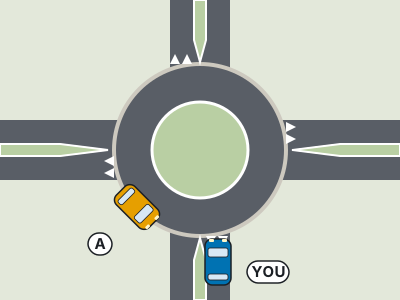
- Assume the entering vehicle has priority
- Check every sign and the intentions of traffic already inside
- Stop in the center for another driver’s signal
- Follow the largest vehicle
Show answer
Check every sign and the intentions of traffic already inside. Traffic circles can be governed by established flow, major-road priority, or entrance stop and yield signs. The manual directs drivers to check all signs and determine what traffic already in the circle intends to do. Automatic entry priority ignores those controls. Stopping in the center creates a hazard, and vehicle size is not a right-of-way rule. Approach slowly, read the entrance, and yield when required.
Study this in the handbook: Right of way, intersections and passing
6. How many points accumulated in 24 months trigger a mailed Notice of Scheduled Suspension?
- Six to eight points
- Twelve to 14 points or more
- Twenty points only
- Four points exactly
Show answer
Twelve to 14 points or more. A motorist who accumulates between 12 and 14 points in a 24-month period or more receives a Notice of Scheduled Suspension by mail from the MVC. Six to eight points falls short of that trigger; six points is where the separate violation surcharge begins. Four points alone does not meet this notice trigger, and the rule does not wait for exactly 20. Look for both parts of the trigger: the 24-month window and the 12-to-14-or-more point range.
Study this in the handbook: Points, surcharges and driver programs
7. How does New Jersey define a habitual offender?
- A driver whose license has been suspended three times in three years
- A driver with 6 points in three years
- A driver with two tickets in one year
- A driver suspended twice in ten years
Show answer
A driver whose license has been suspended three times in three years. In New Jersey, habitual offender status is about suspensions, not tickets or points. A motorist whose license has been suspended three times within three years is a habitual offender. Having 6 points in three years triggers the surcharge schedule, which is a separate consequence. Two tickets in a year or two suspensions over a decade do not meet the definition. Driving while suspended as a habitual offender can bring a $500 fine, one to two more years of suspension, and possible jail of 10 to 90 days.
Study this in the handbook: DUI, breath test refusal and interlock penalties
8. How many points does completing a voluntary defensive driving course remove from a New Jersey record?
- Three points
- Two points
- Four points
- All points on the record
Show answer
Two points. A voluntary defensive driving course in New Jersey takes two points off the accumulated total, and the driver may also qualify for an insurance rate reduction. The MVC recognizes such a course for point reduction only once every five years. Three points is the reduction for finishing a Driver Improvement Program after a scheduled suspension notice, so the two programs are easy to confuse. Four points is not a reduction any New Jersey course offers, and no course clears the whole record.
Study this in the handbook: Points, surcharges and driver programs
9. Once an emergency vehicle with its siren on has passed, how far behind it should a New Jersey driver stay?
- At least 50 feet
- At least 100 feet
- At least 300 feet
- About one car length
Show answer
At least 300 feet. New Jersey law requires motorists to yield when emergency vehicles sound sirens or show flashing red or blue emergency lights. A driver first steers to the extreme right of the roadway, stops, and waits for the emergency vehicle to pass. Afterward, the driver should keep at least 300 feet behind a signaling emergency vehicle. Fifty or one hundred feet is not enough space under this rule, and one car length is the following guideline for each 10 mph of speed, not the distance kept behind an emergency vehicle.
Study this in the handbook: Right of way, intersections and passing
10. A traffic signal changes from a green arrow to a yellow arrow. What should the New Jersey driver understand?
- The arrow permits a new turn after cross traffic starts
- The driver has an unrestricted protected turn
- The driver must reverse to the previous intersection
- The signal is changing from green to red, so stop safely if possible
Show answer
The signal is changing from green to red, so stop safely if possible. A yellow arrow signals that the protected green-arrow phase is changing to red and gives the motorist a chance to stop safely. It does not grant an unrestricted turn, direct a reversal, or authorize a new movement after cross traffic begins. Watch the arrow’s color change and assess stopping distance immediately. The cue is that yellow marks the end of the protected phase.
Study this in the handbook: Traffic signals and road markings
11. What is the fine range for a first New Jersey conviction for using a handheld phone while driving?
- $50 to $75
- $200 to $400
- $600 to $800
- $1,000 to $1,500
Show answer
$200 to $400. Using a handheld phone or texting device while driving is a primary offense in New Jersey, so an officer can stop a driver for it alone. The first conviction carries a fine of $200 to $400. A second offense within 10 years rises to $400 to $600, and a third or later offense is $600 to $800, so that range belongs to repeat offenders. Fifty to seventy-five dollars is too low, and $1,000 to $1,500 is not on the schedule. Hands-free calling is legal for drivers outside the GDL program but strongly discouraged.
Study this in the handbook: Where not to park, headlights and phones
12. What do white dashed lines separate on multi-lane highways?
- The shoulder from the travel lane
- Traffic moving in opposite directions
- Traffic lanes
- A pedestrian crossing from the roadway
Show answer
Traffic lanes. White dashed lines separate traffic lanes on multi-lane highways. They organize vehicles traveling in the same direction, unlike yellow center lines that separate opposing flows. The shoulder boundary is shown by edge lines, and pedestrian crossing areas are marked with white crosswalks, so those choices describe other markings. Road markings have the same force of law as signs or traffic signals. Check the color and placement of a line before changing lanes, and make sure the movement is safe and permitted.
Study this in the handbook: Traffic signals and road markings
13. What hazard does the yellow pedestrian-crossing sign warn a New Jersey driver about?

- People may be crossing ahead
- A sidewalk ends and vehicles have priority
- Pedestrians are prohibited from the area
- Only bicyclists may cross the roadway
Show answer
People may be crossing ahead. A pedestrian warning sign calls attention to a crossing area where people may enter the roadway. It does not prohibit pedestrians, remove their crossing rights, or convert the space into a bicycle-only route. New Jersey’s manual emphasizes that warning signs alert drivers to hazards that can be difficult to see. The practical response is to scan the sides of the road, reduce speed as needed, and be ready to yield.
Study this in the handbook: Traffic signals and road markings
14. What does New Jersey law set top speed limits for?
- Only roads with a posted school-zone sign
- Any given road, street, highway, or freeway
- Only rural roads without center lines
- Only interstate highways within city limits
Show answer
Any given road, street, highway, or freeway. New Jersey law establishes top speed limits for any given road, street, highway, or freeway. That wording covers the roadway classification itself, so a driver must identify the applicable limit and obey it even when traffic is moving faster. The school-zone choice is too narrow, and the interstate-only choice ignores ordinary streets and highways. The rural-road choice also misses the broader rule. A useful habit is to treat every speed limit as a legal ceiling, then adjust below it for weather, visibility, traffic, or road conditions.
Study this in the handbook: Speed limits and safe speed
15. What does New Jersey’s red octagonal sign require?

- YIELD
- Do not enter
- Keep right around an obstruction
- STOP
Show answer
STOP. The red octagon is reserved for a STOP sign. Its shape and color identify a required stop, unlike the inverted triangle used for YIELD. A square with a red circle and white band identifies DO NOT ENTER, so that choice describes a different design. Keeping right around an obstruction is a different instruction that no octagon gives. When studying signs, connect the eight-sided red outline with stopping, then proceeding only when the way is safe.
Study this in the handbook: Road sign shapes and colors
16. An ice cream truck in New Jersey is flashing red lights and has its stop arm out. After stopping, how fast may you drive past it?
- No more than 5 mph
- No more than 25 mph
- No more than 15 mph
- At the posted speed limit
Show answer
No more than 15 mph. New Jersey's frozen dessert truck law applies when the truck flashes red lights and shows its stop signal arm. A motorist approaching from either direction must yield to anyone crossing to or from the truck, watch for children, stop, and then drive past at no more than 15 mph. Five mph is stricter than the law, while 25 mph and the posted limit are too fast near children. You need not stop on a dual highway if you are on the other side of a safety island or raised median.
Study this in the handbook: Right of way, intersections and passing
17. How far will a New Jersey road test examiner ask you to back the vehicle in a straight line?
- About 100 feet
- About 10 feet
- About 300 feet
- Backing is not tested
Show answer
About 100 feet. Driving in reverse is part of the New Jersey road test: you will be asked to back the vehicle about 100 feet in a straight line, slowly and smoothly. Keep both hands on the wheel while turning your head and body to look out the rear window; palming the wheel with one hand can fail the test. Since August 31, 2016, installed backup cameras and parking sensors may be used, but basic reversing skills still come first. Ten feet and 300 feet are not the test distance.
Study this in the handbook: Seat belts, child seats and vehicle control
18. What does New Jersey say about crash risk for a driver with a BAC of 0.15 percent?
- It doubles
- It is six times as great
- It is 25 times as great
- It is no higher if the driver feels alert
Show answer
It is 25 times as great. New Jersey gives three reference points for how alcohol raises crash risk. Slightly above 0.05 percent, the risk doubles. At 0.10 percent it is six times as great, and at 0.15 percent it is 25 times as great. Doubling and six times are real figures, but they belong to the lower BAC levels. Feeling alert does not change the risk, since alcohol can make a motorist overconfident and slows reaction time even when the driver believes everything is fine.
Study this in the handbook: Alcohol, drugs and your BAC
19. Which hand position does the New Jersey manual recommend for normal steering?
- 11 and 1 o'clock
- 6 and 12 o'clock
- One hand at the top of the wheel
- 9 and 3 o'clock
Show answer
9 and 3 o'clock. For normal driving, New Jersey recommends gripping the outside rim at the 9 and 3 o'clock positions, with the thumbs along the face of the wheel. That placement reduces the chance of hand, wrist, or arm injury if an air bag deploys. The other positions either move both hands away from the recommended side locations or remove one hand from the wheel. Think of the wheel as a clock and place the hands at the horizontal numbers.
Study this in the handbook: Seat belts, child seats and vehicle control
20. After moving permanently to New Jersey with a valid out-of-state license, when must a motorist apply for a New Jersey license?
- Within 60 days or before the current license expires, whichever is sooner
- Only after the out-of-state license has expired
- Within 10 days, regardless of the license expiration date
- Within two years of establishing residency
Show answer
Within 60 days or before the current license expires, whichever is sooner. A motorist with a valid out-of-state license must apply for a New Jersey license within 60 days of moving, or before the current license expires if that happens sooner. The other choices ignore part of the deadline. Commercial drivers have a separate 30-day rule, so confirm the license category before applying this passenger-vehicle timeline. Apply the earlier deadline and surrender the old credential when issued.
Study this in the handbook: Permits and the Graduated Driver License
Insurance in New Jersey
New Jersey policies are handled in cooperation with licensed partner producer Sean Vu. QualitySpace Insurance Agency does not bind coverage in New Jersey directly. Contact us and we will route you to the right person.
Every question is written from the official New Jersey Driver Manual. Need paper? Printable NJ practice test with answer key.
Last verified 2026-10-12. How we check every question · Study all 500 as flashcards
Frequently asked questions
How many questions are on this New Jersey practice test?
This fixed set has 20 questions. It is test 11 of 25 from the 500 question New Jersey bank. The real NJ exam asks 50 questions and you need 40 correct.
What is the passing score for the real New Jersey test?
80 percent, or 40 of the 50 questions, must have correct answers That figure comes from the official New Jersey source cited on the DMV facts page.
How does this fixed test relate to the full New Jersey bank?
Each numbered test is a fixed set of questions in a fixed order, so you can retake the same test later and compare. Every test mixes road signs and the other topics in about the same proportion as the full bank. Tests 1 to 25 together cover every question in the New Jersey bank once. The full practice page mixes the whole bank at random.
Last verified 2026-10-12. See the New Jersey DMV facts page for sourced state details.
Return to the full New Jersey practice test · Study road signs