
Test 16 of 25 · 20 questions · Free 2026
NJ Permit Practice Test 16
Jump to the test ↓A fixed 20 question set from the New Jersey bank with answers and plain English explanations. The real NJ exam is 50 questions, 80 percent to pass; take the full length version on the main practice page.
Talk to Kevin
714-666-6669Call now →California policies handled directly by Kevin Vu (CDI #4037122). New Jersey and Pennsylvania policies handled in cooperation with licensed partner producer Sean Vu (Allstate). QualitySpace Insurance Agency does not bind coverage in NJ or PA directly.
Question 1 of 20 · 0 right so far
All 20 questions in test 16
Every question below comes from the New Jersey question bank on this page. Open a question to see the correct answer and the explanation. Nothing here is hidden behind a signup.
1. In a heavy rainstorm in New Jersey, where should a motorist try to drive on a multiple lane highway?
- On the highest point of the road, using the center lane when available
- In the right lane beside the deepest runoff
- Directly behind a truck to use its cleared path
- On the shoulder above the flooded lanes
Show answer
On the highest point of the road, using the center lane when available. In a heavy rainstorm, try to drive on the highest point of the road. The manual gives using the center lane on a multiple-lane highway, when available, as an example. Slow down when heavy rain, standing water, or slush is present. The cited passage reads: "try to drive on the highest point of the road. For example, use the center lane on a multiple lane highway, when available." Among the options, "On the highest point of the road, using the center lane when available" matches that passage, while "In the right lane beside the deepest runoff", "Directly behind a truck to use its cleared path", and "On the shoulder above the flooded lanes" each alter its terms.
Study this in the handbook: Following distance, weather and staying alert
2. How should pedestrians walk along New Jersey roadways that have no sidewalks?
- Walk with traffic so drivers approach from behind
- Walk in the center of the lane after dark
- Face away from traffic while wearing dark clothing
- Face traffic, and wear reflective or light-colored clothing at night
Show answer
Face traffic, and wear reflective or light-colored clothing at night. Pedestrians should face traffic on roadways without sidewalks and wear reflective or light-colored clothing at night. These precautions do not relieve motorists of their duty to remain vigilant. The cited passage reads: "Pedestrians should face traffic when walking along roadways without sidewalks and use reflective or light-colored clothing at night." Among the options, "Face traffic, and wear reflective or light-colored clothing at night" matches that passage, while "Walk with traffic so drivers approach from behind", "Walk in the center of the lane after dark", and "Face away from traffic while wearing dark clothing" each alter its terms.
3. When parallel parking in New Jersey, how close should the vehicle initially pull alongside the vehicle in front?
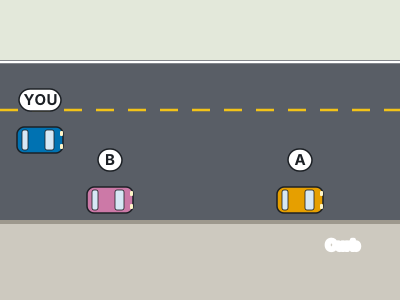
- About two to four feet away
- Less than six inches away
- About eight to ten feet away
- Directly touching the other vehicle
Show answer
About two to four feet away. The parallel-parking setup calls for pulling alongside the vehicle in front at about two to four feet. That spacing leaves room to begin backing while preserving control and clearance. Six inches is the final curb-distance concept, not the starting gap between vehicles, and eight to ten feet makes the turn difficult. Touching another vehicle is a collision. Signal, check behind, and reverse slowly only after the space is clear.
Study this in the handbook: Hill parking and parallel parking
4. An applicant arrives for the road test in a rented vehicle. Under what condition is the rental accepted?
- Whenever any licensed passenger rents the car
- Never, under any circumstances
- Only when the test applicant name is listed as a driver on the rental agreement
- Only when the rental company gives verbal permission by phone
Show answer
Only when the test applicant name is listed as a driver on the rental agreement. A rental car is not permitted for the road test unless the applicant’s name is listed as a driver on the rental agreement. A passenger’s rental or verbal permission alone does not meet that stated requirement. The cited passage reads: "No rental cars are permitted unless the test applicant’s name is listed as a driver on the rental agreement" Among the options, "Only when the test applicant name is listed as a driver on the rental agreement" matches that passage, while "Never, under any circumstances", "Whenever any licensed passenger rents the car", and "Only when the rental company gives verbal permission by phone" each alter its terms.
Study this in the handbook: Permits and the Graduated Driver License
5. Which routes and ramps does the red national truck sign mark in New Jersey?
- Routes and ramps where trucks are permitted
- Routes and ramps where trucks are prohibited
- Roads closed to all traffic
- Exits for truck stops only
Show answer
Routes and ramps where trucks are prohibited. The red national truck sign used in New Jersey marks the routes and ramps where trucks are prohibited, and it also marks the end of designated routes. Its partner, the green sign, marks the routes and ramps where trucks are permitted and the travel route to services and terminals. The red sign is not a road closure for all traffic, and it does not point to truck stops.
Study this in the handbook: Traffic signals and road markings
6. Which pedestrian is specifically identified by a mobility aid in the NJ manual’s list of situations requiring a stop?
- A blind pedestrian using a white or metallic walking cane, or a trained guide dog
- Any pedestrian walking beside the road on a shoulder
- A pedestrian waiting inside a store entrance
- A pedestrian crossing against a signal midblock without any aid
Show answer
A blind pedestrian using a white or metallic walking cane, or a trained guide dog. The manual specifically lists a blind pedestrian using a white or metallic walking cane or a trained guide dog. It also lists a guide dog instructor training a guide dog, and pedestrians in crosswalks or at intersections. The cited passage reads: "For a blind pedestrian using a white or metallic walking cane, or a trained guide dog, or a guide dog instructor engaged in instructing a guide dog" Among the options, "A blind pedestrian using a white or metallic walking cane, or a trained guide dog" matches that passage, while "Any pedestrian walking beside the road on a shoulder", "A pedestrian waiting inside a store entrance", and "A pedestrian crossing against a signal midblock without any aid" each alter its terms.
Study this in the handbook: Pedestrians, cyclists, trucks and trains
7. A New Jersey traffic signal shows a steady red light and the driver intends to go straight ahead. What must the driver do?
- Slow down and proceed with care
- Stop only if other vehicles are near
- Stop and remain stopped until the light changes to green
- Stop, then proceed straight when the way is clear
Show answer
Stop and remain stopped until the light changes to green. At a steady red light, a motorist who is proceeding straight must stop before the intersection or crosswalk and remain stopped until the light changes to green. Slowing and proceeding with care is the rule for a flashing yellow light. A right turn on red is a separate rule: it is allowed after a full stop and yielding, unless a No Turn on Red sign is posted. Going straight on red is never part of that rule.
Study this in the handbook: Traffic signals and road markings
8. What must a motorist bring for a vehicle inspection at a State facility or licensed private facility in New Jersey?
- The vehicle title and a dealer sales receipt
- Last year's inspection report and toll receipts
- A bank statement and two proofs of address
- A valid driver license, valid New Jersey registration, and insurance documents
Show answer
A valid driver license, valid New Jersey registration, and insurance documents. For inspection at a State inspection facility or a State-licensed private inspection facility, motorists must bring a valid driver license, valid New Jersey registration, and insurance documents for the vehicle. The cited passage reads: "All motorists must bring a valid driver license, and valid New Jersey registration, and insurance documents for the vehicle to be inspected at either a State inspection facility or a PIF." Among the options, "A valid driver license, valid New Jersey registration, and insurance documents" matches that passage, while "The vehicle title and a dealer sales receipt", "A bank statement and two proofs of address", and "Last year's inspection report and toll receipts" each alter its terms.
9. A New Jersey driver is convicted of reckless driving. How many points go on the record for that offense?
- 5 motor vehicle points
- 2 motor vehicle points
- 3 motor vehicle points
- 4 motor vehicle points
Show answer
5 motor vehicle points. Reckless driving carries five motor vehicle points. Careless driving carries two, improper right or left turns carry three, and improper passing in a no-passing zone carries four. The cited passage reads: "N.J.S.A. 39:4-96 Reckless driving 5 N.J.S.A. 39:4-97 Careless driving 2" Among the options, "5 motor vehicle points" matches that passage, while "2 motor vehicle points", "3 motor vehicle points", and "4 motor vehicle points" each alter its terms.
Study this in the handbook: Points, surcharges and driver programs
10. For an individual with a mobility-related disability, what top speed capability may a motorized scooter have on public streets?
- No more than 25 mph maximum speed capability
- No more than 15 mph maximum speed capability
- Up to 35 mph on approved streets
- No speed capability limit applies
Show answer
No more than 15 mph maximum speed capability. for an individual, as stated in the manual, with a mobility-related disability, the scooter may have a maximum speed capability of no more than 15 mph. It may be operated on public streets posted at no more than 25 mph, or above 25 mph through 35 mph if local government determines it does not endanger safety or traffic flow. Twenty-five is a street posting threshold instead. Thirty-five is the higher street limit considered. A capability cap does apply to these scooters.
11. When must New Jersey motorists notify the police about a crash?
- Only when another driver asks
- Where there is injury, death, or vehicle or property damage
- Only when damage exceeds $10,000
- Only for crashes on highways
Show answer
Where there is injury, death, or vehicle or property damage. The manual says motorists must notify police of crashes involving injury, death, or vehicle or property damage. If someone has been killed, do not move the body or allow anyone to move it until police or an ambulance arrives. The cited passage reads: "New Jersey law requires motorists to notify the police of crashes where there is injury, death, or vehicle or property damage." Among the options, "Where there is injury, death, or vehicle or property damage" matches that passage, while "Only when another driver asks", "Only when damage exceeds $10,000", and "Only for crashes on highways" each alter its terms.
Study this in the handbook: Vehicle emergencies and what to do after a crash
12. A police officer sees an unbelted front seat passenger and no other violation. What can the officer do?
- Stop the vehicle solely for the seat belt violation
- Nothing, without another offense first
- Issue a warning only, never a stop
- Wait until the vehicle parks
Show answer
Stop the vehicle solely for the seat belt violation. Failure of a driver, front seat passenger, or child under 18 to wear a seat belt is a primary offense in New Jersey, so an officer can stop a motorist solely for that violation. No second offense is needed as a trigger, the stop is not limited to a warning, and the officer need not wait for the trip to end. The back seat rule for adults works differently, as a secondary matter, which separates front and rear enforcement.
Study this in the handbook: Seat belts, child seats and vehicle control
13. Which vehicles may use sirens, whistles, or bells on New Jersey roads?
- Any vehicle with a hazard permit
- Only emergency vehicles
- Non-emergency private vehicles
- Any vehicle clearing an intersection
Show answer
Only emergency vehicles. Only emergency vehicles may use sirens, whistles, or bells. The cited passage reads: "Only emergency vehicles may use sirens, whistles, or bells." Among the options, "Only emergency vehicles" matches that passage, while "Any vehicle with a hazard permit", "Non-emergency private vehicles", and "Any vehicle clearing an intersection" each alter its terms. Keeping the passage wording in view, with its exact figures and conditions, is the cue for picking "Only emergency vehicles" over the alternatives listed here.
Study this in the handbook: Turn signals, hand signals and the horn
14. A vehicle approaches at night with high beams on in New Jersey. What must the other motorist avoid doing?
- Looking to the right of the road until the vehicle passes
- Slowing down while keeping lane position
- Flashing high beams back at the approaching motorist
- Driving within the range of the vehicle headlights
Show answer
Flashing high beams back at the approaching motorist. If an approaching vehicle has high beams on, look to the right of the road until it passes. Never flash high beams at an approaching motorist. The manual says recovery from high-beam glare can take three to five seconds. The cited passage reads: "Never flash high beams at an approaching motorist" Among the options, "Flashing high beams back at the approaching motorist" matches that passage, while "Looking to the right of the road until the vehicle passes", "Slowing down while keeping lane position", and "Driving within the range of the vehicle headlights" each alter its terms.
Study this in the handbook: Where not to park, headlights and phones
15. Who must purchase a New Jersey special learner permit, and how long is it valid?
- The student must purchase it alone, and it is valid for six months
- The parent must purchase it, and it is valid for one year
- The instructor must purchase it, and it is valid for two years
- The driving school owner must purchase it, and it is valid for four years
Show answer
The instructor must purchase it, and it is valid for two years. The instructor must purchase the special learner permit, which is valid for two years. After completing the approved course and before practice driving, the holder must have the permit validated at an MVC Licensing Center with a Driver Testing Center. The cited passage reads: "The instructor must purchase the permit, which is valid for two years" Among the options, "The instructor must purchase it, and it is valid for two years" matches that passage, while "The parent must purchase it, and it is valid for one year", "The student must purchase it alone, and it is valid for six months", and "The driving school owner must purchase it, and it is valid for four years" each alter its terms.
Study this in the handbook: Permits and the Graduated Driver License
16. A six-year-old child who is less than 57 inches tall and weighs 45 pounds is riding in a vehicle with rear seats. Which restraint and seating position does the manual require?
- A regular adult seat belt in a front seat
- Any lap belt alone in a rear seat
- A federally approved booster seat in a front seat
- A federally approved forward-facing restraint with a five-point harness or a booster seat, in a rear seat
Show answer
A federally approved forward-facing restraint with a five-point harness or a booster seat, in a rear seat. For this child, the manual requires a federally approved forward-facing child restraint with a five-point harness or a federally approved booster seat, in a rear seat. If the child outgrows the forward-facing restraint manufacturer’s height or weight recommendations, a federally approved booster seat is required. The cited passage reads: "less than 57 inches (4 feet, 9 inches) tall must ride in either: a) A federally approved forward facing child passenger restraint system that is equipped with a five-point harness in a rear seat of" Among the options, "A federally approved forward-facing restraint with a five-point harness or a booster seat, in a rear seat" matches that passage, while "A regular adult seat belt in a front seat", "A federally approved booster seat in a front seat", and "Any lap belt alone in a rear seat" each alter its terms.
Study this in the handbook: Seat belts, child seats and vehicle control
17. How much is the Drunk Driving Enforcement Fund fee listed for a first DUI offense in New Jersey?
- $75
- $125
- $33
- $100
Show answer
$100. The Drunk Driving Enforcement Fund fee is $100, one line in a stack of first-offense DUI charges. The $75 figure tempts because it pays a different fund for safe neighborhood services, while $125 names the separate DUI surcharge. The $33 figure covers court costs instead. Each dollar amount has its own label, so matching label to amount matters more than remembering that several small fees exist.
Study this in the handbook: DUI, breath test refusal and interlock penalties
18. A motorist is over age 40. How often should that driver have eyes checked?
- Every five years
- Only when renewing a license
- Every year
- Only after failing a screening
Show answer
Every year. A motorist over age 40 should have their eyes checked every year. Good peripheral vision is also essential because it helps a motorist see out of the corners of their eyes while looking straight ahead. The cited passage reads: "If over age 40, a motorist should have their eyes checked every year." Among the options, "Every year" matches that passage, while "Every five years", "Only when renewing a license", and "Only after failing a screening" each alter its terms.
Study this in the handbook: Alcohol, drugs and your BAC
19. If a crash cannot be avoided in New Jersey, what kind of object should a motorist choose to hit?
- A bridge abutment rather than a bush
- An oncoming vehicle rather than a bush
- A parked truck rather than shrubs
- Something that will give way, such as a bush or shrubs, rather than something hard
Show answer
Something that will give way, such as a bush or shrubs, rather than something hard. When a crash cannot be avoided, the manual tells the motorist to choose something that will give way, such as a bush or shrubs, rather than something hard. A bridge abutment is something hard, so it loses to growth that gives way. A parked truck is also something hard and does not give way like shrubs. An oncoming vehicle is something coming straight on, and the manual ranks hitting something not moving ahead of hitting something coming straight on. Give way wins over hard in this choice.
20. How is most of the alcohol a person drinks removed from the body?
- Oxidized, or burned up, by the liver
- Exhaled in breath
- Removed through sweat only
- Neutralized by food in the stomach
Show answer
Oxidized, or burned up, by the liver. About 90 percent of detoxified alcohol is oxidized by the liver; the remaining 10 percent is eliminated in breath, urine, and sweat. Alcohol is removed slowly, and only time makes a person sober. Food slows absorption but does not make a person sober. The cited passage reads: "The majority (90 %) of the alcohol that is detoxified is oxidized (burned up) by the liver. The other 10 % is eliminated in breath, urine, and sweat." Among the options, "Oxidized, or burned up, by the liver" matches that passage, while "Exhaled in breath", "Removed through sweat only", and "Neutralized by food in the stomach" each alter its terms.
Study this in the handbook: Alcohol, drugs and your BAC
Insurance in New Jersey
New Jersey policies are handled in cooperation with licensed partner producer Sean Vu. QualitySpace Insurance Agency does not bind coverage in New Jersey directly. Contact us and we will route you to the right person.
Every question is written from the official New Jersey Driver Manual. Need paper? Printable NJ practice test with answer key.
Last verified 2026-10-12. How we check every question · Study all 500 as flashcards
Frequently asked questions
How many questions are on this New Jersey practice test?
This fixed set has 20 questions. It is test 16 of 25 from the 500 question New Jersey bank. The real NJ exam asks 50 questions and you need 40 correct.
What is the passing score for the real New Jersey test?
80 percent, or 40 of the 50 questions, must have correct answers That figure comes from the official New Jersey source cited on the DMV facts page.
How does this fixed test relate to the full New Jersey bank?
Each numbered test is a fixed set of questions in a fixed order, so you can retake the same test later and compare. Every test mixes road signs and the other topics in about the same proportion as the full bank. Tests 1 to 25 together cover every question in the New Jersey bank once. The full practice page mixes the whole bank at random.
Last verified 2026-10-12. See the New Jersey DMV facts page for sourced state details.
Return to the full New Jersey practice test · Study road signs