
Test 3 of 25 · 20 questions · Free 2026
NJ Permit Practice Test 3
Jump to the test ↓A fixed 20 question set from the New Jersey bank with answers and plain English explanations. The real NJ exam is 50 questions, 80 percent to pass; take the full length version on the main practice page.
Talk to Kevin
714-666-6669Call now →California policies handled directly by Kevin Vu (CDI #4037122). New Jersey and Pennsylvania policies handled in cooperation with licensed partner producer Sean Vu (Allstate). QualitySpace Insurance Agency does not bind coverage in NJ or PA directly.
Question 1 of 20 · 0 right so far
All 20 questions in test 3
Every question below comes from the New Jersey question bank on this page. Open a question to see the correct answer and the explanation. Nothing here is hidden behind a signup.
1. What should a driver do at a flashing yellow traffic signal?
- Slow down and proceed with care
- Stop and wait for green
- Accelerate before the signal changes
- Treat it as a flashing red stop sign
Show answer
Slow down and proceed with care. A flashing yellow light tells the driver to slow down and proceed with care. It does not impose the complete stop required by a flashing red signal, so the stop-and-wait choice applies the wrong signal rule. Accelerating increases risk at the intersection and is not the manual’s instruction. Scan for crossing traffic and pedestrians, reduce speed, and continue only after the path is safe.
Study this in the handbook: Traffic signals and road markings
2. What do New Jersey road work signs alert motorists to?
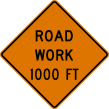
- Permanent license restrictions
- Temporary roadway conditions such as lane shifts and detours
- The current color of a traffic signal
- A guaranteed dry road surface
Show answer
Temporary roadway conditions such as lane shifts and detours. Road work signs alert motorists to temporary roadway conditions, including lane closings, lane shifts, flaggers, uneven pavement, and detours. These changes can alter the normal traffic pattern, so a driver should read the sign and prepare for a slower or different path. The pictured orange road-work sign warns drivers to expect work ahead. A permanent license rule, signal color, or dry surface is not what an orange work sign communicates.
Study this in the handbook: Road sign shapes and colors
3. What should a motorist do after reading a road work warning sign?
- Follow the directions and prepare to slow down or stop
- Ignore the sign if no worker is visible
- Accelerate before the lane pattern changes
- Stop in the active travel lane immediately
Show answer
Follow the directions and prepare to slow down or stop. The manual directs motorists to always read road work signs, follow directions, and prepare to slow down or stop. Preparation gives the driver time to respond to a lane reduction or other temporary change without an abrupt maneuver. Accelerating toward a narrowing lane increases conflict, and the absence of a visible worker does not cancel the warning. Stopping in an active lane creates another hazard unless a flagger or sign directs it. The road-work warning shown reinforces the need to anticipate temporary conditions early.
Study this in the handbook: Road sign shapes and colors
4. Where does the New Jersey manual specifically tell drivers to slow down even when no reduced limit is posted?
- Only on interstates during daylight
- Only on roads with a school-zone sign
- Only after a vehicle begins skidding
- At intersections and railroad crossings
Show answer
At intersections and railroad crossings. The manual lists intersections and railroad crossings among places where motorists should always slow down. A school-zone sign is not required, and waiting for a skid is too late. The instruction is not limited to interstate travel or daylight. These locations deserve an early speed adjustment because crossing traffic, tracks, signals, and limited sight lines can change the stopping problem quickly.
Study this in the handbook: Speed limits and safe speed
5. What authority does a New Jersey flagger have in a road work zone?
- Authority only after a police officer arrives
- The same authority as a regulatory sign
- Authority to change the posted speed limit permanently
- Authority to waive every traffic law in the work zone
Show answer
The same authority as a regulatory sign. The manual gives flaggers the same authority as a regulatory sign, so a motorist may be cited for disobeying their directions. That authority applies to controlling traffic through the work zone, not to permanently changing a speed limit or waiving every law. Waiting for a police officer is not a safe interpretation because the flagger is already directing vehicles. Slow down, watch the person’s signals, and follow the instruction even when the roadway appears clear.
Study this in the handbook: Road sign shapes and colors
6. In New Jersey, which condition requires headlights even during daylight?
- A clear afternoon on a dry road
- Weather that reduces visibility to less than 500 feet
- Any trip shorter than one mile
- A roadway with no streetlights
Show answer
Weather that reduces visibility to less than 500 feet. New Jersey’s night-driving guidance requires headlights when weather conditions reduce visibility to less than 500 feet, even if the sun is still up. The clear-afternoon choice supplies no reduced-visibility trigger, and trip length has no role in the rule. A dark road without streetlights may call for caution but is not the stated measurement. Use the visibility distance as the test cue, and remember that windshield-wiper use is separately identified as a daytime headlight trigger.
Study this in the handbook: Following distance, weather and staying alert
7. What following distance rule of thumb does the manual describe?
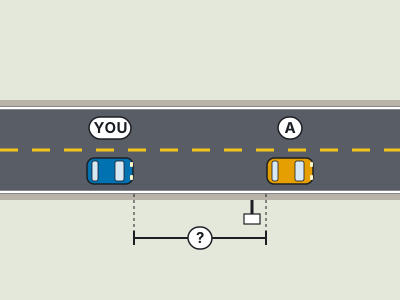
- About one car length, or 20 feet, for each 10 miles per hour
- One car length for every 25 miles per hour
- Ten feet for every 20 miles per hour
- A fixed five-second distance in all conditions
Show answer
About one car length, or 20 feet, for each 10 miles per hour. The manual's rule of thumb is about one car length, or 20 feet, for each 10 miles per hour of speed. It also says there is no perfect following-distance rule and that space should increase at high speeds or in bad weather. The choices using 25 mph, 10 feet, or one fixed five-second distance change the stated figures or ignore conditions. Use the guideline as a starting point, then add room when rain, snow, fog, traffic, or stopping conditions reduce the time available to react.
Study this in the handbook: Following distance, weather and staying alert
8. A New Jersey crash causes more than $500 in property damage, and the police do not file a report. What must the driver do?
- Nothing, since the insurer handles it
- Report to the MVC within 30 days
- Phone the MVC within 24 hours
- Send a written report to the MVC within 10 days
Show answer
Send a written report to the MVC within 10 days. When a New Jersey crash causes personal injury or property damage over $500, the motorist must send a written report to the MVC within 10 days if no police report is filed. If the police do file one, the written report is not required. The driver must also notify the insurance company at once, but that call does not replace the MVC report. Thirty days and a phone call within 24 hours are not the stated rule.
Study this in the handbook: Vehicle emergencies and what to do after a crash
9. How fast can an air bag inflate in a front-end crash, according to the New Jersey manual?
- Up to 20 mph
- Up to 60 mph
- Up to 200 mph
- Up to 1,000 mph
Show answer
Up to 200 mph. Air bags supplement seat belts in frontal crashes, and the New Jersey manual says they inflate at speeds of up to 200 mph. That force protects a correctly belted adult, who usually meets the bag only after it is fully inflated, but it can seriously injure someone sitting too close or a child in the front seat. That is why drivers should keep at least 10 inches between the steering wheel center and the breastbone. Twenty and 60 mph understate the speed, and 1,000 mph exaggerates it.
Study this in the handbook: Seat belts, child seats and vehicle control
10. During a mechanical emergency, where should a New Jersey motorist stop?
- In the nearest intersection with headlights off
- In a marked crosswalk with hazard lights off
- On the left shoulder facing opposing traffic
- On the right highway shoulder with emergency flashers on
Show answer
On the right highway shoulder with emergency flashers on. For mechanical trouble or another emergency, New Jersey advises stopping on the right highway shoulder and turning on emergency flashers. The right shoulder places the disabled vehicle away from the main travel path, while the flashers alert approaching drivers. A left shoulder can expose the vehicle to opposing traffic, and an intersection or crosswalk creates a new obstruction. The practical cue is shoulder, then flashers: move as far right as conditions safely allow and make the vehicle visible before seeking help.
Study this in the handbook: Where not to park, headlights and phones
11. What is a New Jersey motorist’s legal consequence for refusing a breath test after an arrest?
- The refusal is ignored unless property damage occurred
- The refusal is illegal and carries separate penalties
- The refusal is lawful if the driver asks for a blood test
- The refusal matters only after an adult BAC conviction
Show answer
The refusal is illegal and carries separate penalties. New Jersey’s implied-consent rule makes refusal itself unlawful. The listed consequences include loss of driving privileges, an IDRC referral, fines, an ignition interlock device, and a violation surcharge. The property-damage option invents a condition that is not part of the rule, while asking for another test does not erase the refusal. When an exam question says a breath test was refused after arrest, look for the independent refusal penalties rather than treating it as merely evidence in a DUI case.
Study this in the handbook: Alcohol, drugs and your BAC
12. What speed should a New Jersey driver seek in an acceleration lane before merging onto a highway?
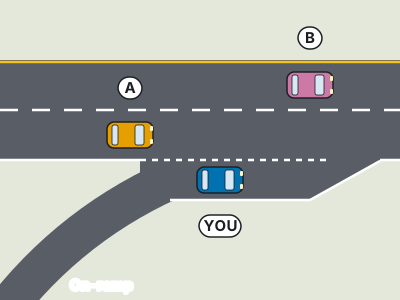
- Walking speed until another driver waves the vehicle in
- The posted limit minus 20 mph in every case
- The speed of the traffic already on the highway
- A complete stop at the lane’s far end
Show answer
The speed of the traffic already on the highway. The acceleration lane exists to let an entering motorist build speed before joining established highway traffic. The manual directs the driver to speed up to the flow of traffic when leaving that lane. Stopping at its end or entering at walking speed would create a sudden obstruction, while subtracting a fixed 20 mph ignores actual traffic conditions. Signal, check the gap, yield to vehicles already present, and merge smoothly at a compatible speed.
Study this in the handbook: School buses, railroad crossings and highway ramps
13. How can a New Jersey motorist tell that a child restraint system meets federal safety standards?
- It has a metal frame
- It was sold in a store
- It carries a label with the manufacture date stating it conforms to federal motor vehicle safety standards
- It fits tightly in the seat
Show answer
It carries a label with the manufacture date stating it conforms to federal motor vehicle safety standards. All child restraint systems built since January 1, 1981 must be designed to pass tough safety tests, and these seats carry a label that gives the date of manufacture and states that the child restraint system conforms to all applicable federal motor vehicle safety standards. Look for that label rather than judging by construction or where the seat was bought. Children of any age are safest belted properly in the back seat.
14. What do motorist service signs provide?
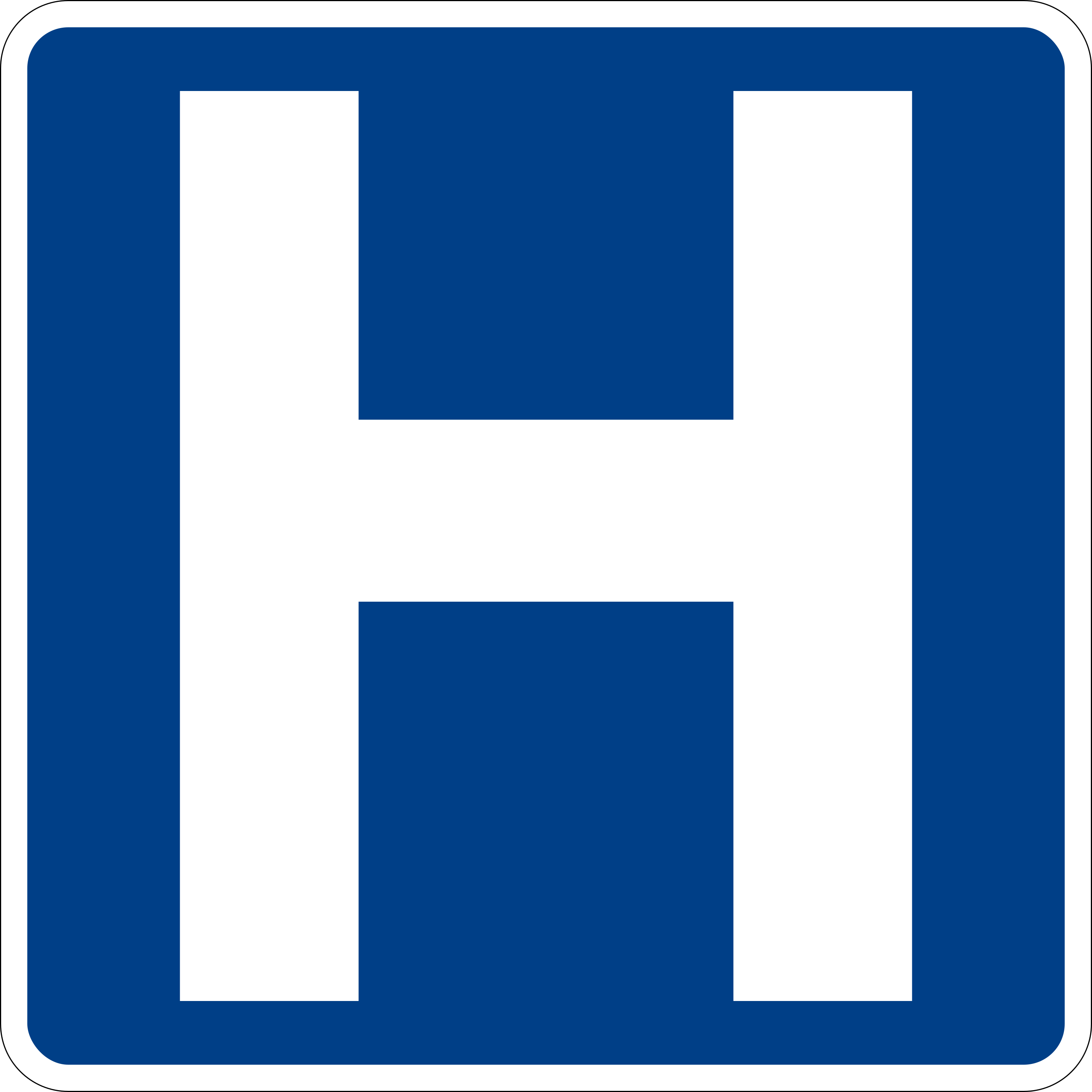
- Advance notice of a lane reduction
- The legal speed for every roadway
- A command to make a U-turn
- Information about motorist services
Show answer
Information about motorist services. Motorist service signs provide information about services available to drivers. They are a type of guidance information, not a lane-control command, a U-turn prohibition, or a universal speed instruction. The pictured white H on a blue background identifies hospital services. When a sign uses the service category, look for information that helps locate a facility or roadside assistance rather than a required vehicle movement.
Study this in the handbook: Road sign shapes and colors
15. Which statement about food and alcohol does the New Jersey manual make?
- Food guarantees a low BAC after heavy drinking
- A meal removes alcohol from the bloodstream immediately
- Eating does not make a steadily drinking motorist sober
- Food permits driving whenever the driver feels alert
Show answer
Eating does not make a steadily drinking motorist sober. Food can slow alcohol absorption, but it cannot make a person sober or prevent a high BAC when large amounts are consumed steadily. The choices promising a guarantee, instant removal, or permission to drive add claims the manual rejects. Alcohol leaves the body with time, not with a meal or a feeling of alertness. Arrange a designated driver or other safe ride.
Study this in the handbook: Alcohol, drugs and your BAC
16. What must a New Jersey motorist do when a train is approaching a railroad crossing?
- Yield to the train
- Rely on the vehicle's size to claim priority
- Enter the crossing before the train gets close
- Cross if the warning lights are still dark
Show answer
Yield to the train. Trains have priority when approaching a railroad crossing, so the motorist must yield and wait for a safe crossing. Vehicle size cannot defeat a train, and dark warning lights do not guarantee that no train is coming. Entering early to beat the locomotive is dangerous because trains appear farther away and move faster than expected. Reduce speed and cross only after warnings clear.
Study this in the handbook: Pedestrians, cyclists, trucks and trains
17. How does the New Jersey manual say to avoid highway hypnosis on a long drive?
- Stare at the center line
- Turn up the radio
- Do not look at any one thing for more than a few seconds, rest every two hours, and share the driving
- Drive faster to finish sooner
Show answer
Do not look at any one thing for more than a few seconds, rest every two hours, and share the driving. A motorist who has been behind the wheel for a long time may experience highway hypnosis, a trance like state. It can be avoided by not looking at any one thing for more than a few seconds, and the manual also recommends resting every two hours and sharing the driving. Staring at the center line keeps the eyes fixed on one thing, which is the habit the manual warns against, and driving faster or louder music does not replace rest.
18. After a first New Jersey conviction for refusing a breath test, how long must an ignition interlock stay installed once driving privileges are restored?
- Three months
- 9 to 15 months
- Two to four years
- No interlock is required for a refusal
Show answer
9 to 15 months. New Jersey's interlock rules give a breath test refusal its own period. For a refusal, the device is required for 9 to 15 months from the date privileges are restored, and a first refusal conviction keeps the driver off the road until an interlock is installed. Three months is the period for a first DUI between 0.08% and 0.10%. Two to four years applies to a second or later DUI or refusal. Saying no device is needed ignores the refusal rule entirely.
Study this in the handbook: DUI, breath test refusal and interlock penalties
19. A New Jersey GDL permit holder drives with two adults in the back seat. Who is required to wear a seat belt?
- Only the permit holder and the front seat passenger
- Only passengers younger than 18
- Only the permit holder
- The permit holder and every passenger, front and back
Show answer
The permit holder and every passenger, front and back. For GDL drivers, New Jersey goes beyond the general seat belt law. A driver with a permit or probationary license must buckle up and must also make every passenger, in any seat, use a seat belt. Under the general rule, unbuckled back seat riders 18 and older can be ticketed only when the vehicle is stopped for another reason, which is why many people think the back seat is optional. For a GDL driver it is not. Limiting the duty to the front seat, to minors, or to the driver leaves out riders the rule covers.
Study this in the handbook: Seat belts, child seats and vehicle control
20. How often will the MVC recognize an approved defensive driving course for point reduction?
- Once every five years
- Once every two years
- Once every year
- Only once in a lifetime
Show answer
Once every five years. The MVC recognizes a defensive driving course for point reduction once every five years. The annual and two-year choices allow a course more frequently than the manual permits. A lifetime-only rule is more restrictive than the stated policy. Keep the purpose in view: this interval concerns MVC recognition for point reduction, not how often a driver may voluntarily take a safety class or qualify for an insurance discount.
Study this in the handbook: Points, surcharges and driver programs
Insurance in New Jersey
New Jersey policies are handled in cooperation with licensed partner producer Sean Vu. QualitySpace Insurance Agency does not bind coverage in New Jersey directly. Contact us and we will route you to the right person.
Every question is written from the official New Jersey Driver Manual. Need paper? Printable NJ practice test with answer key.
Last verified 2026-10-12. How we check every question · Study all 500 as flashcards
Frequently asked questions
How many questions are on this New Jersey practice test?
This fixed set has 20 questions. It is test 3 of 25 from the 500 question New Jersey bank. The real NJ exam asks 50 questions and you need 40 correct.
What is the passing score for the real New Jersey test?
80 percent, or 40 of the 50 questions, must have correct answers That figure comes from the official New Jersey source cited on the DMV facts page.
How does this fixed test relate to the full New Jersey bank?
Each numbered test is a fixed set of questions in a fixed order, so you can retake the same test later and compare. Every test mixes road signs and the other topics in about the same proportion as the full bank. Tests 1 to 25 together cover every question in the New Jersey bank once. The full practice page mixes the whole bank at random.
Last verified 2026-10-12. See the New Jersey DMV facts page for sourced state details.
Return to the full New Jersey practice test · Study road signs