
Test 2 of 25 · 20 questions · Free 2026
NJ Permit Practice Test 2
Jump to the test ↓A fixed 20 question set from the New Jersey bank with answers and plain English explanations. The real NJ exam is 50 questions, 80 percent to pass; take the full length version on the main practice page.
Talk to Kevin
714-666-6669Call now →California policies handled directly by Kevin Vu (CDI #4037122). New Jersey and Pennsylvania policies handled in cooperation with licensed partner producer Sean Vu (Allstate). QualitySpace Insurance Agency does not bind coverage in NJ or PA directly.
Question 1 of 20 · 0 right so far
All 20 questions in test 2
Every question below comes from the New Jersey question bank on this page. Open a question to see the correct answer and the explanation. Nothing here is hidden behind a signup.
1. What do double yellow and white solid lines prohibit?
- Passing
- Turning into every driveway
- Using a railroad crossing
- Parking at a fire hydrant
Show answer
Passing. Double yellow and white solid lines prohibit passing. They mark a roadway condition where a driver must stay in the lane rather than cross the solid lines to overtake another vehicle. A fire-hydrant parking restriction, driveway turn, or railroad crossing rule comes from a different roadway situation and is not the meaning of these markings. Watch the pavement before beginning a pass, obey the solid lines, and wait for a lawful broken-line opportunity with adequate visibility and space.
Study this in the handbook: Traffic signals and road markings
2. What fine range may apply to a New Jersey Move Over law violation?
- $25 to $75
- $100 to $500
- Only a warning for a first offense
- $500 to $1,000
Show answer
$100 to $500. A New Jersey Move Over violation carries a fine of not less than $100 and not more than $500. The $25-to-$75 range belongs to a separate snow-and-ice vehicle rule, not roadside emergency protection. A $500-to-$1,000 amount overstates the listed range, and the manual does not make a first violation warning-only. The practical trigger is the stationary authorized or disabled vehicle with qualifying lights or warning devices.
Study this in the handbook: Right of way, intersections and passing
3. May a GDL permit or probationary license holder use a hands-free cellular telephone while driving?
- Yes, if the phone is mounted securely
- No, neither handheld nor hands-free cellular use is allowed
- Yes, but only before 11:01 p.m.
- Yes, when a passenger answers the call
Show answer
No, neither handheld nor hands-free cellular use is allowed. New Jersey’s GDL restriction covers both handheld and hands-free cellular telephones, along with other handheld electronic devices. The mounted-phone choice confuses the general rule for other motorists with the stricter GDL rule. A time-of-day limit does not create a phone exception, and having a passenger answer does not authorize the license holder to use the device. On an exam, identify GDL status first, then apply the complete prohibition.
Study this in the handbook: Permits and the Graduated Driver License
4. A New Jersey special learner permit holder is supervised by a qualified adult who is not a parent or guardian. Besides the permit holder’s dependents, how many additional passengers may ride?
- No additional passengers
- Two additional passengers
- One additional passenger
- As many as the vehicle’s seat belts allow
Show answer
One additional passenger. For a special learner permit holder, New Jersey limits passengers to any parent, guardian or dependent of the permit holder plus one additional passenger. So when the supervising adult is a qualified driver who is not a parent or guardian, the permit holder may carry dependents and one more person besides the supervisor. Zero leaves out the extra passenger the rule allows, two is one too many, and seat belt count does not set the limit. Every occupant must still wear a seat belt, and the supervisor must sit in the front seat.
Study this in the handbook: Permits and the Graduated Driver License
5. If a solid yellow line is on your side of the road, what passing action is allowed?
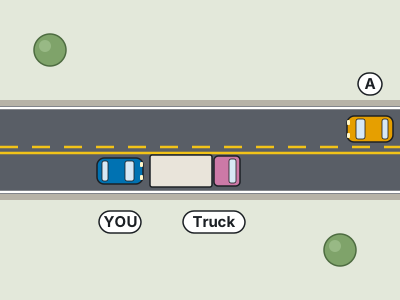
- Pass whenever the road ahead appears clear
- Do not pass
- Pass only at night
- Cross the line to avoid a slow vehicle
Show answer
Do not pass. When the solid yellow line is on the motorist’s side, passing is prohibited. The clear-road choice overlooks the line’s restriction, and darkness does not create permission to cross. Moving around a slow vehicle also remains a pass and is not an exception. Compare the two centerline patterns before acting: a dashed line on your side may permit a safe pass, but a solid line on your side means stay in lane.
Study this in the handbook: Traffic signals and road markings
6. At a stop sign, where does New Jersey law require a driver to bring the vehicle to a complete stop?
- Within five feet of the nearest crosswalk or stop line
- Beside the stop sign, wherever it is placed
- 25 feet before the intersection
- Anywhere, if the car slows below 5 mph
Show answer
Within five feet of the nearest crosswalk or stop line. New Jersey is specific about where a stop happens. A motorist may not enter or cross an intersecting street marked with a stop sign unless the vehicle first comes to a complete stop at a point within five feet of the nearest crosswalk or stop line marked on the pavement at the near side of the intersection. Stopping 25 feet back is not the rule, and rolling below 5 mph is not a stop at all. After stopping, the driver yields to traffic close enough to be an immediate hazard.
Study this in the handbook: Right of way, intersections and passing
7. For a first New Jersey hit-and-run offense involving bodily injury, what happens to the driver's license?
- It is lost for 30 days
- It is lost permanently
- It is lost for one year
- Nothing happens to the license
Show answer
It is lost for one year. A hit-and-run that injures or kills someone is one of the most serious driving offenses in New Jersey. A first offense brings a one-year license loss, a fine of $2,500 to $5,000, and possibly 180 days in jail. Permanent loss of the license is the penalty for a subsequent offense, which is why it is tempting but wrong here. A 30 day loss is far too short, and no version of this offense leaves the license untouched.
Study this in the handbook: Pedestrians, cyclists, trucks and trains
8. By how much do seat belts improve a motorist's chances of surviving a crash, according to the New Jersey manual?
- About 10 percent
- About 25 percent
- About 95 percent
- About 60 percent
Show answer
About 60 percent. The New Jersey manual says seat belts can save a life and improve a motorist's chances of surviving a crash by 60 percent. It adds that survival chances are three to four times better with both a lap belt and a shoulder strap, and that buckling up takes only about three seconds. Belts keep people from being thrown from the vehicle and from striking the dashboard or windshield. Ten and 25 percent understate the benefit, and 95 percent overstates the figure the manual gives.
Study this in the handbook: Seat belts, child seats and vehicle control
9. On what basis are New Jersey highways designated as safe corridors?
- Crash rates 50 percent over the state rate and 1,000 or more crashes reported over three years
- Proximity to schools
- Requests from local police
- Heavy truck traffic alone
Show answer
Crash rates 50 percent over the state rate and 1,000 or more crashes reported over three years. Highways are designated as safe corridors based on statistics showing crash rates 50 percent over the state rate and 1,000 or more crashes reported over a three year period. The Safe Corridors law doubles fines on those highways for a variety of driving offenses, including speeding and aggressive driving. The Commissioner of Transportation can designate corridors as necessary and remove those that show improved safety. Truck volume, schools and police requests are not the criteria the manual describes.
Study this in the handbook: Speed limits and safe speed
10. Which maximum appears in New Jersey’s speed table for certain interstate highways when posted?
- 45 mph
- 50 mph
- 55 mph
- 65 mph
Show answer
65 mph. Certain interstate highways may be posted at 65 mph, the highest category shown in New Jersey’s table. The 55-mph figure belongs to certain state highways and interstates as posted, so it is not the answer for the separate 65-mph category. A road type does not authorize ignoring a lower sign; the displayed limit still controls. Look for the words ‘certain interstate highways’ beside the number rather than choosing the familiar 55-mph figure.
Study this in the handbook: Speed limits and safe speed
11. What should drivers remember about trains at New Jersey railroad crossings?

- Trains use only the track nearest the warning sign
- Trains may travel only during daylight hours
- Trains must stop whenever a vehicle approaches
- Trains can travel on any track, in either direction, or at any time
Show answer
Trains can travel on any track, in either direction, or at any time. The manual warns that trains can travel on any track, in either direction, or at any time. A driver must therefore approach every crossing alertly instead of assuming a train will use a predictable track or schedule. Trains do not have to stop for an approaching vehicle, and daylight does not remove the hazard. Obey the signals and gates, look both ways, and enter only when the vehicle can clear the tracks completely.
Study this in the handbook: Pedestrians, cyclists, trucks and trains
12. What parking distance from a crosswalk at an intersection is prohibited in New Jersey, unless an alley exception applies?
- Within 10 feet
- Within 25 feet
- Within 40 feet
- Within 50 feet
Show answer
Within 25 feet. New Jersey bars parking within 25 feet of a crosswalk at an intersection or the sideline of a street or intersection highway, with the manual noting an alley exception. Ten feet is the hydrant distance, while 50 feet is associated with a railroad crossing. The protected approach area preserves a clear view between people crossing and approaching drivers. When choosing a curb space, measure from the crosswalk rather than stopping wherever the paint ends.
Study this in the handbook: Where not to park, headlights and phones
13. Before making a left turn on a green light, what must a New Jersey driver yield to?
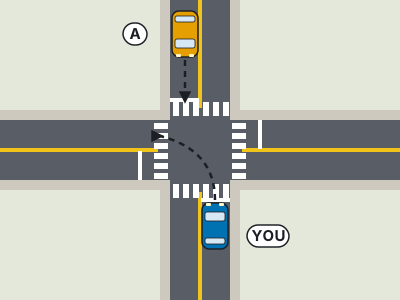
- Only vehicles behind the turning car
- No one because green always gives priority
- Approaching vehicles and pedestrians in the conflict area
- Only pedestrians on the far sidewalk
Show answer
Approaching vehicles and pedestrians in the conflict area. A green light permits movement, but a turning driver still yields to pedestrians and approaching vehicles. The signal does not erase conflicts created by the turn, and traffic behind is not the controlling concern. Waiting only for people on the far sidewalk misses anyone crossing the turning path. Scan the approach and crosswalk, reduce speed as needed, and turn only after those users are clear.
Study this in the handbook: Traffic signals and road markings
14. During the two-year probationary driver period, what conduct requires enrollment in the Probationary Driver Program?
- A single equipment warning
- One parking ticket
- Any failed road test
- Two or more moving violations totaling four or more points
Show answer
Two or more moving violations totaling four or more points. The two-year probationary period has a specific program trigger: conviction of two or more moving violations totaling four or more points requires enrollment in the Probationary Driver Program. A parking ticket does not satisfy the moving-violation condition, and a failed road test or equipment warning is not the stated trigger. Count both the number of convictions and their combined points. The two-part threshold distinguishes this program from ordinary driver testing.
Study this in the handbook: Points, surcharges and driver programs
15. Why does the three-seconds-plus rule help a driver following another vehicle?
- It guarantees exactly three seconds of braking
- It replaces watching traffic ahead
- It permits a shorter gap on wet roads
- It helps judge enough space for a sudden stop
Show answer
It helps judge enough space for a sudden stop. The method uses a fixed object to estimate whether the following gap can accommodate an unexpected stop. It is not a promise of a three-second braking time and never replaces scanning the road. Wet conditions require four or more seconds, not less. Choose a tree or sign, begin counting after the vehicle ahead passes it, and seek at least three seconds in favorable conditions.
Study this in the handbook: Following distance, weather and staying alert
16. For a New Jersey offense on or after December 1, 2019, how long is the license loss for a second alcohol or drug-related DUI within 10 years of the first?
- Two to four years
- One to two years
- Eight years
- Ten years
Show answer
One to two years. New Jersey law says a second DUI conviction brings loss of the right to drive for not less than one year or more than two years, and the manual's penalty table lists 1 to 2 years for a second offense on or after December 1, 2019 that occurs within 10 years of the first. The two to four year figure is the ignition interlock period after restoration, not the suspension itself. Eight years is the listed third offense suspension, and ten years was the third offense entry before December 1, 2019. Read the license loss column separately from the interlock column.
17. A New Jersey driver who is 21 or older has a BAC reading of 0.08 percent. What does that reading mean?
- It is below every alcohol-related limit
- It is legal unless the driver feels impaired
- It reaches the illegal adult threshold
- It triggers only a warning for a first stop
Show answer
It reaches the illegal adult threshold. For an adult motorist, New Jersey treats a BAC of 0.08 percent or higher as illegal, so a reading of exactly 0.08 percent reaches that threshold. It is not below every alcohol limit, and whether the driver feels impaired does not change a measured reading at the legal limit. The manual lists no warning only option for a first stop at that level. Impairment can begin well below 0.08, and a reading slightly above 0.05 percent already raises crash risk, so the safest plan is not to drive after drinking.
Study this in the handbook: Alcohol, drugs and your BAC
18. Which label identifies the yellow plus-shaped intersection warning?

- Side Road
- Merge
- Cross Road
- Divided Highway
Show answer
Cross Road. The New Jersey manual's gallery of warning signs labels the yellow diamond with a black plus shape as Cross Road. Side Road, Merge, and Divided Highway are separate symbols in the same gallery, each with its own picture. The manual also says that as a motorist nears a crossroad that is not controlled, he or she must reduce speed and be ready to stop if any traffic is coming from the right or left. Follow the actual traffic control at the intersection.
19. Which wording appears on the red-circle roadway sign shown here?
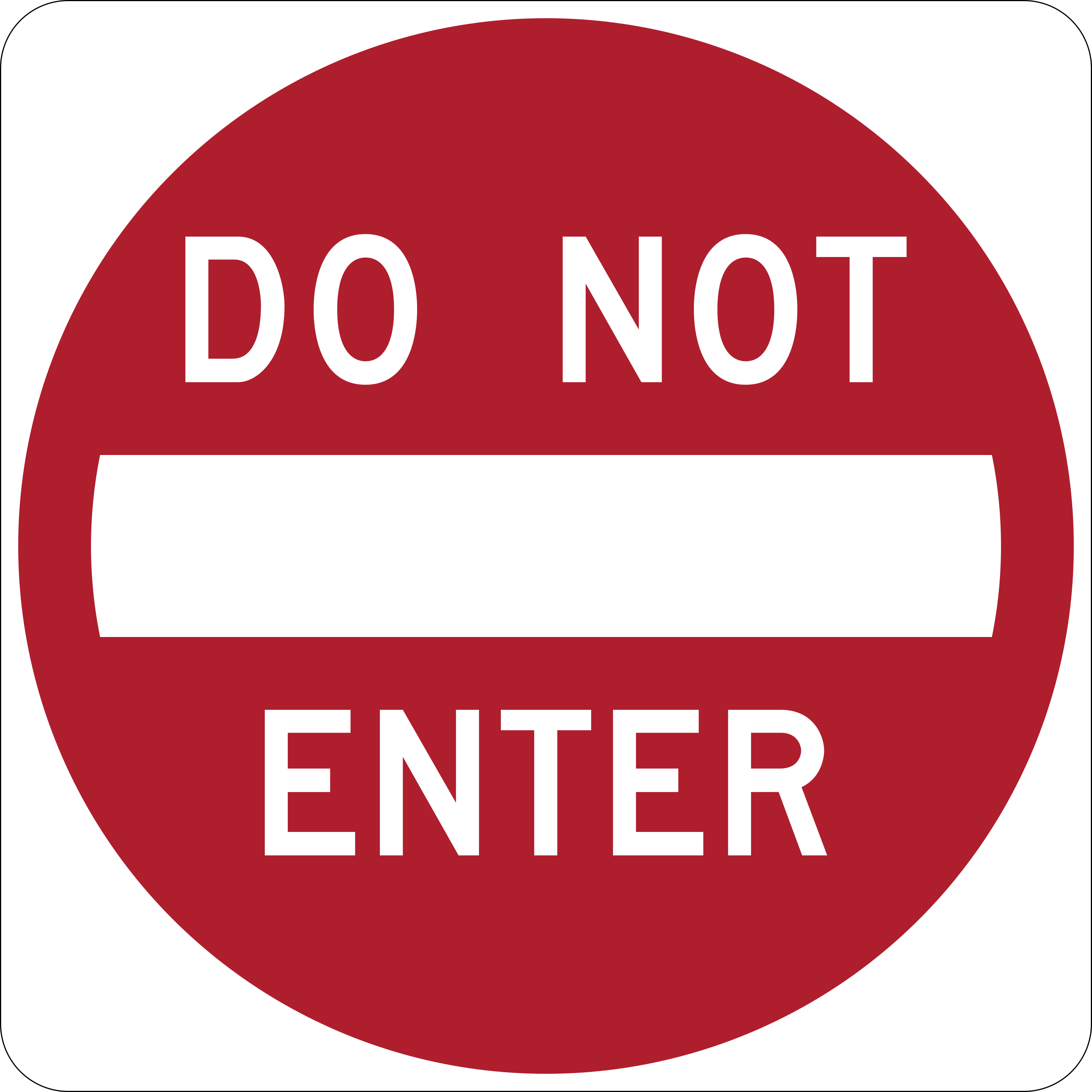
- DO NOT ENTER
- NO PASSING ZONE
- STOP AHEAD
- ROAD CLOSED
Show answer
DO NOT ENTER. The New Jersey manual describes the DO NOT ENTER sign as a white square containing a red circle with a white horizontal band, with the words DO NOT ENTER in white letters on the upper and lower parts of the circle. That design is different from STOP AHEAD, ROAD CLOSED, and NO PASSING ZONE messages, which appear on other signs. Treat the displayed words as a prohibition on entering. The white band across the red circle is the visual cue.
Study this in the handbook: Traffic signals and road markings
20. A New Jersey motorist meets an animal on the road. What does the manual advise?
- Slow down until the animal has passed, because animals make unexpected moves
- Sound the horn to move it along
- Speed up to get past it
- Stop and get out to guide it
Show answer
Slow down until the animal has passed, because animals make unexpected moves. Watch for signs marking places where livestock or deer may cross the road. If a motorist encounters an animal, he or she should slow down until the animal has passed, because animals make unexpected moves and a driver must stay alert. Trying to move the animal along with the horn is not what the manual advises, speeding up removes the time you need to react, and leaving the vehicle puts you on foot in traffic. Slow down and let the animal clear the road.
Insurance in New Jersey
New Jersey policies are handled in cooperation with licensed partner producer Sean Vu. QualitySpace Insurance Agency does not bind coverage in New Jersey directly. Contact us and we will route you to the right person.
Every question is written from the official New Jersey Driver Manual. Need paper? Printable NJ practice test with answer key.
Last verified 2026-10-12. How we check every question · Study all 500 as flashcards
Frequently asked questions
How many questions are on this New Jersey practice test?
This fixed set has 20 questions. It is test 2 of 25 from the 500 question New Jersey bank. The real NJ exam asks 50 questions and you need 40 correct.
What is the passing score for the real New Jersey test?
80 percent, or 40 of the 50 questions, must have correct answers That figure comes from the official New Jersey source cited on the DMV facts page.
How does this fixed test relate to the full New Jersey bank?
Each numbered test is a fixed set of questions in a fixed order, so you can retake the same test later and compare. Every test mixes road signs and the other topics in about the same proportion as the full bank. Tests 1 to 25 together cover every question in the New Jersey bank once. The full practice page mixes the whole bank at random.
Last verified 2026-10-12. See the New Jersey DMV facts page for sourced state details.
Return to the full New Jersey practice test · Study road signs