
Test 5 of 25 · 20 questions · Free 2026
NJ Permit Practice Test 5
Jump to the test ↓A fixed 20 question set from the New Jersey bank with answers and plain English explanations. The real NJ exam is 50 questions, 80 percent to pass; take the full length version on the main practice page.
Talk to Kevin
714-666-6669Call now →California policies handled directly by Kevin Vu (CDI #4037122). New Jersey and Pennsylvania policies handled in cooperation with licensed partner producer Sean Vu (Allstate). QualitySpace Insurance Agency does not bind coverage in NJ or PA directly.
Question 1 of 20 · 0 right so far
All 20 questions in test 5
Every question below comes from the New Jersey question bank on this page. Open a question to see the correct answer and the explanation. Nothing here is hidden behind a signup.
1. A New Jersey driver experiences a tire blowout. What should the driver do first?
- Brake hard before moving toward the shoulder
- Turn sharply toward the nearest open lane
- Release the steering wheel so the vehicle can coast freely
- Hold the steering wheel firmly and keep the vehicle straight
Show answer
Hold the steering wheel firmly and keep the vehicle straight. During a blowout, the first priority is keeping the vehicle pointed straight. Hold the steering wheel firmly, remove your foot from the gas pedal, and let the vehicle gradually slow without using the brakes. Braking hard can upset the vehicle, while a sharp turn creates a second loss-of-control risk. Once the car has coasted down, guide it to a safe area off the roadway. The steering wheel is your anchor during the initial tire failure.
Study this in the handbook: Vehicle emergencies and what to do after a crash
2. A New Jersey motorcycle rider notices a vehicle following too closely. What does the manual advise the rider to do?
- Speed up quickly to get away from the vehicle
- Brake suddenly to warn the driver behind
- Move closer to the vehicle ahead
- Open up additional following distance ahead
Show answer
Open up additional following distance ahead. The motorcycle section of the New Jersey manual says many riders complain about tailgaters, motorists that follow too closely. When another vehicle is following too closely, the rider should open up additional following distance, which gives the tailgater more time to react in an emergency. The manual also advises slowing down so the tailgater can pass when clear. Speeding up, braking suddenly, or closing the gap ahead leaves less room for everyone to react.
3. During what hours may a New Jersey permit or probationary holder under 21 not drive?
- From 10:00 p.m. until 6:00 a.m.
- From midnight until 4:00 a.m.
- From 11:01 p.m. until 5:00 a.m.
- From 9:01 p.m. until 5:01 a.m.
Show answer
From 11:01 p.m. until 5:00 a.m.. The hour restriction for the listed permit and probationary holders under 21 begins at 11:01 p.m. and ends at 5:00 a.m. The one-minute difference from midnight is intentional, so the midnight option is not equivalent. The other windows move both endpoints and do not match the rule. Read the start and finish as a single interval; the age and license type determine whether the restriction applies before the trip begins.
Study this in the handbook: Permits and the Graduated Driver License
4. A single solid white line crosses a New Jersey road at an intersection. Where should the motorist stop?
- Past the line inside the intersection
- Behind the line for the traffic signal or sign
- Beside the line only if a pedestrian is present
- On the shoulder before reaching the intersection
Show answer
Behind the line for the traffic signal or sign. At an intersection, one solid white line marks the stopping point for a traffic signal or sign. Moving inside the intersection reduces space for crossing traffic and pedestrians. A pedestrian is not required for the line to apply, and the shoulder is not the designated location. Identify the line early and halt before it. This keeps the vehicle behind the control point.
Study this in the handbook: Right of way, intersections and passing
5. If New Jersey law enforcement asks a driver using prescription medication for proof, what must the driver show?
- Proof of the prescription
- A receipt for the vehicle
- A note from a passenger
- A certificate showing the last oil change
Show answer
Proof of the prescription. When asked, a motorist using prescription drugs must show proof of the prescription to law enforcement. A vehicle receipt, passenger statement, or maintenance record says nothing about whether medication was legally prescribed. If a prescription is necessary to obtain a drug and the motorist does not have one, the drug will be considered illegal. The manual also warns that some prescription medications can affect basic driving skills, so ask a medical professional how a drug may affect your driving.
Study this in the handbook: Alcohol, drugs and your BAC
6. What does New Jersey's Safe Corridors law do on designated highways?
- It doubles fines for various driving offenses, including speeding and aggressive driving
- It raises every posted speed limit by 10 mph
- It applies only to parking violations
- It removes penalties when traffic is heavy
Show answer
It doubles fines for various driving offenses, including speeding and aggressive driving. On designated Safe Corridors highways, New Jersey doubles fines for various driving offenses, including speeding and aggressive driving. The program is a penalty increase, not permission to exceed a sign and not a parking-only rule. Heavy traffic does not erase the consequence. A corridor designation calls for ordinary speed compliance and calm lane choices because aggressive driving is specifically named.
Study this in the handbook: Speed limits and safe speed
7. A driver reaches an intersection while another vehicle is already inside it. Which vehicle has priority?
- The vehicle that arrived with the higher speed
- The larger vehicle, regardless of position
- The vehicle already in the intersection
- The vehicle closest to the curb
Show answer
The vehicle already in the intersection. New Jersey's basic right-of-way list says a motorist should yield to other vehicles that are already in the intersection. Arrival speed, vehicle size, and curb position do not replace that established position. The manual also reminds drivers that, although laws govern the right-of-way, a motorist should always be prepared to yield. Slow before the junction and let the vehicle inside clear the shared space. Position, rather than impatience, determines the immediate priority.
Study this in the handbook: Right of way, intersections and passing
8. What penalty does New Jersey law set for a person under 21 who buys or drinks alcohol in a licensed bar or restaurant?
- Nothing, as long as the person does not drive afterward
- A $50 fine with no other consequence
- A fine of at least $500, and the court may order an alcohol education or treatment program
- A $5,000 fine and permanent revocation
Show answer
A fine of at least $500, and the court may order an alcohol education or treatment program. Under N.J.S.A. 33:1-81, a person under the legal age who buys, tries to buy, or drinks alcohol on premises licensed for retail alcohol sales is a disorderly person and faces a fine of not less than $500. The court may also require an alcohol education or treatment program. The driver manual still says the person can lose the license for a period of time, but the current statute no longer includes that suspension, so the penalty is the fine plus any ordered program. The penalty does not depend on driving afterward, and a $50 fine or a $5,000 fine with permanent revocation is not what the law provides.
9. A yellow curved-arrow sign appears before a New Jersey roadway bend. What should the driver do?

- Turn only at the next intersection
- Slow down before entering the curve
- Accelerate until the curve is complete
- Follow a detour around construction
Show answer
Slow down before entering the curve. A curved-arrow warning identifies a bend in the road and gives the driver time to prepare. Slowing before entering helps maintain control; waiting until the vehicle is already turning makes the adjustment more abrupt. The symbol is not a mandatory direction sign for an intersection and does not indicate a construction detour. Let the warning shape your speed before the curve, then maintain a steady path through it.
10. How does the New Jersey manual distinguish a speed hump from a speed bump?
- A speed hump is longer and flatter
- A speed hump is shorter and more raised
- A speed hump is a painted lane divider
- A speed hump marks a railroad crossing
Show answer
A speed hump is longer and flatter. The manual describes a speed hump as a longer, flatter version of a speed bump, which is more raised. Both are roadway devices intended to slow cars, but their shape and length differ. A shorter, more raised device describes the bump, not the hump. Do not confuse a hump or bump with a painted lane divider or a railroad warning. Slow before reaching either device, cross it gently, and follow the surrounding traffic controls.
11. Two motorists arrive simultaneously at a New Jersey multi-way stop. Which driver yields?
- The heavier vehicle receives priority
- The driver on the right reverses to let the left vehicle pass
- The driver approaching from the left yields to the driver on the right
- Both vehicles enter together at reduced speed
Show answer
The driver approaching from the left yields to the driver on the right. At a multi-way stop, simultaneous arrival creates a right-side priority rule: the motorist on the left yields to the motorist on the right. Vehicle weight and arrival speed do not change that assignment. Entering together would turn a predictable crossing into a conflict, and reversing is not the prescribed response. The practical cue is to identify your position relative to the other vehicle before moving from the stop line.
Study this in the handbook: Right of way, intersections and passing
12. What does a dashed line on a motorist's side of the center line mean?
- Passing is permitted when safe
- Passing is prohibited in every circumstance
- Traffic must turn sharply right
- The shoulder is ending ahead
Show answer
Passing is permitted when safe. A dashed line on the motorist's side of the center line means passing is permitted when safe. Permission does not remove the need for adequate sight distance, a clear path, and compliance with the rest of the roadway controls. A solid line on that side would mean do not pass. The dashed line gives no instruction to turn and says nothing about the shoulder. Look at the line nearest your vehicle and complete any pass before the dashed lines become solid, as the manual directs.
Study this in the handbook: Traffic signals and road markings
13. What traffic conflict does a New Jersey roundabout eliminate in part?

- All traffic entering from the right
- Some conflicting traffic such as left turns
- Every need to yield at an intersection
- All pedestrian and bicycle crossings
Show answer
Some conflicting traffic such as left turns. The manual says a roundabout eliminates some conflicting traffic, such as left turns, that causes crashes at traditional intersections. It does not remove every yield requirement or exclude pedestrians and bicyclists, who remain among the road users the design must accommodate. The circular arrows on the warning sign identify a roundabout ahead. Enter the circle as directed, yield where required, and follow the circulating lane instead of assuming conflicts disappear entirely.
14. What restraint is required for a New Jersey child under age two who weighs less than 30 pounds?
- A federally approved rear-facing restraint with a five-point harness
- An adult lap belt only in the front seat
- A forward-facing seat without a harness
- No restraint when accompanied by a parent
Show answer
A federally approved rear-facing restraint with a five-point harness. For a child under age two who weighs less than 30 pounds, New Jersey requires a federally approved rear-facing child passenger restraint equipped with a five-point harness. A lap belt alone and an unrestrained ride provide no approved child system. A forward-facing seat describes a different stage and does not match this age and weight condition. Read the two thresholds together, then choose the rear-facing harnessed restraint rather than relying on the adult belt system.
Study this in the handbook: Seat belts, child seats and vehicle control
15. Who must drive a road-test vehicle to the test area when the accompanying motorist has less than three years of driving experience?
- The applicant, even if unlicensed to drive there
- The accompanying motorist
- The MVC examiner before the appointment
- Any passenger who is at least 16
Show answer
The accompanying motorist. For a road test, a licensed driver must remain with the applicant, and the manual adds a special transport rule. If that accompanying motorist is licensed outside New Jersey or has less than three years of driving experience, that person must drive the vehicle to the road-test area. The applicant cannot simply drive alone to the queue, and the MVC does not provide a driver. Arrange the trip with the qualified accompanying person before arriving.
Study this in the handbook: The knowledge test and road test
16. When parallel parking in New Jersey, how far from the curb should the tires be at the end?
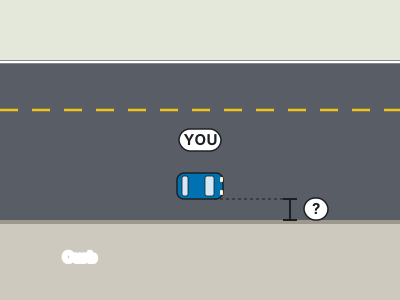
- About two feet
- No more than six inches
- At least four feet
- Touching the curb with both tires
Show answer
No more than six inches. After completing a parallel-park maneuver, New Jersey says the vehicle's tires should be no more than six inches from the curb. Two feet describes the initial position alongside the vehicle in front, not the final curb clearance. Four feet leaves the vehicle too far out, and touching the curb risks contact. Distinguish setup distance from finishing distance: begin about two to four feet from the other vehicle, then end within six inches of the curb.
Study this in the handbook: Hill parking and parallel parking
17. In a vehicle with air bags, where does the New Jersey manual say children 12 years old and younger should always ride?
- In the front passenger seat if they wear a belt
- In the front seat with the air bag on
- Anywhere, once they reach 40 pounds
- In the back seat
Show answer
In the back seat. Children of any age are safest when properly belted in the back seat, especially in a vehicle with a passenger-side air bag. The manual's safety points say to always be sure that children 12 years old and younger ride in the backseat, to put an infant in a rear-facing seat in the back, and to make sure everyone is buckled. A belt does not make the front seat safe for a young child, a 40 pound weight is not the rule, and an active air bag is the hazard the advice is meant to avoid.
18. What is the youngest age at which a New Jersey resident without a driver license can apply for a non-driver ID card?
- 17
- 16
- 14
- 18
Show answer
14. New Jersey lets anyone 14 years of age or older who does not hold a valid driver license apply for a non-driver identification card. Applicants must show proof of age and residential address and provide 6 Points of ID Verification, the same identity standard used for licenses. Sixteen is the age for a special learner permit through a driver training school, 17 is the minimum for a regular examination permit, and 18 is the age for an unrestricted basic license, so none of them is the non-driver ID age.
19. If a New Jersey vehicle’s headlights suddenly go out, what should the driver do first?
- Accelerate until the lights return
- Turn the steering wheel sharply toward oncoming traffic
- Continue normally because the parking lights replace headlights
- Bring the vehicle safely to a stop off the roadway
Show answer
Bring the vehicle safely to a stop off the roadway. When headlights fail, the first priority is to bring the vehicle to a safe stop off the roadway. Once stopped, the driver may try the headlight or dimmer switches; if that fails, parking lights, flashers, or turn signals can help while calling for assistance. Continuing at normal speed creates a visibility hazard. The immediate cue is loss of forward illumination, not a routine bulb check.
Study this in the handbook: Vehicle emergencies and what to do after a crash
20. Where must a New Jersey GDL driver under 21 display the two red reflective decals?
- On the rear windshield and the driver's side window
- On the rear bumper only
- Inside the windshield next to the inspection sticker
- On the top left corner of the front and rear license plates
Show answer
On the top left corner of the front and rear license plates. The New Jersey decals go on the license plates themselves: one at the top left corner of the rear plate and one at the top left corner of the front plate. Placing both on plates marks the vehicle from the front and from behind, while a bumper sticker covers only one side. Window and windshield locations are not what the manual describes. The decals are removable, come with the permit for a fee, and must be shown on any vehicle the permit or probationary driver operates.
Study this in the handbook: Permits and the Graduated Driver License
Insurance in New Jersey
New Jersey policies are handled in cooperation with licensed partner producer Sean Vu. QualitySpace Insurance Agency does not bind coverage in New Jersey directly. Contact us and we will route you to the right person.
Every question is written from the official New Jersey Driver Manual. Need paper? Printable NJ practice test with answer key.
Last verified 2026-10-12. How we check every question · Study all 500 as flashcards
Frequently asked questions
How many questions are on this New Jersey practice test?
This fixed set has 20 questions. It is test 5 of 25 from the 500 question New Jersey bank. The real NJ exam asks 50 questions and you need 40 correct.
What is the passing score for the real New Jersey test?
80 percent, or 40 of the 50 questions, must have correct answers That figure comes from the official New Jersey source cited on the DMV facts page.
How does this fixed test relate to the full New Jersey bank?
Each numbered test is a fixed set of questions in a fixed order, so you can retake the same test later and compare. Every test mixes road signs and the other topics in about the same proportion as the full bank. Tests 1 to 25 together cover every question in the New Jersey bank once. The full practice page mixes the whole bank at random.
Last verified 2026-10-12. See the New Jersey DMV facts page for sourced state details.
Return to the full New Jersey practice test · Study road signs