
Test 18 of 25 · 20 questions · Free 2026
NJ Permit Practice Test 18
Jump to the test ↓A fixed 20 question set from the New Jersey bank with answers and plain English explanations. The real NJ exam is 50 questions, 80 percent to pass; take the full length version on the main practice page.
Talk to Kevin
714-666-6669Call now →California policies handled directly by Kevin Vu (CDI #4037122). New Jersey and Pennsylvania policies handled in cooperation with licensed partner producer Sean Vu (Allstate). QualitySpace Insurance Agency does not bind coverage in NJ or PA directly.
Question 1 of 20 · 0 right so far
All 20 questions in test 18
Every question below comes from the New Jersey question bank on this page. Open a question to see the correct answer and the explanation. Nothing here is hidden behind a signup.
1. For a three-year-old child weighing 35 pounds in a vehicle with rear seats, which restraint options does the manual list?
- A federally approved rear-facing or forward-facing child restraint with a five-point harness, in a rear seat
- An adult shoulder belt in a rear seat
- A booster seat without a harness in a front seat
- A forward-facing restraint with no harness in a rear seat
Show answer
A federally approved rear-facing or forward-facing child restraint with a five-point harness, in a rear seat. For children under four who weigh less than 40 pounds, the manual lists a federally approved rear-facing restraint with a five-point harness in a rear seat, or a federally approved forward-facing restraint with a five-point harness in a rear seat. It also directs a transition from the rear-facing restraint when its manufacturer’s top height or weight recommendations are outgrown. The cited passage reads: "Children under age four who weigh less than 40 pounds must ride: a)In a federally approved rear-facing child passenger restraint system that is equipped with a five-point harness in a rear seat of the motor"
Study this in the handbook: Seat belts, child seats and vehicle control
2. Under New Jersey’s Move Over law, what must a driver do when changing lanes is unsafe near a stationary emergency vehicle with flashing lights?
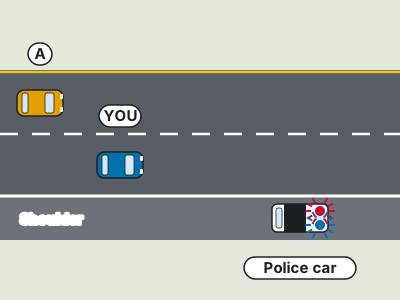
- Stop in the adjacent lane beside the emergency vehicle
- Maintain the posted speed if the vehicle is partly on the shoulder
- Reduce speed below the posted limit and be prepared to stop
- Pass on the shoulder to create extra room
Show answer
Reduce speed below the posted limit and be prepared to stop. The Move Over rule normally calls for a safe lane change into a lane that is not adjacent to the stationary vehicle. When a lane change is impossible, prohibited, or unsafe, the driver must reduce speed to a reasonable and proper speed below the posted limit and be ready to stop. Merely keeping to the limit misses the required reduction. Stopping beside the emergency vehicle or using the shoulder creates another hazard instead of providing a safe buffer.
Study this in the handbook: Right of way, intersections and passing
3. What fine applies to a third or later New Jersey conviction for unsafe driving?
- Not less than $200 or more than $500
- Not less than $50 or more than $150
- Not less than $100 or more than $250
- Not less than $250 or more than $750
Show answer
Not less than $200 or more than $500. A third or later unsafe driving conviction carries a fine of not less than $200 or more than $500, plus the $250 surcharge that attaches to each offense. Both lower spans tempt drivers who remember earlier tiers, yet repetition pushes the range to its highest level. Four points also arrive when that later offense falls within five years of the prior one. History drives the price here.
4. What fine and jail exposure follow a New Jersey hit-and-run involving bodily injury or death?
- A fine of $500 to $1,000 and up to 30 days in jail
- A fine of $2,500 to $5,000, 180 days in jail, or both
- A fine of $5,000 to $10,000 and up to one year in jail
- A fine of $1,000 to $2,500 and up to 90 days in jail
Show answer
A fine of $2,500 to $5,000, 180 days in jail, or both. A hit-and-run involving bodily injury or death may result in a fine of $2,500 to $5,000, 180 days in jail, or both. The motorist also loses the license for one year for a first offense and permanently for a subsequent offense. The cited passage reads: "A hit-and-run involving bodily injury or death may result in a fine of $2,500 to $5,000 and/or 180 days in jail for the motorist." Among the options, "A fine of $2,500 to $5,000, 180 days in jail, or both" matches that passage, while "A fine of $500 to $1,000 and up to 30 days in jail", "A fine of $1,000 to $2,500 and up to 90 days in jail", and "A fine of $5,000 to $10,000 and up to one year in jail" each alter its terms.
Study this in the handbook: Pedestrians, cyclists, trucks and trains
5. What happens to traffic fines in a New Jersey work zone?
- Only parking fines are doubled near cones
- The rule applies only to commercial vehicles
- Fines are waived when workers are present
- All traffic fines are doubled in work zones
Show answer
All traffic fines are doubled in work zones. New Jersey doubles all traffic fines in work zones, adding a financial consequence to temporary roadway hazards. Limiting the rule to parking or commercial vehicles narrows a statement that applies to all traffic fines. Workers do not create a waiver. Slow down, read the temporary signs, and assume the work-zone penalty applies throughout the marked area. The doubled amount applies even if the work area looks quiet.
Study this in the handbook: Road sign shapes and colors
6. An applicant holds a valid, non-probationary license from another state. What testing may New Jersey waive?
- Knowledge and road tests
- Only the vision screening
- The road test only, never the knowledge test
- No test can ever be waived
Show answer
Knowledge and road tests. New Jersey waives knowledge and road tests for an applicant with a valid, non-probationary license, or a certified driver abstract, from another state, the District of Columbia, or a U.S. territory. Vision screening still applies, so claiming only vision is waived reverses the rule, and splitting the waiver to cover just one written or road portion understates it. The out-of-state license must still be surrendered once the New Jersey license is issued.
7. A passenger rides in a wheelchair in a New Jersey car, van, pickup, or utility vehicle. What must the driver do?
- Ask the passenger to hold the door handle
- Secure the passenger in a properly adjusted and fastened wheelchair and occupant securement device
- Move the passenger to a loose folding chair
- Rely on the parking brake to hold the passenger
Show answer
Secure the passenger in a properly adjusted and fastened wheelchair and occupant securement device. The driver must secure a passenger using a wheelchair in a properly adjusted and fastened wheelchair and occupant securement device. This requirement applies to passenger vehicles including cars, vans, pickup trucks and utility vehicles. The cited passage reads: "The driver of a passenger vehicle including cars, vans, pickup trucks, and utility vehicles shall secure any passenger using a wheelchair in a properly adjusted and fastened wheelchair and occupant securement device." Among the options, "Secure the passenger in a properly adjusted and fastened wheelchair and occupant securement device" matches that passage, while "Ask the passenger to hold the door handle", "Move the passenger to a loose folding chair", and "Rely on the parking brake to hold the passenger" each alter its terms.
Study this in the handbook: Seat belts, child seats and vehicle control
8. What civil fine may the insurance fraud prosecutor impose for each violation in New Jersey?
- Up to $15,000 for each violation
- Up to $5,000 for each violation
- Up to $500 for each violation
- A flat $1,000 regardless of violations
Show answer
Up to $15,000 for each violation. The Office of the Insurance Fraud Prosecutor may impose civil fines of up to $15,000 for each insurance-fraud violation. The manual also says it can file criminal charges that may result in incarceration, and that a person convicted of insurance fraud could lose their driver license. The cited passage reads: "the OIFP can file criminal charges that can result in incarceration. It may also impose civil fines of up to $15,000 for each violation. (N.J.S.A. 17:33A-5)" Among the options, "Up to $15,000 for each violation" matches that passage, while "Up to $500 for each violation", "Up to $5,000 for each violation", and "A flat $1,000 regardless of violations" each alter its terms.
9. A person riding a horse in the opposite direction signals by raising a hand in New Jersey. What must a motorist do?
- Honk once so the rider can steady the horse
- Slow to 25 mph and pass with caution
- Stop and remain stationary for as long as it takes the horse to pass
- Pass quickly on the far side of the road
Show answer
Stop and remain stationary for as long as it takes the horse to pass. At the request or raised-hand signal of a person riding or driving a horse-drawn vehicle in the opposite direction, stop and remain stationary for as long as it takes the horse to pass. The general rule for approaching or passing is to reduce speed to 25 mph or less and proceed cautiously. The cited passage reads: "or otherwise, of a person riding or driving a horse-drawn vehicle in the opposite direction, the motorist must stop their motor vehicle and remain stationary for as long as it takes the horse to pass. (N.J.S.A. 39:4-72)"
Study this in the handbook: Pedestrians, cyclists, trucks and trains
10. Someone has been killed in a New Jersey crash. What must happen with the body?
- It should be moved to the shoulder to reopen traffic
- It may be moved once photographs are taken
- It should be covered and moved by the first driver on scene
- It must not be moved until the police or ambulance arrives
Show answer
It must not be moved until the police or ambulance arrives. If someone has been killed, do not move the body or permit anyone else to move it until police or an ambulance arrives. The manual also requires police notification for crashes involving injury, death, or vehicle or property damage. The cited passage reads: "If someone has been killed, do not move the body or permit anyone to move the body until the police or ambulance arrives." Among the options, "It must not be moved until the police or ambulance arrives" matches that passage, while "It should be moved to the shoulder to reopen traffic", "It may be moved once photographs are taken", and "It should be covered and moved by the first driver on scene" each alter its terms.
Study this in the handbook: Vehicle emergencies and what to do after a crash
11. A driver is looking for a place to park in New Jersey. Where does the manual say a motorist should never stop or park, unless a police officer directs it or a crash must be avoided?
- On a street with a curb
- In a marked angle parking space
- On any bridge, elevated roadway, or in a tunnel
- On a one-way street
Show answer
On any bridge, elevated roadway, or in a tunnel. A New Jersey motorist should never stop or park on any bridge or elevated roadway or in any tunnel. The manual's do not park list makes exceptions only when a police officer directs the motorist to do so or when stopping is needed to avoid a crash. Ordinary curbside streets, marked angle spaces, and one-way streets are not named in that list for this rule, so they are not covered by this item.
Study this in the handbook: Where not to park, headlights and phones
12. A host serving alcohol at a party should stop serving at what point?
- Only after the last guest leaves
- Well before the party ends
- When the first guest feels ill
- Never; guests decide for themselves
Show answer
Well before the party ends. Stop serving alcohol well before the party ends. Provide alcohol-free drinks and nutritious food or snacks, never insist on drinks or refills, and do not let someone who has drunk too much drive. Hosts may become involved in a lawsuit if a guest has a drinking-and-driving crash after leaving. The cited passage reads: "Stop serving alcohol well before the party ends." Among the options, "Well before the party ends" matches that passage, while "Only after the last guest leaves", "When the first guest feels ill", and "Never; guests decide for themselves" each alter its terms.
13. How should a motorist manage radio volume and earphones for hearing while driving?
- Use earphones only at night
- Turn the radio up to stay awake
- Wear one earphone at low volume on highways
- Keep the radio turned down and never wear earphones
Show answer
Keep the radio turned down and never wear earphones. Horns, sirens, and screeching tires warn motorists to be careful. Even people with good hearing cannot hear well with a blaring radio or earphones. Keep the radio turned down and never wear earphones while driving. The cited passage reads: "Even people with good hearing cannot hear well if the radio is blaring or they are wearing earphones. A motorist should always keep the radio turned down and never, wear earphones." Among the options, "Keep the radio turned down and never wear earphones" matches that passage, while "Turn the radio up to stay awake", "Wear one earphone at low volume on highways", and "Use earphones only at night" each alter its terms.
Study this in the handbook: Alcohol, drugs and your BAC
14. Unsafe driving points are assessed only at the third or subsequent offense. How many points, and within what window?
- Four points, if that offense occurs within five years of the prior offense
- Two points, within one year of the prior offense
- Five points, within ten years
- Four points, with no time window at all
Show answer
Four points, if that offense occurs within five years of the prior offense. A third or subsequent unsafe-driving offense brings four motor vehicle penalty points if it occurs within five years of the prior offense. The manual also lists fines for first, second, and subsequent offenses and a $250 court surcharge for each offense. The cited passage reads: "Motorists will be assessed four (4) motor vehicle penalty points if the third or subsequent offense occurs within five years of the prior offense." Among the options, "Four points, if that offense occurs within five years of the prior offense" matches that passage, while "Two points, within one year of the prior offense", "Five points, within ten years", and "Four points, with no time window at all" each alter its terms.
15. After a left turn from a two-way road onto a four-lane highway, what should the driver do when traffic permits?
- Stop in the passing lane to check traffic
- Stay in the passing lane indefinitely
- Move to the right, out of the passing lane
- Cross back over the center line
Show answer
Move to the right, out of the passing lane. Turn into the lane nearest the center line on the right side of the four-lane highway. This is the passing lane. When traffic permits, move to the right, out of the passing lane. The cited passage reads: "This is the passing lane of the four-lane highway. When traffic permits, the motorist should move to the right, out of the passing lane." Among the options, "Move to the right, out of the passing lane" matches that passage, while "Stay in the passing lane indefinitely", "Stop in the passing lane to check traffic", and "Cross back over the center line" each alter its terms.
16. While traveling in a lane, where should a motorist generally keep the vehicle positioned?
- Hugging the left line
- Alternating between lane edges
- In the center of the lane being traveled
- As close to parked cars as possible
Show answer
In the center of the lane being traveled. The manual sets lane position directly: keep the vehicle in the center of the lane that it is traveling. On a two lane road with traffic coming toward the vehicle, the motorist should keep to the right. Hugging the left line departs from that centered position, alternating between lane edges abandons a steady centered path, and crowding parked cars moves away from the center without the basis the manual gives for changing position on the road.
Study this in the handbook: Seat belts, child seats and vehicle control
17. How must the rear license plate be visible at night in New Jersey?
- Reflectors on the bumper are enough
- The rear plate must be lighted so it is visible from 50 feet at night
- It must be visible from 500 feet
- No lighting is needed with reflectorized plates
Show answer
The rear plate must be lighted so it is visible from 50 feet at night. The rear plate must be lighted, so it is visible from 50 feet at night, even with reflectorized plates. The cited passage reads: "The rear plate must be lighted, so it is visible from 50 feet at night, even with reflectorized plates." Among the options, "The rear plate must be lighted so it is visible from 50 feet at night" matches that passage, while "Reflectors on the bumper are enough", "It must be visible from 500 feet", and "No lighting is needed with reflectorized plates" each alter its terms.
18. When headlights are required in New Jersey, what lighting substitution is illegal?
- Using low beams in city traffic
- Using parking or auxiliary lights in place of headlights
- Using fog lights with low beams in fog
- Turning on taillights with headlights
Show answer
Using parking or auxiliary lights in place of headlights. Parking or auxiliary lights cannot legally replace headlights when headlights are required, no matter how bright a parking lot feels. Low beams remain the proper choice for city traffic and following other vehicles. Fog lights may supplement low beams during foggy weather. Taillights naturally accompany headlights and brake use. A parked-car glow cannot do a headlight job on a dark road, so switch to real beams before rolling.
Study this in the handbook: Where not to park, headlights and phones
19. How is the New Jersey knowledge test administered to an applicant who cannot read in any language?
- The test is waived entirely
- The applicant takes only a road test instead
- A family member reads questions aloud without approval
- Headphones are supplied to administer an oral test
Show answer
Headphones are supplied to administer an oral test. If an applicant cannot read in any language, headphones are supplied to administer an oral knowledge test. The knowledge test has 50 questions plus a survey question about organ donation. The cited passage reads: "If the applicant cannot read in any language, headphones are supplied to administer an oral test" Among the options, "Headphones are supplied to administer an oral test" matches that passage, while "The test is waived entirely", "A family member reads questions aloud without approval", and "The applicant takes only a road test instead" each alter its terms.
Study this in the handbook: The knowledge test and road test
20. What does the New Jersey manual say a few seconds of inattention can mean at highway speed?
- A few seconds of inattention is harmless at highway speed
- Inattention matters only for new drivers
- Inattention matters only on rural roads
- A few seconds of inattention can mean traveling the length of a football field without looking at the road
Show answer
A few seconds of inattention can mean traveling the length of a football field without looking at the road. The manual says operating a motor vehicle requires full attention at all times, and that distractions are one of the leading causes of crashes for teen drivers especially. Even a few seconds of inattention at highway speed can mean traveling the length of a football field without looking at the road. The risk applies to every driver and every road, not only new drivers or rural roads.
Insurance in New Jersey
New Jersey policies are handled in cooperation with licensed partner producer Sean Vu. QualitySpace Insurance Agency does not bind coverage in New Jersey directly. Contact us and we will route you to the right person.
Every question is written from the official New Jersey Driver Manual. Need paper? Printable NJ practice test with answer key.
Last verified 2026-10-12. How we check every question · Study all 500 as flashcards
Frequently asked questions
How many questions are on this New Jersey practice test?
This fixed set has 20 questions. It is test 18 of 25 from the 500 question New Jersey bank. The real NJ exam asks 50 questions and you need 40 correct.
What is the passing score for the real New Jersey test?
80 percent, or 40 of the 50 questions, must have correct answers That figure comes from the official New Jersey source cited on the DMV facts page.
How does this fixed test relate to the full New Jersey bank?
Each numbered test is a fixed set of questions in a fixed order, so you can retake the same test later and compare. Every test mixes road signs and the other topics in about the same proportion as the full bank. Tests 1 to 25 together cover every question in the New Jersey bank once. The full practice page mixes the whole bank at random.
Last verified 2026-10-12. See the New Jersey DMV facts page for sourced state details.
Return to the full New Jersey practice test · Study road signs