
Test 1 of 25 · 20 questions · Free 2026
NJ Permit Practice Test 1
Jump to the test ↓A fixed 20 question set from the New Jersey bank with answers and plain English explanations. The real NJ exam is 50 questions, 80 percent to pass; take the full length version on the main practice page.
Talk to Kevin
714-666-6669Call now →California policies handled directly by Kevin Vu (CDI #4037122). New Jersey and Pennsylvania policies handled in cooperation with licensed partner producer Sean Vu (Allstate). QualitySpace Insurance Agency does not bind coverage in NJ or PA directly.
Question 1 of 20 · 0 right so far
All 20 questions in test 1
Every question below comes from the New Jersey question bank on this page. Open a question to see the correct answer and the explanation. Nothing here is hidden behind a signup.
1. A New Jersey resident plans to learn with a parent instead of a driving school. What is the minimum age for this examination permit?
- 17
- 16
- 18
- 21
Show answer
17. New Jersey's examination permit does not need a student enrollment or an instructor, and it is available once a resident is at least 17 and not under suspension. The applicant still passes the knowledge test and vision screening before practice driving begins, and anyone under 18 needs parent or guardian consent. Sixteen is the minimum only for the special learner permit tied to an approved behind-the-wheel course. Eighteen is the age for a basic license, and 21 marks the adult road, not the minimum for this permit.
Study this in the handbook: Permits and the Graduated Driver License
2. What does New Jersey law impose on a driver convicted of failing to stop for a pedestrian in a marked crosswalk, when no one is seriously injured?
- A $54 fine with no points
- A written warning for a first offense
- A $1,000 fine and 8 points
- A $200 fine, with possible community service of up to 15 days
Show answer
A $200 fine, with possible community service of up to 15 days. N.J.S.A. 39:4-36 sets a $200 fine for a driver convicted of failing to stop and stay stopped for a pedestrian in a marked crosswalk, and the court may add up to 15 days of community service. Heavier penalties apply only when the violation causes serious bodily injury to the pedestrian: a fine of $100 to $500 and possibly up to 25 days in jail, a suspension of up to six months, or both. The driver manual folds those serious injury penalties into the ordinary case. A written warning is not a listed outcome, $54 is far below the statutory fine, and $1,000 with 8 points does not match the crosswalk law.
3. What kinds of hazards can New Jersey warning signs identify?

- Only toll booths and route numbers
- Only vehicle inspection stations and rest areas
- Only lane-use rules printed on white signs
- Road conditions, deer crossings, railroad crossings, school crossings, or curved roadways
Show answer
Road conditions, deer crossings, railroad crossings, school crossings, or curved roadways. The manual says warning signs can alert motorists to road conditions, deer crossings, railroad crossings, school crossings, or curved roadways. These signs call for attention and caution because the roadway or nearby hazard may change how a driver should proceed. Route guidance and motorist services belong to other sign categories. The narrow choices also omit several hazards named in the manual. When a yellow warning sign appears, scan ahead, reduce speed when needed, and prepare for the condition it identifies.
Study this in the handbook: Road sign shapes and colors
4. When should a New Jersey driver slow down to help avoid hydroplaning?
- Only after the tires leave the road surface
- Only when driving on a dry center lane
- When heavy rain, standing water, or slush is present
- After accelerating above 55 mph
Show answer
When heavy rain, standing water, or slush is present. The manual specifically advises slowing down when heavy rain, standing water, or slush is present because those conditions increase the chance of hydroplaning. Waiting until the tires leave the surface is dangerously late, and accelerating increases the loss of control risk. A dry center lane can be useful during a heavy rainstorm on a multilane highway, but it does not remove the need to reduce speed. The practical cue is water on or across the roadway, especially when visibility and traction are deteriorating.
Study this in the handbook: Following distance, weather and staying alert
5. Which sign tells a New Jersey driver not to enter a roadway or ramp?
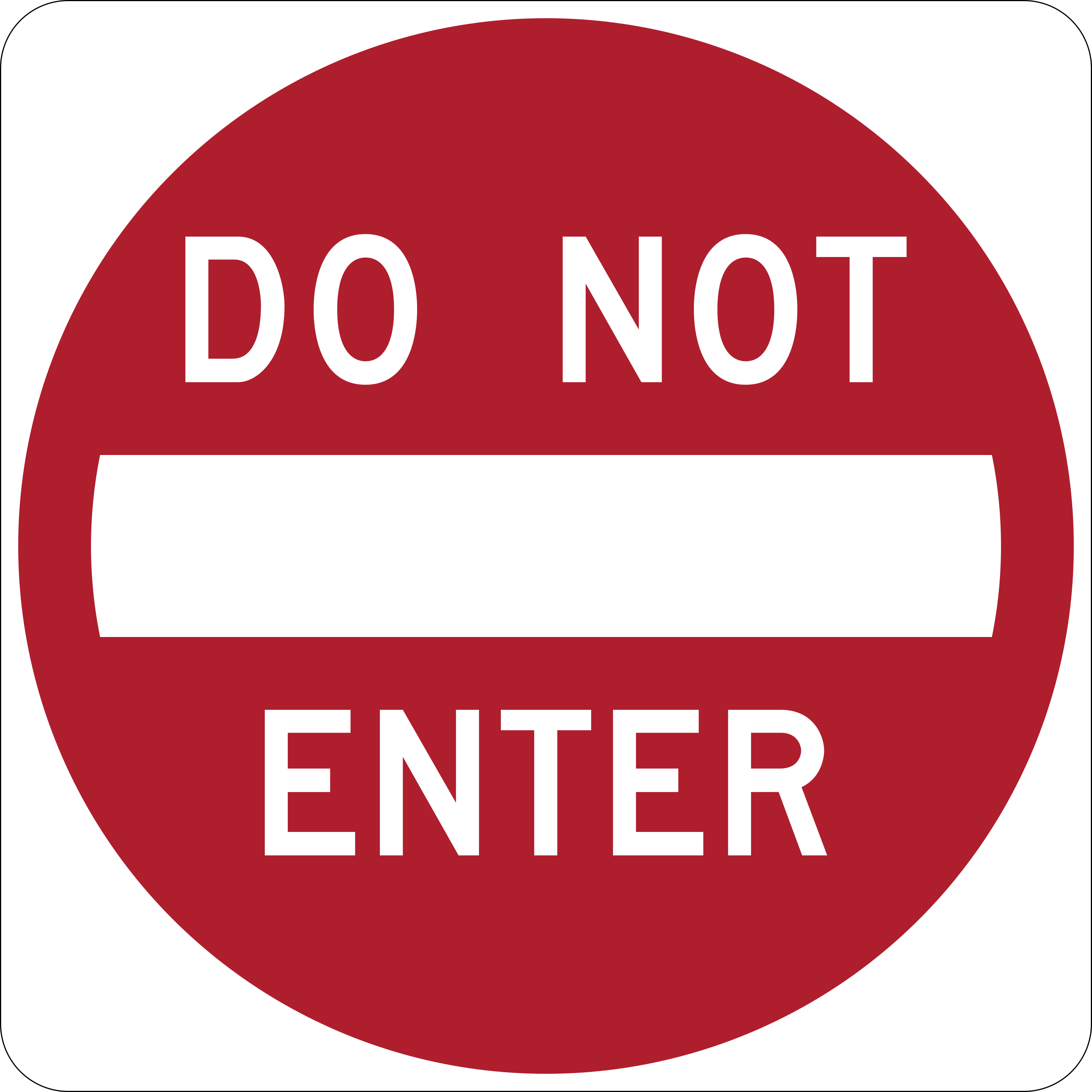
- A red octagon with white lettering
- A yellow pennant with three sides
- A blue rectangle with service information
- The white square with a red circle and horizontal white band
Show answer
The white square with a red circle and horizontal white band. DO NOT ENTER uses a white square containing a red circle crossed by a horizontal white band. The red octagon is the STOP sign, while the yellow pennant carries a no-passing warning. Blue rectangular signs provide service or information, not a prohibition against entering. A quick visual check is to look for the red circular field and the white bar across its center before moving onto a ramp or roadway.
Study this in the handbook: Traffic signals and road markings
6. What color and shape generally identify New Jersey warning signs?
- White and rectangular with a green route number
- Yellow and diamond-shaped with a black symbol or word message
- Blue and circular with a white service symbol
- Orange and triangular with a slow-moving vehicle symbol
Show answer
Yellow and diamond-shaped with a black symbol or word message. The manual says warning signs are yellow and diamond-shaped, with a black symbol or word message. That format distinguishes a warning from a white regulatory sign, a blue motorist service sign, and the fluorescent orange triangle used for slow-moving vehicles. A warning sign tells you about a condition ahead rather than marking the spot where you must act. Use the color and shape as the first recognition step, then read the symbol to identify the condition that requires extra attention.
Study this in the handbook: Road sign shapes and colors
7. A traffic signal is unlit because of a power outage, and no one is directing traffic. How should drivers treat the intersection?
- As a four-way stop
- As a flashing yellow signal
- As an uncontrolled intersection with no stopping duty
- Only traffic turning left must stop
Show answer
As a four-way stop. An unlit signal with no person directing traffic is treated as a four-way stop. Each approach must stop, look left and right, yield as required, and proceed only when safe. The flashing-yellow choice permits movement with caution but removes the required stop. Calling it uncontrolled likewise skips the stop requirement, and limiting the rule to left turns leaves other approaches exposed. Treat every direction as stop-controlled until the signal works.
Study this in the handbook: Traffic signals and road markings
8. How far from a fire station driveway must a New Jersey motorist park on the opposite side of the street?
- 100 feet
- 20 feet
- 50 feet
- 75 feet
Show answer
75 feet. Parking is prohibited within 20 feet of the driveway entrance to any fire station and within 75 feet on the street opposite a fire station entrance. The longer distance across the street leaves room for apparatus to swing out. The same list bars parking on any bridge or elevated roadway, in any tunnel, within 50 feet of a stop sign and within 50 feet of a railroad crossing.
Study this in the handbook: Where not to park, headlights and phones
9. Before merging from a highway entrance ramp, what should the driver do?
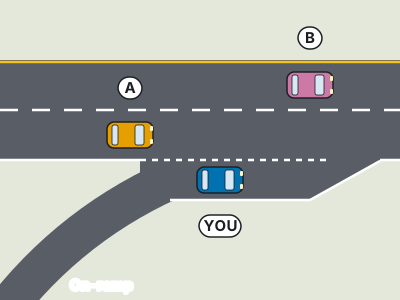
- Stop until every lane is empty
- Yield to main-road traffic and enter the right lane when safe
- Assume main-road traffic must yield
- Enter the left lane first
Show answer
Yield to main-road traffic and enter the right lane when safe. Traffic already on the highway has priority over a vehicle entering from an acceleration lane. Build speed toward the flow, yield, and merge into the right-hand lane when a safe opening exists. Stopping is discouraged unless necessary, and moving first into the left lane reverses the normal entry pattern. Use the ramp to match speed, signal, check the gap, and merge only when the movement is safe.
Study this in the handbook: Right of way, intersections and passing
10. An aggressive driver is following too closely. Which response best protects the driver ahead?
- Stay calm and avoid escalating the encounter
- Brake sharply to punish the follower
- Move unpredictably between lanes
- Speed above the limit to create distance
Show answer
Stay calm and avoid escalating the encounter. The manual lists following another vehicle too closely as one of the unlawful actions that make up aggressive driving, and it advises every motorist to remain calm and follow the rules of the road. A sudden brake can cause a rear-end crash, erratic lane movement creates another conflict, and speeding adds a violation of its own. Keep control of your vehicle and your temper rather than answering one unlawful act with another. The goal is to reduce conflict, not compete with it.
11. What do guidance signs identify for New Jersey motorists?
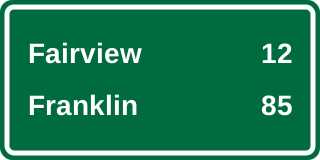
- Temporary lane closures only
- DUI penalties and license suspensions
- Destinations and routes
- Railroad crossing warning devices
Show answer
Destinations and routes. Guidance signs identify destinations and routes for motorists. They help a driver follow a route or locate a destination, unlike work-zone signs that warn about temporary conditions or regulatory signs that state rules. DUI penalties belong to the penalties section, and railroad devices warn about a specific crossing hazard. Read guidance signs early, confirm the route before changing lanes, and avoid making a sudden maneuver just because an exit or turn is approaching.
Study this in the handbook: Road sign shapes and colors
12. After a driver reaches a BAC slightly above 0.05 percent, how does New Jersey describe the crash risk?
- It stays exactly the same
- It becomes six times as great immediately
- It doubles
- It falls if the driver ate first
Show answer
It doubles. The manual says crash risk doubles when a motorist reaches a BAC slightly above 0.05 percent. That figure describes increased danger, not a safe-driving threshold. Six times the risk is tied to a BAC of 0.10 percent, and eating does not make alcohol harmless. Separate risk figures from legal BAC limits because they answer different exam questions. No amount of confidence changes that measured risk.
Study this in the handbook: Alcohol, drugs and your BAC
13. In addition to qualifying speeding, what other conduct can receive a doubled fine in a posted 65-mph New Jersey zone?
- A vehicle inspection appointment made after noon
- Any unpaid parking ticket from another municipality
- A registration renewal filed one week late
- Most other moving violations committed in that zone
Show answer
Most other moving violations committed in that zone. New Jersey extends the double-fine provision in a 65-mph zone beyond the speed threshold: most other moving violations committed there are also covered. The rule concerns conduct while driving, not administrative lateness or a parking debt from elsewhere. A broad claim that every ticket doubles is also too wide because the manual says most other moving violations. The useful cue is the combination of location, 65-mph posting, and a moving violation.
Study this in the handbook: Speed limits and safe speed
14. A driver has six or more points within three years. What surcharge structure applies?
- $150 for six points plus $25 for each additional point, for three years
- $50 once, regardless of the total
- $1,000 each year for three years
- No surcharge unless a crash occurred
Show answer
$150 for six points plus $25 for each additional point, for three years. Six or more points within three years create a surcharge of $150 for six points plus $25 for each additional point. The surcharge is assessed for the applicable three-year period and is separate from court fines and penalties. A flat $50 payment ignores the point count, while the $1,000 annual amount belongs to a different DUI-related surcharge. A crash is not required for this point-record rule to apply.
Study this in the handbook: Points, surcharges and driver programs
15. Following a first DUI with BAC of 0.15% or higher, how long is the ignition interlock required after restoration?
- Three months
- Twelve to 15 months
- Seven months to one year
- Only until the first vehicle start
Show answer
Twelve to 15 months. A first DUI with BAC of 0.15% or higher requires the ignition interlock during the suspension and for 12 to 15 months after driving privilege restoration. The three-month and seven-month-to-one-year periods belong to lower BAC ranges. The first-start-only answer misunderstands the device as a one-time check rather than a continuing requirement. The key cue is the 0.15% threshold, which moves the case into the longest first-offense interval.
Study this in the handbook: DUI, breath test refusal and interlock penalties
16. How long are New Jersey driver licenses valid?
- Two years
- Four years
- Ten years
- Six years
Show answer
Four years. The New Jersey manual states that driver licenses are valid for four years. The two-year and six-year choices change the stated renewal period, while ten years is not the validity period listed for the license. Keeping the term separate from permit stages and probationary rules helps avoid mixing different parts of the licensing system. When reviewing license paperwork, remember the four-year validity period and check the issued document for its actual expiration date.
Study this in the handbook: Permits and the Graduated Driver License
17. What does a driver's left arm pointing straight out signal to other road users?
- A left turn
- A stop or slowing movement
- A request to pass
- A right turn
Show answer
A left turn. New Jersey's hand-signal instructions assign a straight-out left arm to a left turn. An upward arm indicates a right turn, and a downward arm with the palm facing the rear indicates stopping or slowing. The signal is meant to be visible to nearby motorists, so the arm should extend well outside the vehicle. When a question describes the direction of the arm, match the posture to the maneuver instead of relying on the vehicle's turn signal lights.
Study this in the handbook: Turn signals, hand signals and the horn
18. When traffic and road surfaces are normal, what slow-driving conduct does New Jersey prohibit?
- Traveling below the posted limit on every empty road
- Blocking traffic through unnecessarily slow driving
- Using the right lane at a reduced speed
- Reducing speed before a blind curve
Show answer
Blocking traffic through unnecessarily slow driving. New Jersey prohibits blocking normal traffic through slow driving when road surfaces and traffic conditions are ordinary. That is narrower than a blanket ban on traveling below the posted limit: a driver may need to slow for weather, curves, hazards, or another safe reason. The right lane and cautious curve option can be proper actions. Watch the traffic behind you, remain within the limit, and avoid creating an unnecessary queue.
Study this in the handbook: Speed limits and safe speed
19. After moving, how soon must a New Jersey motorist report an address change to the MVC?
- Within 30 calendar days
- At the next license renewal only
- Within one week
- Only when moving to another state
Show answer
Within one week. A New Jersey motorist who changes an address must notify the MVC within one week after moving. The obligation also covers someone moving out of New Jersey, so the out-of-state-only choice is too narrow. Thirty days and waiting for renewal postpone a report the manual places in a seven-day window. Treat an address change as a prompt for an MVC update, not as paperwork that can be bundled with the next credential transaction.
Study this in the handbook: Permits and the Graduated Driver License
20. Which three components does New Jersey use to describe stopping distance?
- Lane distance, mirror distance, and shoulder distance
- Speed distance, tire distance, and signal distance
- Perception distance, reaction distance, and braking distance
- Turning distance, passing distance, and parking distance
Show answer
Perception distance, reaction distance, and braking distance. New Jersey expresses stopping distance as the sum of perception distance, reaction distance, and braking distance. Perception is the time and space used to recognize a hazard, reaction is the movement before braking begins, and braking is the distance needed to bring the vehicle to a stop. The other choices combine roadway actions that are not components of the formula. Keeping a foot near the brake can reduce reaction distance, but it cannot eliminate the need for a safe following gap.
Study this in the handbook: Following distance, weather and staying alert
Insurance in New Jersey
New Jersey policies are handled in cooperation with licensed partner producer Sean Vu. QualitySpace Insurance Agency does not bind coverage in New Jersey directly. Contact us and we will route you to the right person.
Every question is written from the official New Jersey Driver Manual. Need paper? Printable NJ practice test with answer key.
Last verified 2026-10-12. How we check every question · Study all 500 as flashcards
Frequently asked questions
How many questions are on this New Jersey practice test?
This fixed set has 20 questions. It is test 1 of 25 from the 500 question New Jersey bank. The real NJ exam asks 50 questions and you need 40 correct.
What is the passing score for the real New Jersey test?
80 percent, or 40 of the 50 questions, must have correct answers That figure comes from the official New Jersey source cited on the DMV facts page.
How does this fixed test relate to the full New Jersey bank?
Each numbered test is a fixed set of questions in a fixed order, so you can retake the same test later and compare. Every test mixes road signs and the other topics in about the same proportion as the full bank. Tests 1 to 25 together cover every question in the New Jersey bank once. The full practice page mixes the whole bank at random.
Last verified 2026-10-12. See the New Jersey DMV facts page for sourced state details.
Return to the full New Jersey practice test · Study road signs