
Test 10 of 25 · 20 questions · Free 2026
NJ Permit Practice Test 10
Jump to the test ↓A fixed 20 question set from the New Jersey bank with answers and plain English explanations. The real NJ exam is 50 questions, 80 percent to pass; take the full length version on the main practice page.
Talk to Kevin
714-666-6669Call now →California policies handled directly by Kevin Vu (CDI #4037122). New Jersey and Pennsylvania policies handled in cooperation with licensed partner producer Sean Vu (Allstate). QualitySpace Insurance Agency does not bind coverage in NJ or PA directly.
Question 1 of 20 · 0 right so far
All 20 questions in test 10
Every question below comes from the New Jersey question bank on this page. Open a question to see the correct answer and the explanation. Nothing here is hidden behind a signup.
1. What do yellow edge lines separate from the travel lane?
- Opposing traffic lanes
- The shoulder
- A railroad crossing gate
- A pedestrian waiting area
Show answer
The shoulder. Yellow edge lines separate the shoulder from the travel lane and show the edge of the highway. They help a driver recognize where the normal travel path ends. Yellow center lines separate traffic flowing in opposite directions, so the opposing-traffic choice describes a different marking. Railroad crossings use crossbucks, lights, bells and gates, and white crosswalks mark pedestrian crossing areas. Use the edge line as a visual boundary for the travel lane when scanning the roadway.
Study this in the handbook: Pedestrians, cyclists, trucks and trains
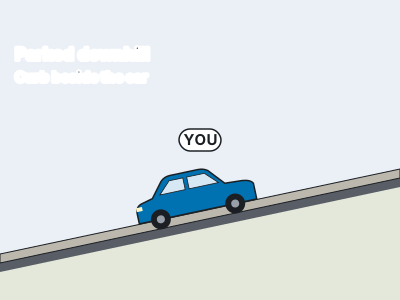
2. How should a New Jersey motorist secure a vehicle parked facing downhill?
- Turn the wheels straight and use first gear
- Turn the wheels away from the curb and use neutral
- Leave it in drive with the brake set
- Set the hand brake, turn the wheels toward the curb, and use park or reverse with a manual transmission
Show answer
Set the hand brake, turn the wheels toward the curb, and use park or reverse with a manual transmission. When parking a vehicle facing downhill, the hand brake should be set, the wheels should be turned toward the curb, and the vehicle should be in park or, with a manual transmission, in reverse. When parking facing uphill, the wheels are turned away from the curb and a manual transmission goes in low. Leaving the wheels straight, using neutral, or leaving the vehicle in drive are not among the steps the manual lists. Match the wheel direction and gear to the slope.
Study this in the handbook: Hill parking and parallel parking
3. What should a New Jersey driver do after missing an exit on a highway, parkway, or turnpike?
- Cross the median to return to the missed ramp
- Back up on the exit ramp when traffic clears
- Stop in the travel lane and wait for a gap
- Continue to the next exit
Show answer
Continue to the next exit. If a motorist misses an exit on a New Jersey highway, parkway, or turnpike, the safe instruction is to continue to the next exit. Backing up on an exit ramp is prohibited and creates a severe conflict with vehicles following the ramp. Stopping in a travel lane or crossing a median introduces hazards that the missed-exit rule avoids. Stay on the roadway, follow the next-exit signs, and reroute from a lawful location.
Study this in the handbook: School buses, railroad crossings and highway ramps
4. Which organization is associated with New Jersey’s designated-driver campaign?
- The National Highway Traffic Safety Administration
- The Safe Neighborhood Services Fund
- The Hero Campaign for Designated Drivers
- The New Jersey Driver Improvement Program
Show answer
The Hero Campaign for Designated Drivers. The manual identifies New Jersey as the first state to officially launch the Hero Campaign for Designated Drivers. That campaign encourages residents to arrange sober transportation whether they are driving or riding as passengers. The federal agency choice is not the organization named in this passage, and the fund and driver program serve different purposes. The cue is the phrase designated driver, which points to the Hero Campaign.
Study this in the handbook: Alcohol, drugs and your BAC
5. What is the first-offense fine for carrying an open or unsealed alcoholic beverage container in a vehicle’s passenger area?
- $250
- $1,000
- $500
- $200
Show answer
$200. New Jersey sets a $200 fine for a first offense involving an open or unsealed alcoholic beverage container in the passenger area of a motor vehicle. The $250 amount applies to subsequent offenses, so it cannot be used for the first occurrence. The $500 and $1,000 choices are not the listed amounts for this conduct. When the question says first offense, distinguish the initial fine from the later penalty or community-service alternative.
Study this in the handbook: DUI, breath test refusal and interlock penalties
6. What fine can a New Jersey motorist face for throwing dangerous objects from a vehicle onto a roadway?
- Up to $50
- Up to $1,000
- Up to $100
- Up to $10,000
Show answer
Up to $1,000. Throwing trash or rubbish from a moving or parked vehicle is illegal in New Jersey, and fines of up to $1,000 may be imposed on motorists found throwing dangerous objects onto a roadway. If the vehicle is moving when litter is thrown, the motorist may also lose the license. Any trash carried in a vehicle must be covered so it cannot blow onto the road. Fifty and 100 dollars understate the maximum, and $10,000 overstates it.
7. After an emergency stop on the shoulder, where should a New Jersey motorist place a second warning device?
- Right beside the driver's door
- Warning devices are only for trucks
- About 20 feet ahead of the vehicle
- At least 300 feet back, about 120 paces
Show answer
At least 300 feet back, about 120 paces. For an emergency highway stop, pull onto the shoulder, turn on parking lights or emergency lights, and never block the taillights at night. Day or night, place a flare or other warning sign just behind the vehicle and put another warning device at least 300 feet back, about 120 paces, so approaching drivers get early notice. Raise the hood, and tie a white cloth to the antenna or left door handle if you need help. A device by the door or ahead of the car gives too little warning, and the advice applies to every motorist.
Study this in the handbook: Vehicle emergencies and what to do after a crash
8. A school bus has stopped directly in front of a New Jersey school to load children. How may a motorist pass?
- Not at all until the bus leaves
- At normal speed if no children are visible
- At no more than 25 mph, only from behind
- At no more than 10 mph, from either direction
Show answer
At no more than 10 mph, from either direction. Normally, when a school bus stops, motorists behind or approaching it must stop at least 25 feet away. The manual gives one exception: if the bus has stopped directly in front of a school to pick up or let off children or persons with developmental disabilities, a motorist may pass from either direction at no more than 10 mph. That does not mean normal speed, and 25 mph is too fast. Even when passing is allowed, watch closely for children crossing.
Study this in the handbook: School buses, railroad crossings and highway ramps
9. A New Jersey teen with a GDL permit ignores the permit restrictions. What penalty does the manual list?
- A written warning, because GDL rules are only guidelines
- A $100 fine or suspension of the driving privilege
- A mandatory 30 days in jail
- A permanent ban on ever getting a basic license
Show answer
A $100 fine or suspension of the driving privilege. New Jersey treats the Graduated Driver License restrictions as enforceable law, not advice. A new driver who breaks them can be fined $100 or lose the driving privilege for a time, so a mere warning is not the consequence. The GDL section sets no jail term for a restriction violation and no lifetime bar on a basic license. Curfew, passenger, phone, seat belt, and decal rules all fall under this penalty. A suspension also matters because the supervised stage must be completed without any suspensions or postponements.
Study this in the handbook: Permits and the Graduated Driver License
10. What does New Jersey impose for a first conviction of driving while the license is suspended?
- A $1,000 fine and a 10 day jail sentence
- A $500 fine and up to six more months of suspension
- A $50 fine only
- Permanent revocation of the license
Show answer
A $500 fine and up to six more months of suspension. For a first conviction of driving while suspended, New Jersey sets a $500 fine and up to six months of additional license or registration suspension. Penalties climb with repeat offenses: a second offense is $750 with up to five days in jail, and a third is $1,000 with a 10 day jail sentence, so that choice describes a third offense. A $50 fine alone understates the law. Permanent revocation is not listed for a first offense, although the reason for the original suspension, such as DUI, can add much heavier penalties.
Study this in the handbook: Pedestrians, cyclists, trucks and trains
11. How many points does New Jersey add to a driving record for going 20 mph over the speed limit?
- 2 points
- 5 points
- 4 points
- 8 points
Show answer
4 points. New Jersey's point chart sorts speeding by how far over the limit the driver was. From 1 to 14 mph over, the charge is 2 points; 15 to 29 mph over is 4 points; and 30 mph or more over is 5 points. At 20 mph over, the driver falls in the middle band. Two points would apply only up to 14 over, and 5 points starts at 30 over. Eight points is used for leaving the scene of a crash with personal injury, not for speeding. Points add up toward a suspension notice at 12.
Study this in the handbook: Points, surcharges and driver programs
12. A New Jersey driver is caught a second time with an open alcoholic beverage container in the passenger area. What penalty applies?
- $200, the same as a first offense
- A written warning
- $1,000 and a one-year suspension
- $250 or 10 days of community service
Show answer
$250 or 10 days of community service. New Jersey's open container rule covers open or unsealed alcoholic beverage containers, and unsealed cannabis items, in a vehicle's passenger area. A first offense is a $200 fine. Every later offense rises to $250 or 10 days of community service, so a repeat does not cost the same as the first time. No warning-only stage appears in the rule. A $1,000 fine with a one-year suspension confuses the open container law with far heavier alcohol penalties.
Study this in the handbook: DUI, breath test refusal and interlock penalties
13. A New Jersey driver completes a Driver Improvement Program after receiving a Notice of Scheduled Suspension. How many points are removed?
- Three points
- One point
- Six points
- Every point on the record
Show answer
Three points. The Driver Improvement Program is one of the options after a New Jersey driver reaches 12 to 14 points and gets a Notice of Scheduled Suspension. Completing it removes three points. It also starts a one-year probationary period, and any moving violation during that year results in a scheduled suspension. One point understates the credit, while six points or a full wipe of the record is not what the program provides. A voluntary defensive driving course is different and removes two points.
Study this in the handbook: Points, surcharges and driver programs
14. Which vehicle is barred from use during a New Jersey road test?
- A self-parking vehicle
- A vehicle with working turn signals
- A vehicle with a manual transmission
- A properly registered passenger car
Show answer
A self-parking vehicle. New Jersey's road test vehicle rules state that self-parking vehicles cannot be used for the test. The same list requires all signals, brake lights, and windshield wipers on the vehicle to be in working order, so working turn signals are a requirement rather than a disqualifier. A properly registered vehicle may be driven to the road test area, and nothing in the list bars a manual transmission. Before the appointment, check the test vehicle against each item on that list.
Study this in the handbook: The knowledge test and road test
15. What hearing loss level is associated with New Jersey's special hearing-impaired driver license?
- 10 decibels exactly
- 25 percent hearing loss in one ear
- 41 decibels or more
- Only complete deafness qualifies
Show answer
41 decibels or more. New Jersey provides a special driver license for deaf or hearing-impaired motorists with a hearing loss of 41 decibels or more. The lower figure and percentage choice do not state the manual's threshold, and complete deafness is not required by the description. The question concerns the license designation, not a general driving prohibition. Remember the numeric cue of 41 dB or more when distinguishing this credential from ordinary license requirements.
16. Which New Jersey driver may not use either a handheld or hands-free cellular telephone while operating the vehicle, except in limited circumstances?
- A school bus driver
- A driver stopped at a red light in a travel lane
- A driver with a passenger holding the phone
- A driver using a phone mounted below the windshield
Show answer
A school bus driver. The school-bus rule is stricter than the ordinary hands-free allowance. A school bus driver may not use a handheld or hands-free cellular telephone while operating the bus, except during an emergency or when the bus is parked safely off the highway. A passenger holding the phone does not change who is operating the bus. Identify the vehicle and driver category first; that special combination overrides the general phone discussion.
Study this in the handbook: Where not to park, headlights and phones
17. A white diamond painted on a highway lane generally identifies what?
- A lane where parking is allowed
- An emergency-vehicles-only lane
- An HOV lane reserved under posted conditions
- A shoulder that may be crossed freely
Show answer
An HOV lane reserved under posted conditions. A white pavement diamond marks a high-occupancy-vehicle lane when regulatory signs identify the vehicle or passenger requirement and operating hours. It does not create parking space, reserve the lane only for emergency responders, or authorize casual shoulder crossings. Read the accompanying sign because eligibility and hours can vary. The diamond is a lane-use cue, so check the restriction before entering.
Study this in the handbook: Pedestrians, cyclists, trucks and trains
18. When passing a horseback rider, what speed and conduct are required?
- Keep the posted limit and sound the horn
- Reduce speed to 25 mph or less and proceed with caution
- Pass at walking speed with high beams
- Stop in the lane until another driver passes
Show answer
Reduce speed to 25 mph or less and proceed with caution. Horseback riders have the same roadway rights and responsibilities as motor-vehicle drivers. When approaching or passing one, reduce speed to 25 mph or less and proceed cautiously. Continuous horn use and high beams are not the stated requirement. Stopping in the lane is not the ordinary passing rule, although a rider’s signal can require a stop in a particular situation. Slow early and give the rider room.
Study this in the handbook: Pedestrians, cyclists, trucks and trains
19. A yellow diamond with a black plus sign warns of what?

- A crossroad
- A hospital entrance
- A no-passing zone
- A lane ending at the shoulder
Show answer
A crossroad. The plus-shaped warning represents a crossroad, where vehicles may enter from either side ahead. Scan both directions, adjust speed, and prepare for crossing or turning traffic. A hospital is a service symbol, while a no-passing restriction uses roadway markings or a pennant. A lane ending has a merge or lane-reduction symbol. The plus sign announces an upcoming intersection; it does not itself grant priority or require a turn.
Study this in the handbook: Right of way, intersections and passing
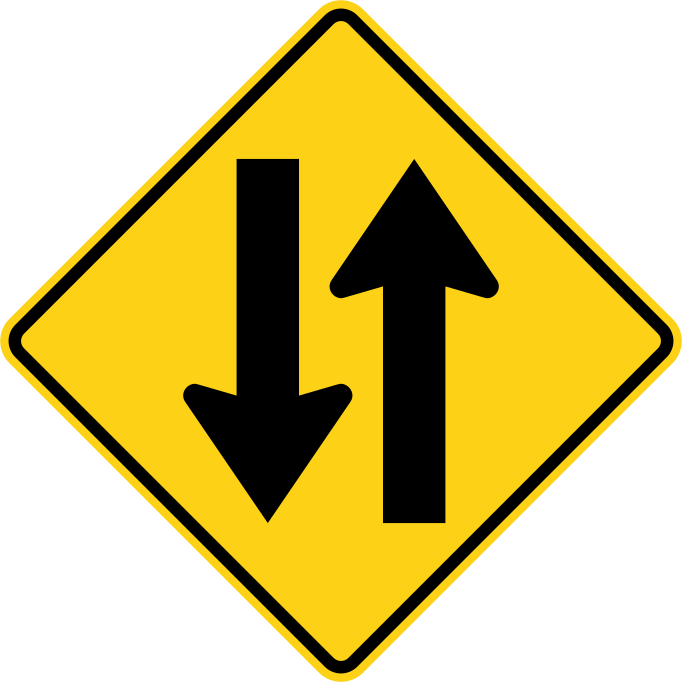
20. A yellow New Jersey warning sign shows two opposing arrows, one pointing up and one pointing down. What does the manual's sign gallery call it?
- Passing is permitted in both directions
- A divided highway begins
- Two-lane traffic
- The road becomes one-way
Show answer
Two-lane traffic. The New Jersey manual's gallery of warning signs labels the yellow diamond with two opposing arrows as Two-Lane Traffic. Like other yellow diamond warning signs, it tells you about a road condition ahead so you can prepare before you reach it. Divided Highway is a separate symbol in the same gallery, and nothing about this sign grants permission to pass or turns the road into a one-way street. Expect traffic moving in both lanes and stay in your own lane on the right.
Insurance in New Jersey
New Jersey policies are handled in cooperation with licensed partner producer Sean Vu. QualitySpace Insurance Agency does not bind coverage in New Jersey directly. Contact us and we will route you to the right person.
Every question is written from the official New Jersey Driver Manual. Need paper? Printable NJ practice test with answer key.
Last verified 2026-10-12. How we check every question · Study all 500 as flashcards
Frequently asked questions
How many questions are on this New Jersey practice test?
This fixed set has 20 questions. It is test 10 of 25 from the 500 question New Jersey bank. The real NJ exam asks 50 questions and you need 40 correct.
What is the passing score for the real New Jersey test?
80 percent, or 40 of the 50 questions, must have correct answers That figure comes from the official New Jersey source cited on the DMV facts page.
How does this fixed test relate to the full New Jersey bank?
Each numbered test is a fixed set of questions in a fixed order, so you can retake the same test later and compare. Every test mixes road signs and the other topics in about the same proportion as the full bank. Tests 1 to 25 together cover every question in the New Jersey bank once. The full practice page mixes the whole bank at random.
Last verified 2026-10-12. See the New Jersey DMV facts page for sourced state details.
Return to the full New Jersey practice test · Study road signs