
Test 7 of 25 · 20 questions · Free 2026
NJ Permit Practice Test 7
Jump to the test ↓A fixed 20 question set from the New Jersey bank with answers and plain English explanations. The real NJ exam is 50 questions, 80 percent to pass; take the full length version on the main practice page.
Talk to Kevin
714-666-6669Call now →California policies handled directly by Kevin Vu (CDI #4037122). New Jersey and Pennsylvania policies handled in cooperation with licensed partner producer Sean Vu (Allstate). QualitySpace Insurance Agency does not bind coverage in NJ or PA directly.
Question 1 of 20 · 0 right so far
All 20 questions in test 7
Every question below comes from the New Jersey question bank on this page. Open a question to see the correct answer and the explanation. Nothing here is hidden behind a signup.
1. How long must a New Jersey permit holder under 21 practice with a supervising driver before a probationary license can be issued?
- At least three months, with no suspensions or postponements
- At least one full year of supervised practice
- At least six months, with no suspensions or postponements
- No set period once the 50 practice hours are logged
Show answer
At least six months, with no suspensions or postponements. Under 21, the supervised stage in New Jersey lasts at least six months, and that time must be free of suspensions or postponements before the probationary license step. The 50 practice hours, including 10 in darkness, are required as well, but logging them quickly does not shorten the six months. Three months is the shorter period for drivers 21 and older on the adult road. A full year is the length of the later unsupervised probationary stage, not the supervised one.
Study this in the handbook: Permits and the Graduated Driver License
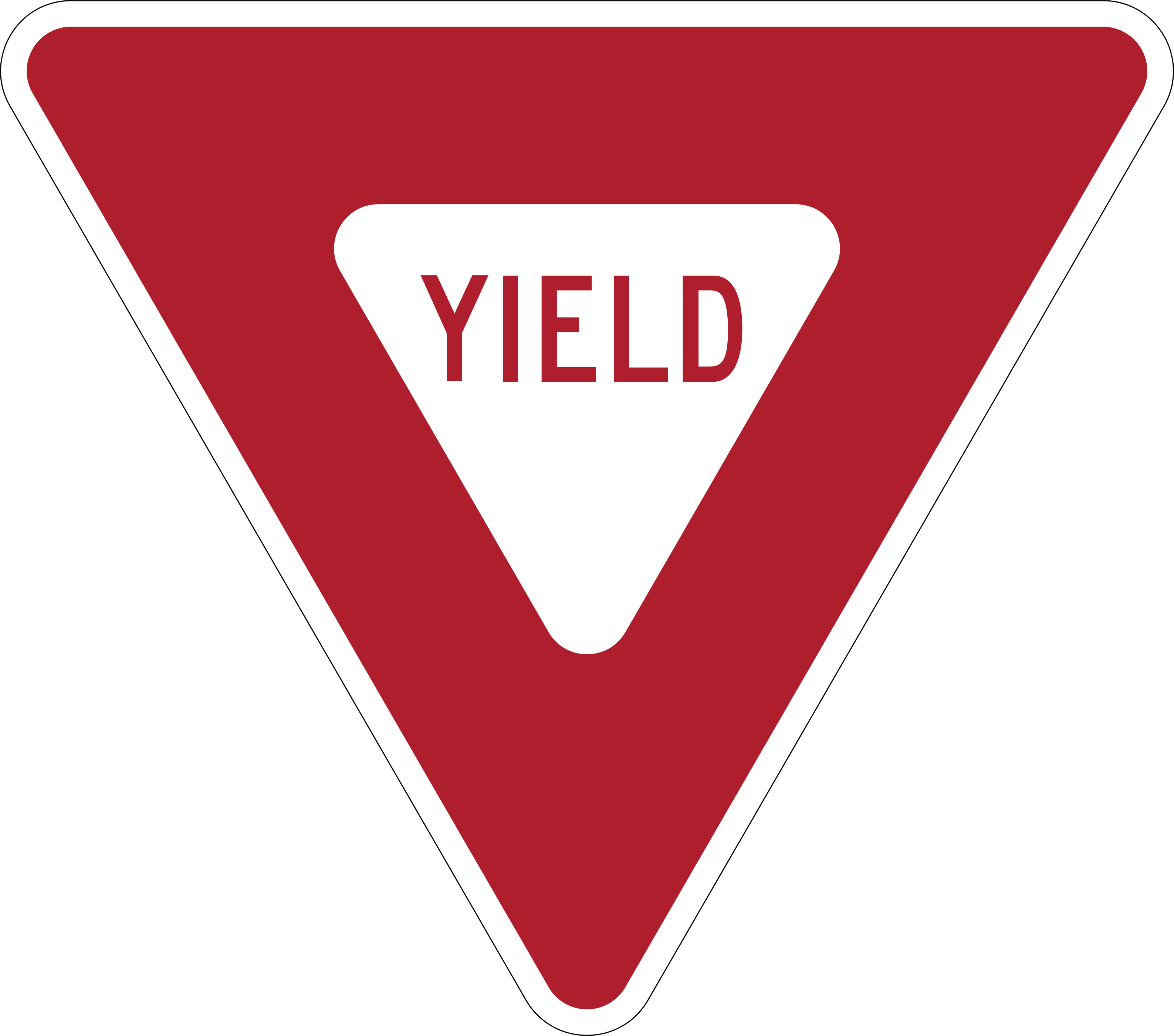
2. A red-bordered inverted triangle in New Jersey identifies which instruction?
- YIELD
- STOP
- No passing
- Railroad crossing ahead
Show answer
YIELD. The inverted triangle is the distinctive shape assigned to a YIELD sign. Its red wording and border tell the driver to give right-of-way as required, rather than make the complete stop associated with the red octagon. A yellow pennant warns of a no-passing area, and the round yellow sign warns of a railroad crossing ahead. The useful recognition cue is the triangle pointing downward, with a white center and red border.
Study this in the handbook: Road sign shapes and colors
3. What does a white steady pedestrian silhouette or countdown indication allow?
- Pedestrians must wait until every vehicle stops
- Only turning vehicles may use the crosswalk
- Pedestrians may cross anywhere without watching traffic
- Pedestrians may cross in the indicated direction
Show answer
Pedestrians may cross in the indicated direction. The white pedestrian indication permits people facing it to cross in the shown direction. It does not remove the need to use the crosswalk carefully or make every vehicle stop before entry. The symbol authorizes pedestrian movement, not a vehicle turn. The displayed direction is the cue: follow that path while continuing to watch for vehicles. Keep scanning until the crossing is complete.
Study this in the handbook: Traffic signals and road markings
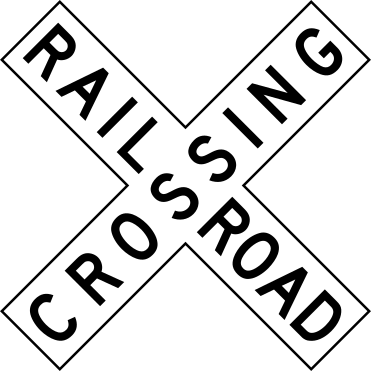
4. What does a cross buck sign require a New Jersey driver to do?
- Stop only when a gate is lowered
- Yield the right-of-way to trains
- Pass the tracks without checking both directions
- Treat the sign as permission to cross anywhere
Show answer
Yield the right-of-way to trains. The cross buck is an X-shaped railroad crossing sign, and the manual says it means the same as a Yield sign. A driver must give trains the right-of-way because trains cannot swerve to avoid a vehicle. Waiting for a lowered gate misses the point, because the crossbuck itself already requires yielding to any train, and crossing without checking ignores the hazard. The sign does not authorize crossing away from a marked location. Slow, look, and proceed only when the crossing is clear.
Study this in the handbook: Road sign shapes and colors
5. What general feature identifies New Jersey regulatory signs?
- They are always yellow diamonds with black symbols
- They are blue circles with white arrows
- They are orange triangles used only in work zones
- They are generally rectangular with black wording and border on white
Show answer
They are generally rectangular with black wording and border on white. New Jersey describes regulatory signs as generally rectangular, with black wording and a black border on a white background. Yellow diamonds warn of roadway hazards, orange signs warn of construction and maintenance, and blue signs give motorist services and information, so none of those describe the regulatory pattern. Individual regulatory signs can have distinctive shapes, such as the red octagon for STOP or the inverted triangle for YIELD, so the word generally matters. Read a regulatory sign's exact message before acting.
Study this in the handbook: Road sign shapes and colors
6. When must motorists yield to an emergency vehicle?
- Only when it is stopped at an intersection
- Only when it is traveling faster than surrounding traffic
- Only after a police officer waves from the vehicle
- When it sounds its siren or displays flashing red or blue emergency lights
Show answer
When it sounds its siren or displays flashing red or blue emergency lights. New Jersey requires motorists to yield when an emergency vehicle sounds its siren or displays flashing red or blue emergency lights. A driver should move safely toward the side of the road, stop, and wait for the emergency vehicle to pass. The vehicle does not need to be stopped, speeding, or accompanied by a hand signal for the duty to apply. Watch and listen for the emergency warning signs, check surrounding traffic, and avoid blocking the vehicle's path while moving over.
Study this in the handbook: Right of way, intersections and passing
7. What rule applies when a New Jersey driver considers traveling faster than the posted speed limit?
- Exceeding it is allowed when no police vehicle is visible
- Never exceed it, and slow down further when conditions require
- Exceeding it is allowed when the vehicle has four-wheel drive
- Exceeding it is allowed when the driver is late for work
Show answer
Never exceed it, and slow down further when conditions require. New Jersey treats the posted limit as a maximum, not a target that may be exceeded when a road looks open. The manual also requires a driver to judge speed by existing conditions and slow for weather, road surface, visibility, traffic, and hazards. An empty roadway, four-wheel drive, or personal urgency does not create an exception. The safe and lawful choice is to remain at or below the posted limit, then reduce speed further whenever conditions make that necessary.
8. What point value does New Jersey assign to a tailgating conviction?
- Two points
- Three points
- Eight points
- Five points
Show answer
Five points. Following too closely is one of the heavier moving violations on New Jersey's chart, carrying 5 points. That puts it alongside reckless driving, racing, and improperly passing a school bus. Many ordinary violations, such as failing to observe traffic lanes or failing to yield at an intersection, are 2 points, which is why that figure looks familiar. Three points is used for improper turns and U-turns. Eight points is reserved for leaving the scene of a crash that caused personal injury.
Study this in the handbook: Points, surcharges and driver programs
9. When stopped by police in New Jersey, a motorist refuses an officer's request to light up the driver's compartment. What fine applies?
- $10
- No fine, because it is optional
- $500
- $50
Show answer
$50. New Jersey law requires a stopped motorist to comply with a police officer's request to illuminate the driver's compartment of the vehicle. A motorist who fails to comply faces a $50 fine. Turning on the interior light helps the officer see inside and keeps the stop calm and safe for everyone. Ten dollars understates the fine, $500 overstates it, and the request is not optional under the law.
Study this in the handbook: DUI, breath test refusal and interlock penalties
10. How large is the violation surcharge for refusing a breath test in New Jersey?
- $1,000 per year for three years
- $100 one time
- $250 per year for one year
- $5,000 per year for ten years
Show answer
$1,000 per year for three years. New Jersey treats a refused breath test as a violation of its own, and the manual sets the violation surcharge at $1,000 per year for three years. That surcharge is separate from the loss of driving privileges a judge can order for a refusal conviction. A single $100 charge or one year at $250 badly understates it, and ten years at $5,000 is not what the manual lists. Leaving the surcharge unpaid leads to an indefinite suspension of driving privileges until it is paid.
Study this in the handbook: DUI, breath test refusal and interlock penalties
11. A New Jersey driver younger than 21 has a BAC of 0.01 percent. Is driving permitted?
- Yes, until the reading reaches 0.08 percent
- No, the under-21 threshold has already been reached
- Yes, when a supervising adult is in the vehicle
- Yes, if the trip is less than five miles
Show answer
No, the under-21 threshold has already been reached. New Jersey uses a much lower BAC threshold for a person younger than 21: 0.01 percent or higher is illegal. The adult figure of 0.08 percent belongs to a different age category and cannot be substituted here. A short trip and an accompanying adult do not create exceptions to the alcohol rule. The useful exam cue is the age phrase; once it appears, compare the reading with 0.01 percent before considering any adult standard.
Study this in the handbook: Alcohol, drugs and your BAC
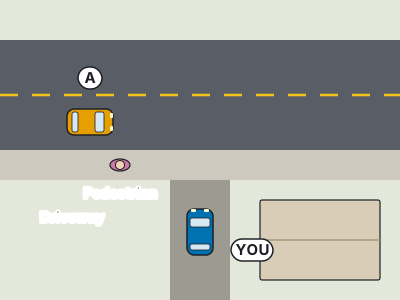
12. A New Jersey driver exits a private driveway onto a public road. Which traffic must be yielded to?
- Every vehicle already traveling on the main road
- Only traffic approaching from the driver’s left
- Only the first vehicle visible at the curb
- No traffic when the driveway has a wide opening
Show answer
Every vehicle already traveling on the main road. A driveway is not an equal branch of the public roadway. The motorist emerging from private property must yield to all traffic on the main road, which means checking both directions and waiting for a safe opening. Limiting the obligation to the left side overlooks vehicles approaching from the other direction. A wide driveway changes visibility, not the legal priority. Stop before entering the road, scan both ways, and proceed only after the established traffic is clear.
Study this in the handbook: Right of way, intersections and passing
13. If a gas pedal sticks, what sequence should the driver follow?
- Pump the pedal while keeping speed
- Turn sharply and apply the parking brake first
- Shift to neutral, steer to safety, turn off the engine, and call for help
- Switch off immediately in moving traffic
Show answer
Shift to neutral, steer to safety, turn off the engine, and call for help. A stuck accelerator requires the driver to keep watching the roadway while removing engine drive. Shift quickly to neutral, steer to a safe area off the roadway, turn the engine off, and call for help. Repeated pumping may fail, a sharp turn can cause loss of control, and switching off before reaching safety leaves the vehicle exposed. Control the path first, then deal with the disabled vehicle.
Study this in the handbook: Vehicle emergencies and what to do after a crash
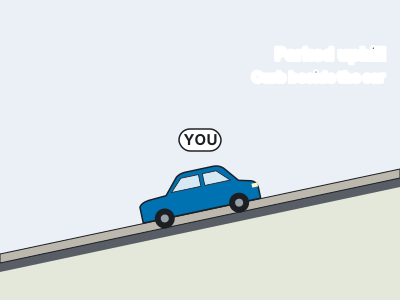
14. When parking uphill beside a curb in New Jersey, which way should the front wheels point?
- Toward the curb
- Straight ahead, with the transmission in neutral
- Away from the curb
- Toward the center of the roadway
Show answer
Away from the curb. On an uphill curbside space, New Jersey directs the motorist to set the hand brake and turn the wheels away from the curb, with the vehicle in park or, with a manual transmission, in low gear. Turning toward the curb is the downhill procedure, so it reverses the condition in this question. Leaving the wheels straight or aiming them toward the center of the roadway is not the stated procedure. Identify the slope first, then pair uphill with away and downhill with toward.
Study this in the handbook: Hill parking and parallel parking
15. What can an International Driving Permit do for a New Jersey motorist traveling abroad?
- It is required only for local New Jersey trips
- It replaces the driver license in every country
- It permits driving without carrying any license
- It can accompany a valid driver license and help span language barriers
Show answer
It can accompany a valid driver license and help span language barriers. An International Driving Permit is an additional identification and translation document used with a valid driver license; it cannot replace that license. The replacement and no-license options remove the manual condition, while a local New Jersey trip is not the described purpose. Before traveling, carry the actual license and use the permit or an acceptable translation to help officials understand the credential.
16. At what approximate speed should a New Jersey motorist drive in reverse?
- 15 to 20 mph to maintain momentum
- Walking speed, about 2 to 4 mph
- The posted speed limit for the street
- At least 30 mph on a straight path
Show answer
Walking speed, about 2 to 4 mph. When reversing, New Jersey advises driving slowly at approximately walking speed, about 2 to 4 mph. Slow movement gives the motorist time to look through the rear window, detect a person or object, and make a controlled correction. The faster choices create unnecessary stopping distance and reduce the time available when the rear view is limited. Keep the vehicle moving gently, check the path directly, and do not turn forward until the vehicle is completely stopped.
Study this in the handbook: Seat belts, child seats and vehicle control
17. A pedestrian is already partway across the street when New Jersey's orange, steady raised-palm signal appears. What does the manual say that pedestrian should do?
- Turn around and wait in the middle of the street
- Quickly go to a safe spot
- Stop and wait for a driver to wave
- Stay in the roadway until the next walk signal
Show answer
Quickly go to a safe spot. New Jersey's orange, steady raised-palm symbol means pedestrians must not leave the sidewalk or enter the roadway when facing the light. Those already in the roadway should quickly go to a safe spot, and the manual adds that pedestrians already within the crosswalk will have time to cross the intersection before the signal changes. Those who have not yet left the sidewalk or curb should not enter the roadway. Waiting in the street or for a driver's wave keeps the pedestrian exposed to traffic.
Study this in the handbook: Traffic signals and road markings
18. Under New Jersey GDL Option A, what minimum supervised practice is required before advancing from the learner stage?
- 50 hours, including 10 hours in darkness
- 60 hours, including 20 hours after sunset
- Three months with no hour requirement
- 30 hours, all during daylight
Show answer
50 hours, including 10 hours in darkness. The early-bird pathway requires at least 50 practice-driving hours, and 10 of those hours must occur during darkness. The 30-hour choice understates the total, while the 60-hour answer adds figures not printed for Option A. The three-month answer belongs to the adult pathway and uses the wrong measurement. Treat the nighttime portion as included within the 50-hour minimum, then remember that the supervising driver must certify the practice.
Study this in the handbook: Permits and the Graduated Driver License
19. A New Jersey driver heads out without clearing snow from the car's roof. If none falls off, what fine can still apply?
- No fine, because nothing came loose
- $1,500
- $25 to $75
- $5,000
Show answer
$25 to $75. New Jersey requires motorists to make all reasonable efforts to remove ice and snow from exposed surfaces, including the hood, trunk, roof and windshield, before driving. A violation brings a fine of $25 to $75 even if no snow or ice is dislodged from the vehicle. If snow or ice does come loose and causes injury or property damage, fines up to $1,500 may be assessed, so $1,500 applies only when harm results. Five thousand dollars is not the penalty, and having nothing fall off is not a defense.
Study this in the handbook: Seat belts, child seats and vehicle control
20. How far ahead should a New Jersey motorist look while driving?
- At least 2 seconds ahead
- At least 1 minute ahead
- At least 12 seconds ahead
- Only as far as the vehicle in front
Show answer
At least 12 seconds ahead. The New Jersey manual says a motorist should look at least 12 seconds ahead, meaning you should see objects far enough down the road that it would take at least 12 seconds to reach them. At 25 mph on a clear city street, that is about a block. Two seconds gives almost no time to react, a full minute is unrealistic, and fixing your eyes on the vehicle ahead keeps you from spotting hazards early. When traffic is heavy, slow down to gain extra reaction time.
Study this in the handbook: Following distance, weather and staying alert
Insurance in New Jersey
New Jersey policies are handled in cooperation with licensed partner producer Sean Vu. QualitySpace Insurance Agency does not bind coverage in New Jersey directly. Contact us and we will route you to the right person.
Every question is written from the official New Jersey Driver Manual. Need paper? Printable NJ practice test with answer key.
Last verified 2026-10-12. How we check every question · Study all 500 as flashcards
Frequently asked questions
How many questions are on this New Jersey practice test?
This fixed set has 20 questions. It is test 7 of 25 from the 500 question New Jersey bank. The real NJ exam asks 50 questions and you need 40 correct.
What is the passing score for the real New Jersey test?
80 percent, or 40 of the 50 questions, must have correct answers That figure comes from the official New Jersey source cited on the DMV facts page.
How does this fixed test relate to the full New Jersey bank?
Each numbered test is a fixed set of questions in a fixed order, so you can retake the same test later and compare. Every test mixes road signs and the other topics in about the same proportion as the full bank. Tests 1 to 25 together cover every question in the New Jersey bank once. The full practice page mixes the whole bank at random.
Last verified 2026-10-12. See the New Jersey DMV facts page for sourced state details.
Return to the full New Jersey practice test · Study road signs