
Test 6 of 25 · 20 questions · Free 2026
NJ Permit Practice Test 6
Jump to the test ↓A fixed 20 question set from the New Jersey bank with answers and plain English explanations. The real NJ exam is 50 questions, 80 percent to pass; take the full length version on the main practice page.
Talk to Kevin
714-666-6669Call now →California policies handled directly by Kevin Vu (CDI #4037122). New Jersey and Pennsylvania policies handled in cooperation with licensed partner producer Sean Vu (Allstate). QualitySpace Insurance Agency does not bind coverage in NJ or PA directly.
Question 1 of 20 · 0 right so far
All 20 questions in test 6
Every question below comes from the New Jersey question bank on this page. Open a question to see the correct answer and the explanation. Nothing here is hidden behind a signup.
1. Which statement describes New Jersey's yellow and dashed center-line combination?
- Pass whenever the solid line is on your side
- Cross the lines to make a U-turn at any time
- Ignore the markings if no vehicle is visible
- Pass only when the dashed line is on your side, and finish before it becomes solid
Show answer
Pass only when the dashed line is on your side, and finish before it becomes solid. A mixed yellow marking permits passing from the side with the broken line, and the driver must finish before that section changes to solid. Choosing the solid-line side reverses the rule, and an empty road does not cancel a restriction. The lines also do not automatically authorize a U-turn. Find the line nearest your lane, then check sight distance and oncoming traffic.
Study this in the handbook: Pedestrians, cyclists, trucks and trains
2. In bad weather, how much longer can a truck, tractor-trailer or bus take to stop, according to the New Jersey manual?
- About 5 percent longer
- No longer than a car
- About twice as long
- As much as 25 percent longer
Show answer
As much as 25 percent longer. Large vehicles have deep blind spots, called no-zones, and they need more room to stop than cars do. The New Jersey manual adds that during bad weather a truck, tractor-trailer or bus can take as much as 25 percent longer to stop. Cutting in front of one in rain or snow leaves its driver even less room. Five percent understates the effect, twice as long overstates it, and large vehicles never stop as quickly as cars.
Study this in the handbook: Pedestrians, cyclists, trucks and trains
3. A New Jersey motorist's vehicle becomes disabled. What are the first steps the manual lists?
- Stop in the lane and put out flares
- Leave the vehicle and walk for help
- Pull off as far as possible onto the shoulder or median, turn on the emergency flashers, and raise the hood
- Wait in the travel lane with the lights off
Show answer
Pull off as far as possible onto the shoulder or median, turn on the emergency flashers, and raise the hood. If a motorist's vehicle becomes disabled, he or she must pull off as far as possible onto the shoulder or median, turn on the emergency flashers, raise the hood to signal for assistance, and stay in the vehicle with the seat belt on until help arrives. Walking along the highway or stopping in a lane exposes you to traffic. The Move Over law then protects the responders who come to help.
4. What fine can follow a violation of New Jersey's child passenger restraint law?
- Not less than $50 nor more than $75, plus fees and court costs
- $500 to $1,000
- A warning only for a first offense
- $5 per child
Show answer
Not less than $50 nor more than $75, plus fees and court costs. New Jersey requires children under age eight who are under 57 inches tall to ride in a federally approved child restraint system or booster seat, in the rear seat when one is available. Failing to comply can bring a fine of not less than $50 nor more than $75, plus fees and court costs. The manual lists no warning-only first offense, $5 per child understates the penalty, and $500 to $1,000 is far beyond it. A rear-facing seat may never go in front of an active passenger air bag.
Study this in the handbook: Seat belts, child seats and vehicle control
5. What is the ordinary maximum idling time for a vehicle in New Jersey?
- Five minutes at all locations
- Three minutes
- Ten minutes when parked
- There is no statewide limit
Show answer
Three minutes. New Jersey law requires motorists to restrict vehicle idling to three minutes or less. The rule targets unnecessary running of the engine and includes specific exemptions, such as being stuck in traffic or at a drive-through establishment. Five and ten minutes are not the ordinary limit, and the state does impose a limit. The practical cue is to turn the key off during an extended stationary wait unless a listed exception applies.
Study this in the handbook: Seat belts, child seats and vehicle control
6. When parking a New Jersey vehicle facing downhill beside a curb, which way should the wheels point?
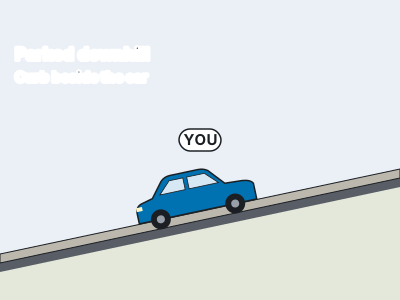
- Away from the curb
- Toward the curb
- Straight toward the center line
- Toward the nearest driveway
Show answer
Toward the curb. Facing downhill, the parked vehicle wheels should turn toward the curb, with the hand brake set and the transmission in park or reverse for a manual vehicle. Turning away would let a rolling vehicle move farther into the roadway, while a straight setting does not use the curb as a stop. Before leaving, secure the brake, check surroundings, and match wheel position to the slope.
Study this in the handbook: Hill parking and parallel parking
7. Where must children under age eight generally ride in a New Jersey vehicle?
- In the front seat beside the driver
- On an adult passenger's lap
- Anywhere if the vehicle is moving slowly
- In a rear seat
Show answer
In a rear seat. New Jersey's child passenger safety law requires all children under age eight to be seated in a rear seat. If the vehicle has no rear seat, the child must instead be secured in an approved restraint or booster in the front seat. An adult's lap and a slow-moving trip do not replace the required restraint location. Check whether a rear seat exists, then use the appropriate federally approved child passenger system.
Study this in the handbook: Seat belts, child seats and vehicle control
8. Under normal conditions, from how far away should a vehicle's horn be heard in New Jersey?
- At least 50 feet
- At least one mile
- At least 500 feet
- At least 200 feet
Show answer
At least 200 feet. The horn is a warning signal that calls attention to what a motorist is doing, and New Jersey law says that under normal conditions it should be heard for at least 200 feet. Motorists may sound the horn when passing another vehicle outside business or residential zones. Fifty feet is too short to warn approaching traffic, while 500 feet and a mile overstate the requirement. Only emergency vehicles may use sirens, whistles or bells.
Study this in the handbook: Turn signals, hand signals and the horn
9. If a vehicle catches fire, what is the driver’s immediate priority?
- Open the hood and pour water on the engine
- Get passengers out and away, then call for help
- Remain inside until smoke clears
- Drive farther before stopping
Show answer
Get passengers out and away, then call for help. A vehicle fire can spread rapidly, so do not spend time trying to save the car. Get passengers out immediately, move everyone away from the vehicle, and call for help. Opening the hood or attempting to fight the fire increases exposure, while remaining inside leaves people beside the danger. The memory cue is evacuate, create distance, and summon assistance. Personal safety comes before property.
Study this in the handbook: Vehicle emergencies and what to do after a crash
10. How is a roundabout described in the New Jersey manual?

- A four-way stop with no circulating roadway
- A railroad crossing controlled by a crossbuck
- A one-way, circular intersection around a center island
- A divided highway where U-turns are required
Show answer
A one-way, circular intersection around a center island. A roundabout is a one-way, circular intersection in which traffic flows around a center island. That design is different from a conventional four-way stop, a railroad crossing, or a divided highway. Drivers should follow the circulating roadway and use the entry and exit lanes rather than cut across the center island. The circular arrows on the warning sign identify a roundabout ahead.
11. At a New Jersey intersection without painted lines, what pedestrian crossing should a driver expect?
- Pedestrians have no crossing area until paint is added
- An unmarked crosswalk exists at the intersection
- Only cyclists may cross without painted markings
- The driver may treat the corner as a parking space
Show answer
An unmarked crosswalk exists at the intersection. New Jersey recognizes a crosswalk at every intersection, even where pavement markings are absent. That unmarked crossing still requires a motorist to watch for people and yield as the pedestrian law requires. The paint-based option mistakes visibility of the marking for existence of the crossing. A corner with no stripes is therefore not a free pass to maintain speed. Slow your approach, look toward both sidewalks, and be ready to stop before the person enters your path.
Study this in the handbook: Pedestrians, cyclists, trucks and trains
12. When must New Jersey headlights be used because of weather or visibility, even if it is daytime?
- When visibility is 500 feet or less or windshield wipers are in use
- Only after a police vehicle flashes its headlights
- Only when the road has no streetlights
- Only when the temperature falls below freezing
Show answer
When visibility is 500 feet or less or windshield wipers are in use. New Jersey requires headlights in daytime conditions when visibility is 500 feet or less and whenever windshield wipers are being used during rain, snow, or ice. Fog, mist, and smoke are additional visibility triggers. Streetlights and temperature do not define the rule, and a police signal is unnecessary. A simple driving cue is to turn on the headlights when the wipers come on; that habit covers a condition specifically named in the statute summary.
Study this in the handbook: Where not to park, headlights and phones
13. What is the minimum age for an unrestricted basic driver license in New Jersey?
- 16
- 17
- 18
- 21
Show answer
18. New Jersey built its GDL program so that no first-time driver receives an unrestricted basic license before age 18. A teen can hold a probationary license at 17, but that license keeps the curfew, passenger, phone, and decal limits and must be held for a year of unsupervised driving. Sixteen is only the age for a special learner permit. Twenty-one matters for the adult alcohol limit and for dropping some GDL restrictions, yet it is not the minimum age for the basic license.
Study this in the handbook: Permits and the Graduated Driver License
14. For a first New Jersey DUI with a BAC of at least 0.08% but less than 0.10%, what is the court fine range?
- $250 to $400
- $50 to $100
- $300 to $500
- $1,000 to $2,500
Show answer
$250 to $400. New Jersey scales first-offense DUI fines by BAC. From 0.08% up to but not including 0.10%, the fine is $250 to $400. At 0.10% or higher the range rises to $300 to $500, so that figure describes the next BAC band. The fine is only part of the cost: the same first offense brings 12 to 48 hours at an Intoxicated Driver Resource Center, possible jail of up to 30 days, several fund fees, and a $1,000 yearly surcharge for three years. Amounts like $50 to $100 or $1,000 to $2,500 do not match the schedule.
Study this in the handbook: DUI, breath test refusal and interlock penalties
15. At a New Jersey intersection controlled by a yield sign, what must a driver do?
- Always continue without reducing speed
- Yield only to vehicles approaching from the left
- Stop only when a police officer is present
- Slow down and yield to traffic on the intersecting roadway, stopping if necessary
Show answer
Slow down and yield to traffic on the intersecting roadway, stopping if necessary. A yield sign requires the motorist to slow and give priority to traffic on the intersecting roadway, stopping when necessary. It is not permission to continue at full speed, and a police officer is not needed for the sign to apply. Restricting the obligation to left-side vehicles overlooks traffic from the other direction. Stop if a safe merge is impossible.
Study this in the handbook: Right of way, intersections and passing
16. The New Jersey manual's regulatory sign gallery pictures this white sign with an arrow curving past an obstruction. What is it labeled?
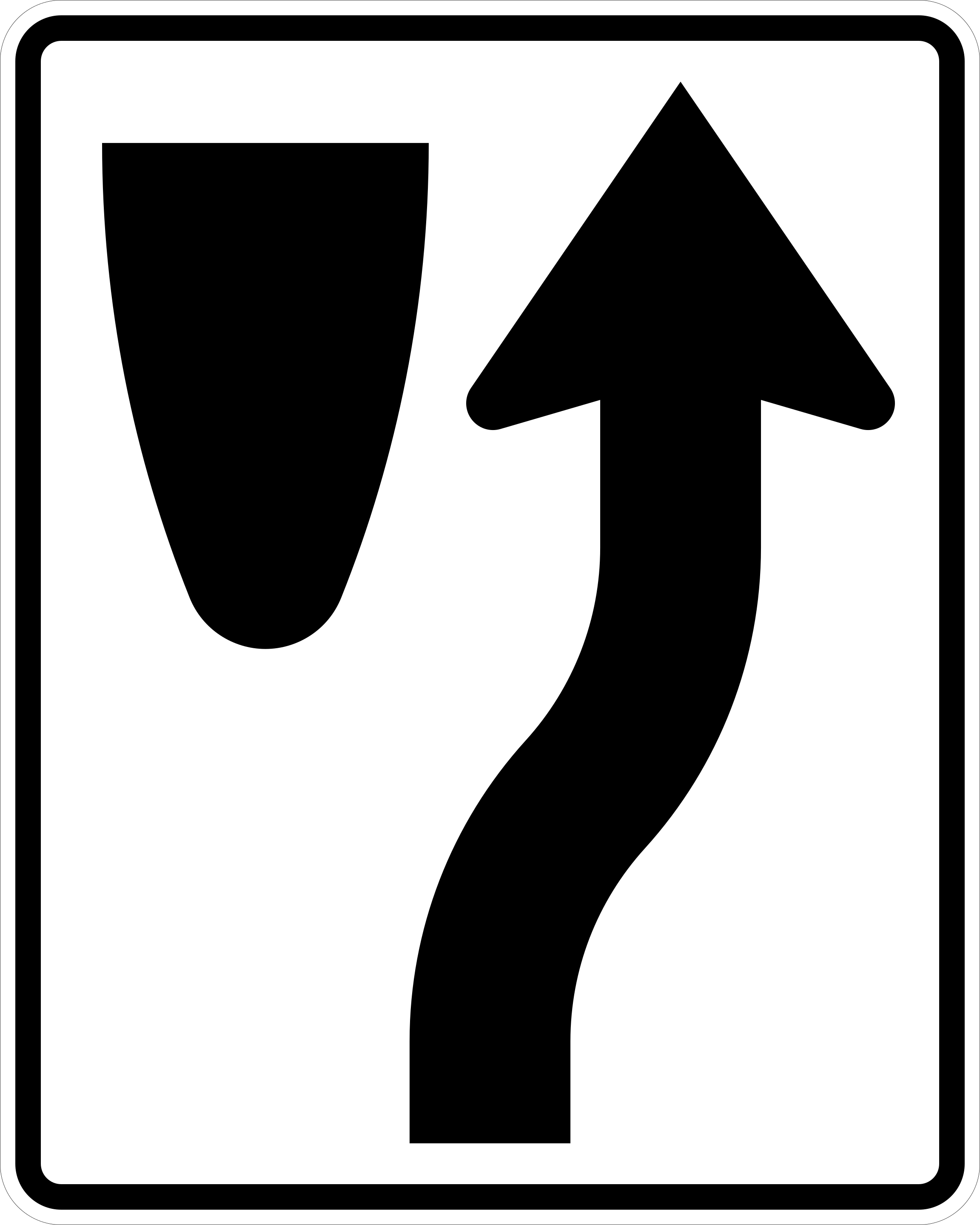
- One Way
- Wrong Way
- Keep Right
- Yield
Show answer
Keep Right. The New Jersey manual's appendix gallery of regulatory signs pictures this sign and labels it Keep Right. Regulatory signs regulate traffic speed and movement, so the driver should follow the direction the sign shows. One Way and Wrong Way are separate signs in the same gallery, and YIELD is the white inverted triangle with red wording and border. New Jersey law also requires motorists to keep to the right, and the manual's point table lists failure to keep right as a two point violation.
17. A vehicle problem prevents a New Jersey driver from keeping up with normal traffic. What should the driver do?
- Remain in the travel lane without warning
- Pull off the road and activate the hazard lights
- Stop across the nearest intersection
- Speed above the limit to match traffic
Show answer
Pull off the road and activate the hazard lights. If vehicle trouble prevents normal traffic speed, the manual directs the motorist to pull off the road and activate hazard lights. Staying in the lane leaves following drivers less time to react, while speeding creates another violation and stopping across an intersection blocks users. Move to a safe location as soon as control permits, make the vehicle visible, and seek assistance outside active traffic.
Study this in the handbook: Speed limits and safe speed
18. What does a New Jersey sign labeled LEFT TURN ONLY require?
- Turn left at the location marked
- Turn right at the next intersection
- Make a U-turn before proceeding
- Pass on the left side of traffic
Show answer
Turn left at the location marked. LEFT TURN ONLY directs traffic into a left turn; it is not a general instruction to pass, turn right, or reverse direction. The sign’s wording identifies the permitted movement at that location, so a driver should position the vehicle for the left turn and watch for pedestrians, vehicles, and the applicable signal or right-of-way rule. A U-turn prohibition and a passing rule are separate controls. Reading the complete sign message prevents treating a lane-direction instruction as permission for any other maneuver.
Study this in the handbook: Traffic signals and road markings
19. For a New Jersey GDL Option C applicant age 21 or older, how long must supervised driving continue before the next license step?
- At least six weeks
- At least nine months
- At least three months
- At least 50 logged hours
Show answer
At least three months. Option C is the adult road and requires practice with an adult supervising driver for at least three months. It does not use the 50-hour minimum printed for the younger pathways, so a logged-hour answer imports the wrong route. Six weeks and nine months are not the stated duration. Match the applicant’s age and GDL option to the chart: adult applicants count a three-month supervised period before the probationary-license step.
Study this in the handbook: Permits and the Graduated Driver License
20. After a first DUI with BAC from 0.08% to below 0.10%, how long is an ignition interlock required after restoration?
- Three months
- Nine to 15 months
- Two to four years
- Seven months to one year
Show answer
Three months. For a first DUI offense with BAC at least 0.08% but below 0.10%, New Jersey requires an ignition interlock for three months from the date driving privileges are restored. The seven months to one year range belongs to the higher 0.10% to below 0.15% bracket. Nine to 15 months is the period listed for a breath test refusal, while a first offense at 0.15% or higher carries 12 to 15 months. Two to four years applies to a second or subsequent DUI or refusal. Match the duration to the offense and BAC bracket.
Study this in the handbook: DUI, breath test refusal and interlock penalties
Insurance in New Jersey
New Jersey policies are handled in cooperation with licensed partner producer Sean Vu. QualitySpace Insurance Agency does not bind coverage in New Jersey directly. Contact us and we will route you to the right person.
Every question is written from the official New Jersey Driver Manual. Need paper? Printable NJ practice test with answer key.
Last verified 2026-10-12. How we check every question · Study all 500 as flashcards
Frequently asked questions
How many questions are on this New Jersey practice test?
This fixed set has 20 questions. It is test 6 of 25 from the 500 question New Jersey bank. The real NJ exam asks 50 questions and you need 40 correct.
What is the passing score for the real New Jersey test?
80 percent, or 40 of the 50 questions, must have correct answers That figure comes from the official New Jersey source cited on the DMV facts page.
How does this fixed test relate to the full New Jersey bank?
Each numbered test is a fixed set of questions in a fixed order, so you can retake the same test later and compare. Every test mixes road signs and the other topics in about the same proportion as the full bank. Tests 1 to 25 together cover every question in the New Jersey bank once. The full practice page mixes the whole bank at random.
Last verified 2026-10-12. See the New Jersey DMV facts page for sourced state details.
Return to the full New Jersey practice test · Study road signs