
Test 8 of 25 · 20 questions · Free 2026
NJ Permit Practice Test 8
Jump to the test ↓A fixed 20 question set from the New Jersey bank with answers and plain English explanations. The real NJ exam is 50 questions, 80 percent to pass; take the full length version on the main practice page.
Talk to Kevin
714-666-6669Call now →California policies handled directly by Kevin Vu (CDI #4037122). New Jersey and Pennsylvania policies handled in cooperation with licensed partner producer Sean Vu (Allstate). QualitySpace Insurance Agency does not bind coverage in NJ or PA directly.
Question 1 of 20 · 0 right so far
All 20 questions in test 8
Every question below comes from the New Jersey question bank on this page. Open a question to see the correct answer and the explanation. Nothing here is hidden behind a signup.
1. What is the New Jersey response when an engine dies and power steering fails?
- Release the wheel so the vehicle can center itself
- Keep a firm grip because extra hand power is needed, then stop safely
- Turn off all warning lights and continue at normal speed
- Apply the parking brake sharply while making a fast turn
Show answer
Keep a firm grip because extra hand power is needed, then stop safely. If an engine dies and power steering is lost, the driver should keep a firm grip because extra hand power is needed to turn or maintain control, then stop in a safe area off the roadway. Releasing the wheel abandons control, and a sharp parking-brake turn may cause a skid. The tactile cue is suddenly heavier steering after the engine stops.
Study this in the handbook: Vehicle emergencies and what to do after a crash
2. What do road arrows show when used with other signs?
- The location of the nearest inspection station
- That passing is always permitted
- That the roadway is closed to all traffic
- The correct direction a motorist must take in that lane
Show answer
The correct direction a motorist must take in that lane. Road arrows, when used with other signs, show the correct direction a motorist must take in that lane. They communicate lane-specific movement, not a service location, blanket passing permission, or a full road closure. Read the arrow together with the sign or marking beside it, since the two work as one instruction. Before entering an intersection, line up with the permitted direction and avoid treating an arrow as optional decoration.
Study this in the handbook: Traffic signals and road markings
3. What must an applicant under 18 present when applying for a New Jersey driver license?
- A court order waiving all testing
- A letter from an employer confirming full-time work
- A completed consent form signed by a parent or guardian
- A signed statement from any adult passenger
Show answer
A completed consent form signed by a parent or guardian. Applicants younger than 18 must present a completed consent form signed by a parent or guardian when applying for a New Jersey driver license. An employer letter and a statement from an unrelated adult do not supply the required parental or guardian consent. The rule also does not eliminate testing through a court order. For a minor applicant, check that the correct adult has signed the completed form before the licensing transaction.
4. How long may a motorist drive in New Jersey with a valid license from another country?
- Up to 30 days
- Until the foreign license expires, regardless of time
- Only while accompanied by a New Jersey license holder
- Up to one year
Show answer
Up to one year. A motorist with a valid license from another country may drive in New Jersey with that license for up to a year. Thirty days is the period associated with a different licensing circumstance, and an indefinite period ignores the manual's one-year limit. The foreign-license holder does not need a New Jersey license holder sitting alongside merely because the license was issued abroad. Track the one-year boundary and check the separate IDP guidance when language assistance is needed.
Study this in the handbook: Permits and the Graduated Driver License
5. Where does the New Jersey manual say to find the proper tire pressure?
- The owner's manual or the door jamb of the driver's door, or ask at a service station
- The tire sidewall only
- The registration card
- The inspection sticker
Show answer
The owner's manual or the door jamb of the driver's door, or ask at a service station. Bumps, cuts or bad tread can cause blowouts, so tires should be checked, and pressure should be checked often, especially when the tires are cold. A motorist should check the owner's manual or the door jamb of the driver's door to determine proper tire pressure, or ask for advice at a service station. The tire sidewall, registration card and inspection sticker are not the sources the manual names. Properly inflated tires also save money in fuel consumption.
Study this in the handbook: Seat belts, child seats and vehicle control
6. When a traffic signal shows a green arrow alone, what may the driver do?
- Travel in any direction after stopping
- Ignore the arrow and follow the next red signal
- Proceed only as shown by the arrow and yield to pedestrians
- Enter only after another car moves
Show answer
Proceed only as shown by the arrow and yield to pedestrians. A green arrow authorizes movement only along its displayed direction. It is not permission to select another turn or lane, and another vehicle does not determine whether the movement is allowed. The driver still watches for pedestrians in the crossing path. Read the arrow as a directional instruction, then proceed carefully when the route is clear. The signal controls direction, not careful observation.
Study this in the handbook: Traffic signals and road markings
7. What must a New Jersey motorist always obey?
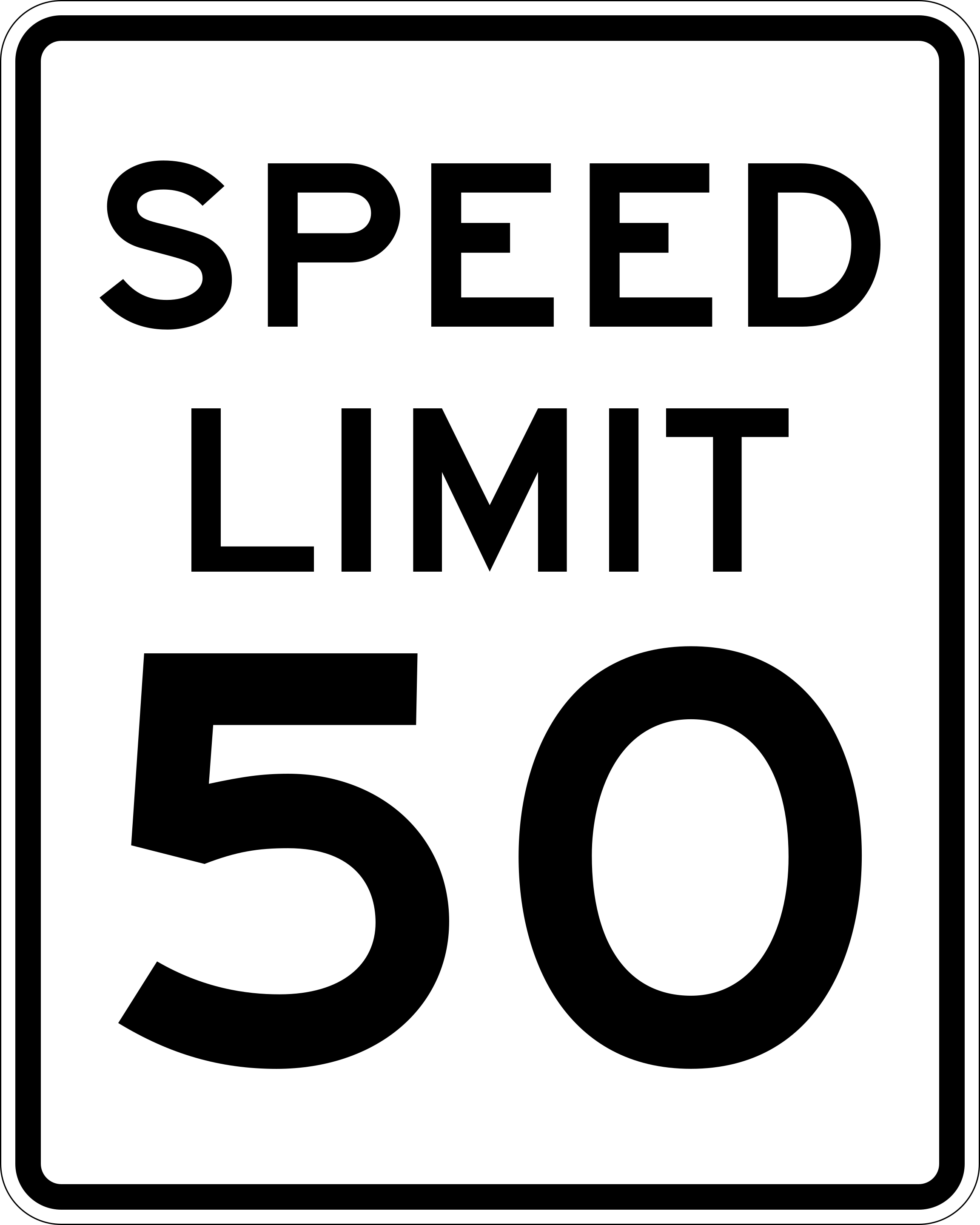
- The flow of traffic even when it exceeds the limit
- A 50 mph value regardless of road conditions
- An advisory speed as a mandatory minimum
- The speed limit
Show answer
The speed limit. The manual states that a motorist must always obey the speed limit. Keeping pace with traffic is acceptable only at a legal speed, and an advisory speed is not a mandatory minimum. A posted number such as 50 mph sets the legal ceiling for that location, but weather, traffic, and road hazards can require a slower speed. The cue on the pictured SPEED LIMIT sign is the word limit: it marks an upper boundary, not a promise that the same speed is safe in every condition.
Study this in the handbook: Speed limits and safe speed
8. At about what speed can tires start to hydroplane on a wet road, according to the New Jersey manual?
- About 35 mph
- About 15 mph
- About 65 mph
- Only above 80 mph
Show answer
About 35 mph. Wet roads can make tires hydroplane, riding up on a film of water, starting at about 35 mph, and the risk rises as speed rises. After 55 mph the tires may leave the road surface entirely, at which point braking is virtually impossible and turning is not possible. Fifteen mph is lower than the threshold the manual gives, while 65 and 80 mph wrongly suggest that only very high speeds are risky. On wet roads, drive more slowly and extend the following gap to four or more seconds.
Study this in the handbook: Following distance, weather and staying alert
9. What penalty can a New Jersey driver face for a first reckless driving offense?
- A $10 fine only
- Up to 60 days in jail, a fine of $50 to $200, or both
- A mandatory 10 year license revocation
- A written warning
Show answer
Up to 60 days in jail, a fine of $50 to $200, or both. Reckless driving in New Jersey means driving in a way that willfully endangers the rights, property or safety of others. A first offense is punishable by imprisonment of up to 60 days, a fine of not less than $50 or more than $200, or both, and motor vehicle points are also assessed. A ten dollar fine or a written warning understates the offense, and a mandatory ten year revocation is not the listed penalty.
Study this in the handbook: DUI, breath test refusal and interlock penalties
10. Under New Jersey's implied consent law, what happens to a driver who refuses a breath test after an arrest for intoxicated driving?
- The driver is released, because testing requires written consent
- The DUI charge must be dropped
- The driver is taken to a hospital, where staff may draw blood
- The driver may test at home the next day instead
Show answer
The driver is taken to a hospital, where staff may draw blood. By driving on New Jersey roads, a motorist has already agreed to submit to a breath test after an arrest for an intoxicated driving offense. Refusal does not end the matter. The driver is detained and brought to a hospital, and hospital staff may draw blood. Written consent at the scene is not needed, because the consent is implied by using the roads. Refusing does not cancel the DUI charge; it adds a separate refusal offense. Testing at home later is not an option the law offers.
Study this in the handbook: DUI, breath test refusal and interlock penalties
11. How long is a first-offense New Jersey DUI driver required to take part in an Intoxicated Driver Resource Center program?
- One to two hours
- 12 to 48 hours
- Two weeks
- Six months
Show answer
12 to 48 hours. A first DUI in New Jersey carries 12 to 48 hours of participation at an Intoxicated Driver Resource Center, and the driver pays an IDRC fee on top of the fine. During that time the center runs an alcohol and highway safety education program and evaluates the driver for an alcohol or drug problem. One or two hours is far shorter than required. Two weeks and six months describe no part of the first offense detention; if treatment is needed, the IDRC refers the person to a separate provider.
Study this in the handbook: DUI, breath test refusal and interlock penalties
12. What may road work do to traffic patterns in New Jersey?
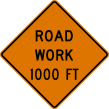
- Remove the need to obey posted signs
- Guarantee that all lanes remain open
- Change a road into a railroad crossing
- Temporarily close lanes or divert them
Show answer
Temporarily close lanes or divert them. The manual notes that road work may temporarily close lanes or divert them, changing traffic patterns. Drivers should expect cones, lane shifts, flaggers, uneven pavement, or detours rather than assuming the normal path remains available. The other choices reverse the warning: work zones do not guarantee open lanes, create railroad crossings, or suspend traffic rules. Reduce speed as directed, leave extra space, read every temporary sign, and be ready to stop for workers or a flagger.
Study this in the handbook: Road sign shapes and colors
13. What does a downward hand and arm signal mean?
- The driver is turning right
- The driver is stopping or slowing down
- The driver is turning left
- The driver is passing another vehicle
Show answer
The driver is stopping or slowing down. A downward hand and arm signal, with the palm facing the rear, means the driver is stopping or slowing down. An upward arm signals a right turn, while an arm extended straight out signals a left turn. Passing is not represented by this hand signal. The arm should extend well outside the vehicle so other motorists can see it. Even when using the vehicle's turn signals, understand these standard hand signals because a bicyclist or another motorist may use one to communicate an upcoming movement.
Study this in the handbook: Turn signals, hand signals and the horn
14. Which passing action is illegal under New Jersey rules?
- Passing on the left where the center line is broken and the view is clear
- Passing on a road with two lanes going in the same direction when traffic permits
- Passing on the right shoulder of the road
- Passing a vehicle ahead that is turning left when there is room
Show answer
Passing on the right shoulder of the road. New Jersey expressly says never to pass on the right shoulder of the road and identifies that action as against the law. The other choices describe circumstances in which passing may be allowed, but they still require a clear view, lawful markings, and enough room to complete the maneuver. A shoulder is not an extra travel lane for overtaking. Before passing, check the center line, roadway width, traffic movement, and the vehicle ahead’s action, then remain within the marked travel lanes.
Study this in the handbook: Right of way, intersections and passing
15. How does the fatality rate of a vehicle-pedestrian crash change between 20 mph and 40 mph, according to the New Jersey manual?
- It stays about the same
- It rises from about 20 percent to 30 percent
- It rises from about 5 percent to 85 percent
- It falls because drivers brake harder
Show answer
It rises from about 5 percent to 85 percent. Speed is the biggest factor in whether a struck pedestrian survives. The New Jersey manual says vehicle-pedestrian crashes have a five percent fatality rate when the car is going 20 mph, but the rate jumps to 85 percent at 40 mph. Pedestrians accounted for 27 percent of New Jersey traffic deaths in 2016, well above the 15 percent national average. Claiming the rate stays the same or falls is wrong, and a rise from 20 to 30 percent badly understates the jump.
Study this in the handbook: Pedestrians, cyclists, trucks and trains
16. At an intersection where stop lines are missing, where does the New Jersey manual tell you to stop for a pedestrian in a crosswalk?
- Before the crosswalk
- On the crosswalk line
- Past the crosswalk in the far lane
- Only at intersections with a traffic signal
Show answer
Before the crosswalk. The current manual states the rule as a position, not a set distance: at intersections where stop lines are missing, stop before the crosswalk when required to stop by signs, signals, or for pedestrians. Stopping on or past the line puts your vehicle in the crossing, and the rule applies whenever you must stop for a pedestrian, with or without a signal. Never pass a vehicle stopped at a crosswalk.
Study this in the handbook: Pedestrians, cyclists, trucks and trains
17. A New Jersey driver leaves the scene of a crash in which someone was injured. How many points are assessed?
- Two
- Eight
- Four
- Five
Show answer
Eight. Leaving the scene is split into two lines on New Jersey's point chart. When no one is hurt, it is 2 points. When the crash involves personal injury, it jumps to 8 points, the highest single value on the chart. Beyond the points, a hit-and-run involving bodily injury can bring a fine of $2,500 to $5,000, jail time, and a one-year license loss for a first offense. Four and five points belong to other violations, such as improper passing and tailgating.
Study this in the handbook: Points, surcharges and driver programs
18. When does a handheld phone conviction put motor vehicle points on a New Jersey driving record?
- On the first violation, which adds two points
- Never, because phone offenses carry fines only
- Only when the phone use causes a crash
- On a third or subsequent violation, which adds three points
Show answer
On a third or subsequent violation, which adds three points. New Jersey handles phone violations mostly with fines at first. Points arrive with a third or subsequent conviction, which adds three motor vehicle penalty points, and a 90 day license suspension is also possible. A first violation carries a fine but no points, so the two point claim is wrong. Saying phone offenses never carry points ignores the rule for repeat offenders. A crash is not required for the points; the conviction itself is enough.
Study this in the handbook: Where not to park, headlights and phones
19. How can a New Jersey driver's point total go down without taking any course?
- All points are erased after six months
- Points drop only if the driver pays a fee
- Up to three points come off for each year with no violation or suspension
- Points never decrease without a course
Show answer
Up to three points come off for each year with no violation or suspension. New Jersey rewards a clean year. For every year a motorist goes without a violation or suspension, and keeps the driving privilege in good standing, up to three points are subtracted from the total, which never goes below zero. Points are not wiped out after six months, and no fee buys them off. Courses are another route: a defensive driving course removes two points and a Driver Improvement Program removes three, but the yearly reduction happens with no class at all.
Study this in the handbook: Points, surcharges and driver programs
20. How close to a stop sign may a New Jersey driver park?
- No closer than 50 feet
- No closer than 10 feet
- No closer than 25 feet
- Right up to the sign
Show answer
No closer than 50 feet. New Jersey's no-parking list keeps cars at least 50 feet from a stop sign, and the same 50 feet applies near a railroad crossing. Ten feet is the distance from a fire hydrant, and 25 feet is the distance from a crosswalk at an intersection, so both are real numbers that belong to other items on the same list. Parking right up to the sign falls inside the 50 foot zone. In case of mechanical trouble or another emergency, stop on the right shoulder and turn on the emergency flashers.
Study this in the handbook: Where not to park, headlights and phones
Insurance in New Jersey
New Jersey policies are handled in cooperation with licensed partner producer Sean Vu. QualitySpace Insurance Agency does not bind coverage in New Jersey directly. Contact us and we will route you to the right person.
Every question is written from the official New Jersey Driver Manual. Need paper? Printable NJ practice test with answer key.
Last verified 2026-10-12. How we check every question · Study all 500 as flashcards
Frequently asked questions
How many questions are on this New Jersey practice test?
This fixed set has 20 questions. It is test 8 of 25 from the 500 question New Jersey bank. The real NJ exam asks 50 questions and you need 40 correct.
What is the passing score for the real New Jersey test?
80 percent, or 40 of the 50 questions, must have correct answers That figure comes from the official New Jersey source cited on the DMV facts page.
How does this fixed test relate to the full New Jersey bank?
Each numbered test is a fixed set of questions in a fixed order, so you can retake the same test later and compare. Every test mixes road signs and the other topics in about the same proportion as the full bank. Tests 1 to 25 together cover every question in the New Jersey bank once. The full practice page mixes the whole bank at random.
Last verified 2026-10-12. See the New Jersey DMV facts page for sourced state details.
Return to the full New Jersey practice test · Study road signs