
Test 13 of 25 · 20 questions · Free 2026
NJ Permit Practice Test 13
Jump to the test ↓A fixed 20 question set from the New Jersey bank with answers and plain English explanations. The real NJ exam is 50 questions, 80 percent to pass; take the full length version on the main practice page.
Talk to Kevin
714-666-6669Call now →California policies handled directly by Kevin Vu (CDI #4037122). New Jersey and Pennsylvania policies handled in cooperation with licensed partner producer Sean Vu (Allstate). QualitySpace Insurance Agency does not bind coverage in NJ or PA directly.
Question 1 of 20 · 0 right so far

All 20 questions in test 13
Every question below comes from the New Jersey question bank on this page. Open a question to see the correct answer and the explanation. Nothing here is hidden behind a signup.
1. What does the round yellow railroad sign warn of in New Jersey?
- A railroad crossing behind the vehicle
- A railroad crossing ahead
- A station where parking is required
- A crossing reserved for pedestrians only
Show answer
A railroad crossing ahead. The yellow circular RR advance-warning sign announces a railroad crossing ahead. It gives the driver time to reduce speed, look for trains, and avoid entering the crossing without room to clear it. A crossbuck marks the crossing itself, so confusing those two signs reverses their locations. The round shape is the key study cue: yellow and circular means prepare for the railroad crossing that is still ahead on the roadway.
Study this in the handbook: Pedestrians, cyclists, trucks and trains
2. When may a New Jersey motorist drive over a fire hose?
- Only when directed to do so by a fire, emergency rescue, or police official
- When no fire truck is visible nearby
- Whenever the hose looks flat and empty
- At any speed, if the motorist honks first
Show answer
Only when directed to do so by a fire, emergency rescue, or police official. Driving over a fire hose requires direction from a fire, emergency rescue, or police official, with no self-granted exceptions. The manual bars crossing a hose unless an official directs it, so a flat appearance gives no permission to cross. A missing truck nearby does not create an exception to that bar. Honking announces the violation without curing it. Treat every hose on the roadway as protected equipment: cross only when a fire, emergency rescue, or police official directs the vehicle across.
Study this in the handbook: Right of way, intersections and passing
3. On a multi-lane New Jersey roadway, where must a motorist normally drive when that lane is available?
- In the lane nearest the right-hand edge or curb, except when overtaking or preparing for a left turn
- In the left lane at all times to stay visible
- In whichever lane feels smoothest, with no default side
- In the center lane only, even when the right lane is open
Show answer
In the lane nearest the right-hand edge or curb, except when overtaking or preparing for a left turn. On a multi-lane roadway, drive in the available lane nearest the right-hand edge or curb, except when overtaking another vehicle or preparing for a left turn. The cited passage reads: "motorists must drive in the lane nearest to the righthand edge or curb of the roadway when the lane is available for travel, except when overtaking another vehicle or in preparation for a left turn" Among the options, "In the lane nearest the right-hand edge or curb, except when overtaking or preparing for a left turn" matches that passage, while "In the left lane at all times to stay visible", "In whichever lane feels smoothest, with no default side", and "In the center lane only, even when the right lane is open" each alter its terms.
Study this in the handbook: Right of way, intersections and passing
4. Between intersections in New Jersey, when may solid center lines be crossed with care?
- Whenever no traffic is visible in either direction
- When passing a slow vehicle on a two-lane road
- When entering or leaving driveways in business or residential areas
- Only during daylight hours on any street
Show answer
When entering or leaving driveways in business or residential areas. Between intersections, solid lines still bar passing, yet they may be crossed with care when entering or leaving driveways in business or residential areas. An empty view in both directions does not convert solid paint into a passing invitation. Passing a slow vehicle is exactly the maneuver those lines forbid. Daylight adds no exception either. Driveway access is the narrow doorway through an otherwise closed line.
5. A New Jersey railroad crossing has flashing red lights and ringing bells. Where must the driver stop?
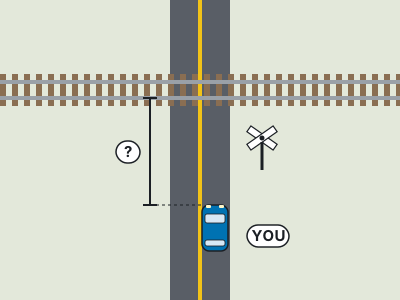
- At least 5 feet from the crossing
- At least 50 feet from the crossing
- At least 15 feet from the crossing
- Just past the lowered gate
Show answer
At least 15 feet from the crossing. When a New Jersey crossing shows flashing red lights, ringing bells, lowered or descending gates, or a flag signal, a train is coming and the driver must stop at least 15 feet from the crossing. Five feet leaves too little room from a passing train. Fifty feet is the no-parking distance from a railroad crossing, a different rule. Going past the gate is never allowed. The driver waits until the gates rise, the bells stop, and the lights stop flashing, because a freight train traveling at 55 mph can take a mile or more to stop.
Study this in the handbook: School buses, railroad crossings and highway ramps
6. One standard drink of liquor, beer, or wine contains about how much pure alcohol?
- About 1 ounce
- About a half ounce
- About 2 ounces
- Each drink type contains a different large amount
Show answer
About a half ounce. The manual states that 1½ ounces of 80-proof whiskey, 12 ounces of beer, or 5 ounces of wine each contain about a half ounce of alcohol. The cited passage reads: "For example, 1½ ounces of 80-proof whiskey, 12 ounces of beer or 5 ounces of wine all contain the same amount of alcohol: about a ½ ounce of alcohol per drink." Among the options, "About a half ounce" matches that passage, while "About 1 ounce", "About 2 ounces", and "Each drink type contains a different large amount" each alter its terms.
Study this in the handbook: Alcohol, drugs and your BAC
7. A plate cover hides part of the lettering on a New Jersey license plate. What fine may follow?
- Up to $25
- Up to $1,000
- Up to $100
- No fine for a clear cover
Show answer
Up to $100. Using license plates covers or holders that obscure or conceal any lettering on the license plate is a violation, with a fine of up to $100. The cited passage reads: "Using license plates covers or holders that obscure or conceal any lettering on the license plate is a violation, with a fine of up to $100." Among the options, "Up to $100" matches that passage, while "Up to $25", "Up to $1,000", and "No fine for a clear cover" each alter its terms.
8. How many states plus the District of Columbia belong to the Nonresident Violator Compact described in the manual?
- 44 states and the District of Columbia
- 30 states and the District of Columbia
- 49 states and the District of Columbia
- All 50 states and the District of Columbia
Show answer
44 states and the District of Columbia. Equal treatment for visitors drives this network: nonresident motorists in member states receive the same handling as residents, and forty four states plus the District of Columbia take part. A citation earned away from home must be satisfied, otherwise the home state can suspend the license until its terms are met, while due process bars detaining the visitor out of state. Thirty members shrinks the reach, and the highest guesses ignore six states named as staying outside.
Study this in the handbook: Points, surcharges and driver programs
9. How soon must a New Jersey motorist report a legal name change to the MVC?
- Within two weeks
- Within six months
- Only at the next traffic stop
- No report is needed after marriage
Show answer
Within two weeks. A legal name change caused by marriage, divorce, or a court order must be reported to the MVC within two weeks. The six-month option gives the motorist far longer than the stated period, and a traffic stop is not the reporting mechanism. Marriage is specifically included rather than being an exemption. When a question describes a legal name change, look for the two-week deadline and distinguish it from the separate one-week deadline for an address change.
Study this in the handbook: Permits and the Graduated Driver License
10. How much is the DUI surcharge listed apart from fund fees for a first DUI offense in New Jersey?
- $75
- $125
- $100
- $33
Show answer
$125. The DUI surcharge itself is $125, distinct from the fund fees surrounding it in the penalty list. The $75 figure pays safe neighborhood services, so it tempts anyone scanning amounts without labels. The $100 figure pays enforcement or rehabilitation funds instead. The $33 figure settles court costs. Reading the label beside each amount prevents swapping one charge for another when the total bill arrives.
Study this in the handbook: DUI, breath test refusal and interlock penalties
11. What does the term stale green light mean?
- A light that turns green twice quickly
- A green light with a broken bulb
- A green arrow pointing left only
- A light that has been green for some time
Show answer
A light that has been green for some time. A stale green light is a light that has been green for some time. Be alert: when a yellow follows a green, stop before entering the intersection unless the yellow appears when you are too close to stop safely. The cited passage reads: "Be alert for a stale green light; this is a light that has been green for some time." Among the options, "A light that has been green for some time" matches that passage, while "A green light with a broken bulb", "A green arrow pointing left only", and "A light that turns green twice quickly" each alter its terms.
12. Which condition does the New Jersey manual list as a time when a motorist should always slow down?
- On a straight, dry road with no traffic
- When visibility is limited
- When a vehicle ahead is far away
- On a multi lane road in daylight
Show answer
When visibility is limited. The manual lists conditions when a motorist should always slow down: narrow or winding roads, intersections or railroad crossings, hills, sharp or blind curves, places with pedestrians or driving hazards, wet, icy, or slippery roads, and when visibility is limited. A straight, dry, empty road, a distant vehicle, or a daylight multi lane road does not appear on that list.
Study this in the handbook: Speed limits and safe speed
13. During rush hour on a highway through a city, which lane choice avoids merge conflicts?
- Weave between lanes to find gaps
- Stay in the right lane beside every ramp
- Stop on the shoulder until traffic thins
- Drive in the left or center lane
Show answer
Drive in the left or center lane. On highways through cities during rush hour, the manual recommends driving in the left or center lane to avoid merge conflicts. Search for exits early and adjust position for your exit. The cited passage reads: "The motorist should drive in the left or center lane to avoid merge conflicts during rush hour." Among the options, "Drive in the left or center lane" matches that passage, while "Stay in the right lane beside every ramp", "Stop on the shoulder until traffic thins", and "Weave between lanes to find gaps" each alter its terms.
14. What yearly surcharge faces a New Jersey unlicensed driver under the violation surcharge table?
- $250
- $1,000
- $100
- $1,500
Show answer
$100. The violation surcharge table lists $100 for an unlicensed driver. The manual says convicted or administratively suspended motorists must pay the prescribed amount each year for three years. The cited passage reads: "Unlicensed driver (N.J.A.C. 13:19-13.1) $100 No insurance - motorized bicycle (N.J.A.C. 13:19-13.1) $100" Among the options, "$100" matches that passage, while "$250", "$1,000", and "$1,500" each alter its terms.
Study this in the handbook: Points, surcharges and driver programs
15. A truck ahead is preparing to back up in New Jersey. What must a following motorist do?
- Slip past quickly before the reverse lights brighten
- Stop directly behind its bumper to block other traffic
- Honk steadily while crossing behind the trailer
- Stay far behind it and never pass close behind it while it backs
Show answer
Stay far behind it and never pass close behind it while it backs. Stay far behind a truck or tractor-trailer that is preparing to back up or is backing up, and never pass close behind it. The manual explains that the area behind it is a blind spot for the truck driver and other motorists, and that its width can hide objects between it and a loading area. The cited passage reads: "Stay far behind a truck or tractor-trailer that is preparing to back up or is backing up. Never pass close behind a truck or tractor-trailer that is preparing to back up or is in the process of backing up."
16. A basic license applicant has sight in one eye only. What vision rule applies to that applicant?
- That eye must meet 20/40, with no paperwork
- One-eyed applicants cannot be licensed
- That eye must meet the 20/50 rule, with documentation signed by a licensed physician
- That eye must meet 20/70, with a note from any employer
Show answer
That eye must meet the 20/50 rule, with documentation signed by a licensed physician. Basic applicants normally need 20/50 vision with or without corrective lenses. For sight in one eye only, that single eye must meet the same 20/50 rule and the applicant must bring documentation signed by a licensed physician. The standard is not raised to 20/40, licensing is not banned outright, and an employer note cannot substitute for a physician signature. Two checks matter here: the acuity number and who signs the proof.
Study this in the handbook: The knowledge test and road test
17. When making a 3-point turn, also called a K-turn, where should a motorist start?
- From the left edge of the road
- From a driveway apron, without signaling
- From the center of an intersection
- From the right edge of the road
Show answer
From the right edge of the road. Start a K-turn from the right edge of the road at a safe spot with good visibility in both directions. If there is no other traffic, signal left and move forward slowly while turning the steering wheel left. The cited passage reads: "When turning a vehicle around, a motorist should start from the right edge of the road." Among the options, "From the right edge of the road" matches that passage, while "From the left edge of the road", "From the center of an intersection", and "From a driveway apron, without signaling" each alter its terms.
Study this in the handbook: Turn signals, hand signals and the horn
18. How long can it take a motorist to recover from the glare of approaching high-beam headlights?
- No recovery time is needed
- One second
- Fifteen seconds
- Three to five seconds
Show answer
Three to five seconds. Bright beams shrink pupils that darkness had opened, and full vision needs three to five seconds to return after the glare passes. One second understates a recovery that can carry a car the length of a football field at 50 mph, fifteen stretches it beyond the stated span, and claiming instant recovery denies the temporary blindness altogether. Look toward the right edge until the oncoming vehicle goes by.
Study this in the handbook: Where not to park, headlights and phones
19. If litter is thrown from a vehicle while that vehicle is moving, what extra consequence can follow?
- Only a warning with no penalty
- The motorist may lose their license
- The passengers lose their licenses
- The vehicle is impounded for a year
Show answer
The motorist may lose their license. If litter is thrown while the vehicle is moving, the motorist may lose their license. The manual also states that fines of up to $1,000 may be imposed on motorists who throw dangerous objects from a vehicle onto a roadway. The cited passage reads: "If the vehicle is moving when litter is thrown, the motorist may lose their license." Among the options, "The motorist may lose their license" matches that passage, while "Only a warning with no penalty", "The passengers lose their licenses", and "The vehicle is impounded for a year" each alter its terms.
20. A driver leaves a New Jersey crash scene where nobody was hurt. How many points are assessed?
- Two points on the driving record
- Eight points on the driving record
- Five points on the driving record
- No points for a property-only crash
Show answer
Two points on the driving record. Leaving a crash with no personal injury adds two points. Eight points is reserved for scenes where someone was injured, and five points overshoots the property only value. Treating a damage only departure as free of points misses the two point assessment in the chart. The chart lists the no injury and personal injury values side by side, so whether anyone was hurt decides which value applies.
Study this in the handbook: Points, surcharges and driver programs
Insurance in New Jersey
New Jersey policies are handled in cooperation with licensed partner producer Sean Vu. QualitySpace Insurance Agency does not bind coverage in New Jersey directly. Contact us and we will route you to the right person.
Every question is written from the official New Jersey Driver Manual. Need paper? Printable NJ practice test with answer key.
Last verified 2026-10-12. How we check every question · Study all 500 as flashcards
Frequently asked questions
How many questions are on this New Jersey practice test?
This fixed set has 20 questions. It is test 13 of 25 from the 500 question New Jersey bank. The real NJ exam asks 50 questions and you need 40 correct.
What is the passing score for the real New Jersey test?
80 percent, or 40 of the 50 questions, must have correct answers That figure comes from the official New Jersey source cited on the DMV facts page.
How does this fixed test relate to the full New Jersey bank?
Each numbered test is a fixed set of questions in a fixed order, so you can retake the same test later and compare. Every test mixes road signs and the other topics in about the same proportion as the full bank. Tests 1 to 25 together cover every question in the New Jersey bank once. The full practice page mixes the whole bank at random.
Last verified 2026-10-12. See the New Jersey DMV facts page for sourced state details.
Return to the full New Jersey practice test · Study road signs