
Test 14 of 25 · 20 questions · Free 2026
NJ Permit Practice Test 14
Jump to the test ↓A fixed 20 question set from the New Jersey bank with answers and plain English explanations. The real NJ exam is 50 questions, 80 percent to pass; take the full length version on the main practice page.
Talk to Kevin
714-666-6669Call now →California policies handled directly by Kevin Vu (CDI #4037122). New Jersey and Pennsylvania policies handled in cooperation with licensed partner producer Sean Vu (Allstate). QualitySpace Insurance Agency does not bind coverage in NJ or PA directly.
Question 1 of 20 · 0 right so far
All 20 questions in test 14
Every question below comes from the New Jersey question bank on this page. Open a question to see the correct answer and the explanation. Nothing here is hidden behind a signup.
1. At what blood alcohol concentration may a New Jersey driver be convicted of driving under the influence?
- 0.15% only when a crash occurs
- 0.01% only for drivers over 21
- 0.08% or higher
- Any reading only after a refusal
Show answer
0.08% or higher. New Jersey identifies a BAC of 0.08 percent or higher as a basis for a DUI conviction, and impairment by intoxicating liquor or drugs can also qualify. The 0.01 percent figure belongs to an additional penalty rule for drivers under age 21, not the general threshold for adult drivers. A 0.15 percent reading is relevant to some penalty categories, but it is not the point at which the DUI rule begins. Treat the BAC figure as a legal threshold, not a safe-driving target.
Study this in the handbook: DUI, breath test refusal and interlock penalties
2. Why does the New Jersey manual urge lower speeds where pedestrians may be present?
- They only matter on highways
- They mostly reduce fuel use
- They have little effect on injuries
- They give drivers more time to react and greatly improve pedestrian survival
Show answer
They give drivers more time to react and greatly improve pedestrian survival. The manual says speed is especially dangerous where pedestrians may be present, and that even small increases in speed significantly raise the risk of severe injury or death in a crash. Lower speeds give drivers more time to react and greatly improve pedestrian survival. The rule is about people on foot near the road, not highways only, fuel use, or a claim that speed changes little.
Study this in the handbook: Speed limits and safe speed
3. On a multi-lane roadway, where should a motorist stop for a crosswalk, and why?
- Only in the far left lane
- Directly on the crosswalk for best visibility
- Past the crosswalk, near the far curb
- Far enough in advance of the crosswalk to avoid blocking the view of drivers in adjacent lanes
Show answer
Far enough in advance of the crosswalk to avoid blocking the view of drivers in adjacent lanes. On a multi-lane roadway, stop far enough in advance of the crosswalk to avoid blocking the view of drivers in adjacent lanes. The cited passage reads: "When stopping on a multi-lane roadway, motorists should stop far enough in advance of the crosswalk to avoid blocking the view of drivers in adjacent lanes." Among the options, "Far enough in advance of the crosswalk to avoid blocking the view of drivers in adjacent lanes" matches that passage, while "Directly on the crosswalk for best visibility", "Past the crosswalk, near the far curb", and "Only in the far left lane" each alter its terms.
4. A person drives while the license is suspended and crashes, injuring another person. What jail exposure is listed?
- No jail time
- A potential minimum 45-day jail sentence, plus fine and continued suspension
- Up to 10 days in jail
- A minimum one year in jail
Show answer
A potential minimum 45-day jail sentence, plus fine and continued suspension. Driving suspended is serious alone, yet injury raises it further: the result is a fine, continued suspension, and the potential for a minimum 45-day jail sentence when the crash injures another person. Ten days understates that floor, no jail ignores it, and a full year overshoots the minimum described. The injury element is what separates this scenario from ordinary suspended driving, so note how the penalty language changes once someone is hurt.
5. How does the New Jersey manual say a driver should use the interim (overhead) lights inside the vehicle while driving?
- Keep them on whenever driving at night
- Use them to light the dashboard dials
- Leave them on to improve rear visibility
- Only briefly, when necessary
Show answer
Only briefly, when necessary. The manual describes interim, or overhead, lights found inside the vehicle and says they should be used only briefly, when necessary, while driving. They may also be used to comply with a police officer's request to illuminate the compartment of a stopped vehicle. Leaving them on at night, using them for the dials, or using them for rear visibility is not what the manual describes.
Study this in the handbook: Where not to park, headlights and phones
6. Two vehicles meet at a New Jersey intersection and both signal left turns. How should each motorist turn when safe?
- To the right of the center of the intersection
- To the left of the center of the intersection
- One vehicle must abandon the turn and go straight
- Straight through first, then reverse into the side street
Show answer
To the left of the center of the intersection. When two vehicles meet at an intersection and both signal left turns, use extra caution. When safe, each motorist should turn to the left of the center of the intersection. The cited passage reads: "Left turns, two vehicles: When two vehicles meet at an intersection and both have signaled to turn left, extra caution must be applied. When safe, each motorist should turn to the left of the center of the intersection" Among the options, "To the left of the center of the intersection" matches that passage, while "To the right of the center of the intersection", "Straight through first, then reverse into the side street", and "One vehicle must abandon the turn and go straight" each alter its terms.
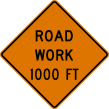
7. What temporary conditions can orange road work signs warn about?
- Only permanent speed limits on rural highways
- A vehicle's registration expiration date
- The location of every railroad crossing
- Lane closings, lane shifts, flaggers, uneven pavement, and detours
Show answer
Lane closings, lane shifts, flaggers, uneven pavement, and detours. Orange, diamond-shaped road work signs can warn about lane closing, lane shifts, flaggers, uneven pavement, and detours. These conditions may temporarily change traffic patterns, so drivers should read the signs, follow directions, and be ready to slow or stop. The orange road-work sign shown is an example of this temporary warning category. A permanent speed limit, registration date, or railroad location requires a different sign or document.
Study this in the handbook: Road sign shapes and colors
8. A 23-year-old in New Jersey holds an examination permit. Which GDL restrictions no longer apply because of age?
- The hour, passenger, and decal restrictions
- The requirement to practice with an adult supervising driver
- The rule that the permit holder and passengers wear seat belts
- Every restriction, since permits do not limit adults
Show answer
The hour, passenger, and decal restrictions. Once an examination permit or probationary license holder is 21 or older, New Jersey drops three GDL limits: the 11:01 p.m. to 5:00 a.m. hours rule, the passenger limit, and the red decal requirement. Other conditions remain. An adult on a permit still practices with a qualified supervising driver, which is why the adult road keeps a supervised driving step. Seat belt use by the driver and every passenger is still required. Claiming that all restrictions vanish overstates the exemption; age lifts only those three.
Study this in the handbook: Permits and the Graduated Driver License
9. Which single vehicle requires a Class B commercial driver license in New Jersey?
- Any vehicle with a gross vehicle weight rating of 26,001 pounds or more
- Any vehicle with a gross vehicle weight rating of 15,001 to 20,000 pounds
- Any vehicle with a gross vehicle weight rating under 10,000 pounds
- Any passenger car regardless of weight rating
Show answer
Any vehicle with a gross vehicle weight rating of 26,001 pounds or more. The manual lists a GVWR of 26,001 pounds or more for Class B vehicles. Lower weight alone does not rule out all CDL requirements: the manual also lists Class C requirements for certain buses and vehicles carrying hazardous materials. The cited passage reads: "Class B: License is necessary for the operation of: • Any vehicle with a GVWR of 26,001 pounds or more" Among the options, "Any vehicle with a gross vehicle weight rating of 26,001 pounds or more" matches that passage, while "Any vehicle with a gross vehicle weight rating under 10,000 pounds", "Any vehicle with a gross vehicle weight rating of 15,001 to 20,000 pounds", and "Any passenger car regardless of weight rating" each alter its terms.
10. Where are second-time DUI offenders detained for Intoxicated Driver Resource Center programs in New Jersey?
- At any private treatment office the driver chooses
- At the county IDRC in each of the 21 counties
- At one of three regional IDRCs
- At the MVC Licensing Center where the license was issued
Show answer
At one of three regional IDRCs. Second-time offenders are detained at one of three regional IDRCs. Each of New Jersey’s 21 counties has an IDRC where first- and third-time offenders are detained. The cited passage reads: "Second-time offenders are detained at one of three regional IDRCs" Among the options, "At one of three regional IDRCs" matches that passage, while "At the county IDRC in each of the 21 counties", "At any private treatment office the driver chooses", and "At the MVC Licensing Center where the license was issued" each alter its terms.
11. What must a motorist never do with a steering wheel ignition while the vehicle is still moving in New Jersey guidance?
- Turn the ignition to the accessory position to restart the radio
- Turn the ignition to the lock position
- Shift to neutral before coasting to a stop
- Grip the wheel firmly while slowing
Show answer
Turn the ignition to the lock position. Never turn the ignition to the lock position while the vehicle is in motion, because the steering will lock as the vehicle turns and the motorist will lose control. The manual names the lock position for this prohibition, so a turn toward accessory for a radio is not the stated forbidden action, even though the switch is not a control to play with in an emergency. Shifting to neutral is the move the manual gives for a stuck gas pedal, and holding the wheel firmly supports control. Lock waits until the wheels stop.
Study this in the handbook: Following distance, weather and staying alert
12. A motorist is convicted for the third time of operating on a suspended license or registration in New Jersey. What penalty applies?
- A $1,000 fine, a 10-day jail sentence, and up to six months added suspension
- A $750 fine, jail for not more than five days, and up to six months added suspension
- A $500 fine and up to six months added suspension
- A $1,500 fine, a 30-day jail sentence, and up to one year added suspension
Show answer
A $1,000 fine, a 10-day jail sentence, and up to six months added suspension. For a third offense of driving while a license or registration is suspended, the manual lists a $1,000 fine, a 10-day jail sentence, and up to six months of additional license or registration suspension. The second-offense fine is $750 with a jail sentence of not more than five days; the first-offense fine is $500. The cited passage reads: "Third offense: Fine of $1,000, a 10-day jail sentence and up to six months additional license and/or registration suspension."
Study this in the handbook: Pedestrians, cyclists, trucks and trains
13. A vehicle owner knowingly lets a person whose license is suspended for DUI or refusal drive the vehicle. What fine and jail exposure apply to a first or second offense by the owner?
- A $500 fine, imprisonment for not more than 5 days, or both
- A $250 fine, imprisonment for not more than 10 days, or both
- A $1,000 fine, imprisonment for not more than 15 days, or both
- A $2,000 fine, imprisonment for not more than 30 days, or both
Show answer
A $1,000 fine, imprisonment for not more than 15 days, or both. An owner who knowingly hands keys to a driver suspended for DUI or refusal faces, for a first or second offense, a $1,000 fine, imprisonment for not more than 15 days, or both, plus suspension of license and registration for up to six months. Halving the fine understates the owner responsibility, and doubling it invents a harsher tier. Lending a car is a legal decision, not a favor outside the law.
14. Above what speed may tires totally leave the road surface on a wet road, making braking and turning nearly impossible?
- After 35 mph
- After 25 mph
- After 55 mph
- Only above 75 mph
Show answer
After 55 mph. Hydroplaning escalates from partial lift to full separation: after 55 mph, tires may totally leave the road surface, and once they do, braking is virtually impossible and turning is not possible. Thirty five is the zone where lifting can begin, twenty five sits below that range, and waiting until seventy five ignores the stated threshold. A gust of wind or slight road level change can then push the car sideways, so ease off the speed before water depth builds.
Study this in the handbook: Following distance, weather and staying alert
15. How far in advance of a highway work area can its advance warning sign or flashing lights appear?
- Only at the first cone
- Up to one-half mile before the work area
- Up to five miles before the work area
- After traffic enters the work area
Show answer
Up to one-half mile before the work area. An advance warning sign or flashing lights on a vehicle may identify a work zone up to one-half mile before the work area. Stay alert, pay attention to signs and flaggers, turn on headlights, avoid tailgating, and obey posted speed limits. The cited passage reads: "These work zones are identified by an advance warning sign or flashing lights on a vehicle up to one-half mile before the work area." Among the options, "Up to one-half mile before the work area" matches that passage, while "Only at the first cone", "Up to five miles before the work area", and "After traffic enters the work area" each alter its terms.
16. What should a New Jersey driver do at a flashing red traffic signal?
- Stop, yield to traffic and pedestrians, and go only when safe
- Slow down and proceed with care
- Proceed only as the arrow shows
- Stop only if a police officer is present
Show answer
Stop, yield to traffic and pedestrians, and go only when safe. A flashing red light means stop. The driver must yield to traffic and pedestrians and go only when it is safe. Slowing down and proceeding with care is the rule for a flashing amber or yellow light, and proceeding only as shown applies to a green arrow. A flashing red light requires a stop whether or not an officer is present.
Study this in the handbook: Traffic signals and road markings
17. A student driver commits a traffic offense during a supervised practice drive. Who carries responsibility for that offense?
- Only the student
- Only the supervising adult
- Both the student and the instructor or adult supervising driver
- The owner of the vehicle, whoever that is
Show answer
Both the student and the instructor or adult supervising driver. If the student driver commits a traffic offense, responsibility will be with both the student and instructor or adult supervising driver. The cited passage reads: "If the student driver commits a traffic offense, responsibility will be with both the student and instructor or adult supervising driver." Among the options, "Both the student and the instructor or adult supervising driver" matches that passage, while "Only the student", "Only the supervising adult", and "The owner of the vehicle, whoever that is" each alter its terms.
Study this in the handbook: Permits and the Graduated Driver License
18. A motorcycle is passing your car on a New Jersey road. How should you respond?
- Speed up to finish the encounter quickly
- Slow abruptly to half your speed
- Move toward the motorcycle to guide it
- Maintain your speed and position
Show answer
Maintain your speed and position. When passed by a motorcycle, maintain your speed and position. Allow plenty of room for the motorcycle to complete the pass and resume proper lane position. The cited passage reads: "When passed by a motorcycle, a motorist should maintain their speed and position." Among the options, "Maintain your speed and position" matches that passage, while "Speed up to finish the encounter quickly", "Move toward the motorcycle to guide it", and "Slow abruptly to half your speed" each alter its terms.
Study this in the handbook: Pedestrians, cyclists, trucks and trains
19. Which New Jersey diesel passenger vehicles must pass State emissions inspections every two years?
- Model year 1996 or newer gasoline vehicles of any weight
- Model year 1997 or newer, more than five model years old, with a GVWR of 8,500 pounds or less
- Diesel vehicles over 8,500 pounds GVWR of any age
- All diesel passenger vehicles regardless of model year
Show answer
Model year 1997 or newer, more than five model years old, with a GVWR of 8,500 pounds or less. New Jersey diesel-fueled, passenger-registered vehicles must pass State emissions inspections every two years if they are model year 1997 or newer, more than five model years old, and have a GVWR of 8,500 pounds or less. The cited passage reads: "all diesel-fueled, passenger-registered vehicles, model year 1997 and newer, more than five model years old, with a GVWR of 8,500 pounds or less, registered in New Jersey must pass State emissions inspections every two years" Among the options, "Model year 1997 or newer, more than five model years old, with a GVWR of 8,500 pounds or less" matches that passage, while "Model year 1996 or newer gasoline vehicles of any weight", "Diesel vehicles over 8,500 pounds GVWR of any age", and "All diesel passenger vehicles regardless of model year" each alter its terms.
20. Why should a motorist never follow a motorcycle too closely in New Jersey?
- Motorcycles can brake within shorter distances than other types of vehicles
- Motorcycle brakes lock at half the speed of car brakes
- Riders stop without any brake light warning
- Motorcycles must legally stop at every intersection
Show answer
Motorcycles can brake within shorter distances than other types of vehicles. The manual says never to follow a motorcycle too closely because motorcycles could brake within shorter distances than other types of vehicles. Always leave plenty of room between an automobile and a motorcycle. The cited passage reads: "Never follow a motorcycle too closely because motorcycles could brake within shorter distances than other types of vehicles" Among the options, "Motorcycles can brake within shorter distances than other types of vehicles" matches that passage, while "Motorcycles must legally stop at every intersection", "Motorcycle brakes lock at half the speed of car brakes", and "Riders stop without any brake light warning" each alter its terms.
Insurance in New Jersey
New Jersey policies are handled in cooperation with licensed partner producer Sean Vu. QualitySpace Insurance Agency does not bind coverage in New Jersey directly. Contact us and we will route you to the right person.
Every question is written from the official New Jersey Driver Manual. Need paper? Printable NJ practice test with answer key.
Last verified 2026-10-12. How we check every question · Study all 500 as flashcards
Frequently asked questions
How many questions are on this New Jersey practice test?
This fixed set has 20 questions. It is test 14 of 25 from the 500 question New Jersey bank. The real NJ exam asks 50 questions and you need 40 correct.
What is the passing score for the real New Jersey test?
80 percent, or 40 of the 50 questions, must have correct answers That figure comes from the official New Jersey source cited on the DMV facts page.
How does this fixed test relate to the full New Jersey bank?
Each numbered test is a fixed set of questions in a fixed order, so you can retake the same test later and compare. Every test mixes road signs and the other topics in about the same proportion as the full bank. Tests 1 to 25 together cover every question in the New Jersey bank once. The full practice page mixes the whole bank at random.
Last verified 2026-10-12. See the New Jersey DMV facts page for sourced state details.
Return to the full New Jersey practice test · Study road signs