
Key points
At a multi way stop, if two drivers arrive at the same time, yield to the driver on your right.
Source: Handbook p. 67
“At a multi-way stop, a driver must yield to the motorist on the right if both arrive at the same time”
New Jersey Driver Manual, Handbook p. 67At a stop sign, come to a complete stop within 5 feet of the nearest crosswalk or stop line.
Source: Handbook p. 67
“A motorist approaching a stop sign must bring the vehicle to a complete stop within five feet of the nearest crosswalk or stop line before proceeding.”
New Jersey Driver Manual, Handbook p. 67When turning left, yield to oncoming traffic and stop for pedestrians in the crosswalk.
Source: Handbook p. 67
“When making a left turn, a driver must yield to oncoming traffic and stop for pedestrians within a crosswalk.”
New Jersey Driver Manual, Handbook p. 67Coming out of a private road or driveway, yield to all traffic on the main road.
Source: Handbook p. 68
“A motorist coming from a private road or driveway must yield to all traffic on the main road.”
New Jersey Driver Manual, Handbook p. 68A traffic signal that is dark from a power failure is treated as a 4 way stop.
Source: Handbook p. 68
“When a traffic signal is not illuminated because of a power failure or other malfunction; the traffic signal is observed as a 4-way stop signal.”
New Jersey Driver Manual, Handbook p. 68Always yield to a train approaching a railroad crossing and to a bus pulling back into traffic.
Source: Handbook p. 65
“Trains When a train is approaching a railroad crossing. • Buses When re-entering the flow of traffic.”
New Jersey Driver Manual, Handbook p. 65For a siren or flashing emergency lights, pull to the far right and stop, then stay at least 300 feet behind the emergency vehicle.
Source: Handbook p. 78
“A motorist should steer to the extreme right of the roadway, stop, and wait for the emergency vehicle to pass. Afterward, the motorist should keep at least 300 feet behind a signaling emergency vehicle.”
New Jersey Driver Manual, Handbook p. 78Failing to stop for a pedestrian in a crosswalk can cost up to $500, 25 days in jail, a 6 month suspension and 2 points.
Source: Handbook p. 66
“Failure to stop for a pedestrian may result in fines of up to $500, up to 25 days in jail, community service, a driving privilege suspension of up to six months, and two motor vehicle points.”
New Jersey Driver Manual, Handbook p. 66Never pass on the right shoulder of the road. It is against the law.
Source: Handbook p. 65
“Never pass on the right shoulder of the road. This is against the law.”
New Jersey Driver Manual, Handbook p. 65In a weave lane, drivers coming in from the entrance ramp yield to drivers leaving the expressway.
Source: Handbook p. 70
“The motorist entering from the entrance ramp must yield the right-of-way to the motorist leaving the expressway.”
New Jersey Driver Manual, Handbook p. 70
Numbers to know
| Number | What it means | Manual |
|---|---|---|
| 5 feet | how close to the crosswalk or stop line you stop at a stop sign | Handbook p. 67 |
| 4 way stop | how to treat a dark traffic signal | Handbook p. 68 |
| 300 feet | distance to stay behind a signaling emergency vehicle | Handbook p. 78 |
| $500, 25 days, 6 months, 2 points | maximum penalties for not stopping for a pedestrian in a crosswalk | Handbook p. 66 |
| $100 to $500 | fine for breaking the Move Over law | Handbook p. 78 |
| 200 feet | never park this close to a fire department vehicle in service | Handbook p. 78 |
Recognize these signs

Stop 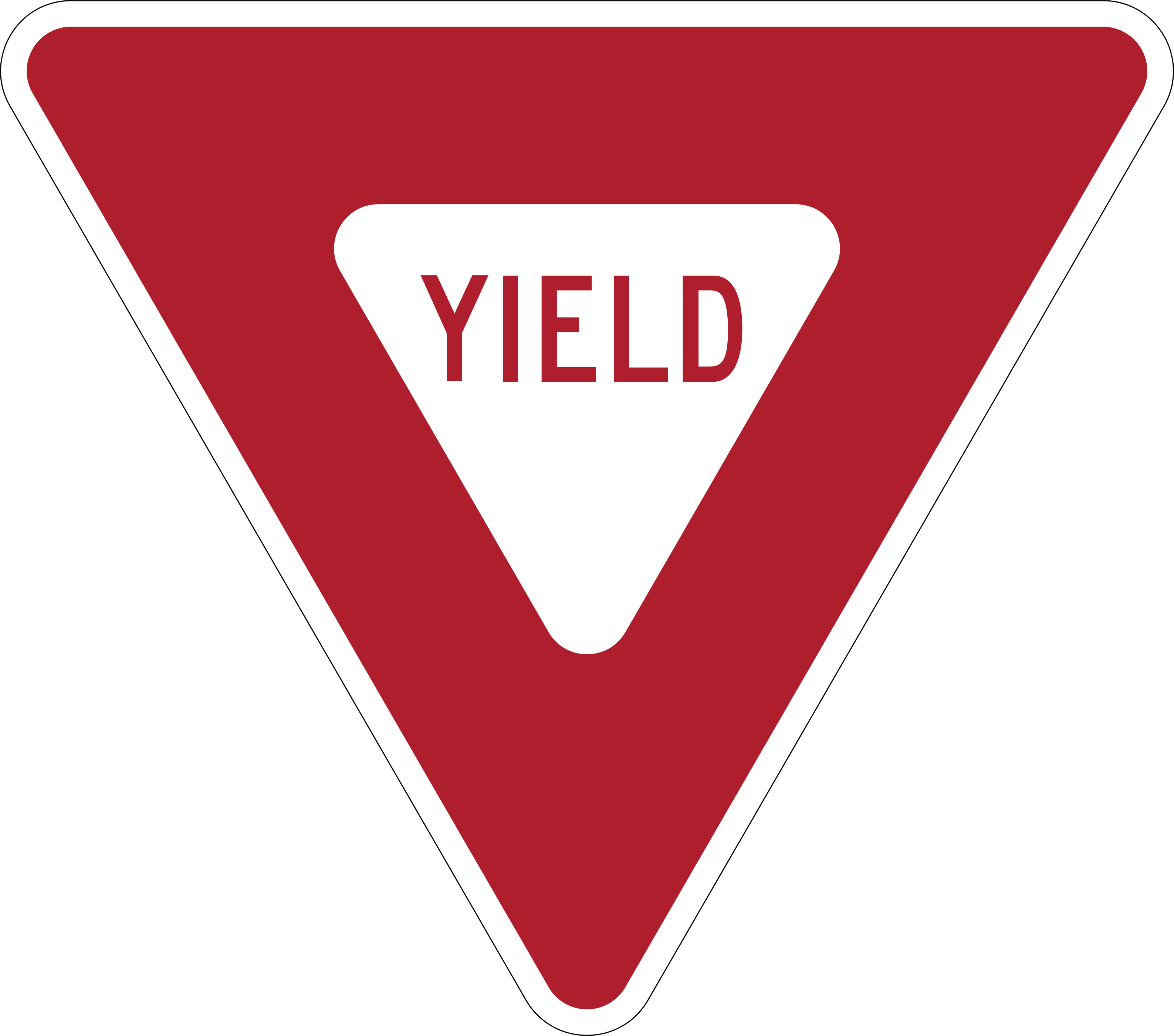
Yield
3 questions from the New Jersey practice test
1. Two motorists arrive simultaneously at a New Jersey multi-way stop. Which driver yields?
- The heavier vehicle receives priority
- The driver on the right reverses to let the left vehicle pass
- The driver approaching from the left yields to the driver on the right
- Both vehicles enter together at reduced speed
Show answer
The driver approaching from the left yields to the driver on the right. At a multi-way stop, simultaneous arrival creates a right-side priority rule: the motorist on the left yields to the motorist on the right. Vehicle weight and arrival speed do not change that assignment. Entering together would turn a predictable crossing into a conflict, and reversing is not the prescribed response. The practical cue is to identify your position relative to the other vehicle before moving from the stop line.
2. A New Jersey driver exits a private driveway onto a public road. Which traffic must be yielded to?
- Every vehicle already traveling on the main road
- Only traffic approaching from the driver’s left
- Only the first vehicle visible at the curb
- No traffic when the driveway has a wide opening
Show answer
Every vehicle already traveling on the main road. A driveway is not an equal branch of the public roadway. The motorist emerging from private property must yield to all traffic on the main road, which means checking both directions and waiting for a safe opening. Limiting the obligation to the left side overlooks vehicles approaching from the other direction. A wide driveway changes visibility, not the legal priority. Stop before entering the road, scan both ways, and proceed only after the established traffic is clear.
3. While turning left at a New Jersey intersection, what must a driver do before crossing the opposing lane?
- Turn first because a green signal gives absolute priority
- Wait only for a police officer’s hand signal
- Yield to oncoming traffic and stop for pedestrians in the crosswalk
- Yield to vehicles behind the turning car
Show answer
Yield to oncoming traffic and stop for pedestrians in the crosswalk. A left turn crosses the path of approaching vehicles and may also cross a pedestrian route. New Jersey therefore requires the turning motorist to yield to oncoming traffic and stop for pedestrians within the crosswalk. A green light authorizes movement only after those conflicts are cleared; it is not a guarantee that the turn can begin immediately. Before steering left, check the opposing lane, the crossing area, and the space into which the vehicle will travel.
Practice this topic
Lock it in with right of way questions from the free New Jersey practice test. Every answer comes with a plain English explanation.
Source: the New Jersey Driver Manual, Chapter 4: Safe Driving Rules and Regulations. This lesson is a plain English summary, not the law itself; where it differs, the manual and the statute govern. Last checked 2026-10-12.