
Test 7 of 11 · 20 questions · Free 2026
NE Permit Practice Test 7
Jump to the test ↓A fixed 20 question set from the Nebraska bank with answers and plain English explanations. The real NE exam is 25 questions, 80 percent to pass; take the full length version on the main practice page.
Question 1 of 20 · 0 right so far
All 20 questions in test 7
Every question below comes from the Nebraska question bank on this page. Open a question to see the correct answer and the explanation. Nothing here is hidden behind a signup.
1. After stopping for an authorized emergency vehicle, when may the driver proceed?
- As soon as the siren becomes quieter
- After it has passed and the driver checks for other emergency vehicles
- When the vehicle ahead begins moving, without looking again
- Immediately if the stopped vehicle is blocking traffic
Show answer
After it has passed and the driver checks for other emergency vehicles. Stopping is only part of the emergency-vehicle response. Nebraska says to remain stopped until the emergency vehicle has passed, then watch for other emergency vehicles before proceeding. A fading siren is not a reliable signal that the route is clear, and following another driver's movement can hide a second responder. Even when traffic behind you is impatient, preserving the emergency corridor comes first. Look in both directions after the first vehicle passes, confirm the intersection or roadway is clear, and reenter traffic gradually.
Study this in the handbook: Yield signs, driveways and pedestrians
2. What does a yellow diamond-shaped sign warn a driver about?
- A motorist service such as a hospital
- A mandatory speed limit that applies immediately
- Special conditions or hazards ahead
- A recreation or cultural interest area
Show answer
Special conditions or hazards ahead. A yellow diamond is a warning sign for special conditions or hazards ahead. Slow down and proceed with caution while reading the specific symbol or message. It is not automatically a regulatory speed sign, a blue service sign, or a brown recreation sign. The diamond provides advance notice so you can manage speed and attention before reaching the condition. When the sign shows a curve, crossing, merge, or other hazard, pair the warning with an appropriate driving adjustment.
Study this in the handbook: Sign colors and shapes
3. What does a white SPEED LIMIT sign communicate?
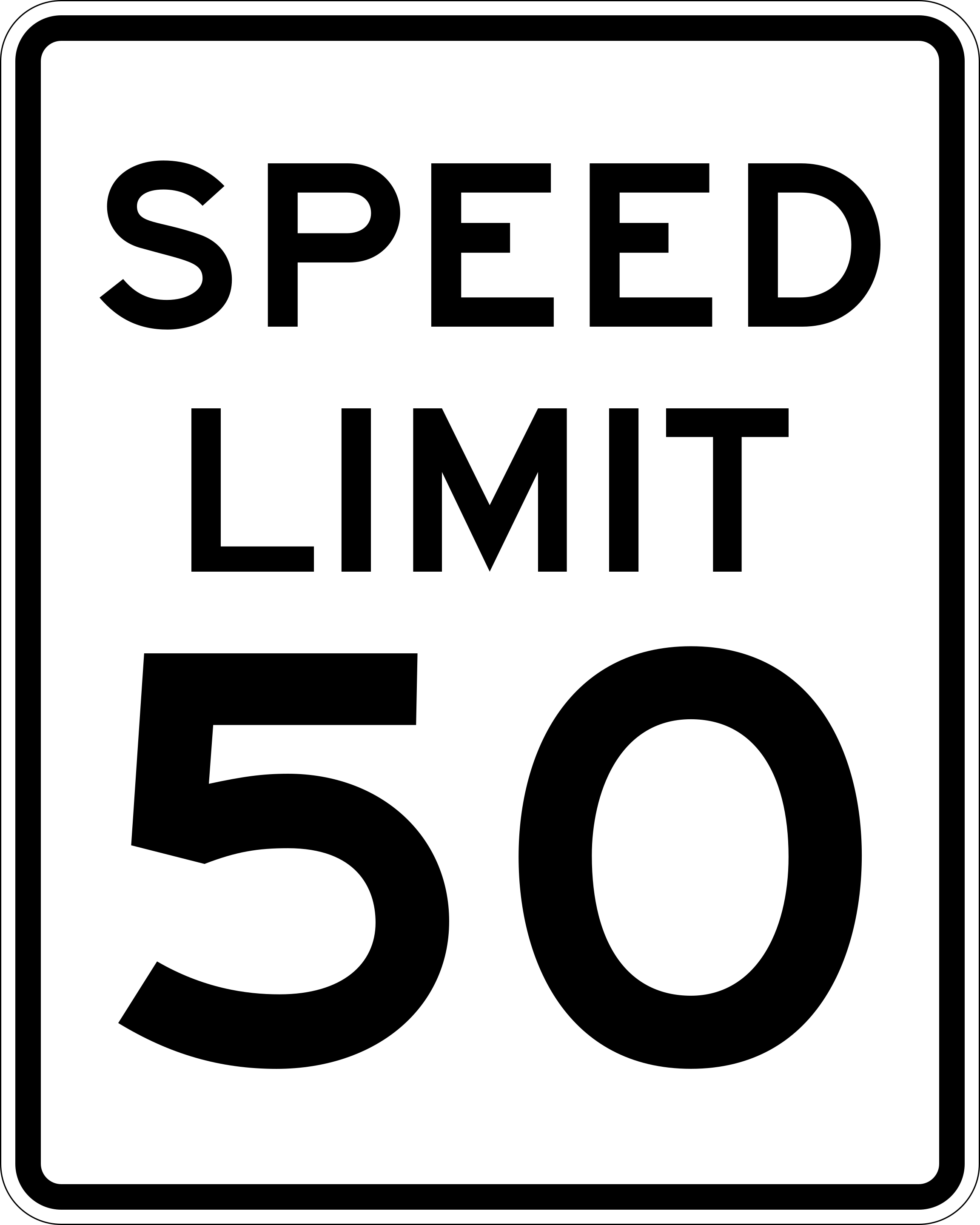
- The maximum lawful speed on that roadway
- A suggested speed that may be ignored
- The minimum speed required in every condition
- A warning that the road is ending
Show answer
The maximum lawful speed on that roadway. Nebraska classifies white signs as regulatory, and its Speed Limit definition identifies the maximum speed a vehicle can lawfully travel on the roadway. That makes the displayed number more than a suggestion. It is not a universal minimum, and the sign does not warn that pavement ends. A posted maximum also does not guarantee that driving at that number is safe in rain, ice, congestion, or poor visibility. Use the sign as the legal ceiling, then choose a lower speed whenever conditions, traffic, or the manual's reasonable-speed rule require more control.
Study this in the handbook: Regulatory and warning signs
4. What action does Nebraska's manual require in a school zone?
- Maintain highway speed until a crossing guard enters the road
- Reduce speed, obey signs, and be prepared to stop
- Stop only when another vehicle has already stopped
- Pass any vehicle traveling below the posted limit
Show answer
Reduce speed, obey signs, and be prepared to stop. The school-zone instruction is to reduce speed, obey every sign, and remain ready to stop at any time. Maintaining highway speed ignores the special environment, and waiting for another vehicle or a crossing guard adds a condition the rule does not require. Passing is especially poor judgment when children or pedestrians may be nearby. Treat a school-zone sign as an immediate preparation cue, even when the roadway looks clear. A posted instruction may add a specific limit, but the baseline response still involves slower travel, careful observation, and readiness to brake.
Study this in the handbook: Work zones, school zones and speeding fines
5. What does the red and white DO NOT ENTER sign shown tell a driver?
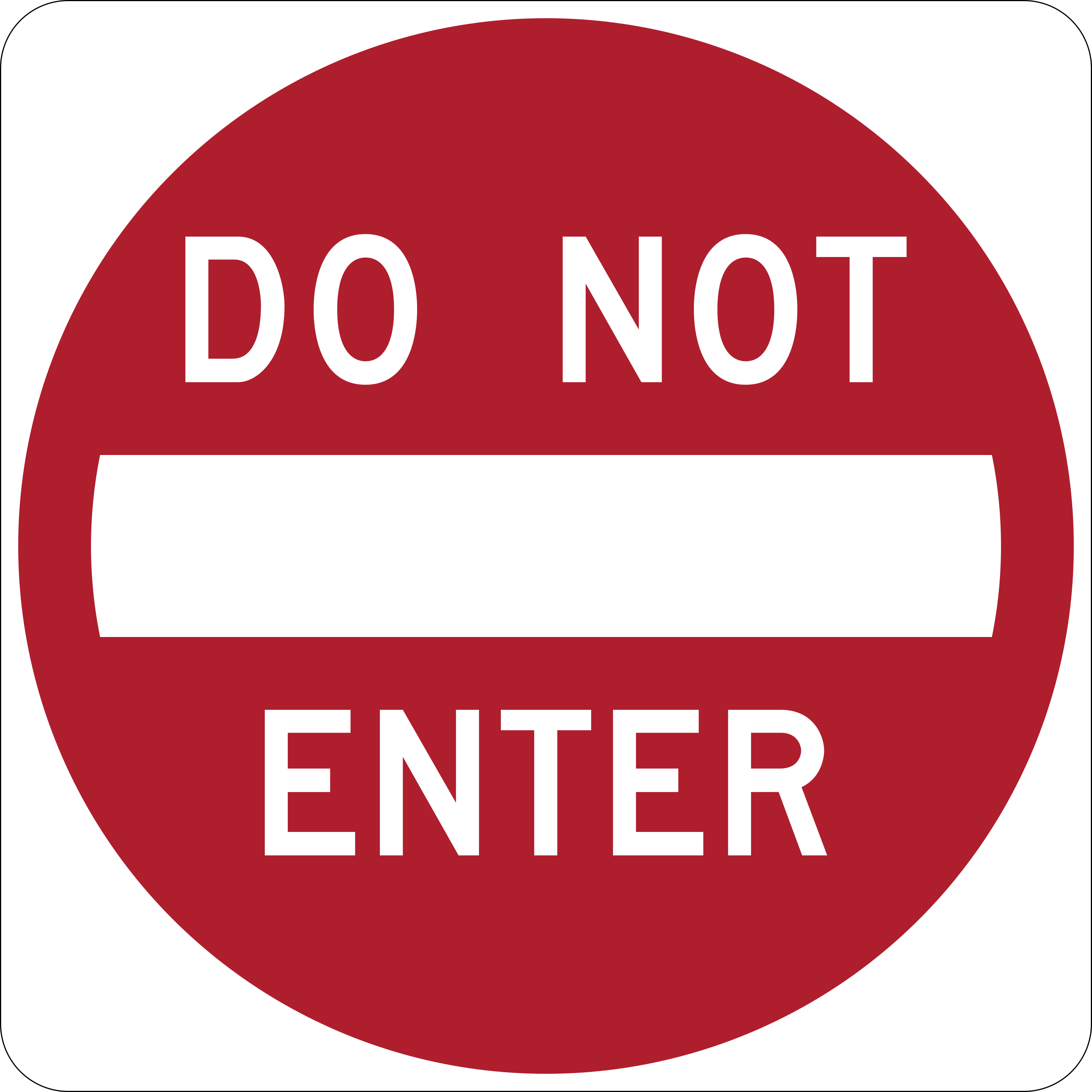
- The road becomes two-way ahead
- Parking is prohibited for the next block
- Entry is prohibited past the sign
- Only trucks may enter the ramp
Show answer
Entry is prohibited past the sign. The DO NOT ENTER message means a driver must not proceed past the sign. Nebraska explains that this sign is commonly paired with WRONG WAY to identify a one-way street or expressway ramp. It is not a parking restriction, a notice that two-way travel begins, or a truck-only permission. Use the sign as a boundary: stop before crossing it and choose a route that approaches in the lawful direction. Its red and white design reinforces the regulatory command, but the words themselves state the action that is prohibited.
Study this in the handbook: Regulatory and warning signs
6. If a train is clearly visible at a railroad crossing and crossing would be hazardous, what must the driver do?
- Stop before the tracks and wait
- Accelerate so the vehicle clears the rails first
- Cross normally because trains can stop quickly
- Drive around any gate that has not fully lowered
Show answer
Stop before the tracks and wait. A visible train is an explicit stop condition when crossing would put the driver in danger. The safest response is to stop before the tracks and wait for a clear crossing. Trying to beat the train depends on a timing guess and ignores the train's limited ability to stop. An open gate does not cancel the obligation to respond to the train itself, and driving around a barrier is never a legitimate shortcut. Treat the rails as a place requiring patience: remain stopped until the route is clear and enough room exists beyond the tracks.
Study this in the handbook: Parking and railroad crossings
7. A driver approaching a school bus with its red stop lights on and stop arm extended must do what?
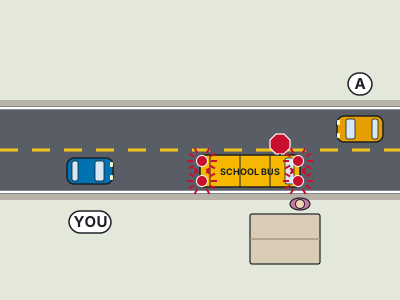
- Pass if no child is visible
- Slow to 25 MPH and continue past
- Stop and remain stopped until the arm retracts and red lights deactivate
- Stop only when traveling behind the bus
Show answer
Stop and remain stopped until the arm retracts and red lights deactivate. When the school bus door has opened, its red stop lights and stop arm signal that approaching or overtaking traffic must stop. Remain stopped until the bus driver retracts the arm and turns off the red warning lights. The 25 MPH instruction belongs to the earlier amber warning phase, before the bus door opens. A driver cannot rely on seeing a child, and the requirement is not limited to vehicles behind the bus. Watch the bus equipment, not just the roadway around it.
Study this in the handbook: School buses, snow plows and large trucks
8. What must a Nebraska driver have to move from a Provisional Operator's Permit to a Class O license?
- Reached age 16 with any record
- Held the POP at least 12 months, be at least 17, and have fewer than three points in the previous 12 months
- Held the POP for 30 days
- Completed a road test only
Show answer
Held the POP at least 12 months, be at least 17, and have fewer than three points in the previous 12 months. To receive a Class O operator's license, you must have held your Provisional Operator's Permit for at least 12 months, be at least 17 years old, and not have accumulated three or more points on your driving record during the previous 12 month period. All three conditions apply together, so meeting the age alone is not enough, and a record with three or more points in that period does not qualify.
Study this in the handbook: Provisional Operator's Permit and Class O license
9. For a driver age 21 or older operating a noncommercial vehicle in Nebraska, what is the lowest BAC covered by the general alcohol per se threshold?
- .02% or higher
- .04% or higher
- .10% or higher
- .08% or higher
Show answer
.08% or higher. Nebraska identifies .08% BAC or higher as unlawful regardless of the driver's age or vehicle type. The other listed thresholds are narrower rules: .02% applies to a driver under 21 and .04% applies to commercial motor vehicle operation. The phrase regardless of age or vehicle type is the signal to use .08, not to combine the question with one of those special categories. The manual also explains that significant impairment often appears below .08, so treating the threshold as a safe level would be a serious misunderstanding of the rule and the safety message.
Study this in the handbook: Alcohol limits, implied consent and revocation
10. What does Nebraska advise a driver to do if insisting on right-of-way could cause a collision?
- Avoid insisting and prevent the collision
- Insist because priority always overrides safety
- Accelerate to establish priority
- Stop in the intersection to prove the rule
Show answer
Avoid insisting and prevent the collision. Nebraska says never to insist on the right of way when doing so risks a collision. A driver may have priority under the ordinary sequence and still need to yield or slow down when another road user makes a mistake. Accelerating or stopping in the intersection can turn a misunderstanding into a crash. The useful cue is safety over argument: identify the conflict, take the action that prevents impact, and continue only when the path is clear. Right of way organizes traffic, but it never makes a collision acceptable or removes the duty to use ordinary care.
Study this in the handbook: Right of way at intersections
11. Which behavior is an example of aggressive driving?
- Waiting for a pedestrian to finish crossing
- Leaving a safe space before changing lanes
- Checking mirrors before entering an intersection
- Tailgating another vehicle
Show answer
Tailgating another vehicle. Tailgating is specifically listed as aggressive driving because it pressures the vehicle ahead and leaves too little room to stop. Cutting off another driver, running a red light, and failing to yield are also examples. The other choices describe defensive habits that reduce conflict and protect vulnerable road users. If anger is building, reduce interaction, allow space, and focus on a predictable path rather than competing with other traffic.
Study this in the handbook: Distracted, aggressive and drowsy driving
12. What movement is allowed under a flashing yellow arrow when the driver is in the proper lane?
- Remain stopped until the arrow becomes a steady green
- Turn in any direction without yielding
- Enter cautiously only to make the movement shown by the arrow
- Proceed straight regardless of the arrow direction
Show answer
Enter cautiously only to make the movement shown by the arrow. A flashing yellow arrow allows a cautious entry only for the movement indicated by that arrow, and the driver must yield to pedestrians in an adjacent crosswalk and to other traffic. It is not a free movement in every direction. Waiting for a steady green is unnecessarily restrictive, while proceeding straight against the arrow ignores the lane control. Check the arrow, scan the conflict area, and yield before moving.
Study this in the handbook: Traffic signals and turning on red
13. Why should a driver allow a full lane width to a motorcycle?
- A motorcycle may use only half a lane on a two-lane road
- Motorcycles are required to ride beside the lane line
- The motorcycle must always travel below the posted speed
- The motorcycle needs room to maneuver safely
Show answer
The motorcycle needs room to maneuver safely. Nebraska says a motorcycle needs the full lane width to maneuver safely, even when the pavement seems wide enough for a car and motorcycle side by side. Do not share the lane. A rider may need space to respond to surface problems, changing traffic, or a sudden hazard, and squeezing into a partial lane removes that margin. The lane-line choice invents a placement requirement, while the speed and half-lane choices contradict the manual's safety principle. Picture the motorcycle as occupying the entire lane whenever you pass or travel beside it.
Study this in the handbook: Motorcycles and bicycles
14. How many points does a third offense drunk driving conviction add to a Nebraska driving record?
- 6 points
- 12 points
- 8 points
- 9 points
Show answer
12 points. A third offense drunk driving conviction carries 12 points on the Nebraska chart, the same value as motor vehicle homicide. Because 12 points in two years causes automatic revocation, this single conviction reaches the revocation threshold on its own. Six points is the value for an ordinary DUI conviction. The 8 and 9 point figures do not appear on the chart.
Study this in the handbook: The point system and license revocation
15. A Nebraska POP holder drives alone at 1 a.m. on a trip that is not to or from work or a school activity. What does the manual say the violation carries?
- A $200 fine and a six month revocation
- A mandatory 30 day license impoundment
- A one point assessment on the driving record
- No penalty, because the curfew is only advice
Show answer
A one point assessment on the driving record. A Provisional Operator's Permit holder may not drive from midnight to 6 a.m. unless the trip is to or from school activities or work, and the manual says a violation carries a one point assessment on the driving record. The $200 figure belongs to the GDL phone rule, and no six month revocation is listed for a curfew violation. A 30 day impoundment is the court penalty tied to a first underage zero tolerance offense, not the curfew. The restriction is law, so calling it advice is wrong.
Study this in the handbook: Graduated licensing restrictions for teens
16. Which pass is unlawful under Nebraska's passing rules?
- Passing within 100 feet of an intersection
- Passing after checking traffic and signaling on a clear straight roadway
- Passing a slower vehicle where a broken yellow line permits it and the way is clear
- Returning to the right lane after seeing the passed vehicle in the rearview mirror
Show answer
Passing within 100 feet of an intersection. Nebraska prohibits passing within 100 feet of an intersection. A clear road and a signal cannot make that restricted location safe or lawful. The other choices describe steps that can support a legal pass when markings, visibility, and traffic conditions permit: check around the vehicle, use the passing lane appropriately, and return after the passed vehicle is visible in the mirror. Identify the intersection distance before pulling out, because waiting until the vehicle is alongside the crossing is too late.
Study this in the handbook: Speed limits
17. When is a right turn on a circular red light allowed in Nebraska?
- Only from a one way street onto another one way street
- Without stopping when no pedestrians are present
- Only after the light changes to a flashing yellow
- After a complete stop, unless a sign prohibits the turn
Show answer
After a complete stop, unless a sign prohibits the turn. A right turn on a circular red light may be made after the driver comes to a complete stop, looks both ways, and yields to pedestrians and other traffic, unless a posted sign prohibits the turn. Rolling through the red is not enough, even if the intersection seems empty. The one way to one way condition applies to a left turn on red, not the ordinary right turn. Stop behind the line or crosswalk, check again, and turn only when the path is open.
Study this in the handbook: Traffic signals and turning on red
18. How many times may a Nebraska Class O or M license be renewed online before the driver's 72nd birthday?
- Two consecutive times
- Unlimited
- Once
- Never, renewals are in person only
Show answer
Two consecutive times. If your license expires before your 72nd birthday, you may renew your Class O or Class M license two consecutive times online, after which an in person renewal with a vision test is required. A State ID card may be renewed online three consecutive times regardless of age, and a valid Class O holder may move to a State ID card online.
Study this in the handbook: Tests, renewal and address changes
19. According to Nebraska's alcohol guidance, what can reduce the alcohol level and its effects in the body?
- Coffee
- Only time
- Fresh air
- A cold shower
Show answer
Only time. Nebraska's manual says only time can reduce the alcohol level and its effects in the body. Coffee, a cold shower, and fresh air may change how alert a person feels, but they do not remove alcohol or restore safe driving ability. The safest cue is to plan transportation before drinking and wait rather than trying a quick remedy afterward. Feeling more awake is not the same as having recovered the judgment, coordination, and response ability needed behind the wheel.
Study this in the handbook: How alcohol impairs driving
20. According to Nebraska's speeding fine schedule, what is the normal fine for driving more than 35 MPH over the limit outside a work or school zone?
- $125 plus court costs
- $200 plus court costs
- $600 plus court costs
- $300 plus court costs
Show answer
$300 plus court costs. The speeding fine schedule lists $300, plus court costs, for driving more than 35 MPH over the limit in a normal zone. The $125 and $200 amounts are for lower speeding bands. The $600 amount is the doubled figure for the same speed in a work or school zone, since fines are doubled in school zones and when workers are present in work zones. A violation at that speed also adds 4 points.
Study this in the handbook: Speed limits
QualitySpace is expanding to Nebraska
We are a California-based independent insurance brokerage working on licensing in more states. We cannot help with Nebraska insurance yet. Leave your email and we will let you know when we can.
Every question is written from the official Nebraska Driver's Manual. Need paper? Printable NE practice test with answer key.
Last verified 2026-10-05. How we check every question · Study all 220 as flashcards
Frequently asked questions
How many questions are on this Nebraska practice test?
This fixed set has 20 questions. It is test 7 of 11 from the 220 question Nebraska bank. The real NE exam asks 25 questions and you need 20 correct.
What is the passing score for the real Nebraska test?
80% minimum on all written tests; on the 25-question Class O test that means 20 correct (can miss 5) That figure comes from the official Nebraska source cited on the DMV facts page.
How does this fixed test relate to the full Nebraska bank?
Each numbered test is a fixed set of questions in a fixed order, so you can retake the same test later and compare. Every test mixes road signs and the other topics in about the same proportion as the full bank. Tests 1 to 11 together cover every question in the Nebraska bank once. The full practice page mixes the whole bank at random.
Last verified 2026-10-05. See the Nebraska DMV facts page for sourced state details.
Return to the full Nebraska practice test · Study road signs