
Test 3 of 11 · 20 questions · Free 2026
NE Permit Practice Test 3
Jump to the test ↓A fixed 20 question set from the Nebraska bank with answers and plain English explanations. The real NE exam is 25 questions, 80 percent to pass; take the full length version on the main practice page.
Question 1 of 20 · 0 right so far
All 20 questions in test 3
Every question below comes from the Nebraska question bank on this page. Open a question to see the correct answer and the explanation. Nothing here is hidden behind a signup.
1. How large a point credit can a Nebraska driver earn by completing a DMV approved driver improvement course before reaching 12 points, and how often?
- 3 points, once a year
- 4 points, once every three years
- 2 points, once every five years
- 6 points, with no limit
Show answer
2 points, once every five years. A driver who completes a DMV approved driver improvement course before 12 points are accumulated may receive a 2 point credit, and the credit can only be used once every five years. The course must be finished before the date of the violation that would add the twelfth point. CDL and CLP holders are not eligible. The 3, 4, and 6 point figures, and the other time limits, do not match the manual.
Study this in the handbook: The point system and license revocation
2. An underage Nebraska driver's license is impounded for a .02% conviction, and the driver is convicted of driving during that impoundment. What does the court do?
- Extends the impoundment by 30 days
- Revokes the license for six months
- Revokes the license for one year
- Adds 12 points to the record
Show answer
Revokes the license for six months. For an underage driver convicted of driving during the impoundment, the court revokes the license for six months. The one year revocation is the general rule for other drivers who drive during an impoundment, so it does not fit this underage case. A 30 day extension is not described. Twelve points is the chart value for motor vehicle homicide or third offense drunk driving, not this violation.
Study this in the handbook: Alcohol limits, implied consent and revocation
3. In the manual's example, if car A turns left, which cars must car A yield to?
- Only car B
- Both cars B and C
- Neither car B nor car C
- Only pedestrians
Show answer
Both cars B and C. At an uncontrolled intersection, the Nebraska example says that car A yields to both car B and car C when A turns left. A left turn crosses or conflicts with the paths represented by both vehicles, so the turning driver must wait for them. The signal used to announce the turn does not grant priority. The choice naming only B leaves out one conflict, while the other two choices ignore the stated traffic relationships. A useful visual cue is that a left turn sweeps across more of the intersection than proceeding straight.
Study this in the handbook: Right of way at intersections
4. Which location is specifically listed as prohibited for parking or stopping in Nebraska?
- On a marked shoulder during daylight
- On the far side of a public driveway
- Within 50 feet of a railroad track
- Beside a curb on a one-way street
Show answer
Within 50 feet of a railroad track. Nebraska prohibits parking or stopping on a bridge, inside a highway tunnel, or within 50 feet of railroad tracks. The public driveway option is not what the manual lists; it names parking in front of a public or private driveway, not on its far side. A marked shoulder in daylight or a curb on a one way street is not automatically forbidden in every circumstance. Think of the railroad measurement as a fixed 50 foot buffer, and check the rest of the no parking list before leaving a vehicle near any listed feature.
Study this in the handbook: Parking and railroad crossings
5. What do black on orange roadway signs identify?
- A permanent speed limit regulation
- A hospital or other motorist service
- A recreational or cultural destination
- A highway work zone
Show answer
A highway work zone. Black lettering on an orange background identifies a highway work zone in Nebraska. These signs can warn about the zone itself or provide directions while traffic moves through it. A service sign is associated with blue, recreation information with brown, and regulatory instructions such as speed limits with white. Treat the orange message as an early request for attention and possible action. Prepare to change lanes or reduce speed with enough space, rather than waiting until workers or barricades are immediately beside the vehicle.
Study this in the handbook: Guide, service and work zone signs
6. What two adjustments does Nebraska recommend when rain makes the road surface wet?
- Reduce speed and increase following distance
- Maintain speed and follow more closely
- Increase speed and use high beams
- Keep the same gap and use cruise control
Show answer
Reduce speed and increase following distance. Water reduces tire grip and can produce hydroplaning, so the manual pairs a lower speed with more space behind the vehicle ahead. Slowing gives the tires a better chance to remain in contact with the pavement, while the larger gap compensates for longer stopping distance. Following more closely is especially hazardous because wet braking may take longer than expected. Nebraska also points drivers toward low-beam headlights in rain. A good visual cue is standing water or spray: ease off the accelerator early and create room before the road becomes difficult to manage.
Study this in the handbook: Night driving, rain, fog, wind and floods
7. During what period must Nebraska drivers use headlights?
- From sunset to sunrise
- Only when driving on an interstate
- From midnight until dawn, but not after sunset
- Only when high beams are needed
Show answer
From sunset to sunrise. Nebraska requires headlights from sunset to sunrise. Parking lights alone are not a lawful substitute, and the rule applies beyond interstate travel. Waiting until high beams seem necessary can leave the vehicle unlit during the first and last portions of darkness. Turn on the headlights as daylight fades, use the appropriate beam for nearby traffic, and adjust speed so stopping remains possible within the illuminated area. A clean windshield also helps reduce glare from oncoming lights.
Study this in the handbook: Night driving, rain, fog, wind and floods
8. When must high beams be dimmed while following another vehicle?
- Only after the other driver flashes headlights
- Within 20 feet of the vehicle ahead
- Within 200 feet of the vehicle ahead
- Only on a road with a posted speed below 35 MPH
Show answer
Within 200 feet of the vehicle ahead. Nebraska's night driving guidance says to dim high beams when following within 200 feet of another vehicle and when meeting oncoming vehicles. Leaving high beams on at that distance can create glare in the other driver's mirrors and reduce safety. The 20 foot choice is too short, and neither a complaint from the other driver nor a particular speed limit is required before dimming. Monitor the gap as traffic changes, switch early, and restore high beams only when the surrounding vehicles are safely farther away.
Study this in the handbook: Night driving, rain, fog, wind and floods
9. When may a driver turn left on a circular red light?
- Only when a green arrow appears in the opposite direction
- From any two way street after slowing and checking for traffic
- After stopping, only from one one way street onto another one way street, unless prohibited
- Without stopping if the turn is made from the left lane
Show answer
After stopping, only from one one way street onto another one way street, unless prohibited. Nebraska permits a left turn on a circular red light only when the vehicle is traveling on a one way street and turning onto another one way street. The driver must first stop completely and yield, and signs can prohibit the movement at particular locations. A two way street does not qualify, and lane position or a quick check cannot replace the stop. Confirm the street directions before entering the intersection, then check for a posted prohibition and conflicting road users.
Study this in the handbook: Traffic signals and turning on red
10. Where may a yellow no passing zone pennant be found?
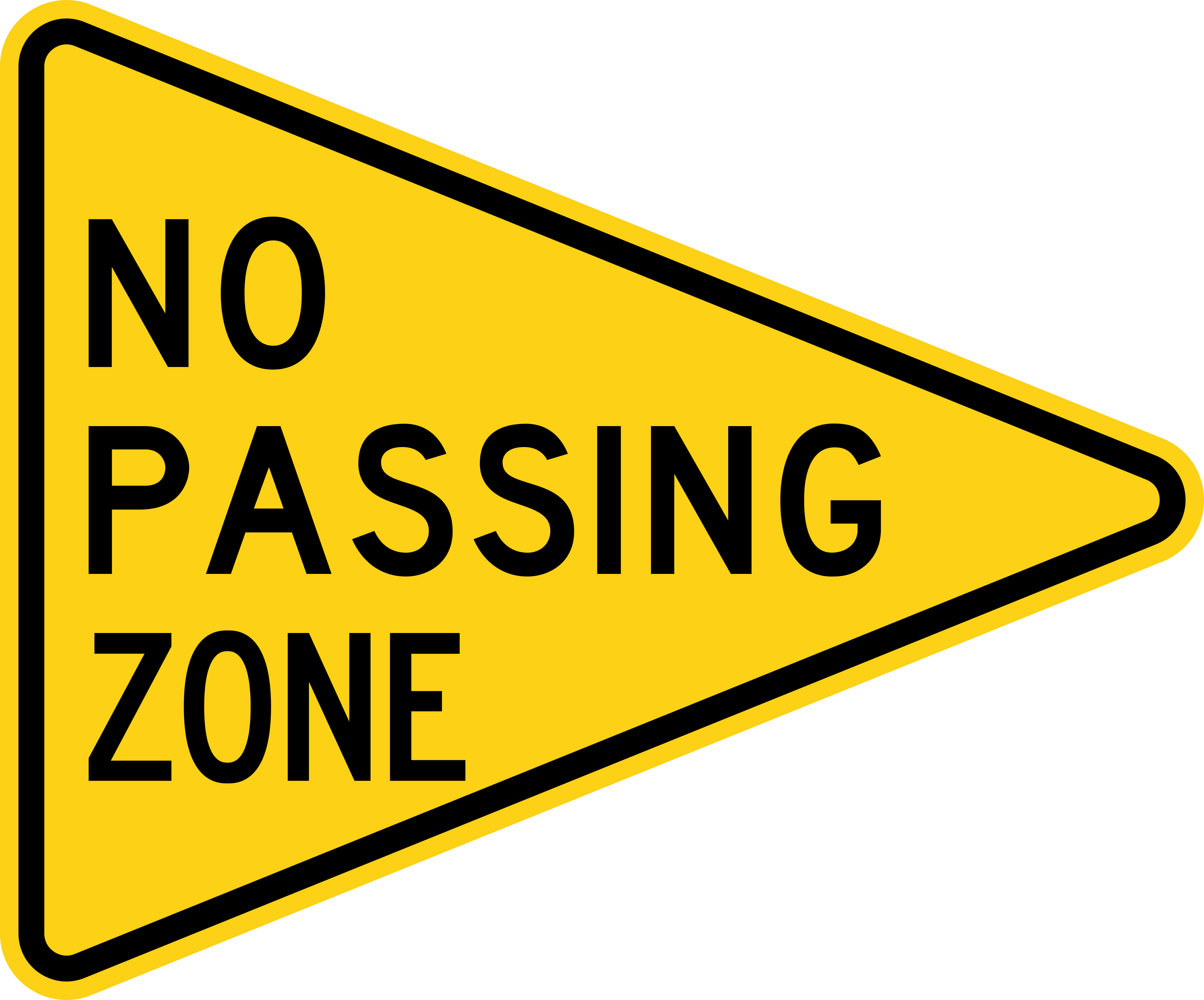
- At the end of every divided highway
- On the right side after passing becomes legal
- Above a school crossing in the center of town
- On the left side of the road at the beginning of the zone
Show answer
On the left side of the road at the beginning of the zone. Nebraska uses the yellow pennant shaped no passing zone sign on the left side of the road at the beginning of a no passing zone. Its unusual shape and placement identify the start of the restriction. It does not mark the point where passing becomes legal, serve as a school crossing sign, or announce the end of a divided highway. When you see it, remain behind the vehicle ahead unless another lawful and clearly marked opportunity permits passing later. Treat the pennant as an early warning against entering the opposing lane.
Study this in the handbook: Guide, service and work zone signs
11. A divided highway begins sign tells the driver that the lanes ahead are separated by what?

- A median or divider
- A railroad gate
- A shared center turn lane
- A pedestrian refuge only
Show answer
A median or divider. When a divided highway begins, the traffic lanes ahead are separated by a median or divider, and each lane is one way. The driver must keep right of that separation and follow the lane direction. This is different from a shared left turn lane, which handles opposing turning movements without creating two separate roadways. Do not cross the median to correct a missed turn. The sign is a planning cue to recognize the roadway split before entering it.
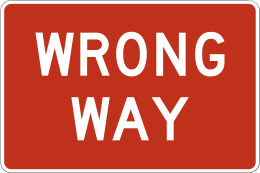
12. If the WRONG WAY sign shown faces you, what should you do?
- Continue slowly because the sign is only advisory
- Back up in the travel lane until another opening appears
- Turn into the nearest driveway without checking traffic
- Stop safely, leave the wrong-way path, and find the proper direction
Show answer
Stop safely, leave the wrong-way path, and find the proper direction. A WRONG WAY sign means the vehicle is traveling where it should not. The safe response is to stop or pull over as soon as that can be done safely, then leave the wrong-way path and reorient in the lawful direction. Continuing treats a regulatory warning as optional, while backing in a travel lane creates a new hazard. A sudden driveway turn without checking traffic can expose you to pedestrians, vehicles, or a curb. Nebraska groups WRONG WAY with DO NOT ENTER at one-way streets and expressway ramps, so use the sign as an immediate direction check.
Study this in the handbook: Regulatory and warning signs
13. A Nebraska driver whose license is revoked under the point system does not surrender the license. What penalty does the manual list?
- A fine of $500 or less and/or up to 30 days in county jail
- A $25 fine plus court costs
- An automatic 15 year revocation
- A one point assessment only
Show answer
A fine of $500 or less and/or up to 30 days in county jail. Persons who fail to surrender the license after a point revocation can be fined $500 or less, jailed in county jail for 30 days or less, or both. The $25 fine is the seat belt and child restraint amount. Fifteen years is the longest ignition interlock period a court or the Board of Pardons may order, not a surrender penalty. A single point is far too light for ignoring a revocation order from the DMV.
Study this in the handbook: The point system and license revocation
14. How many points does Nebraska assign for using a handheld wireless device to read, type, or send written communication while driving?
- 1 point
- 2 points
- 3 points
- 6 points
Show answer
3 points. Nebraska assigns three points for using a handheld wireless communication device to read, type, or send written communication while operating a motor vehicle. One point is assigned to several other violations, two points apply to failing to yield to a pedestrian when no bodily injury occurs, and six points are associated with more serious offenses such as DUI or failing to report a crash. The wording is important: this point entry concerns written communication and a handheld device while the vehicle is being operated. It is not a six point category merely because distraction can be dangerous.
Study this in the handbook: The point system and license revocation
15. What is Nebraska's default maximum speed on a gravel or other non-dustless roadway?
- 25 MPH
- 50 MPH
- 40 MPH
- 60 MPH
Show answer
50 MPH. A gravel roadway, or another roadway that is not dustless, has a 50 MPH default maximum unless a posted sign changes it. The 25 MPH choice is tied to residential districts, not surface type. Forty and sixty miles per hour are not the manual's default for this category; 55 MPH is the figure for dustless paved roads outside the state highway system. Look first at the surface description, then match it to the 50 MPH rule. A driver must still follow a lower posted limit and use a speed that is reasonable for current conditions.
Study this in the handbook: Yield signs, driveways and pedestrians
16. If a traffic signal is dark and no peace officer, flagger, or other traffic control is present, how should the intersection be treated?
- As a flashing yellow signal in every direction
- As a green light for the larger roadway
- As an uncontrolled intersection where stopping is optional
- As an all-way stop
Show answer
As an all-way stop. When a traffic signal is dark because of a power failure or another cause, and no peace officer, flagger, or other traffic control is present, Nebraska treats the intersection as an all-way stop. Each approach must stop, then drivers proceed using the applicable right-of-way rules. A dark signal is not a green light for the larger roadway, an invitation to treat stopping as optional, or a flashing yellow indication. The practical cue is to replace every dark signal with a stop sign in your mind before entering the intersection.
Study this in the handbook: Traffic signals and turning on red
17. How long does sending or receiving a text take a driver's eyes off the road, according to the Nebraska manual?
- Less than half a second
- An average of 4.6 seconds, a football field at 55 mph
- About 30 seconds
- About 10 seconds
Show answer
An average of 4.6 seconds, a football field at 55 mph. Sending or receiving a text takes a driver's eyes from the road for an average of 4.6 seconds, the equivalent at 55 mph of driving the length of an entire football field blindfolded. Texting involves visual, manual and cognitive distraction at once, which is why studies show it multiplies crash risk 23 times. Adjust controls, mirrors and the radio before you start driving.
Study this in the handbook: Distracted, aggressive and drowsy driving
18. How must a Nebraska applicant prove a principal address?
- With a single utility bill
- With documents from two different issuing sources, and never a P.O. box
- With a verbal statement
- With a P.O. box receipt
Show answer
With documents from two different issuing sources, and never a P.O. box. Proof of principal address must come from two different issuing sources, such as a bank statement and a pay stub, and a P.O. box will not be accepted. If you are under 21 and cannot provide proof, your parents' or guardians' address documents are accepted. Documents must be certified with a raised seal or stamp, photocopies are not accepted, and a lease or rental agreement must include the landlord's name and contact information. One bill or a spoken statement is not enough.
19. What does Nebraska's zero-tolerance law mean for drivers younger than 21?
- The driver may drink if the vehicle is parked on a public roadway
- Only a BAC of .08% or higher is prohibited
- The rule applies only while operating a commercial vehicle
- Any alcohol in the driver's system can violate the rule
Show answer
Any alcohol in the driver's system can violate the rule. For a driver under 21, Nebraska treats operating a motor vehicle with alcohol in the driver's system as a violation. That is stricter than relying only on the general .08% BAC threshold, and it is not limited to commercial vehicles. Parking on a public roadway does not create an exception to the under-21 rule when the person is operating. The age condition is the study cue: before driving, an under-21 driver must avoid alcohol in the system rather than calculate whether the amount might be below an adult limit.
Study this in the handbook: Alcohol limits, implied consent and revocation
20. How should a Nebraska driver brake on ice in a vehicle without antilock brakes?
- Pump the brake pedal to keep the wheels from locking, since there is no steering control unless the tires roll
- Press the pedal hard and hold it
- Use the parking brake
- Shift to neutral and coast
Show answer
Pump the brake pedal to keep the wheels from locking, since there is no steering control unless the tires roll. In a vehicle not equipped with antilock brakes, pump the brake pedal to keep the brakes from locking up, because there is no steering control unless the tires are rolling. In a vehicle with ABS, press the pedal firmly and do not pump. Make speed and direction changes gradually, do not use cruise control on slick roads, and keep the windows clear.
Study this in the handbook: Snow, ice, blizzards and wheels off the pavement
QualitySpace is expanding to Nebraska
We are a California-based independent insurance brokerage working on licensing in more states. We cannot help with Nebraska insurance yet. Leave your email and we will let you know when we can.
Every question is written from the official Nebraska Driver's Manual. Need paper? Printable NE practice test with answer key.
Last verified 2026-10-05. How we check every question · Study all 220 as flashcards
Frequently asked questions
How many questions are on this Nebraska practice test?
This fixed set has 20 questions. It is test 3 of 11 from the 220 question Nebraska bank. The real NE exam asks 25 questions and you need 20 correct.
What is the passing score for the real Nebraska test?
80% minimum on all written tests; on the 25-question Class O test that means 20 correct (can miss 5) That figure comes from the official Nebraska source cited on the DMV facts page.
How does this fixed test relate to the full Nebraska bank?
Each numbered test is a fixed set of questions in a fixed order, so you can retake the same test later and compare. Every test mixes road signs and the other topics in about the same proportion as the full bank. Tests 1 to 11 together cover every question in the Nebraska bank once. The full practice page mixes the whole bank at random.
Last verified 2026-10-05. See the Nebraska DMV facts page for sourced state details.
Return to the full Nebraska practice test · Study road signs