
Key points
For an emergency roadside stop, park within 12 inches of and parallel to the curb or road edge.
Source: Handbook p. 56
“Park vehicle within 12 inches of and parallel to the curb, or road's edge.”
Nebraska Driver's Manual, Handbook p. 56Do not park within 20 feet of a crosswalk at an intersection, or within 50 feet of railroad tracks.
Source: Handbook p. 57
“Within 20 feet of a crosswalk at an intersection. On bridges, within a highway tunnel, or within 50 feet of railroad tracks.”
Nebraska Driver's Manual, Handbook p. 57Facing uphill with a curb, turn the wheels away from the curb; otherwise turn them toward the curb or edge.
Source: Handbook p. 57
“If you park facing uphill where there is a curb, set the parking brake and turn the wheels away from the curb. In any other situation, turn the wheels toward the curb or edge of the road.”
Nebraska Driver's Manual, Handbook p. 57Handicapped stalls are reserved 24 hours a day, 7 days a week.
Source: Handbook p. 57
“Handicapped parking stalls are reserved for vehicles which display handicap license plate or permit from which the handicapped person enters or exits, 24 hours per day, 7 days per week.”
Nebraska Driver's Manual, Handbook p. 57When required to stop at a railroad crossing, stop at the stop line, or 15 to 50 feet from the nearest rail.
Source: Handbook p. 58
“When required to stop, stop at the stop line. If none, stop not less than 15 feet nor more than 50 feet from the nearest rail.”
Nebraska Driver's Manual, Handbook p. 58Never drive through, around or under a crossing gate or barrier.
Source: Handbook p. 58
“Never drive any vehicle through, around or under any gate or barrier.”
Nebraska Driver's Manual, Handbook p. 58If your vehicle stalls on the tracks, get everyone out and off the tracks immediately.
Source: Handbook p. 58
“If the vehicle stalls on a crossing, get everyone out and off the tracks immediately.”
Nebraska Driver's Manual, Handbook p. 58A 150 car freight train at 30 MPH needs 3150 feet to stop.
Source: Handbook p. 59
“An average 150-car freight train traveling 30 MPH requires a stopping distance of 3150 feet”
Nebraska Driver's Manual, Handbook p. 59After stopping at a crossing, watch for vehicles that must stop there, such as buses and trucks carrying hazardous materials.
Source: Handbook p. 58
“Watch for vehicles that must stop at railroad crossings, such as buses and trucks carrying hazardous materials.”
Nebraska Driver's Manual, Handbook p. 58Stop at a crossing when a train is clearly visible or its whistle is heard and crossing would be hazardous.
Source: Handbook p. 58
“Train or on-track equipment is clearly visible or train whistle is heard and would be hazardous for you to cross.”
Nebraska Driver's Manual, Handbook p. 58
Numbers to know
| Number | What it means | Manual |
|---|---|---|
| 12 inches | maximum distance from the curb for a roadside stop | Handbook p. 56 |
| 20 feet | from a crosswalk at an intersection | Handbook p. 57 |
| 50 feet | from railroad tracks | Handbook p. 57 |
| 24 hours, 7 days | when handicapped stalls are reserved | Handbook p. 57 |
| 15 to 50 feet | stopping distance from the nearest rail | Handbook p. 58 |
| 150 cars at 30 MPH = 3150 feet | freight train stopping distance | Handbook p. 59 |
Recognize these signs

Railroad crossing ahead 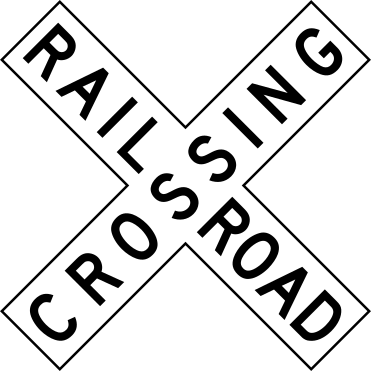
Railroad crossbuck 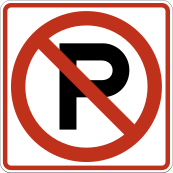
No parking
3 questions from the Nebraska practice test
1. If a train is clearly visible at a railroad crossing and crossing would be hazardous, what must the driver do?
- Stop before the tracks and wait
- Accelerate so the vehicle clears the rails first
- Cross normally because trains can stop quickly
- Drive around any gate that has not fully lowered
Show answer
Stop before the tracks and wait. A visible train is an explicit stop condition when crossing would put the driver in danger. The safest response is to stop before the tracks and wait for a clear crossing. Trying to beat the train depends on a timing guess and ignores the train's limited ability to stop. An open gate does not cancel the obligation to respond to the train itself, and driving around a barrier is never a legitimate shortcut. Treat the rails as a place requiring patience: remain stopped until the route is clear and enough room exists beyond the tracks.
2. If a vehicle stalls on railroad tracks, what should the occupants do first?
- Wait for a crossing gate to rise before opening the doors
- Remain inside while trying to restart the engine
- Push the vehicle farther along the tracks before exiting
- Get everyone out and off the tracks immediately
Show answer
Get everyone out and off the tracks immediately. A stalled vehicle on a crossing puts everyone in immediate danger, so all occupants should get out and move off the tracks without delay. Do not stay inside trying to restart the engine, push the vehicle along the rails before escaping, or wait for a gate to rise. Move in the direction the train or on-track equipment is expected. If none is seen immediately, call the 1-800 number on the crossing sign to try to stop it. If a train or on-track equipment is coming, stay clear of the tracks and call 911.
3. At a railroad crossing, what should you expect from a truck carrying hazardous materials?
- It may have to stop at the crossing, so watch for it before proceeding
- It can cross without checking because its load has priority
- It must use the shoulder before crossing the tracks
- It may pass through a lowered gate if no train is visible
Show answer
It may have to stop at the crossing, so watch for it before proceeding. Hazardous-materials trucks are among the vehicles that must stop at railroad crossings. That means a driver approaching from behind should anticipate a stopped truck and leave room to stop safely. The distractor about priority reverses the safety obligation: the special load increases the need for caution rather than granting an exception. Never go around a gate or assume that an empty-looking crossing is safe. A useful cue is the truck's hazardous-materials placard combined with the crossing itself, prompting you to look for a stop and wait behind it.
Practice this topic
Lock it in with emergencies questions from the free Nebraska practice test. Every answer comes with a plain English explanation.
Source: the Nebraska Driver's Manual, Section 4: Rules of the Road. This lesson is a plain English summary, not the law itself; where it differs, the manual and the statute govern. Last checked 2026-09-27.