
Key points
In a work zone, move away from workers and equipment, avoid slowing abruptly, and be ready to stop anytime.
Source: Handbook p. 53
“adjust your lane position away from workers and equipment, do not slow your speed abruptly, but be prepared to stop anytime.”
Nebraska Driver's Manual, Handbook p. 53In a school zone, reduce speed, obey all signs and be prepared to stop anytime.
Source: Handbook p. 53
“School Zone: reduce speed, obey all signs and be prepared to stop anytime.”
Nebraska Driver's Manual, Handbook p. 53Fines are doubled in school zones and when workers are present in work zones.
Source: Handbook p. 53
“Fines are doubled in school zones and when workers are present in work zones.”
Nebraska Driver's Manual, Handbook p. 53Speeding points depend on how many MPH over the limit you were and the type of road.
Source: Handbook p. 19
“Points are assessed for speeding on the basis of miles per hour (MPH) over the posted speed limit and the type of road:”
Nebraska Driver's Manual, Handbook p. 19The fine for texting and driving is $200 to $500.
Source: Handbook p. 64
“The fine for texting and driving is $200 to $500.”
Nebraska Driver's Manual, Handbook p. 64
Numbers to know
| Number | What it means | Manual |
|---|---|---|
| $200 to $500 | fine for texting and driving | Handbook p. 64 |
Recognize these signs
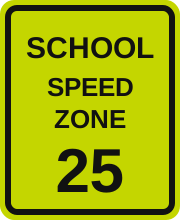
School speed zone 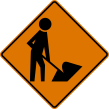
Workers present
3 questions from the Nebraska practice test
1. When are Nebraska traffic fines doubled in a school zone or work zone?
- Only after a crash occurs
- Only during overnight hours
- In school zones and when workers are present in work zones
- Whenever the road has two lanes
Show answer
In school zones and when workers are present in work zones. Nebraska doubles fines in school zones and when workers are present in work zones. The work zone part of the rule depends on workers being present, while the school zone part is tied to the school zone itself. A crash, overnight timing, or lane count does not create this fine increase. Remember two separate settings: school zones, and work zones with workers present. When either condition applies, obey the posted controls carefully and expect the financial penalty for a violation to be doubled.
2. In a Nebraska work zone, what should a driver be prepared to do at any time?
- Drive faster than surrounding traffic
- Accelerate sharply whenever cones appear
- Ignore signs after entering the zone
- Stop when conditions or traffic control require it
Show answer
Stop when conditions or traffic control require it. Work zones can narrow the driving area and remove escape space, so the manual tells drivers to remain ready for a stop at any time. That does not mean braking immediately whenever cones appear. Stay alert, obey signs and other traffic control devices, keep movement predictable, and avoid abrupt speed changes that could cause a rear end crash. The acceleration choice adds risk near workers, while ignoring signs removes the instructions that organize the zone. Use a simple cue: expect changing conditions, leave room, and be prepared to stop when the roadway or a flagger requires it.
3. What action does Nebraska's manual require in a school zone?
- Maintain highway speed until a crossing guard enters the road
- Reduce speed, obey signs, and be prepared to stop
- Stop only when another vehicle has already stopped
- Pass any vehicle traveling below the posted limit
Show answer
Reduce speed, obey signs, and be prepared to stop. The school-zone instruction is to reduce speed, obey every sign, and remain ready to stop at any time. Maintaining highway speed ignores the special environment, and waiting for another vehicle or a crossing guard adds a condition the rule does not require. Passing is especially poor judgment when children or pedestrians may be nearby. Treat a school-zone sign as an immediate preparation cue, even when the roadway looks clear. A posted instruction may add a specific limit, but the baseline response still involves slower travel, careful observation, and readiness to brake.
Practice this topic
Lock it in with speed limits questions from the free Nebraska practice test. Every answer comes with a plain English explanation.
Source: the Nebraska Driver's Manual, Section 4: Rules of the Road. This lesson is a plain English summary, not the law itself; where it differs, the manual and the statute govern. Last checked 2026-09-27.