
Key points
When a school bus shows amber lights, slow to 25 MPH and prepare to stop.
Source: Handbook p. 70
“When a school bus is about to stop and load or unload children, the bus driver activates amber warning lights. When meeting or overtaking a bus, slow to 25 MPH and prepare to stop.”
Nebraska Driver's Manual, Handbook p. 70When the red lights and STOP arm are on, stop and stay stopped until the arm retracts and the red lights go off.
Source: Handbook p. 70
“When the bus driver opens the bus door, the red stop lights and STOP arm activates. Stop and remain stopped until the bus driver retracts the stop arm and deactivates the red warning lights.”
Nebraska Driver's Manual, Handbook p. 70The only exception is meeting a school bus from the opposite direction on a road divided by a median.
Source: Handbook p. 70
“The only exception occurs when approaching a school bus in the opposite direction on a roadway divided by a median.”
Nebraska Driver's Manual, Handbook p. 70Stay 100 feet behind snow removal or maintenance vehicles working on the road, except to pass.
Source: Handbook p. 70
“Maintain a following distance of 100 feet from snow removal equipment or other maintenance vehicles while working on roadways, except to pass.”
Nebraska Driver's Manual, Handbook p. 70A loaded truck at 55 MPH needs at least 340 feet to stop.
Source: Handbook p. 71
“A loaded truck with good tires and properly adjusted brakes, traveling at 55 MPH on a clear, dry roadway, requires a minimum of 340 feet to come to a complete stop.”
Nebraska Driver's Manual, Handbook p. 71Trucks and buses have air brakes that do not work instantly, so never stop suddenly in front of them.
Source: Handbook p. 71
“Air brakes do not operate instantly as do hydraulic brakes. Do not make sudden stops in front of large vehicles.”
Nebraska Driver's Manual, Handbook p. 71After passing a truck, do not pull in front until you can see its entire front in your mirror.
Source: Handbook p. 72
“Don't pull in front of the truck or bus unless the entire front of the truck or bus can be seen in the rear view mirror.”
Nebraska Driver's Manual, Handbook p. 72Always be alert for students on or near the roadway when a school bus is stopped.
Source: Handbook p. 70
“Always be alert for students on or near the roadway when a school bus is stopped.”
Nebraska Driver's Manual, Handbook p. 70On some highways an additional right lane lets slower vehicles such as trucks, farm equipment and recreational vehicles move right so other traffic can pass.
Source: Handbook p. 71
“will be associated with an additional right lane. This permits slower vehicles such as trucks, farm equipment, and recreational vehicles to move to the right lane thus allowing other”
Nebraska Driver's Manual, Handbook p. 71
Numbers to know
| Number | What it means | Manual |
|---|---|---|
| 25 MPH | speed when meeting or overtaking a bus with amber lights | Handbook p. 70 |
| 100 feet | following distance from snow removal equipment | Handbook p. 70 |
| 340 feet at 55 MPH | minimum stopping distance for a loaded truck | Handbook p. 71 |
Recognize these signs
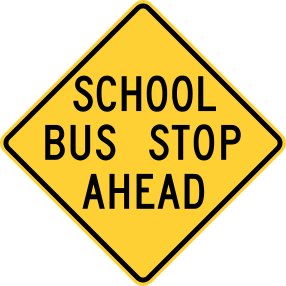
School bus stop ahead
3 questions from the Nebraska practice test
1. A driver approaching a school bus with its red stop lights on and stop arm extended must do what?
- Pass if no child is visible
- Slow to 25 MPH and continue past
- Stop and remain stopped until the arm retracts and red lights deactivate
- Stop only when traveling behind the bus
Show answer
Stop and remain stopped until the arm retracts and red lights deactivate. When the school bus door has opened, its red stop lights and stop arm signal that approaching or overtaking traffic must stop. Remain stopped until the bus driver retracts the arm and turns off the red warning lights. The 25 MPH instruction belongs to the earlier amber warning phase, before the bus door opens. A driver cannot rely on seeing a child, and the requirement is not limited to vehicles behind the bus. Watch the bus equipment, not just the roadway around it.
2. When a Nebraska school bus is stopped to load or unload students, what should drivers do?
- Use the shoulder to get around the bus
- Pass immediately if the bus door is still closed
- Remain alert for students on or near the roadway
- Watch only for students crossing behind the bus
Show answer
Remain alert for students on or near the roadway. A stopped school bus creates a student safety zone, even when no child is visible in the lane. Nebraska tells drivers to stay alert for students near the roadway, since children may approach from either side or move unpredictably. The choice about passing because the door is closed ignores the possibility that boarding or unloading is about to begin. A practical cue is to scan the shoulders, sidewalk, and area around the bus before moving. If the bus displays its red stop lights and extended arm, the separate stopping rule applies and you remain stopped until those warnings end.
3. Why might a long hill have a Slow Traffic Keep Right sign with an additional lane?
- It marks a lane reserved for emergency vehicles only
- It requires every vehicle to use the right lane before climbing
- It lets slower vehicles such as trucks and farm equipment move right while others pass
- It warns that passing is prohibited for the entire hill
Show answer
It lets slower vehicles such as trucks and farm equipment move right while others pass. On a long, steep grade, heavy or slow vehicles may not maintain the pace of ordinary traffic. The added right lane gives trucks, farm equipment, and recreational vehicles a place to move so other traffic can pass more smoothly. It is not a command for every vehicle to crowd into that lane, nor is it an emergency-only lane. The passing option also is not automatically prohibited by the sign. Read the posted instructions, keep a safe buffer around slower equipment, and merge only when the lane and traffic conditions allow it.
Practice this topic
Lock it in with safe driving questions from the free Nebraska practice test. Every answer comes with a plain English explanation.
Source: the Nebraska Driver's Manual, Section 6: Sharing the Road With Other Users. This lesson is a plain English summary, not the law itself; where it differs, the manual and the statute govern. Last checked 2026-09-27.