
Test 9 of 11 · 20 questions · Free 2026
NE Permit Practice Test 9
Jump to the test ↓A fixed 20 question set from the Nebraska bank with answers and plain English explanations. The real NE exam is 25 questions, 80 percent to pass; take the full length version on the main practice page.
Question 1 of 20 · 0 right so far
All 20 questions in test 9
Every question below comes from the Nebraska question bank on this page. Open a question to see the correct answer and the explanation. Nothing here is hidden behind a signup.
1. What should a driver do after leaving a protected area and entering an open space during high winds?
- Accelerate to reduce the effect of the wind
- Release the steering wheel so the vehicle can self-correct
- Be ready to make steering corrections as the wind changes
- Move beside a large truck for shelter
Show answer
Be ready to make steering corrections as the wind changes. A protected area can hide wind that becomes noticeable as soon as the vehicle reaches an open stretch. Nebraska tells drivers to anticipate that change and be ready for steering corrections. Releasing the wheel removes control, and accelerating does not make a sudden side force predictable. Driving beside a large truck creates another hazard because the truck can also experience wind movement and block the driver's view. Reduce surprises by holding a steady course, watching the roadway, and leaving room to correct smoothly rather than making a sharp reaction.
Study this in the handbook: Night driving, rain, fog, wind and floods
2. What range does the Nebraska manual give for the fine for texting and driving?
- $200 to $500
- $100 to $200
- $25 to $100
- $500 to $1,000
Show answer
$200 to $500. The manual gives a $200 to $500 fine range for texting and driving. The smaller ranges understate the stated exposure, while the $500 to $1,000 option starts above the manual's minimum and therefore does not describe the full range. The rule belongs to distracted-driving guidance, where the risk comes from taking attention away from the roadway. Treat a text as a driving task that must wait until the vehicle is safely stopped, rather than assuming a quick message falls below the penalty threshold.
Study this in the handbook: Work zones, school zones and speeding fines
3. How closely may a vehicle follow a fire apparatus traveling in emergency status?
- It may follow within 50 feet on a roadway with two lanes
- It may follow within 100 feet if the siren is audible
- It may not follow closer than 500 feet
- It may follow immediately after the apparatus clears an intersection
Show answer
It may not follow closer than 500 feet. Nebraska prohibits following a fire apparatus traveling in emergency status closer than 500 feet. Hearing the siren or reaching an intersection does not shorten that distance, and fifty or one hundred feet is far too close. The same passage also prohibits driving onto or parking within the block where the apparatus has stopped to answer an emergency. Slow down and let the apparatus create separation rather than trying to keep pace. The manual adds that funeral procession escort vehicles are classified as emergency vehicles that drivers must yield to.
Study this in the handbook: Emergency vehicles and the Move Over law
4. At a flashing red traffic signal, what must a driver do before proceeding?
- Slow down without stopping if the intersection appears empty
- Stop completely, yield to oncoming traffic or pedestrians, and proceed when clear
- Continue at the posted speed because flashing signals are advisory
- Wait for the signal to change to a steady green before moving
Show answer
Stop completely, yield to oncoming traffic or pedestrians, and proceed when clear. Nebraska treats a flashing red light as a stop condition. Bring the vehicle to a complete stop, then yield to approaching traffic and pedestrians before moving through the intersection. A driver who merely slows has not met the stopping requirement, even when the road looks empty. Waiting for a steady green is also unnecessary because the flashing indication can be cleared after the required stop and a safe gap. Scan the crosswalk and both approaches after stopping, then continue only when the way is clear.
Study this in the handbook: Traffic signals and turning on red
5. What occupant protection requirement applies to everyone transported in a vehicle operated by a Nebraska POP holder?
- Everyone transported must be secured in an occupant protection system
- Only front-seat occupants must be secured
- Only the permit holder must be secured
- Passengers may ride unsecured during daytime travel
Show answer
Everyone transported must be secured in an occupant protection system. The POP rule requires every person transported in the vehicle to be secured in an occupant protection system. It is not limited to the driver, the front seat, or nighttime trips. The broad word everyone is the important cue because a passenger's age or seating position does not create the exceptions offered in the other choices. Before moving, the permit holder should make a quick cabin check for belts or another required restraint for each occupant.
Study this in the handbook: Provisional Operator's Permit and Class O license
6. How much space should a driver allow when following a motorcycle?
- Three or four seconds
- One second because motorcycles are small
- The same two-second gap used behind a parked vehicle
- No extra space in dry conditions
Show answer
Three or four seconds. Motorcycles can change position or speed in response to pavement seams, gravel, wet surfaces, and railroad crossings. Nebraska therefore recommends three or four seconds behind one, giving the rider time to maneuver or stop in an emergency. The motorcycle's small size is not a reason to reduce the gap; it can make the vehicle harder to judge and leaves less visual margin. Dry pavement does not remove the need for space. Choose a fixed marker and preserve the longer interval, especially when the roadway presents a surface problem.
Study this in the handbook: Motorcycles and bicycles
7. What does the pedestrian warning sign shown tell a driver to anticipate?

- A lane reserved exclusively for bicycles
- A roadway where pedestrians are forbidden
- A repair crew working on the sidewalk only
- A pedestrian area or crossing requiring extra attention
Show answer
A pedestrian area or crossing requiring extra attention. The pedestrian warning sign tells drivers to watch for people crossing the street. Nebraska directs drivers to slow down, yield the right of way to pedestrians, or stop if necessary. The sign does not ban pedestrians, identify only a sidewalk repair crew, or establish a bicycle lane. Scan the crossing and its approaches, especially where another vehicle or roadside object may hide a person. The useful cue is action as well as detection: seeing this sign should make you ready to reduce speed and yield, not merely note that pedestrians might be nearby.
8. What happens to a Nebraska driver whose license is revoked under the point system twice within five years?
- The license is lost for three years
- The license is lost for six months, the same as the first time
- The license is lost for one year
- The license is permanently cancelled
Show answer
The license is lost for three years. A second point system revocation within five years costs the license or privilege for three years. The driver must also give and maintain proof of financial responsibility for three years and complete a course of at least four hours before reinstatement. Six months is the length of a first revocation for 12 points in two years, so the repeat penalty is harsher. One year and permanent cancellation are not what the manual states.
Study this in the handbook: The point system and license revocation
9. Where must a Nebraska applicant live or attend school to be eligible for a School Permit?
- Outside a city of 5,000 or more
- Inside any city with a high school
- Outside a city of 50,000 or more
- Within 10 miles of the school
Show answer
Outside a city of 5,000 or more. A School Permit can be issued when the person lives outside a city of 5,000 or more, or attends a school outside a city of 5,000 or more. The permit exists for students in smaller communities and rural areas, so living inside a city with a high school is not the test. The 50,000 figure is ten times the real threshold. The manual sets no 10 mile distance rule; the permit instead limits unsupervised trips to the most direct route between home and school.
Study this in the handbook: School learner's, school and learner's permits
10. How should the three second following rule be adjusted, according to the Nebraska manual?
- Subtract a second in heavy traffic
- Add one second for each adversity factor such as rain or heavy traffic
- Double it at night only
- Keep it fixed in all conditions
Show answer
Add one second for each adversity factor such as rain or heavy traffic. The three second rule is a minimum requirement and should be increased by one second for each adversity factor encountered, and the manual names rain and heavy traffic as examples. Subtracting a second in heavy traffic reverses that rule, and keeping the count fixed in every condition ignores it. The manual also says to maintain space on both sides of the vehicle and to keep space behind by holding a steady speed and signaling in advance whenever slowing or stopping. Count from a fixed roadside point, then add time as conditions require.
Study this in the handbook: Defensive driving and following distance
11. What type of information does a white roadway sign generally provide?
- A warning about unexpected road conditions
- Motorist services, such as food or lodging
- Regulatory information, such as a speed limit
- Directions to recreation and cultural areas
Show answer
Regulatory information, such as a speed limit. White signs generally provide regulatory information, including speed limits. Regulatory signs communicate traffic laws and their instructions must be obeyed. Blue signs identify motorist services, yellow signs warn about unexpected conditions, and brown signs identify recreation or cultural interest areas. Color is an early classification cue, so read the wording and symbol for the actual rule. A white sign may regulate speed, movement, parking, or another roadway action, rather than merely offering optional guidance.
Study this in the handbook: Sign colors and shapes
12. What is a two-way left-turn center lane permitted to be used for?
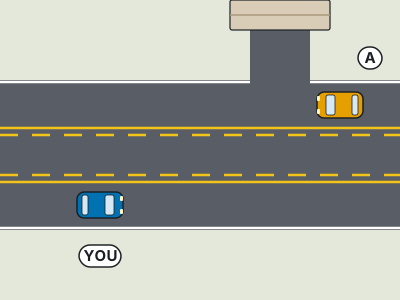
- Passing traffic whenever the center lane is empty
- Making a left turn, with caution for opposing left-turning vehicles
- Traveling straight until the next traffic signal
- Parking while waiting for a turn opportunity
Show answer
Making a left turn, with caution for opposing left-turning vehicles. The center lane is reserved for left turns shared with traffic from the opposite direction. Enter it carefully, watch for another driver preparing to turn, and use it only for the left-turn movement. It is not a passing lane, a through lane, or a parking area. Pavement arrows and signs help identify the lane, but the driver still needs to check for conflict. The visual cue is the two-way center lane serving turning traffic from both directions.
Study this in the handbook: Pavement markings
13. What does the crossed left-turn arrow shown prohibit?
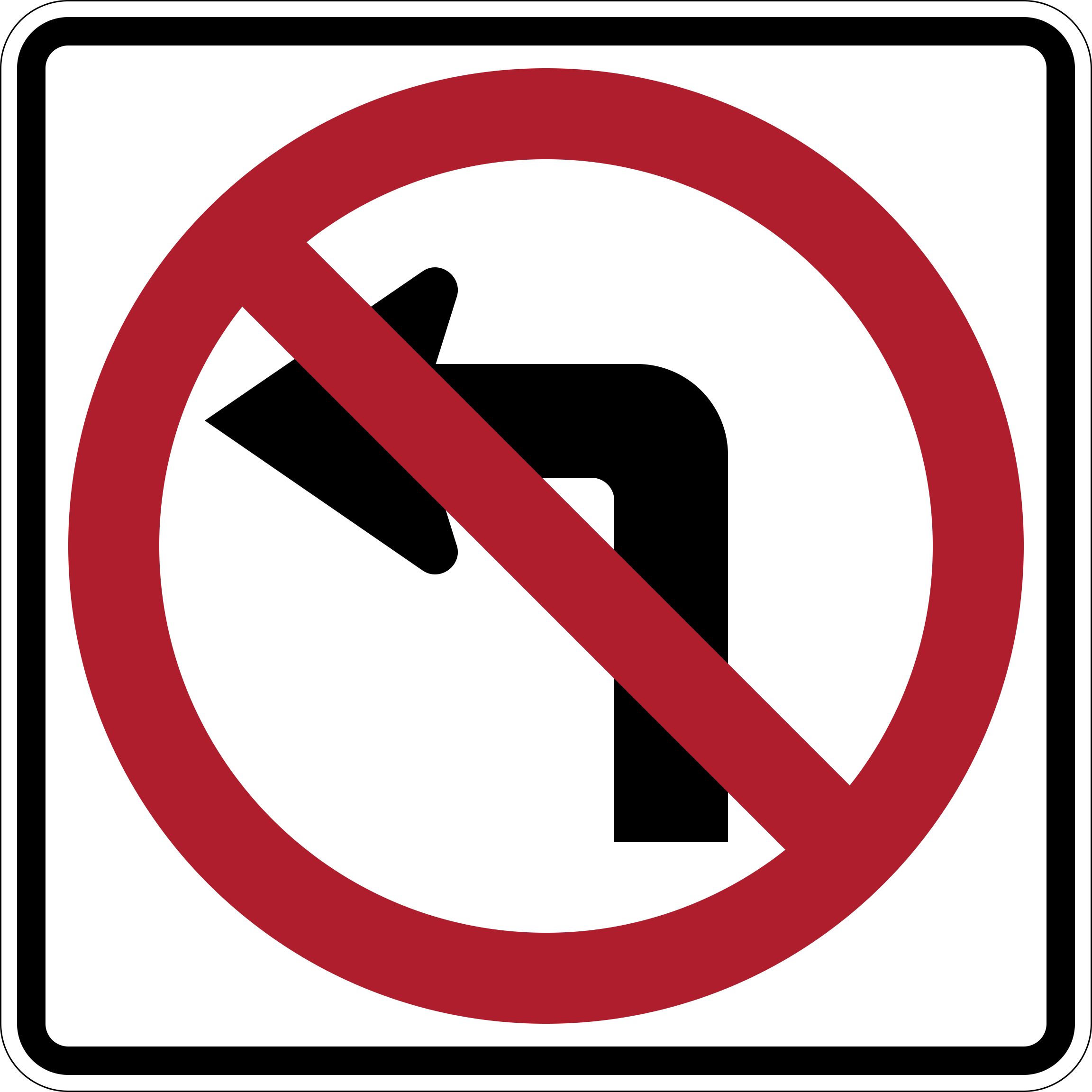
- Turning right
- Making a U-turn
- Turning left
- Proceeding straight
Show answer
Turning left. The sign depicts a left-turn arrow with a slash, and Nebraska defines NO LEFT TURN as left turn prohibited. It does not ban a U-turn unless the symbol specifically shows that movement, and it does not address a right turn or straight travel. Read the arrow rather than treating every red slash as a complete closure of the roadway. At the approach, plan another legal route or continue as the remaining signs and signals allow. Check for a separate U-turn restriction if you are considering reversing direction, because these movements are regulated independently.
Study this in the handbook: Regulatory and warning signs
14. What share of first time Nebraska applicants fail the written test, according to the manual?
- About 2 percent
- Over 32 percent
- About 75 percent
- Almost none
Show answer
Over 32 percent. Over 32 percent of first time applicants fail the written test, which is why the manual urges careful study and points to the practice interactive test on the DMV website. Any test failed may not be retaken the same day. Bring the required identity, Social Security and residency documents, since a missing document sends you home with a Return for Services form.
Study this in the handbook: Tests, renewal and address changes
15. At what BAC does Nebraska's manual say a driver's risk of being in a crash begins to rise noticeably?
- Between .01% and .02%
- Between .02% and .03%
- At .08% only
- Between .04% and .05%
Show answer
Between .04% and .05%. The manual says crash risk begins to rise noticeably between .04% and .05% BAC and then increases rapidly. Waiting until .08% misses the earlier warning in the text, while the lower ranges are not the stated threshold. This is a safety observation, not permission to drive until a legal limit is reached. A driver who plans to drink should arrange another ride before consuming alcohol, because measurable impairment and increasing crash risk can appear well before the familiar .08% figure.
Study this in the handbook: How alcohol impairs driving
16. How many distracted driving crashes did Nebraska record in the year cited by the manual?
- About 100
- 4,699 crashes, injuring 1,546 and killing 19
- About 50,000
- About 12
Show answer
4,699 crashes, injuring 1,546 and killing 19. Nebraska recorded 4,699 distracted driving crashes injuring 1,546 people and causing 19 deaths, while nationally 3,166 people were killed in distracted driving crashes in 2017, including 434 tied to cell phone use. Drivers using handheld phones are four times more likely to crash seriously enough to injure themselves. Distraction can be visual, manual or cognitive, and texting is all three.
Study this in the handbook: Work zones, school zones and speeding fines
17. What must a Nebraska driver under 21 do after accumulating six or more points within one year?
- Complete a commercial driving course within one year
- Surrender the license permanently
- Repeat the written test within 30 days
- Take a driver improvement course within three months
Show answer
Take a driver improvement course within three months. A Nebraska driver under 21 who accumulates six or more points within one year must take a driver improvement course within three months. The manual does not call for permanent surrender, an immediate written-test retake, or a commercial course. The two time periods matter: six points are counted across one year, then the required course must be completed within three months. Young drivers should monitor the point record early rather than waiting for a notice after the threshold has already been reached.
Study this in the handbook: Graduated licensing restrictions for teens
18. If a deer is about to enter your path, what sequence does Nebraska recommend?
- Turn off the headlights and continue at the same speed
- Swerve sharply into oncoming traffic before braking
- Accelerate and leave the roadway to pass behind the deer
- Brake firmly, steer to maintain control, and stop as safely as possible
Show answer
Brake firmly, steer to maintain control, and stop as safely as possible. Nebraska's deer guidance prioritizes control over a sudden evasive swerve. If impact is about to occur, brake firmly, steer to maintain control, and stop as safely as possible. Swerving into oncoming traffic or off the roadway can produce a more serious crash, while acceleration reduces the time available to respond. Slow in marked deer caution zones, watch from dusk to dawn and near wooded or water areas, and remember that deer often travel in groups. Keep the seat belt fastened before the risk appears.
Study this in the handbook: Crashes, deer and police stops
19. A first time Nebraska offender under an ALR installs an ignition interlock after the 15 day temporary license expires. How long is the Ignition Interlock Permit valid?
- 30 days
- 12 months
- Six months
- Two years
Show answer
Six months. First time offenders may install an ignition interlock system and apply for an Ignition Interlock Permit after the 15 day temporary license expires, and that permit is valid for six months. One year is the ALR length for subsequent offenders and for refusals, whose permits run for the balance of that year. Thirty days and two years are not the periods in the manual.
Study this in the handbook: Alcohol limits, implied consent and revocation
20. At an uncontrolled intersection, two vehicles arrive at approximately the same time. Who yields?
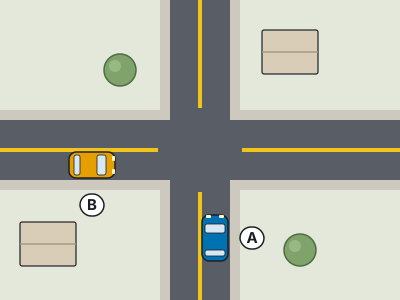
- Neither driver yields because no signs are present
- The driver on the wider roadway always proceeds first
- The driver who is traveling faster has priority
- The driver yields to the vehicle coming from the right
Show answer
The driver yields to the vehicle coming from the right. When signs and signals are absent and vehicles approach at approximately the same time, watch for the vehicle on your right and yield the right of way. The rule does not depend on road width, speed, or a driver's confidence, and the lack of a sign does not mean neither driver yields. Even when you have priority, drive defensively because another driver may fail to stop. The manual says never to insist on the right of way and risk a collision, so slow enough to identify the other vehicle and be ready to yield.
Study this in the handbook: Right of way at intersections
QualitySpace is expanding to Nebraska
We are a California-based independent insurance brokerage working on licensing in more states. We cannot help with Nebraska insurance yet. Leave your email and we will let you know when we can.
Every question is written from the official Nebraska Driver's Manual. Need paper? Printable NE practice test with answer key.
Last verified 2026-10-05. How we check every question · Study all 220 as flashcards
Frequently asked questions
How many questions are on this Nebraska practice test?
This fixed set has 20 questions. It is test 9 of 11 from the 220 question Nebraska bank. The real NE exam asks 25 questions and you need 20 correct.
What is the passing score for the real Nebraska test?
80% minimum on all written tests; on the 25-question Class O test that means 20 correct (can miss 5) That figure comes from the official Nebraska source cited on the DMV facts page.
How does this fixed test relate to the full Nebraska bank?
Each numbered test is a fixed set of questions in a fixed order, so you can retake the same test later and compare. Every test mixes road signs and the other topics in about the same proportion as the full bank. Tests 1 to 11 together cover every question in the Nebraska bank once. The full practice page mixes the whole bank at random.
Last verified 2026-10-05. See the Nebraska DMV facts page for sourced state details.
Return to the full Nebraska practice test · Study road signs