
Test 6 of 11 · 20 questions · Free 2026
NE Permit Practice Test 6
Jump to the test ↓A fixed 20 question set from the Nebraska bank with answers and plain English explanations. The real NE exam is 25 questions, 80 percent to pass; take the full length version on the main practice page.
Question 1 of 20 · 0 right so far
All 20 questions in test 6
Every question below comes from the Nebraska question bank on this page. Open a question to see the correct answer and the explanation. Nothing here is hidden behind a signup.
1. How long does a Nebraska Learner's Permit, or LPD, last from its date of issuance?
- Six months
- Two years
- Eighteen months
- One year
Show answer
One year. An LPD lasts one year after the date it is issued. Six months is associated with the School Learner's Permit, while eighteen months and two years are not the LPD duration listed in this manual. The starting point is issuance, so calculate from the date printed on the permit rather than from the applicant's birthday or the date of a driving lesson. Tracking that date helps a learner avoid treating an expired permit as permission to continue practice driving.
Study this in the handbook: Graduated licensing restrictions for teens
2. On a Nebraska multi lane controlled access highway, what lane change does the Move Over law require when you approach a stopped emergency or road assistance vehicle with flashing lights?
- Move onto the shoulder beside the stopped vehicle
- Move into a lane at least one travel lane away
- Stay in the same lane and sound the horn
- Cross two lanes even when the nearest lane is occupied
Show answer
Move into a lane at least one travel lane away. When a qualifying vehicle is stopped with flashing lights on a multi-lane controlled-access highway, the driver must move into a lane at least one travel lane away from it. The requirement is a full lane of separation, not a shoulder pass or a horn signal. Crossing extra lanes is unsafe when traffic does not permit it and is not the stated minimum. If the move cannot be completed safely, the rule supplies a different response: reduce speed and pass at a safe speed. Watch for an opening early and signal before moving.
Study this in the handbook: Yield signs, driveways and pedestrians
3. Under Nebraska's GDL restrictions, who must wear a seat belt when riding with a permit holder?
- Only the permit holder
- Only passengers younger than 18
- All occupants, including the driver
- Only people in the front passenger seat
Show answer
All occupants, including the driver. Nebraska requires all occupants riding with a permit holder, including the driver, to wear a seat belt. The rule does not depend on age, front-seat location, or whether the permit holder is the person driving. That makes each narrower choice incomplete. Use a whole-vehicle check before starting: the driver and every passenger should be secured. The manual also identifies a $25 violation fine, which reinforces that this is an enforceable permit restriction rather than a suggestion for optional safety behavior.
Study this in the handbook: Graduated licensing restrictions for teens
4. What action does the triangular sign shown require at an intersection?
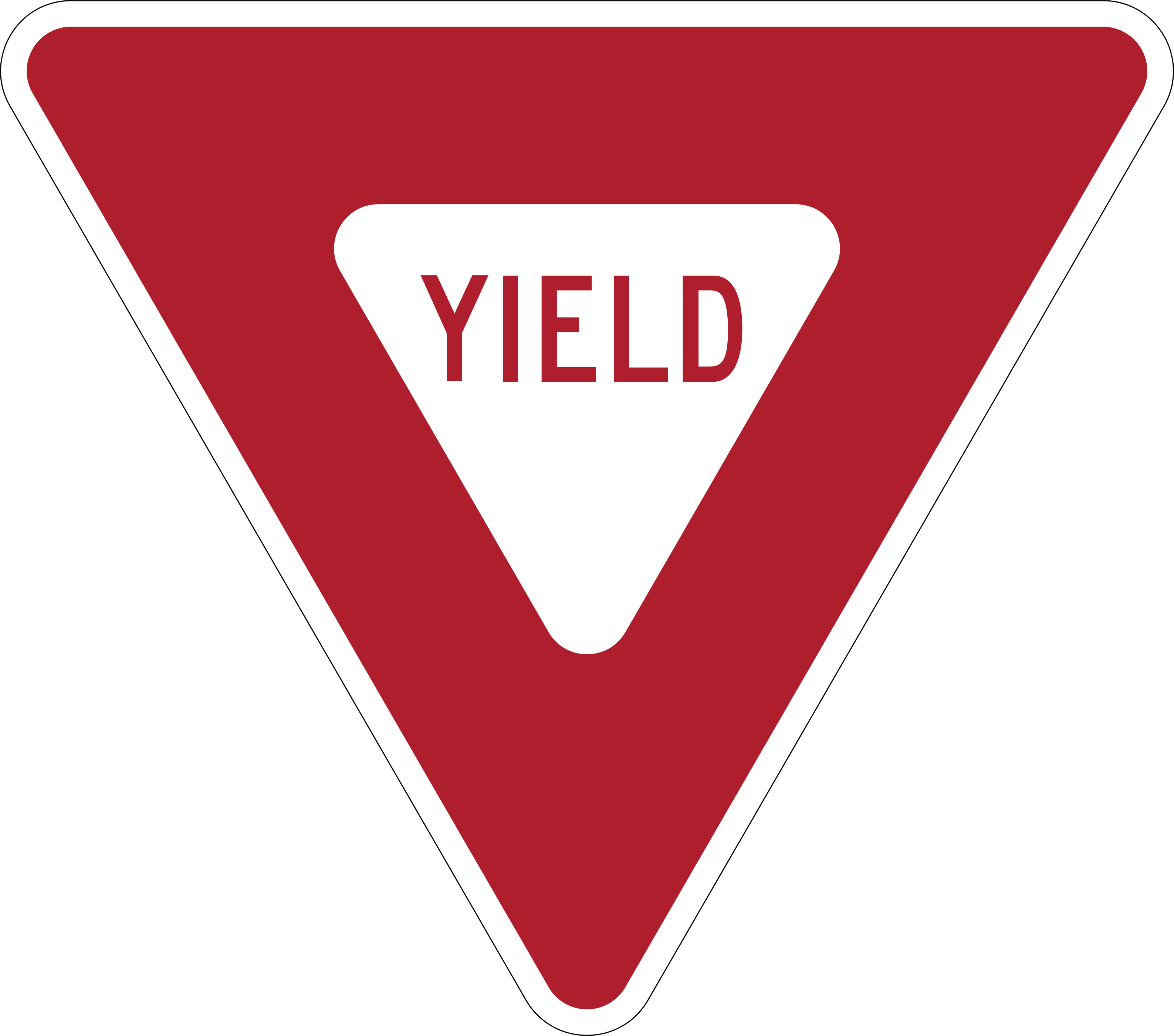
- Slow down or stop if necessary to give right-of-way
- Stop at every approach regardless of traffic
- Continue first because the triangle grants priority
- Enter only after a green signal appears
Show answer
Slow down or stop if necessary to give right-of-way. The triangular YIELD sign tells a driver to slow down or stop when necessary to give the right-of-way to crossing or merging vehicles. It does not impose a complete stop in every circumstance, so the choice “Stop at every approach regardless of traffic” adds an unnecessary requirement. The triangle does not grant priority, and a traffic signal is not required at every yield location. Approach with enough control to stop, scan for vehicles and pedestrians, and enter only after the conflicting movement has been given priority. The shape itself is a useful recognition cue because the manual assigns the triangle to YIELD.
Study this in the handbook: Regulatory and warning signs
5. How should a driver respond to a blind or visually impaired person using a white cane or service dog?
- Honk twice and continue if the person pauses
- Stop and remain stopped until the person is clear of the roadway
- Pass closely before the person reaches the lane
- Yield only when the person is inside a marked crosswalk
Show answer
Stop and remain stopped until the person is clear of the roadway. A person using a white cane or service dog receives the right of way, and the driver must stop and remain stopped until that person is clear of the roadway. A horn does not replace yielding, and passing close by creates a serious risk. The protection is not limited to a painted crosswalk. Watch for the mobility cue, stop early, and wait until the entire roadway path is clear before moving.
Study this in the handbook: Yield signs, driveways and pedestrians
6. For a Nebraska speeding citation dated on or after 11/14/20, how many points are assessed for 1 through 5 MPH over the limit?
- 0 points
- 1 point
- 2 points
- 3 points
Show answer
0 points. For citations dated on or after 11/14/20, speeding 1 through 5 MPH over the limit is assessed 0 points, inside or outside city limits. One point was the value for the same speed before that date, so it describes the old rule. Two and three points belong to higher speeding bands. A fine still applies; the speeding fine schedule lists $10 plus court costs for 1 through 5 over in a normal zone.
Study this in the handbook: The point system and license revocation
7. What does a double solid yellow center line generally mean?
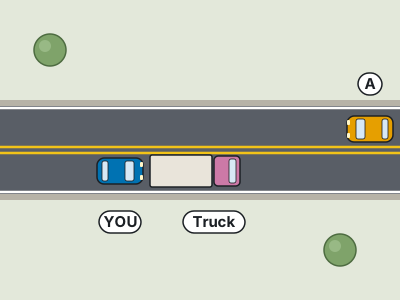
- Only trucks may cross to pass another vehicle
- Passing is allowed for traffic traveling in both directions
- Passing is prohibited in both directions
- The road is changing from two way to one way
Show answer
Passing is prohibited in both directions. Double solid yellow lines separate opposing traffic and prohibit passing in either direction. They are not changed into passing permission by a driver's impatience or by a vehicle's size. Nebraska identifies only limited lawful crossings, such as making a left turn or avoiding an obstruction, when the move is otherwise permitted. Do not treat the center marking as a lane to borrow for overtaking. Wait for a legal passing opportunity and keep the vehicle on its side of the roadway.
Study this in the handbook: Pavement markings
8. What roadway condition is represented by a winding road warning?

- A series of turns or curves ahead
- A single straight grade
- A lane reserved for bicycles
- A railroad crossing immediately ahead
Show answer
A series of turns or curves ahead. The winding road warning means the roadway continues through a series of turns or curves. Because the sequence extends beyond one bend, choose a controlled speed before entering and maintain attention through each change in direction. It does not describe a straight grade, a bicycle lane, or a railroad crossing. Avoid treating the first curve as the whole hazard. Look through the roadway, keep both hands ready for steering, and leave enough space to respond if another vehicle appears after a bend.
Study this in the handbook: Regulatory and warning signs
9. What is the Nebraska guidance for braking in a vehicle without antilock brakes?
- Pump the brake pedal to help keep the brakes from locking
- Press the pedal firmly and never release it
- Turn off the ignition before braking
- Use the parking brake alone while steering sharply
Show answer
Pump the brake pedal to help keep the brakes from locking. For a vehicle without ABS, pumping the brake pedal helps keep the wheels from locking, preserving the ability to steer while the tires continue rolling. Holding the pedal down hard can lock the tires and reduce directional control. This advice is specific to non-ABS equipment; a vehicle with ABS receives different instructions to press the pedal firmly without pumping. The key first step is to know which braking system the vehicle has. During an emergency, combine the prescribed pedal technique with controlled steering and attention to the open path ahead.
Study this in the handbook: Snow, ice, blizzards and wheels off the pavement
10. What administrative license sanction does Nebraska impose for refusing a requested chemical test?
- A permanent revocation in every case
- A warning with no license action
- A seven day suspension
- A one year license revocation
Show answer
A one year license revocation. Refusing a requested blood, breath, or urine test brings a one year administrative license revocation under Nebraska's implied consent rules. The refusal is also a separate crime, and the manual says criminal penalties can match those for a DUI conviction at .15 BAC or above. A warning, a seven day suspension, or an automatic permanent revocation misses the stated administrative sanction. The key cue is that operating on Nebraska roadways already carries agreement to submit when law enforcement requests the test. Refusal therefore creates consequences even before considering any separate impairment charge.
Study this in the handbook: Alcohol limits, implied consent and revocation
11. What general speed principle applies on Nebraska roads even when a posted maximum exists?
- Always travel at the posted maximum
- Drive at a speed reasonable and safe under existing conditions
- Use the same speed on every road type
- Choose a speed based only on the vehicle's capability
Show answer
Drive at a speed reasonable and safe under existing conditions. Nebraska's general speed law requires a speed that is reasonable and safe under the conditions that exist. A posted maximum is a ceiling, not a promise that the same number is safe in rain, ice, darkness, congestion, or reduced visibility. Using one speed on every road ignores the manual's separate limits and roadway differences. A vehicle's capability cannot replace the driver's duty to respond to surroundings. The practical cue is to read the sign, then lower speed whenever traction, sight distance, traffic flow, or roadside activity calls for more control.
Study this in the handbook: Yield signs, driveways and pedestrians
12. How long does a Nebraska license stay valid for a service member after discharge?
- It expires on the discharge date
- One year after discharge
- Ten days after discharge
- While on active duty and for 60 days after discharge or return to Nebraska, whichever is later
Show answer
While on active duty and for 60 days after discharge or return to Nebraska, whichever is later. If the license was valid on or after August 27, 1971, it remains valid while the holder serves on active duty and for 60 days following a discharge or return to Nebraska, whichever is later. Members who qualify can request Form 07-08, a small card explaining the exemption, and present military orders or a DD214 to driver licensing staff when renewing.
13. On a Nebraska controlled-access highway, how is a second failure to move over or slow down for a stopped vehicle classified if it comes within five years of a prior conviction?
- A Class IIIA misdemeanor
- A warning with no penalty
- A felony with automatic license revocation
- A parking violation
Show answer
A Class IIIA misdemeanor. Nebraska Revised Statute 60-6,378, as amended in 2025, treats a first violation of the controlled access highway move over rule as a traffic infraction, but a second or later violation within five years after a conviction is a Class IIIA misdemeanor. The driver's manual lists fines of up to $500 and/or up to 7 days in jail for second and subsequent offenses. When approaching a stopped vehicle, move at least one lane away when two lanes run your direction; otherwise slow down and pass with care.
14. What do green and white guide signs provide?
- Warnings about road workers in a construction area
- Directional and distance information
- Regulatory instructions that prohibit every listed movement
- Reserved parking for drivers with handicapped privileges
Show answer
Directional and distance information. Green and white guide signs provide directional and distance information. Diagrams may show exit and entrance movements at interchanges, helping drivers select lanes and plan ahead. Orange signs identify work zones, white regulatory signs communicate laws, and handicapped parking signs reserve designated spaces. A guide sign is useful navigation information, but it does not cancel a posted regulatory instruction. Read it early, choose the needed lane in time, and continue following speed and lane controls.
Study this in the handbook: Guide, service and work zone signs
15. How should a driver respond to a pedestrian within a crosswalk?
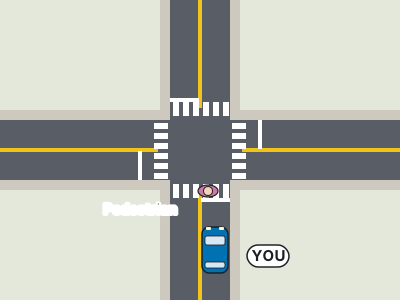
- Continue first because vehicles always have priority outside a signal
- Yield, slow down, and be ready to stop if needed
- Sound the horn so the pedestrian must leave the crosswalk
- Pass the pedestrian by moving into the opposing lane
Show answer
Yield, slow down, and be ready to stop if needed. A pedestrian in a crosswalk must be given room to cross safely. Nebraska directs motorists to yield, slow down, and be ready to stop if needed. A horn does not transfer priority to the vehicle, and moving around the pedestrian into opposing traffic can create a new collision. Do not judge the pedestrian's speed as permission to continue. Reduce speed before the crosswalk, scan both sides for people who may enter, and remain stopped until the crossing path is clear.
Study this in the handbook: Yield signs, driveways and pedestrians
16. How much clearance does Nebraska tell motorists to leave to avoid colliding with a pedestrian on the roadway?
- No less than one foot
- No less than two feet
- No less than three feet
- No less than ten feet
Show answer
No less than three feet. Nebraska says motorists should leave a safe distance of no less than three feet of clearance to avoid colliding with any pedestrian on a roadway. The same three foot minimum applies when passing a bicycle. One and two feet leave too little margin for a sudden step. Ten feet is not the figure in the manual; the rule sets a floor, and more room is always allowed.
Study this in the handbook: Yield signs, driveways and pedestrians
17. For a person age 20 or younger, what penalty does Nebraska list for a second minor in possession conviction?
- A 30 day impoundment
- A 12 month impoundment
- A 90 day impoundment
- A $25 fine only
Show answer
A 90 day impoundment. For minor in possession, the court impounds the permit or license for 30 days on a first conviction, 90 days on a second, and 12 months on a third or later conviction. So 90 days is the second offense penalty. Thirty days is the first offense and 12 months is the third. A driver with no permit or license is barred from getting one for the same period, so a small fine alone is not the rule.
Study this in the handbook: The point system and license revocation
18. When you must stop at a Nebraska railroad crossing with no stop line, how far from the nearest rail must you stop?
- Not less than 15 feet nor more than 50 feet
- Not less than 5 feet nor more than 10 feet
- Exactly 100 feet
- Not less than 50 feet nor more than 100 feet
Show answer
Not less than 15 feet nor more than 50 feet. When required to stop at a railroad crossing, stop at the stop line; if there is none, stop not less than 15 feet nor more than 50 feet from the nearest rail. Five to ten feet leaves too little room from a passing train. One hundred feet is the no passing distance from a railroad crossing, not a stopping point. Fifty to one hundred feet falls outside the stated range.
Study this in the handbook: Parking and railroad crossings
19. What should a driver do when emergency lights appear behind the vehicle?
- Follow the emergency vehicle closely to pass traffic
- Stop immediately in the travel lane
- Turn off all lights and continue until the next town
- Activate the turn signal and pull to the side when safe
Show answer
Activate the turn signal and pull to the side when safe. When emergency lights appear behind you, the manual says to stay calm, activate your turn signal, and pull off or to the side of the roadway as soon as it is safe to do so. Then turn off the engine and audio devices, stay in the vehicle unless directed to exit, and keep your hands visible. Stopping in the travel lane, following the emergency vehicle, or driving on with the lights off does not match these steps.
Study this in the handbook: Crashes, deer and police stops
20. What is the default maximum speed in a Nebraska business district when no other limit is posted?
- 35 MPH
- 25 MPH
- 20 MPH
- 50 MPH
Show answer
20 MPH. Nebraska's business district default is 20 MPH unless a different limit is posted. The 25 MPH choice describes a residential district, and 50 MPH is associated with gravel or other non-dustless roadways. Thirty five miles per hour is not the listed default for a business district. Identify the district before looking at the answer numbers, because the manual assigns separate limits to business areas, residential areas, and roadway surfaces. A posted limit controls when one is present, while the statutory default fills the gap when no sign gives a different number.
Study this in the handbook: Speed limits
QualitySpace is expanding to Nebraska
We are a California-based independent insurance brokerage working on licensing in more states. We cannot help with Nebraska insurance yet. Leave your email and we will let you know when we can.
Every question is written from the official Nebraska Driver's Manual. Need paper? Printable NE practice test with answer key.
Last verified 2026-10-05. How we check every question · Study all 220 as flashcards
Frequently asked questions
How many questions are on this Nebraska practice test?
This fixed set has 20 questions. It is test 6 of 11 from the 220 question Nebraska bank. The real NE exam asks 25 questions and you need 20 correct.
What is the passing score for the real Nebraska test?
80% minimum on all written tests; on the 25-question Class O test that means 20 correct (can miss 5) That figure comes from the official Nebraska source cited on the DMV facts page.
How does this fixed test relate to the full Nebraska bank?
Each numbered test is a fixed set of questions in a fixed order, so you can retake the same test later and compare. Every test mixes road signs and the other topics in about the same proportion as the full bank. Tests 1 to 11 together cover every question in the Nebraska bank once. The full practice page mixes the whole bank at random.
Last verified 2026-10-05. See the Nebraska DMV facts page for sourced state details.
Return to the full Nebraska practice test · Study road signs