
Test 2 of 11 · 20 questions · Free 2026
NE Permit Practice Test 2
Jump to the test ↓A fixed 20 question set from the Nebraska bank with answers and plain English explanations. The real NE exam is 25 questions, 80 percent to pass; take the full length version on the main practice page.
Question 1 of 20 · 0 right so far
All 20 questions in test 2
Every question below comes from the Nebraska question bank on this page. Open a question to see the correct answer and the explanation. Nothing here is hidden behind a signup.
1. Which roadside vehicles are included in Nebraska's Move Over rule when they are stopped on a controlled-access highway with flashing lights?
- Only marked police cars and ambulances
- Only privately owned tow trucks
- Any vehicle stopped on a highway, whether or not its lights are flashing
- Emergency, road assistance, utility, highway maintenance, and waste or recycling collection vehicles
Show answer
Emergency, road assistance, utility, highway maintenance, and waste or recycling collection vehicles. The Nebraska rule covers more than police vehicles. Its listed categories include emergency vehicles, road assistance vehicles, public or private utility maintenance vehicles, highway maintenance vehicles, and solid waste or recycling collection vehicles when flashing lights are in use. Limiting the rule to police and ambulances leaves roadside workers unprotected. The rule applies on a multi-lane controlled-access highway, and when a lane change is not possible the driver must reduce speed and maintain a safe speed past the stopped vehicles. Scan shoulders and ramps for work activity, not just patrol cars.
Study this in the handbook: Yield signs, driveways and pedestrians
2. A yellow warning sign showing a small STOP sign tells you what is ahead?

- An approaching stop sign
- A new passing lane
- A railroad crossing with gates
- A reduced speed zone only
Show answer
An approaching stop sign. The Stop Ahead warning announces that an actual stop sign is approaching. It gives you time to reduce speed, look for the stop line or crosswalk, and prepare for a complete stop at the intersection. The yellow diamond does not replace the red stop sign, add a passing lane, or identify a railroad crossing. Nor does it merely announce a reduced-speed zone. When this warning appears, expect the separate stop requirement shortly ahead and avoid waiting until the last moment to brake.
3. When are Nebraska handicapped parking stalls reserved for permit holders?
- Only during business hours
- 24 hours a day, 7 days a week
- Only when the lot is full
- Only on weekdays
Show answer
24 hours a day, 7 days a week. Handicapped parking stalls are reserved for vehicles displaying a handicap license plate or permit, from which the handicapped person enters or exits, 24 hours a day and 7 days a week. Do not park in the access aisles beside the stalls. Fines for violating handicapped parking laws start at up to $150 for a first offense and rise for later offenses.
Study this in the handbook: Parking and railroad crossings
4. What does Nebraska's zero-tolerance law prohibit a driver under 21 from doing?
- Possessing an unopened beverage in a parked vehicle
- Driving only after reaching a BAC of .08%
- Operating only a commercial motor vehicle after drinking
- Operating with alcohol in the driver's system
Show answer
Operating with alcohol in the driver's system. Nebraska's zero-tolerance rule treats operating a motor vehicle with alcohol in the system as a violation for a driver under 21. The adult .08% figure is not a permission threshold for this age group, and the rule is not confined to commercial vehicles. An unopened beverage in a parked vehicle is a different situation from operating after drinking. Use the age detail as the first filter in the question. If the driver is under 21, selecting a response that allows any alcohol while driving misses the central restriction.
Study this in the handbook: Alcohol limits, implied consent and revocation
5. When a rectangular roadway sign is vertical, what type of message does it generally provide?
- Instructions or information about the law
- A warning about an unexpected hazard only
- A school crossing warning only
- A recreational area symbol only
Show answer
Instructions or information about the law. The manual distinguishes rectangular signs by orientation. A vertical rectangle generally gives instructions or tells the driver the law, which includes regulatory directions such as speed limits or turn restrictions. A horizontal rectangle is more often used for directions or information. The warning-only choice belongs more closely to diamond-shaped signs, while school warnings use the pentagon. The important visual cue is both shape and orientation: do not treat every rectangle as a hazard warning, and read its wording as an instruction that may require a specific driving action.
Study this in the handbook: Sign colors and shapes
6. What does a steady yellow traffic light tell a driver who has not entered the intersection?
- Reverse to the previous intersection
- Speed up to beat the red light
- Stop only if a pedestrian is present
- Bring the vehicle to a safe stop
Show answer
Bring the vehicle to a safe stop. A steady yellow signal warns that the light is changing. If the vehicle has not entered the intersection, Nebraska says it should be brought to a safe stop. Accelerating to beat the light is specifically unlawful and can turn a warning interval into a dangerous entry against the red. The driver should not reverse into traffic, either. If already in the intersection, continue moving and clear it safely. The useful cue is the vehicle's position: before the intersection, stop safely; inside it, finish clearing without delay.
Study this in the handbook: Traffic signals and turning on red
7. A Nebraska teen applying for a POP with a 50 hour certification form instead of a driver safety course must show how many of those hours were driven between sunset and sunrise?
- At least 5 hours
- At least 20 hours
- At least 10 hours
- At least 15 hours
Show answer
At least 10 hours. The 50 hour certification form must be signed by a parent, guardian, or licensed driver who is at least 21, and it must show that at least 10 hours of driving took place between sunset and sunrise. Five hours is half the required night practice. Fifteen and twenty hours are more than the form requires, so they overstate the rule. The same 50 hour and 10 night hour standard also applies to the School Permit certification route.
Study this in the handbook: Graduated licensing restrictions for teens
8. After a Nebraska point system revocation, what course must the driver complete before driving privileges can be reinstated?
- A 30 minute online video
- A course of at least four hours of DMV approved instruction
- A 50 hour supervised driving log
- A 16 week alcohol treatment program
Show answer
A course of at least four hours of DMV approved instruction. A driver revoked under the Nebraska Point System Law must successfully complete a driver's education and training course of at least four hours of DMV approved instruction, at the driver's own cost, before reinstatement. A short online video does not meet that standard. The 50 hour log is a teen permit requirement, not a reinstatement step. An alcohol treatment program is not what the point revocation section requires.
Study this in the handbook: The point system and license revocation
9. When must a Nebraska driver send a Driver's Motor Vehicle Crash Report to the Department of Transportation if no officer investigated?
- Within 30 days, only if someone was killed
- Within 10 days if anyone is injured or killed, or property damage to any one person reaches $1,500
- Within 24 hours for every crash
- Only when an insurance company asks for it
Show answer
Within 10 days if anyone is injured or killed, or property damage to any one person reaches $1,500. If no law enforcement officer investigated, the driver must send a crash report on NDOT Form 41 within ten days when anyone is injured or killed, or when damage to the property of any one person equals or exceeds $1,500. If an officer investigated, the officer submits the report. Thirty days and 24 hours are not the deadline, and the duty does not depend on an insurer. Failing to report is a Class II or III misdemeanor and can cost the license.
Study this in the handbook: Crashes, deer and police stops
10. What happens to a Nebraska driver who is convicted of driving while the court has impounded the license?
- The license is revoked for one year
- The impoundment simply restarts
- The driver receives 1 point
- The license is revoked for 30 days
Show answer
The license is revoked for one year. Any driver convicted of driving during a court ordered impoundment has the license revoked for one year. The penalty is not a restart of the original impoundment or a single point. Thirty days is the length of several first offense impoundments, not the penalty for ignoring one. For an underage driver who drives during a .02 impoundment, the court revocation is six months instead.
Study this in the handbook: Alcohol limits, implied consent and revocation
11. When are Nebraska traffic fines doubled in a school zone or work zone?
- Only after a crash occurs
- Only during overnight hours
- In school zones and when workers are present in work zones
- Whenever the road has two lanes
Show answer
In school zones and when workers are present in work zones. Nebraska doubles fines in school zones and when workers are present in work zones. The work zone part of the rule depends on workers being present, while the school zone part is tied to the school zone itself. A crash, overnight timing, or lane count does not create this fine increase. Remember two separate settings: school zones, and work zones with workers present. When either condition applies, obey the posted controls carefully and expect the financial penalty for a violation to be doubled.
Study this in the handbook: Work zones, school zones and speeding fines
12. Under Nebraska's BAC list, at what concentration is it unlawful for a driver under 21 to operate a motor vehicle?
- .02% or higher
- .05% or higher
- .04% or higher
- .08% or higher only
Show answer
.02% or higher. Nebraska makes driving unlawful at .02% BAC or higher for a driver under 21. The .04% figure applies when operating a commercial motor vehicle, while .08% is the broader threshold listed regardless of driver age or vehicle type. The under 21 rule is therefore stricter than the ordinary adult threshold, and it does not require a reading of .08 before a violation exists. When a question gives both age and BAC, apply the age specific threshold first. Also remember that alcohol and driving can impair decisions well before the highest legal number is reached.
Study this in the handbook: Alcohol limits, implied consent and revocation
13. At a Nebraska four-way stop, which driver should ordinarily be allowed to proceed first?
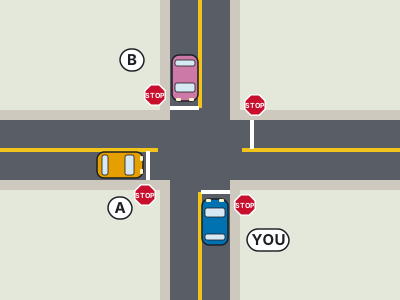
- The driver in the largest vehicle
- The driver who stops first
- The driver farthest left
- The driver who accelerates first
Show answer
The driver who stops first. Nebraska describes it as common courtesy to permit the driver who stops first to go first. That courtesy operates alongside the duty to use ordinary care, so it is not permission to rush into the intersection. Vehicle size, lane position on the left, and accelerating first do not establish this order. Watch who arrives and stops, and continue scanning for a person or vehicle that may not follow the expected sequence. If arrival order is unclear, the manual says to yield to the driver on your right rather than insist on going first.
Study this in the handbook: Right of way at intersections
14. A reverse turn warning sign indicates which roadway pattern?
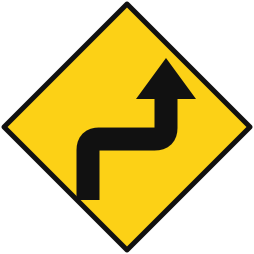
- The road turns sharply right, then left
- The road curves gently left only
- A four way intersection follows
- The lane ends at the next block
Show answer
The road turns sharply right, then left. A reverse turn warning identifies two successive sharp changes, with the roadway turning right and then left. The driver should reduce speed before the first change and remain prepared for the second rather than accelerate after the initial bend. A gentle single curve, an intersection, and a lane ending describe different conditions. Look beyond the first arrow so the second movement does not surprise you. Keep within the lane and avoid braking or steering abruptly while the vehicle is already turning.
15. What does the railroad crossbuck shown tell a driver to do?
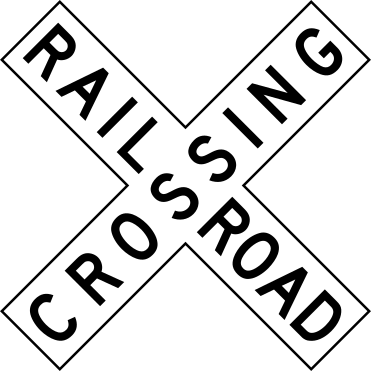
- Cross first because trains must yield at the sign
- Speed up because the crossbuck guarantees tracks are clear
- Stop only when a gate is already lowering
- Look both ways, listen, yield to trains, and be prepared to stop
Show answer
Look both ways, listen, yield to trains, and be prepared to stop. Nebraska says the railroad crossbuck advises of a crossing and means drivers should look both ways, listen, yield to trains, and be prepared to stop if a train approaches. It is not permission to accelerate, and the duty does not wait for a gate to lower. Trains do not yield simply because a vehicle reached the sign first. Slow to a controlled speed, check every track and both directions, and make sure there is room beyond the rails before crossing. A number beneath the crossbuck can indicate more than one set of tracks.
Study this in the handbook: Sign colors and shapes
16. Which red-light left turn is permitted after a complete stop?
- A left turn on a red arrow after yielding
- Any left turn from a two-way street onto a one-way street
- A left turn whenever no pedestrian is visible
- A turn from one one-way street onto another one-way street
Show answer
A turn from one one-way street onto another one-way street. Nebraska permits a left turn at a circular red light after stopping when the vehicle travels from a one-way street onto another one-way street. Signs may prohibit the movement at particular locations. A two-way street does not satisfy the stated pair of one-way streets, and an empty-looking crosswalk is not enough. A red arrow prohibits the turn altogether, regardless of whether the driver yields.
Study this in the handbook: Traffic signals and turning on red
17. How many points does Nebraska assess for leaving the scene of a crash?
- Two points
- Four points
- Six points
- One point
Show answer
Six points. Leaving the scene of a crash is a 6 point violation, the same value as DUI, willful reckless driving, failing to report a crash, and failing to render aid. The 1, 2, and 4 point values belong to lesser violations on the chart. A separate section adds that a person convicted of leaving the scene may have the license revoked for up to one year. Stay at the scene until released by the proper authorities.
Study this in the handbook: The point system and license revocation
18. Why might a long hill have a Slow Traffic Keep Right sign with an additional lane?
- It marks a lane reserved for emergency vehicles only
- It requires every vehicle to use the right lane before climbing
- It lets slower vehicles such as trucks and farm equipment move right while others pass
- It warns that passing is prohibited for the entire hill
Show answer
It lets slower vehicles such as trucks and farm equipment move right while others pass. On a long, steep grade, heavy or slow vehicles may not maintain the pace of ordinary traffic. The added right lane gives trucks, farm equipment, and recreational vehicles a place to move so other traffic can pass more smoothly. It is not a command for every vehicle to crowd into that lane, nor is it an emergency-only lane. The passing option also is not automatically prohibited by the sign. Read the posted instructions, keep a safe buffer around slower equipment, and merge only when the lane and traffic conditions allow it.
Study this in the handbook: School buses, snow plows and large trucks
19. What is the minimum insurance coverage for bodily injury to one person in one crash?
- $10,000
- $25,000
- $50,000
- $100,000
Show answer
$25,000. Nebraska requires $25,000 for bodily injury to or death of one person in one crash. The $50,000 amount applies to bodily injury to or death of two or more people, subject to the one person limit, so it is not the answer for a single injured person. The smaller distractor does not meet the required minimum, and $100,000 is higher than the stated amount. Remember the coverage categories separately: one person, multiple people, and property damage each have their own figure.
Study this in the handbook: Crashes, deer and police stops
20. When a Nebraska school bus is stopped to load or unload students, what should drivers do?
- Use the shoulder to get around the bus
- Pass immediately if the bus door is still closed
- Remain alert for students on or near the roadway
- Watch only for students crossing behind the bus
Show answer
Remain alert for students on or near the roadway. A stopped school bus creates a student safety zone, even when no child is visible in the lane. Nebraska tells drivers to stay alert for students near the roadway, since children may approach from either side or move unpredictably. The choice about passing because the door is closed ignores the possibility that boarding or unloading is about to begin. A practical cue is to scan the shoulders, sidewalk, and area around the bus before moving. If the bus displays its red stop lights and extended arm, the separate stopping rule applies and you remain stopped until those warnings end.
Study this in the handbook: School buses, snow plows and large trucks
QualitySpace is expanding to Nebraska
We are a California-based independent insurance brokerage working on licensing in more states. We cannot help with Nebraska insurance yet. Leave your email and we will let you know when we can.
Every question is written from the official Nebraska Driver's Manual. Need paper? Printable NE practice test with answer key.
Last verified 2026-10-05. How we check every question · Study all 220 as flashcards
Frequently asked questions
How many questions are on this Nebraska practice test?
This fixed set has 20 questions. It is test 2 of 11 from the 220 question Nebraska bank. The real NE exam asks 25 questions and you need 20 correct.
What is the passing score for the real Nebraska test?
80% minimum on all written tests; on the 25-question Class O test that means 20 correct (can miss 5) That figure comes from the official Nebraska source cited on the DMV facts page.
How does this fixed test relate to the full Nebraska bank?
Each numbered test is a fixed set of questions in a fixed order, so you can retake the same test later and compare. Every test mixes road signs and the other topics in about the same proportion as the full bank. Tests 1 to 11 together cover every question in the Nebraska bank once. The full practice page mixes the whole bank at random.
Last verified 2026-10-05. See the Nebraska DMV facts page for sourced state details.
Return to the full Nebraska practice test · Study road signs