
Test 10 of 11 · 20 questions · Free 2026
NE Permit Practice Test 10
Jump to the test ↓A fixed 20 question set from the Nebraska bank with answers and plain English explanations. The real NE exam is 25 questions, 80 percent to pass; take the full length version on the main practice page.
Question 1 of 20 · 0 right so far
All 20 questions in test 10
Every question below comes from the Nebraska question bank on this page. Open a question to see the correct answer and the explanation. Nothing here is hidden behind a signup.
1. What BAC threshold applies in Nebraska when a person is operating a commercial motor vehicle?
- .04% or higher
- .02% or higher
- .06% or higher
- .08% or higher only
Show answer
.04% or higher. The manual lists .04% BAC or higher for operation of a commercial motor vehicle. That is lower than the general .08% threshold and different from the .02% threshold for a driver under 21. The question turns on the vehicle category, so do not substitute the ordinary adult limit simply because the driver is over 21. A commercial vehicle triggers its own figure. The safest operational reminder is that a lower legal threshold does not make alcohol use safe, and Nebraska separately warns that alcohol or other drugs impair decision making and vehicle control.
Study this in the handbook: Alcohol limits, implied consent and revocation
2. How far does an average 150 car freight train need to stop from 30 mph, according to the Nebraska manual?
- 300 feet
- One car length
- 10 miles
- 3,150 feet, about three fifths of a mile
Show answer
3,150 feet, about three fifths of a mile. An average 150 car freight train traveling 30 mph requires a stopping distance of 3,150 feet, about three fifths of a mile, and the same train at 60 mph needs 8,500 feet, or one and three fifths miles. Trains and on track equipment cannot stop quickly, so never try to beat a train across the tracks; even if it is a tie, you will be the loser. Always expect a train or on track equipment at any crossing.
Study this in the handbook: Parking and railroad crossings
3. What should you do when leaving a driveway to enter a roadway?
- Roll across the sidewalk because roadway traffic has priority
- Stop before the sidewalk and yield to pedestrians and approaching vehicles
- Honk and enter before pedestrians reach the curb
- Stop only after the front wheels enter the roadway
Show answer
Stop before the sidewalk and yield to pedestrians and approaching vehicles. Before entering from a driveway, parking lot, or alley, stop before driving onto the sidewalk or sidewalk area. Proceed slowly and yield to pedestrians as well as approaching vehicles. The sidewalk is part of the path that must be checked, so stopping after the front wheels reach the road is too late. A horn does not give permission to enter. Look both ways, allow the sidewalk and roadway to clear, then make the entry smoothly.
Study this in the handbook: Yield signs, driveways and pedestrians
4. How long must a subsequent Nebraska DUI offender wait after the temporary license expires to apply for an ignition interlock permit?
- No wait
- One year
- 45 days
- 10 days
Show answer
45 days. Subsequent offenders must wait 45 days after the temporary license expires to be eligible to apply for the ignition interlock permit during an administrative license revocation, and the permit is then valid for the balance of the one year revocation. The same 45 day wait applies to the Sobriety Program Permit for drivers ordered into the 24/7 program, and a court certified order is required to obtain it.
Study this in the handbook: Alcohol limits, implied consent and revocation
5. On what form must a Nebraska driver's crash report be submitted when police did not investigate?
- NDOT Form 41, available from law enforcement or online
- An insurance claim form
- Any written letter
- No report is needed without police
Show answer
NDOT Form 41, available from law enforcement or online. If a law enforcement officer investigated the crash, the officer submits the report; otherwise the driver's report must be submitted on NDOT Form 41, available through state and local law enforcement or downloaded and filed electronically through the Nebraska Department of Transportation crash reporting page. The manual says to send it within ten days when anyone is injured or killed or property damage to any one person reaches $1,500 or more.
Study this in the handbook: Crashes, deer and police stops
6. With a broken yellow line beside a solid yellow line, which side may pass?
- The side next to the broken line
- Neither side under any circumstance
- Only the side next to the solid line
- Both sides whenever traffic is light
Show answer
The side next to the broken line. A paired yellow centerline gives different instructions to the two directions of travel. Passing is permitted for traffic beside the broken line when the way ahead is clear, while traffic beside the solid line must not pass. The rule is conditional, so a clear line of sight does not erase other hazards or the need to judge oncoming traffic. The distractor that allows passing beside the solid stripe reverses the marking's meaning. Identify the line nearest your lane before beginning any passing maneuver, then check speed, space, and visibility.
Study this in the handbook: Pavement markings
7. What may a flashing arrow panel tell drivers in a Nebraska work zone?
- A permanent speed limit is ending
- A recreational area begins ahead
- A portion of the road ahead is closed
- A hospital entrance is available in the next block
Show answer
A portion of the road ahead is closed. Nebraska describes flashing or sequencing arrow panels as devices that guide drivers into certain traffic lanes and inform them that part of the road ahead is closed. They are work-zone guidance, not recreation, hospital, or permanent speed-limit signs. Watch the direction of the arrow, merge when there is adequate space, and follow any cones, barricades, or flaggers controlling the route. The important cue is the moving or illuminated arrow paired with an altered path. It tells you to prepare for a lane change or closure before reaching the obstruction.
Study this in the handbook: Guide, service and work zone signs
8. When should Nebraska drivers use their headlights while windshield wipers are operating?
- Only if the road has standing water
- Only after sunset
- Only when driving on an interstate
- Whenever using windshield wipers
Show answer
Whenever using windshield wipers. Windshield wipers signal that weather or spray may make it harder for other road users to see your vehicle. Nebraska therefore directs drivers to use headlights whenever the wipers are being used, not just after dark or on a particular type of road. Waiting for standing water misses rain and other conditions that reduce visibility. Turn the lights on as soon as the wipers become necessary, and continue adjusting speed for the surface. The habit improves your vehicle's visibility to approaching and following drivers while helping you see the roadway.
Study this in the handbook: Night driving, rain, fog, wind and floods
9. How can a Nebraska driver use the three-second rule to check following distance?
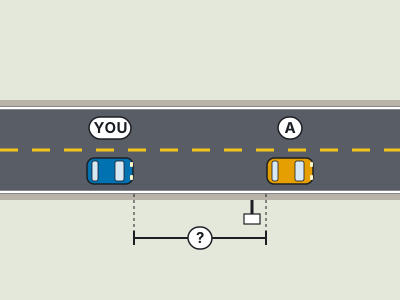
- Count one second from the moment you see a brake light
- Count the seconds between the vehicle ahead passing a fixed point and your vehicle reaching it
- Stay exactly two car lengths behind at every speed
- Measure the distance only after entering an intersection
Show answer
Count the seconds between the vehicle ahead passing a fixed point and your vehicle reaching it. Choose a fixed roadside point, such as a sign or fence, and watch the vehicle ahead pass it. Count until your vehicle reaches that same point. Arriving before three seconds means you are following too closely, so slow down and create more space. Three seconds is the minimum, not a universal maximum. Add one second for each adversity factor, such as rain or heavy traffic. The two car length idea changes with speed and vehicle size, while a brake light gives no reliable baseline. Use the roadside point and count aloud as a quick practical cue.
Study this in the handbook: Defensive driving and following distance
10. What seat belt condition must a vehicle meet to be used for a Nebraska driving test?
- Model year 1973 or later must have working driver and passenger belts; 1964 or later must have a working passenger belt
- Belts are optional for the test
- Only the driver's belt must work
- Belts are required only on vehicles built after 2000
Show answer
Model year 1973 or later must have working driver and passenger belts; 1964 or later must have a working passenger belt. Model year vehicles 1964 or later must have a passenger seat belt that is clean and in working order for the examiner's use, and model year 1973 or later must have both passenger and driver seat belts clean and working. The applicant furnishes the test vehicle, and it must also be in good mechanical condition with working brake lights, a speedometer that works properly, and a clean interior. A belt that only protects the driver does not meet the rule.
Study this in the handbook: Tests, renewal and address changes
11. What does Nebraska's child passenger restraint law require for a child up to age eight?
- Correct securement in a federally approved child safety seat
- Use of an adult lap belt only
- Riding in the front seat without a restraint
- Riding in a cargo area if an adult is present
Show answer
Correct securement in a federally approved child safety seat. Nebraska requires children up to age eight to ride correctly secured in a federally approved child safety seat. An adult belt alone does not state the rule for this age group, and neither an unrestrained front seat nor a cargo area is an acceptable substitute. The manual separately says children ages eight through eighteen must use a seat belt or child safety seat, so age changes the wording of the requirement. The practical cue is to check the child's age first, then use an approved restraint that is installed and secured correctly for that child.
Study this in the handbook: Air bags, seat belts and child restraints
12. What do double solid yellow lines generally mean?
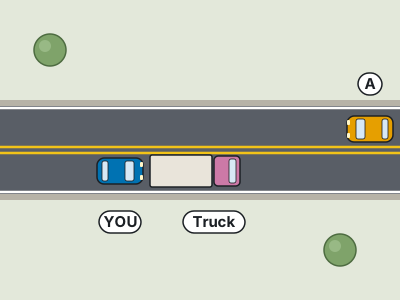
- Only trucks may cross to pass
- Passing is allowed for traffic on both sides
- Passing is not allowed in either direction
- The road is one way
Show answer
Passing is not allowed in either direction. Double solid yellow lines separate opposing traffic and prohibit passing in either direction. Nebraska lists limited lawful crossings, such as making a left turn or avoiding an obstruction, when turning into or from an alley, private road, or driveway and not otherwise prohibited by signs. That exception does not turn the centerline into a passing lane. The two solid lines are the visual cue to stay out of the opposing stream. Wait for a marked condition that permits a different movement rather than overtaking there.
Study this in the handbook: Pavement markings
13. How long must a Nebraska driver keep proof of financial responsibility, such as an SR-22, after a point system revocation ends?
- For one year
- For five years
- For three years
- For six months
Show answer
For three years. Proof of financial responsibility must be maintained for three years following the ending date of the original revocation, and it is usually a written certification of insurance known as Form SR-22. One year and six months are shorter than the stated period. Five years is how long convictions stay on the driving record, not the SR-22 period. Court ordered revocations carry the same three year proof requirement.
Study this in the handbook: The point system and license revocation
14. Which passengers may a Nebraska School Permit (SCP) holder transport under the GDL passenger rule?
- Any passengers, as long as they wear seat belts
- Family members who live with the holder, to the school the holder attends
- One friend younger than 19 during the first six months
- Only a licensed driver who is at least 21
Show answer
Family members who live with the holder, to the school the holder attends. The School Permit passenger rule is narrow: the holder may transport only family members who reside with them, and only to the school the holder attends. Seat belts are required for everyone, but buckling up does not open the car to any passenger. The one nonfamily passenger younger than 19 rule belongs to the Provisional Operator's Permit, not the School Permit. A licensed driver who is at least 21 is a supervisor who allows driving anytime, not the only person the holder may carry.
Study this in the handbook: Graduated licensing restrictions for teens
15. How can a Nebraska driver check whether the gap behind another vehicle is at least three seconds?
- Wait until the lead vehicle is two intersections away
- Keep exactly one car length at every speed
- Use the vehicle's hood to estimate a two-second gap
- Count the time between the lead vehicle and your vehicle reaching the same fixed point
Show answer
Count the time between the lead vehicle and your vehicle reaching the same fixed point. The three-second method uses time rather than a fixed number of feet, so it remains useful as speed changes. Select a stationary reference such as a sign or fence, note when the vehicle ahead passes it, and count until your own vehicle reaches that mark. Arriving before three seconds means the space is too short. The one-car-length option is unreliable because the needed distance grows with speed. In rain or heavy traffic, the manual calls for adding time, making the count a starting minimum rather than a universal maximum.
Study this in the handbook: Night driving, rain, fog, wind and floods
16. How many points does Nebraska assess for a conviction of driving under the influence of alcohol or drugs?
- 3 points
- 4 points
- 5 points
- 6 points
Show answer
6 points. The Nebraska point chart assigns 6 points to driving under the influence of alcohol or drugs, while a third offense drunk driving conviction is listed separately at 12 points. Five points is the value for reckless driving, four points is the value for careless driving, and 3 points covers offenses such as negligent driving or texting on a handheld device. Six points is half of the 12 point total that causes automatic revocation.
Study this in the handbook: The point system and license revocation
17. What hazard does the round yellow railroad warning sign shown announce?

- A circular intersection with no tracks
- A railroad crossing ahead
- A bicycle-only crossing
- A hospital entrance ahead
Show answer
A railroad crossing ahead. The round railroad warning sign tells the driver that a railroad crossing is ahead. It also signals the need to look both ways, listen for trains, yield, and be prepared to stop if a train approaches. The circular shape does not describe a roundabout, and the sign has no connection to bicycle-only crossings or hospital entrances. Treat the warning as advance preparation, not as proof that the tracks are clear. Reduce speed enough to approach under control and continue checking as the actual crossing comes into view.
Study this in the handbook: Regulatory and warning signs
18. What should a driver do when approaching the KEEP RIGHT sign shown?
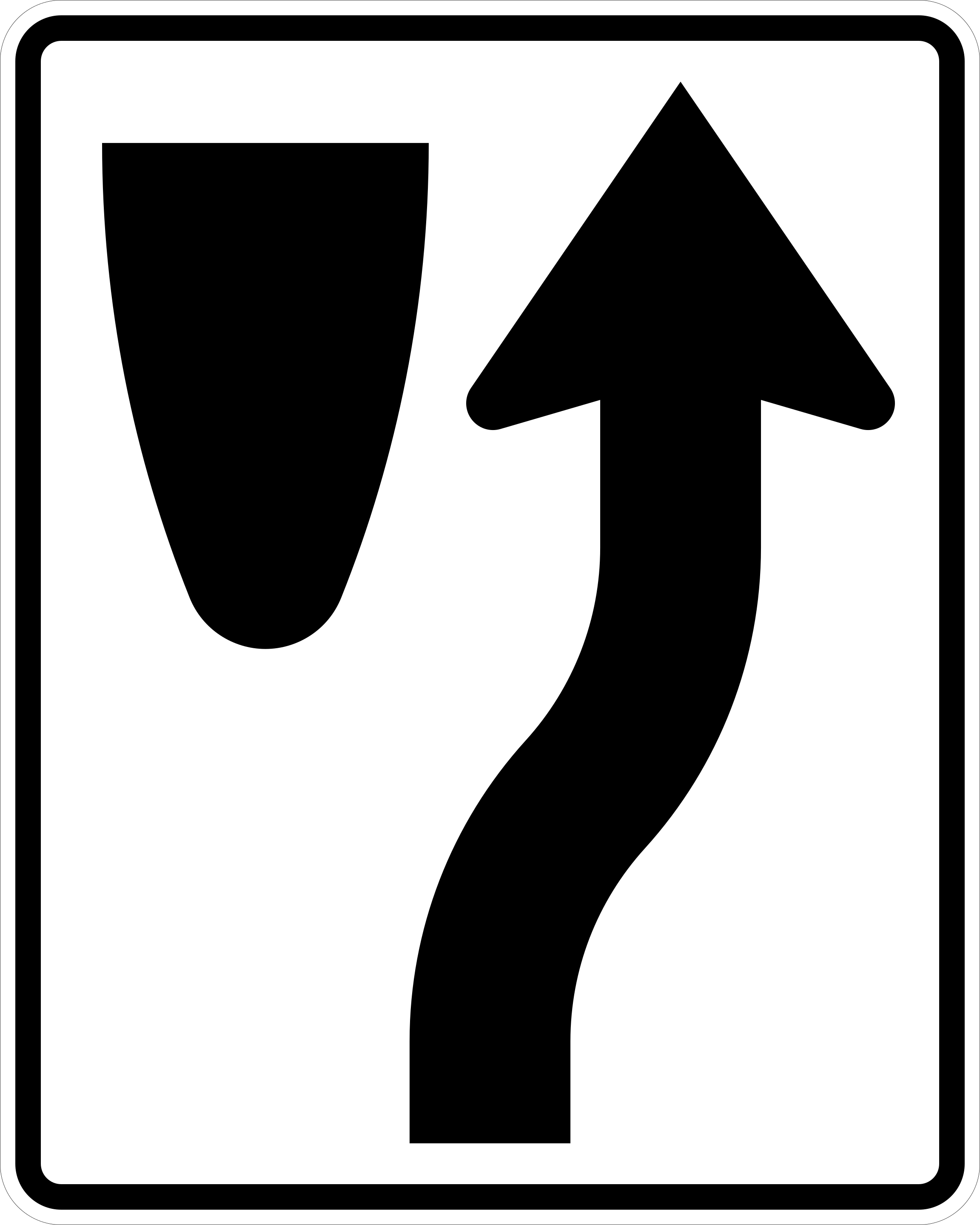
- Stop beside the obstruction and wait for a flagger
- Use the left lane to pass the obstruction on either side
- Keep to the right because an island, median, or obstruction is ahead
- Drive on the shoulder regardless of its condition
Show answer
Keep to the right because an island, median, or obstruction is ahead. KEEP RIGHT warns that a traffic island, median, or obstruction is ahead and directs the driver to keep to its right. The sign does not authorize choosing either side, stopping beside the hazard, or using the shoulder without regard to safety. Read the arrow and position early so the vehicle passes the obstruction on the indicated side. Then continue following lane markings and any additional controls. This sign is especially useful before a split or channelized roadway, where a late maneuver can force a sudden merge or place the vehicle beside opposing traffic.
Study this in the handbook: Regulatory and warning signs
19. Unless otherwise posted, what maximum speed applies to a rural interstate highway in Nebraska?
- 60 MPH
- 68 MPH
- 70 MPH
- 75 MPH
Show answer
75 MPH. Nebraska lists 75 MPH for rural interstate highways unless a different limit is posted. The 70 MPH option belongs to expressways, super-two highways, and freeways that are part of the state highway system. The 60 and 68 MPH choices are not the listed default for this roadway category. The useful memory cue is the word rural paired with interstate, which separates this rule from the state-system highway tiers. Always compare the roadway description with the posted sign, because a posted limit can replace the default schedule.
Study this in the handbook: Speed limits
20. Which vehicle category is included within the authorization of a Nebraska Class O license?
- Motorcycles only
- Motor vehicles including mopeds, autocycles, ATVs, and UTVs, but not motorcycles
- Commercial motor vehicles of every weight
- Farm equipment only
Show answer
Motor vehicles including mopeds, autocycles, ATVs, and UTVs, but not motorcycles. A Nebraska Class O license covers motor vehicles and specifically includes mopeds, autocycles, ATVs, and UTVs. The same description excludes motorcycles and commercial motor vehicles, so the broad commercial choice goes beyond the credential's authority. A motorcycle-only license is a different category, and farm equipment alone is much narrower than the listed authorization. On a test question like this, read past the included examples and check the exclusions too. The phrase not motorcycles is the key boundary that separates Class O from motorcycle licensing.
Study this in the handbook: Provisional Operator's Permit and Class O license
QualitySpace is expanding to Nebraska
We are a California-based independent insurance brokerage working on licensing in more states. We cannot help with Nebraska insurance yet. Leave your email and we will let you know when we can.
Every question is written from the official Nebraska Driver's Manual. Need paper? Printable NE practice test with answer key.
Last verified 2026-10-05. How we check every question · Study all 220 as flashcards
Frequently asked questions
How many questions are on this Nebraska practice test?
This fixed set has 20 questions. It is test 10 of 11 from the 220 question Nebraska bank. The real NE exam asks 25 questions and you need 20 correct.
What is the passing score for the real Nebraska test?
80% minimum on all written tests; on the 25-question Class O test that means 20 correct (can miss 5) That figure comes from the official Nebraska source cited on the DMV facts page.
How does this fixed test relate to the full Nebraska bank?
Each numbered test is a fixed set of questions in a fixed order, so you can retake the same test later and compare. Every test mixes road signs and the other topics in about the same proportion as the full bank. Tests 1 to 11 together cover every question in the Nebraska bank once. The full practice page mixes the whole bank at random.
Last verified 2026-10-05. See the Nebraska DMV facts page for sourced state details.
Return to the full Nebraska practice test · Study road signs