
Test 8 of 11 · 20 questions · Free 2026
NE Permit Practice Test 8
Jump to the test ↓A fixed 20 question set from the Nebraska bank with answers and plain English explanations. The real NE exam is 25 questions, 80 percent to pass; take the full length version on the main practice page.
Question 1 of 20 · 0 right so far
All 20 questions in test 8
Every question below comes from the Nebraska question bank on this page. Open a question to see the correct answer and the explanation. Nothing here is hidden behind a signup.
1. What does Nebraska prohibit while a motor vehicle is in motion under its graduated driver licensing restrictions?
- Any use of an interactive wireless communication device
- Listening to a radio broadcast
- Using a vehicle's climate controls before moving
- Speaking to a passenger
Show answer
Any use of an interactive wireless communication device. Nebraska's GDL restrictions prohibit use of any type of interactive wireless communication device while the motor vehicle is in motion. The rule is broader than texting alone, so narrowing it to a single message type would understate the restriction. Listening to the radio, adjusting controls before moving, and speaking with a passenger are not the described device prohibition. A permit holder should put the wireless device away before motion begins and wait until safely stopped for interactive use.
Study this in the handbook: Graduated licensing restrictions for teens
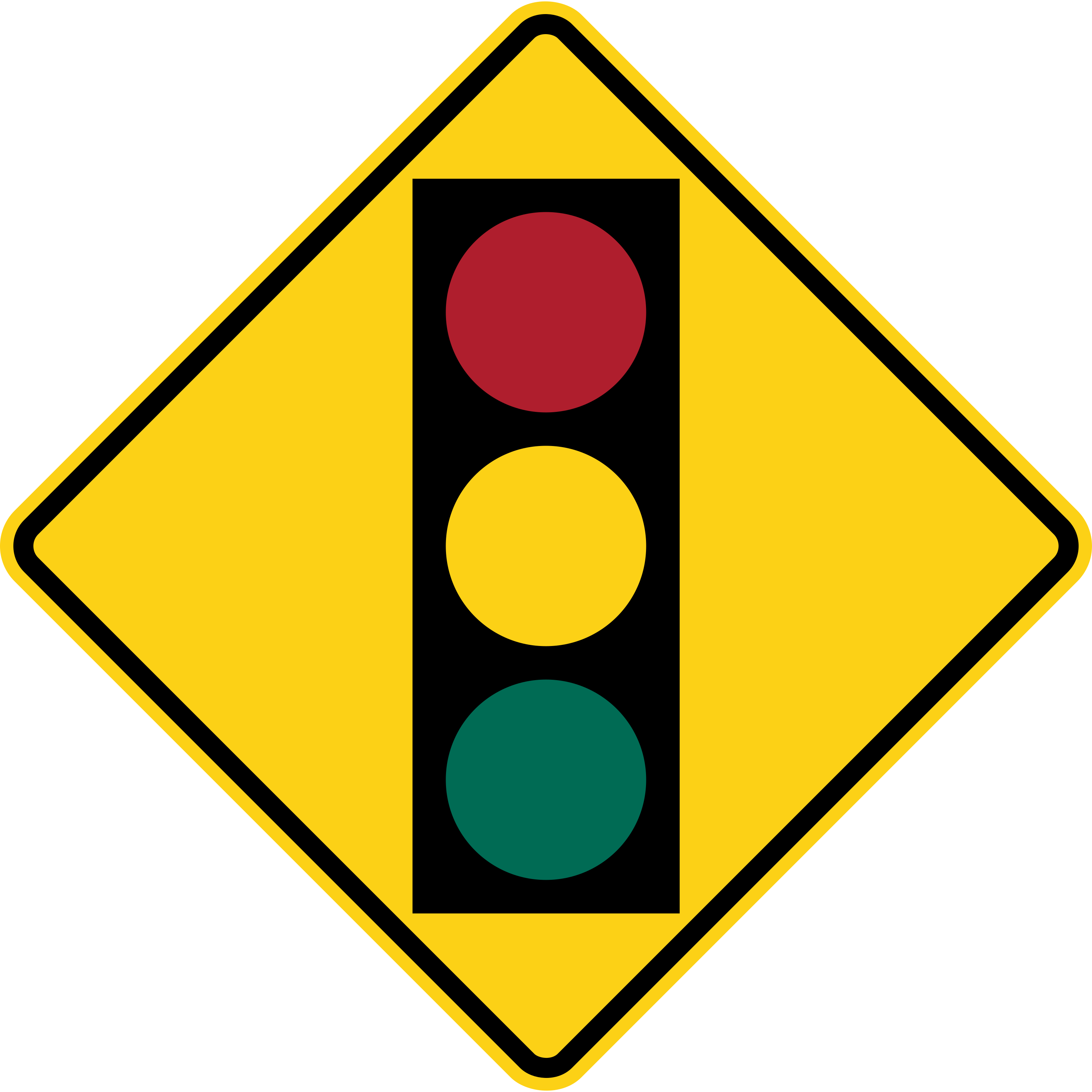
2. What does the traffic signal warning sign shown indicate?
- The next signal is permanently out of service
- A traffic signal is ahead
- A police checkpoint is required ahead
- Streetlights will replace the next intersection signal
Show answer
A traffic signal is ahead. The Signal Ahead warning means a traffic signal is ahead and the driver should be prepared to stop. It does not report a broken signal, announce a police checkpoint, or say that streetlights replace the intersection control. Use the advance notice to ease off the accelerator, identify the lane you need, and watch for the actual signal. The yellow warning sign is not itself a green, yellow, or red traffic light. Its purpose is to give you time to approach the controlled intersection ready to obey the indication you see there.
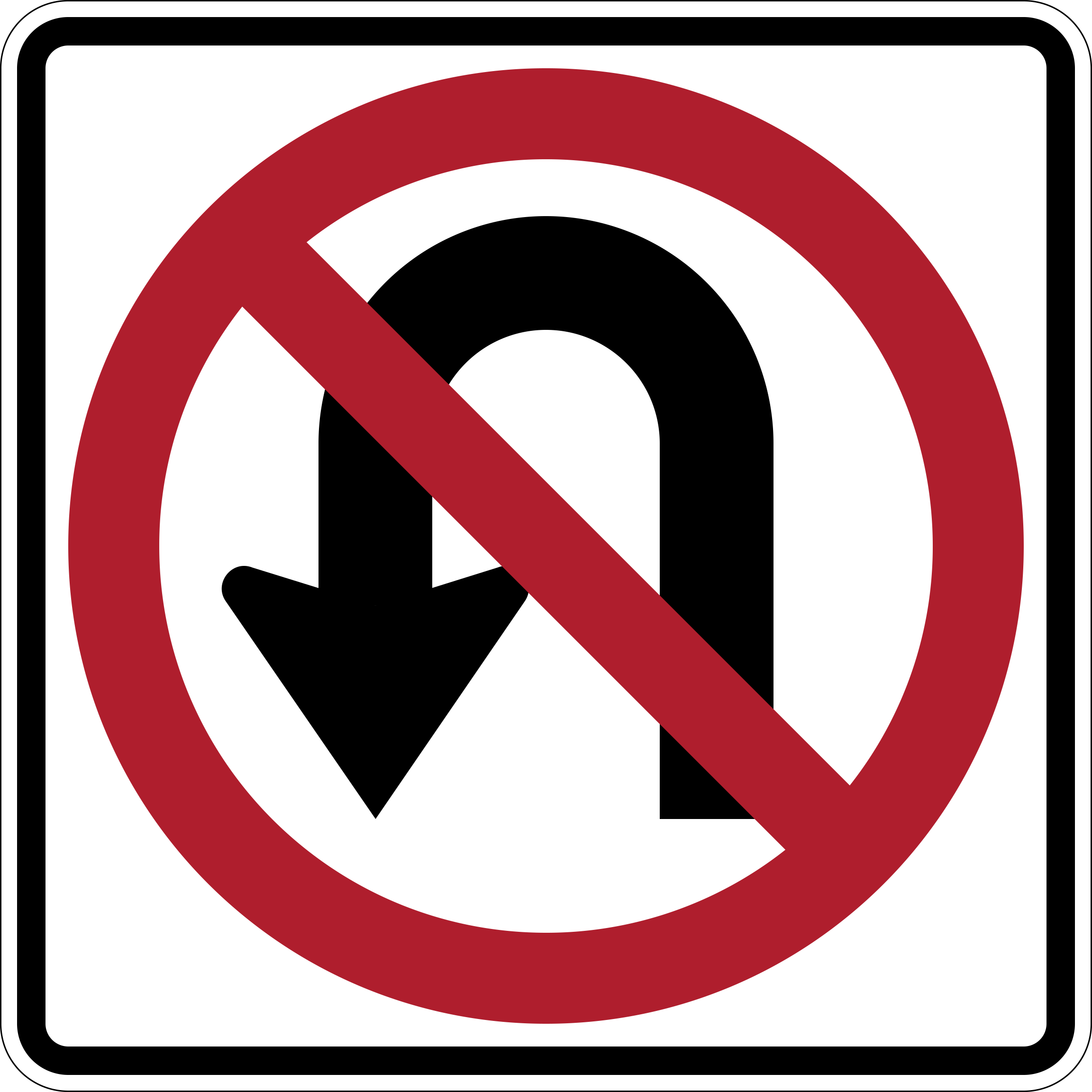
3. What does a red slash over a turning symbol tell the driver?
- The sign gives an advisory speed
- The shown movement is recommended
- The sign identifies a service area
- The shown movement is prohibited
Show answer
The shown movement is prohibited. A red circle with a slash means no, and the symbol inside it identifies the movement that is prohibited. A slash over a turning arrow therefore tells the driver not to make that turn at the sign. It is not a recommendation, a service marker, or an advisory speed instruction. Read the arrow direction carefully, because a left-turn prohibition and a right-turn prohibition control different movements. Use the visual cue directly: the slash cancels the pictured action, while the surrounding roadway signs and lane markings help confirm how traffic must proceed.
Study this in the handbook: Regulatory and warning signs
4. In Nebraska's following-distance guidance, what should a driver do when an adversity factor such as rain is present?
- Reduce the gap to improve traffic flow
- Increase the following interval by one second for each factor
- Use a fixed one-car-length gap
- Keep the same gap if the speed limit is unchanged
Show answer
Increase the following interval by one second for each factor. Nebraska teaches the three-second rule as a minimum and says to add one second for each adversity factor, such as rain or heavy traffic. Reducing the gap or relying on one car length removes the time needed to react when traction or visibility worsens. Keeping the same interval simply because the posted limit stays unchanged also misses the point: the surrounding conditions affect stopping and response time. Count the gap behind a fixed roadside marker, then add time whenever conditions make the drive more demanding.
Study this in the handbook: Defensive driving and following distance
5. During what hours may a Nebraska POP holder drive unsupervised under the normal daytime permission?
- 5 a.m. to 10 p.m.
- Sunrise to sunset only
- 7 a.m. to 11 p.m.
- 6 a.m. to midnight
Show answer
6 a.m. to midnight. A POP holder may drive unsupervised in Nebraska from 6 a.m. to midnight. The manual allows an exception between midnight and 6 a.m. when the trip is to or from home, work, or a school activity, and it also permits driving at any time with a qualified accompanying adult. The other schedules either start too early, end too soon, or omit the permit's stated hours. Separate the normal unsupervised window from the narrower overnight exception when reading the rule.
Study this in the handbook: Provisional Operator's Permit and Class O license
6. Why should a driver avoid traveling much faster or slower than surrounding traffic in a Nebraska work zone?
- It automatically cancels every posted speed limit
- It can contribute to rear-end crashes
- It gives the driver permission to use a closed lane
- It is required only when no workers are visible
Show answer
It can contribute to rear-end crashes. Nebraska warns that driving slower or faster than surrounding traffic is a major cause of rear-end crashes in work zones. The rule does not erase posted limits, authorize a closed lane, or depend on whether workers are visible at that moment. Work areas can be confined, leaving little room to escape an unexpected slowdown. Match the flow when safe, obey signs and flaggers, and keep scanning for equipment or a lane shift. The key cue is the speed difference from nearby traffic, not merely the presence of a worker.
Study this in the handbook: Speed limits
7. How long is Nebraska's administrative license revocation for a first time driver who fails an alcohol test?
- 30 days
- 180 days
- One year
- Five years
Show answer
180 days. First time offenders who fail an alcohol test serve a 180 day administrative license revocation, subsequent offenders who fail serve a one year revocation, and anyone who refuses a chemical test for alcohol or drugs serves a one year revocation. The officer serves a temporary license at the time of arrest, and an ignition interlock permit may be available during the revocation.
Study this in the handbook: Alcohol limits, implied consent and revocation
8. A Nebraska POP, school permit, or learner's permit holder is convicted of using an interactive wireless communication device while driving. How many points does the manual say are assessed?
- One point
- Three points
- Two points
- Six points
Show answer
One point. Nebraska assesses 1 point for a wireless communication device violation by a POP, LPD, SCP, or LPE holder, the same value as a POP or SCP passenger violation. Three points is the chart value for any driver who uses a handheld device to read, type, or send written communication, which is a separate texting law. Two points is for failing to yield to a pedestrian with no injury, and six points covers offenses such as DUI or leaving the scene. The permit rule bans any use of an interactive device while the vehicle is moving.
Study this in the handbook: The point system and license revocation
9. What sequence is required at a flashing red traffic signal in Nebraska?
- Treat it as a green light after checking the mirror
- Slow down but continue without stopping if no car is visible
- Make a complete stop, yield, and proceed when the way is clear
- Stop only when the signal is at a railroad crossing
Show answer
Make a complete stop, yield, and proceed when the way is clear. A flashing red light requires the same disciplined first step as a stop sign: come to a complete stop. Before proceeding, yield to oncoming traffic and pedestrians and make sure the way is clear. Rolling through because the intersection appears empty violates the stop requirement, and the rule applies at ordinary intersections as well as railroad crossings. Stop at the appropriate line or crosswalk, scan for conflicting road users, and continue only after yielding. At a railroad crossing, the manual emphasizes that the complete stop is required even when no train is visible.
Study this in the handbook: Traffic signals and turning on red
10. What do broken white lane lines separate on a Nebraska roadway?
- A railroad track from the nearest travel lane
- Opposing traffic that must never cross
- Lanes of traffic moving in the same direction that may be crossed with care
- A shoulder that may be used as a regular lane
Show answer
Lanes of traffic moving in the same direction that may be crossed with care. Broken white lines separate lanes of traffic moving in the same direction, and a driver may cross them with care. First check mirrors, signal, inspect the blind spot, and confirm the movement will not conflict with another vehicle. The line does not mark opposing traffic, railroad tracks, or permission to use the shoulder as a normal lane. A solid white line also separates same direction lanes, but it is used to discourage lane changes near intersections or at turn lanes. Treat the broken line as conditional permission, not an instruction to move immediately.
Study this in the handbook: Pavement markings
11. May a Nebraska applicant retake a failed test the same day?
- Yes, immediately
- Yes, after one hour
- Only the vision test
- No, any failed test may not be retaken the same day
Show answer
No, any failed test may not be retaken the same day. Any test failed may not be retaken the same day, so a failed vision, written or driving test means a return visit on another day. If an applicant is denied issuance of the document applied for, staff issue a Return for Services form that explains the reason for the denial, and the applicant should bring that form back on the next visit. After passing, the Issuance Certificate is presented to a county treasurer or state licensing office within 90 days.
Study this in the handbook: Tests, renewal and address changes
12. When a vehicle's wheels drop off the pavement edge, what is the safest recovery?
- Reduce speed and gradually return when traffic makes it safe
- Turn sharply back onto the roadway immediately
- Accelerate until the tires climb onto the pavement
- Stop the vehicle across the travel lane without checking traffic
Show answer
Reduce speed and gradually return when traffic makes it safe. Hold the steering wheel firmly, keep the wheels straddling the pavement edge, reduce speed, and check traffic. Return gradually only when the roadway is clear and safe. A sharp immediate turn can make the vehicle skid or cross into another lane. Acceleration does not solve the loss of pavement support, and stopping across a travel lane creates a new obstruction. The recovery cue is patience: stabilize first, slow down, look around, then ease back onto the roadway.
Study this in the handbook: Snow, ice, blizzards and wheels off the pavement
13. How much space should an air-bag-equipped driver allow between the body and steering wheel?
- At least 10 inches
- At least 2 inches
- Exactly 18 inches
- No space, because the driver should touch the wheel
Show answer
At least 10 inches. The manual recommends at least 10 inches between the driver and the steering wheel in a vehicle equipped with an air bag. It also warns that a deploying air bag can pose some risk of injury, even in a low speed crash, especially to children, elderly drivers and short statured adults. Two inches and direct contact are too close, and the manual does not set an exact 18 inch measurement. With air bags in the wheel, hold the wheel at the 9 and 3 o'clock positions.
Study this in the handbook: Air bags, seat belts and child restraints
14. What does a pennant-shaped roadway sign identify in Nebraska?
- A school crossing
- A no passing zone
- A railroad crossing
- A required detour route
Show answer
A no passing zone. The pennant shape identifies a no passing zone. It is a shape clue rather than a speed recommendation or a school warning. Drivers should keep the no passing restriction in mind and look for the related pavement markings and roadway conditions. A pentagon marks school zones and school crossings, while a crossbuck and circle identify a railroad crossing. Treat the pennant as an early warning that passing is not permitted in that zone.
Study this in the handbook: Guide, service and work zone signs
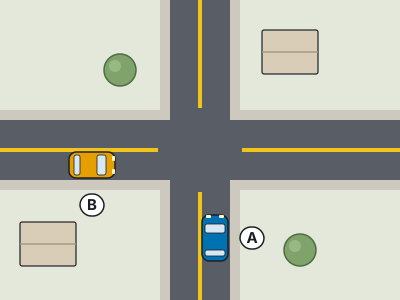
15. At an uncontrolled intersection where vehicles arrive at about the same time, which vehicle must yield?
- The vehicle traveling faster has priority
- The vehicle on the right always yields to the vehicle on the left
- The vehicle on the left yields to the vehicle on the right
- Neither vehicle yields because there is no sign
Show answer
The vehicle on the left yields to the vehicle on the right. At an uncontrolled intersection, the driver must watch for traffic coming from the right and yield when vehicles approach at approximately the same time. The absence of a sign does not remove the duty to avoid a conflict. Speed does not establish priority, and both drivers cannot proceed as if the other must stop. Look right before entering, reduce speed enough to respond, and remain prepared for a driver who fails to follow the rule. Defensive care is especially important when sight lines are limited.
Study this in the handbook: Right of way at intersections
16. At a railroad crossing, what should you expect from a truck carrying hazardous materials?
- It may have to stop at the crossing, so watch for it before proceeding
- It can cross without checking because its load has priority
- It must use the shoulder before crossing the tracks
- It may pass through a lowered gate if no train is visible
Show answer
It may have to stop at the crossing, so watch for it before proceeding. Hazardous-materials trucks are among the vehicles that must stop at railroad crossings. That means a driver approaching from behind should anticipate a stopped truck and leave room to stop safely. The distractor about priority reverses the safety obligation: the special load increases the need for caution rather than granting an exception. Never go around a gate or assume that an empty-looking crossing is safe. A useful cue is the truck's hazardous-materials placard combined with the crossing itself, prompting you to look for a stop and wait behind it.
Study this in the handbook: Parking and railroad crossings
17. How does a phone conversation affect the brain's ability to process moving visual information, according to the Nebraska manual?
- It improves focus
- No effect if hands free
- It has 37 percent less capacity to gather and process driving data
- It doubles reaction speed
Show answer
It has 37 percent less capacity to gather and process driving data. The area of the brain responsible for processing moving visual information, a vital part of driving, has 37 percent less capacity to gather and process critical driving data during a cell phone conversation, because it focuses on the conversation instead. It is the conversation, not the device, that creates the danger, so hands free phones do not solve the problem.
Study this in the handbook: Work zones, school zones and speeding fines
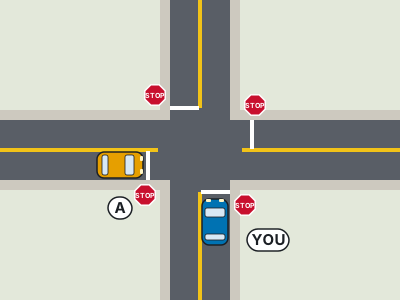
18. If it is unclear who stopped first at a Nebraska four-way stop, whom should a driver yield to?
- The driver in the newest vehicle
- The driver on the left
- The driver on the right
- No one because both drivers have priority
Show answer
The driver on the right. When arrival order is uncertain at a four way stop, Nebraska advises yielding to the driver on your right. The rule resolves ambiguity without relying on vehicle age, size, or a contest between drivers. Yielding to the left reverses the stated direction, while saying that both drivers may proceed ignores the need to prevent a conflict. Pair this rule with the first stopped rule: first to stop normally goes first; if that cannot be determined, give way to the right. Continue using ordinary care rather than treating the rule as permission to enter blindly.
Study this in the handbook: Right of way at intersections
19. According to the Nebraska manual, how much more likely is a driver at .08% BAC to be involved in a fatal crash than a non drinking driver?
- Twice as likely
- Six times as likely
- Ten times as likely
- Three times as likely
Show answer
Three times as likely. By the time a driver reaches .08% BAC, the manual says he or she is three times more likely to be involved in a fatal crash than a non drinking driver. Twice as likely is the figure given for .05% BAC, a lower level. Six and ten times are not figures used in the Nebraska manual. Crash risk begins rising noticeably between .04% and .05% and increases rapidly after that.
Study this in the handbook: How alcohol impairs driving
20. Under Nebraska's window tint law, what is the least light transmission allowed on the front side windows?
- 20%
- 35%
- 50%
- 70%
Show answer
35%. Nebraska restricts front side windows to tint with no more than 35% luminous reflectance and no less than 35% light transmission. The 20% transmission figure applies to the rear or back windows, not the front sides. The 50% and 70% figures are not in the Nebraska rule. Tint that is not clear below the AS 1 line on the windshield is also unlawful, and a violation is a Class III misdemeanor.
QualitySpace is expanding to Nebraska
We are a California-based independent insurance brokerage working on licensing in more states. We cannot help with Nebraska insurance yet. Leave your email and we will let you know when we can.
Every question is written from the official Nebraska Driver's Manual. Need paper? Printable NE practice test with answer key.
Last verified 2026-10-05. How we check every question · Study all 220 as flashcards
Frequently asked questions
How many questions are on this Nebraska practice test?
This fixed set has 20 questions. It is test 8 of 11 from the 220 question Nebraska bank. The real NE exam asks 25 questions and you need 20 correct.
What is the passing score for the real Nebraska test?
80% minimum on all written tests; on the 25-question Class O test that means 20 correct (can miss 5) That figure comes from the official Nebraska source cited on the DMV facts page.
How does this fixed test relate to the full Nebraska bank?
Each numbered test is a fixed set of questions in a fixed order, so you can retake the same test later and compare. Every test mixes road signs and the other topics in about the same proportion as the full bank. Tests 1 to 11 together cover every question in the Nebraska bank once. The full practice page mixes the whole bank at random.
Last verified 2026-10-05. See the Nebraska DMV facts page for sourced state details.
Return to the full Nebraska practice test · Study road signs