
Test 5 of 11 · 20 questions · Free 2026
NE Permit Practice Test 5
Jump to the test ↓A fixed 20 question set from the Nebraska bank with answers and plain English explanations. The real NE exam is 25 questions, 80 percent to pass; take the full length version on the main practice page.
Question 1 of 20 · 0 right so far
All 20 questions in test 5
Every question below comes from the Nebraska question bank on this page. Open a question to see the correct answer and the explanation. Nothing here is hidden behind a signup.
1. If a driver becomes stranded in a blizzard, which action does the Nebraska manual advise?
- Walk away from the vehicle immediately to find help
- Stay with the vehicle and conserve fuel
- Run the engine continuously with all windows closed
- Park in the travel lane and leave the emergency flashers off
Show answer
Stay with the vehicle and conserve fuel. Nebraska's blizzard advice for a stranded driver is to stay calm and stay with the vehicle. Conserve fuel and run the engine and heater sparingly, and only with a window slightly open for ventilation, while keeping snow from blocking the exhaust pipe. Running the engine nonstop with every window closed ignores that ventilation warning. Walking away and parking in a travel lane with flashers off both go against the list. The manual also says to use emergency flashers so work crews can see the car, turn the dome light on at night, and take turns keeping watch.
Study this in the handbook: Snow, ice, blizzards and wheels off the pavement
2. Before entering a roundabout, to which traffic must a driver yield?
- All traffic on the driver's left already in the roundabout
- Only traffic approaching from the right
- No traffic because entering vehicles have priority
- Only large trucks using the outer lane
Show answer
All traffic on the driver's left already in the roundabout. Drivers entering a Nebraska roundabout must yield to all traffic on the left that is already circulating. The rule applies before entry, whether the circulating vehicle is a car, motorcycle, bicycle, or truck. Yielding only to the right reverses the normal conflict point, and entering without a gap risks a collision. Slow to the posted advisory speed, check the crosswalk, then wait for a safe opening. The left side of the circular roadway is the key location to scan before joining the flow.
Study this in the handbook: Right of way at intersections
3. Who must be buckled under Nebraska's occupant protection law?
- Drivers and front-seat passengers
- Only passengers under age eight
- Only the driver when traveling outside city limits
- Rear-seat passengers only when the vehicle has an air bag
Show answer
Drivers and front-seat passengers. Nebraska's occupant protection rule requires the driver and front-seat passengers to ride buckled in a seat belt or child safety seat. It is not limited to children, rural roads, or vehicles without air bags. The manual separately describes child restraint duties and notes that this occupant rule is secondary, meaning the driver may be cited after another violation leads to a stop. Buckle the front occupants before moving.
Study this in the handbook: Air bags, seat belts and child restraints
4. What is the maximum fine for a second handicapped parking offense in Nebraska?
- Up to $150
- Up to $500
- Up to $1,000
- Up to $300
Show answer
Up to $300. Nebraska's handicapped parking fines rise with each offense: up to $150 for a first offense, up to $300 for a second, and up to $500 for a third. Up to $150 is therefore the first offense figure, and up to $500 is the third. No $1,000 figure appears. Parking in the striped access aisle beside a handicapped stall is also prohibited, and blocking a curb cut or wheelchair ramp can bring a separate ticket.
Study this in the handbook: Parking and railroad crossings
5. What does a crossroad warning sign tell you to expect?

- A hospital entrance
- A four way intersection and crossing traffic
- A dead end with no crossing roadway
- A no passing zone only
Show answer
A four way intersection and crossing traffic. The crossroad warning announces a four way intersection and tells the driver to watch for traffic crossing the path. It is a warning, not a traffic control order that grants priority. A hospital sign, a dead end, and a no passing pennant communicate different information. Begin scanning left and right before reaching the junction, reduce speed as needed, and be ready for a vehicle that may enter from either side. The plus shape is the quick visual reminder that another roadway crosses yours.
Study this in the handbook: Regulatory and warning signs
6. What response is appropriate for a slippery when wet warning?

- Maintain speed because the sign marks dry pavement
- Brake hard as soon as rain begins
- Slow and proceed with caution
- Use the shoulder to avoid the slick surface
Show answer
Slow and proceed with caution. The Nebraska manual describes the Slippery When Wet sign this way: the road surface may be slick when wet, so slow and proceed with caution. The warning does not mean the pavement is dry, and it does not tell you to brake hard or to drive on the shoulder. The manual's rain guidance points the same way: reduce speed in relation to the road surface condition, slow down to prevent hydroplaning, and increase your following distance. Nebraska also teaches adding one second to the three second following interval for each adversity factor, such as rain.
Study this in the handbook: Regulatory and warning signs
7. In Nebraska, what is prohibited for children under age eighteen when they ride in a vehicle?
- Using a child safety seat
- Riding in a rear seat
- Riding in a cargo area
- Wearing a seat belt
Show answer
Riding in a cargo area. Nebraska prohibits children under 18 from riding in cargo areas, and the manual identifies that restriction as a Primary Law. The other choices describe protective practices that the manual requires or supports, not conduct it bans. A rear seat is not prohibited, and a seat belt or child safety seat is part of the restraint rules. Keep the age and location together as the cue: under eighteen plus cargo area creates the violation. The primary law designation means an officer can stop and ticket a driver solely for that violation.
Study this in the handbook: Air bags, seat belts and child restraints
8. What appears directly below the dispatch number on a Nebraska railroad crossing ENS sign?
- A Department of Transportation number identifying the exact crossing
- The speed limit
- The train schedule
- The county sheriff's number
Show answer
A Department of Transportation number identifying the exact crossing. Directly below the dispatch number on the Emergency Notification System sign is a Department of Transportation number that identifies the exact location of the crossing. Using the sign, the public can report malfunctioning signals or gates, disabled vehicles blocking the tracks, trespassers, or other unsafe conditions. The toll free number is answered by railroad dispatchers, the first line of defense who attempt to stop all train traffic at that crossing during an emergency.
Study this in the handbook: Parking and railroad crossings
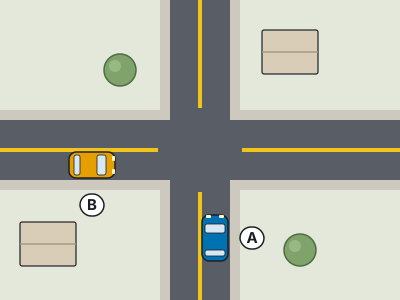
9. At an uncontrolled intersection where vehicles arrive at about the same time, which traffic should a driver watch for and yield to?
- Traffic approaching from the left
- Only traffic traveling faster
- Traffic approaching from the right
- Only vehicles that honk
Show answer
Traffic approaching from the right. At an uncontrolled intersection with no signs or signals, a driver watches for vehicles coming from the right and yields the right of way when vehicles approach at approximately the same time. Speed, horn use, and approach from the left do not create the rule described here. The manual also urges defensive driving because another motorist may fail to stop even when you have priority. A useful cue is the combination of no control device plus simultaneous arrival: scan right, yield as required, and keep enough caution to avoid relying on another driver's mistake.
Study this in the handbook: Right of way at intersections
10. What must a driver do when a reversible lane displays a steady red X?
- Continue in the lane until the next intersection
- Enter the lane only to pass a slower vehicle
- Leave the lane and never drive in it under that signal
- Use the lane if the roadway ahead appears clear
Show answer
Leave the lane and never drive in it under that signal. A steady red X closes the lane to traffic. Leave it when safe and do not enter it simply because the pavement looks open. A passing maneuver, an upcoming intersection, or clear sight distance cannot override the lane signal. A steady yellow X means move out as soon as safely possible because closure is coming. The useful visual cue is simple: red X means stay out, while a downward green arrow permits travel in that lane.
Study this in the handbook: Traffic signals and turning on red
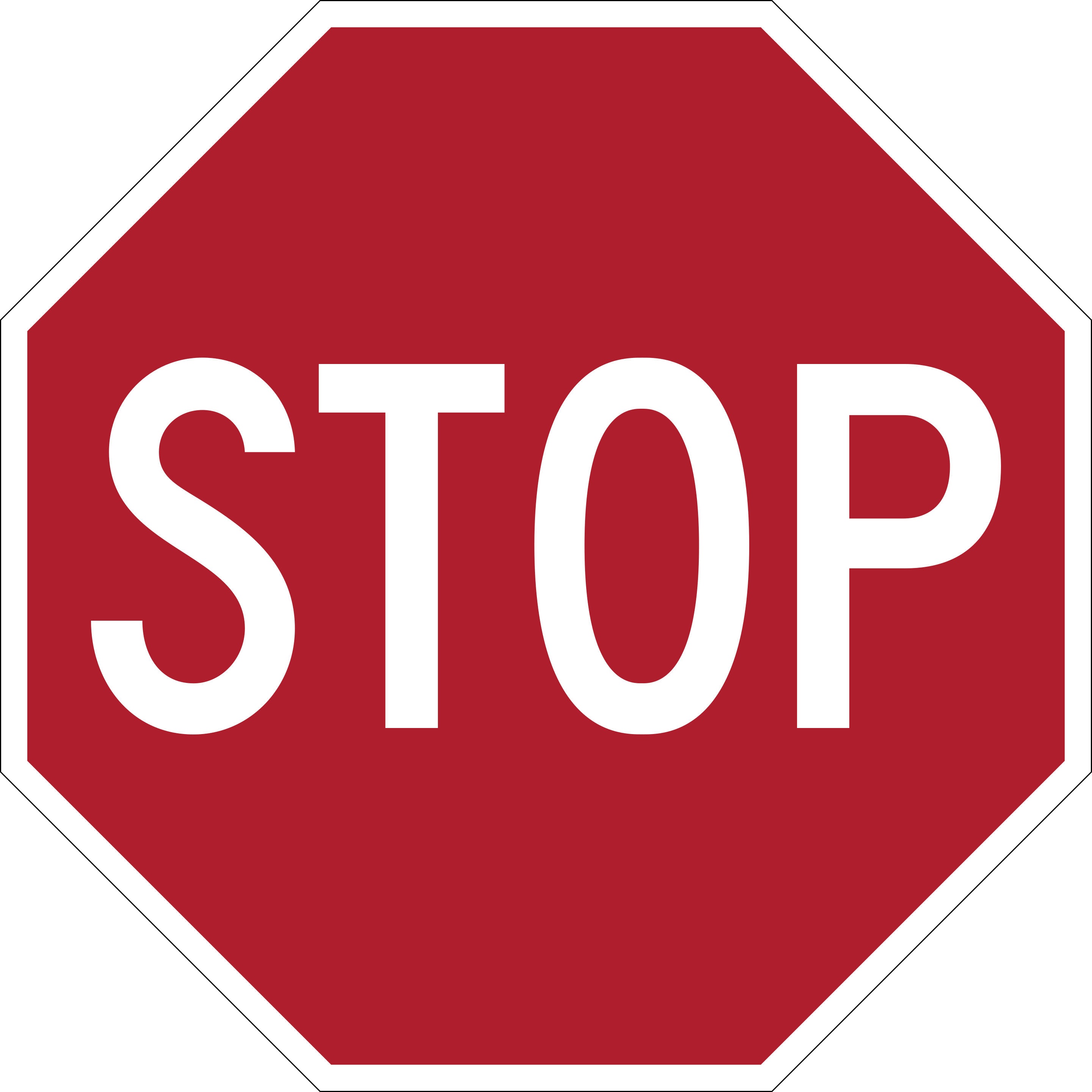
11. What does the octagonal sign shown require before you enter an intersection?
- A yield only if another vehicle is visible
- A complete stop before entering the intersection
- A reduction to the advisory speed
- A stop after entering the crosswalk
Show answer
A complete stop before entering the intersection. Nebraska's octagonal STOP sign requires a complete stop before entering the intersection. If a painted stop line exists, stop at that line; the manual also places the stop before a crosswalk, whether painted or unpainted. Waiting to see another vehicle turns an unconditional stop into a conditional one, and stopping after the crosswalk puts the vehicle too far forward. An advisory-speed reduction is associated with warning situations, not this regulatory sign. At the sign, brake early, stop at the required point, check traffic and pedestrians, then proceed when permitted.
Study this in the handbook: Regulatory and warning signs
12. How many arrests for alcohol or drug driving violations does Nebraska average each year?
- About 500
- Over 8,000
- About 100,000
- About 50
Show answer
Over 8,000. Nebraska averages over 8,000 arrests annually for driving violations involving alcohol or drugs. Only time reduces the alcohol level in the body, so arrange a designated driver or other transportation before drinking. Crash risk starts rising noticeably between .04 and .05 percent BAC, and at .05 a driver is twice as likely to be in a fatal crash as a sober driver.
Study this in the handbook: How alcohol impairs driving
13. How many points does Nebraska assess for driving more than 35 MPH over the posted speed limit?
- 3 points
- 2 points
- 4 points
- 6 points
Show answer
4 points. Driving more than 35 MPH over the posted limit is worth 4 points, both inside and outside city limits. Three points applies to the next lower speeding band, and 2 points to smaller amounts over the limit on some roads. Six points is not a speeding value on the chart; it belongs to offenses such as DUI. Nebraska bases speeding points on how far over the limit the driver was and on the type of road.
Study this in the handbook: The point system and license revocation
14. What message is conveyed by the triangular shape of a roadway sign?
- Stop
- Yield
- Railroad crossing
- No passing zone
Show answer
Yield. The triangle is Nebraska's shape cue for yielding. It does not command the same action as an octagon, which identifies a stop sign. A railroad warning uses a crossbuck or circle, while a pennant marks a no passing zone. When the triangular sign appears, reduce speed, look for conflicting road users, and give them priority as required by the intersection. Shape recognition helps when a sign is partly obscured, seen at an angle, or encountered before its lettering can be read.
Study this in the handbook: Sign colors and shapes
15. Which reference point can a driver use when applying Nebraska's three-second following rule?
- A point chosen only after the vehicle ahead brakes
- The speedometer needle alone
- The rear bumper of a parked car selected after changing lanes
- A fixed point such as an overpass, sign, fence, or corner
Show answer
A fixed point such as an overpass, sign, fence, or corner. The timing exercise works by comparing both vehicles with the same stationary marker. Nebraska gives examples including an overpass, sign, fence, or corner. When the lead vehicle passes that point, begin counting, then compare the count when your vehicle reaches it. The speedometer alone cannot reveal the actual time gap, and waiting for braking creates an unnecessarily late warning. Choose a visible fixed object early, maintain a steady speed, and increase the interval when weather or traffic makes stopping more difficult.
Study this in the handbook: Defensive driving and following distance
16. For an LPE holder practicing in Nebraska, how old must the accompanying licensed motor vehicle or motorcycle operator be?
- At least 18
- At least 19
- At least 25
- At least 21
Show answer
At least 21. The accompanying licensed motor vehicle or motorcycle operator for an LPE must be at least 21 and licensed by Nebraska or another state. The 18 and 19 year options lower the supervision standard, while 25 adds an age requirement that the manual does not state. The permit holder should check both parts of the rule: the adult must meet the age threshold and must hold a license. A person merely old enough to drive is not enough if that person lacks the required license.
Study this in the handbook: School learner's, school and learner's permits
17. What timing test can show that a vehicle is following too closely?
- It checks whether the vehicle reaches a fixed point before three seconds pass
- It requires exactly three car lengths at every speed
- It permits following more closely when traffic is heavy
- It measures reaction time after a collision begins
Show answer
It checks whether the vehicle reaches a fixed point before three seconds pass. To use the rule, watch the vehicle ahead pass a fixed point and count until your vehicle reaches that same point. Arriving before three seconds means the gap is too short, so slow down and increase it. The method uses time rather than a fixed number of car lengths, and heavy traffic is a reason to add space, not remove it. It is a simple visual check before conditions become urgent.
Study this in the handbook: Night driving, rain, fog, wind and floods
18. A Nebraska teen breaks the terms of a School Learner's Permit, School Permit, or Learner's Permit. Besides possible license action, what additional consequence does the manual list?
- A permanent ban on holding a Class O license
- A required second written test only
- A $25 fine with no other effect
- No eligibility for any permit until age 16
Show answer
No eligibility for any permit until age 16. Violating the terms of an LPE, SCP, or LPD is listed as a reason for suspension, revocation, or impoundment, and the manual adds that the person will not be eligible for any permit until reaching age 16. The consequence is a delay, not a permanent ban on a Class O license. The manual does not describe the penalty as merely a retest. The $25 figure is the seat belt fine, and it does not describe this rule.
Study this in the handbook: The point system and license revocation
19. Under Nebraska Revised Statute 60-6,314, what status does a bicyclist have on the road?
- Pedestrian status only
- No legal status on roadways
- Priority over all vehicles
- The same duties and rights as a driver of a motor vehicle
Show answer
The same duties and rights as a driver of a motor vehicle. Per Nebraska Revised Statute 60-6,314, a person riding a bicycle has the same duties and rights as a driver of a motor vehicle and must obey traffic laws. Bicyclists must ride as far right in the lane as practical or on paved shoulders. Drivers must leave at least three feet when passing and watch for riders at intersections and driveways.
Study this in the handbook: Motorcycles and bicycles
20. What is the default maximum speed for a four-lane divided highway that is not part of Nebraska's state highway system?
- 65 MPH
- 55 MPH
- 70 MPH
- 75 MPH
Show answer
65 MPH. The listed default for a four-lane divided highway outside the state highway system is 65 MPH. The 55 MPH option describes a dustless paved roadway that is not part of the state highway system when the more specific four-lane category does not apply. Seventy miles per hour is assigned to expressways, super-two highways, and freeways that are part of the state highway system. Seventy five is reserved for rural interstates. Read the road description carefully, especially the lane count and system status, before selecting a speed.
Study this in the handbook: Yield signs, driveways and pedestrians
QualitySpace is expanding to Nebraska
We are a California-based independent insurance brokerage working on licensing in more states. We cannot help with Nebraska insurance yet. Leave your email and we will let you know when we can.
Every question is written from the official Nebraska Driver's Manual. Need paper? Printable NE practice test with answer key.
Last verified 2026-10-05. How we check every question · Study all 220 as flashcards
Frequently asked questions
How many questions are on this Nebraska practice test?
This fixed set has 20 questions. It is test 5 of 11 from the 220 question Nebraska bank. The real NE exam asks 25 questions and you need 20 correct.
What is the passing score for the real Nebraska test?
80% minimum on all written tests; on the 25-question Class O test that means 20 correct (can miss 5) That figure comes from the official Nebraska source cited on the DMV facts page.
How does this fixed test relate to the full Nebraska bank?
Each numbered test is a fixed set of questions in a fixed order, so you can retake the same test later and compare. Every test mixes road signs and the other topics in about the same proportion as the full bank. Tests 1 to 11 together cover every question in the Nebraska bank once. The full practice page mixes the whole bank at random.
Last verified 2026-10-05. See the Nebraska DMV facts page for sourced state details.
Return to the full Nebraska practice test · Study road signs