
Test 4 of 11 · 20 questions · Free 2026
NE Permit Practice Test 4
Jump to the test ↓A fixed 20 question set from the Nebraska bank with answers and plain English explanations. The real NE exam is 25 questions, 80 percent to pass; take the full length version on the main practice page.
Question 1 of 20 · 0 right so far
All 20 questions in test 4
Every question below comes from the Nebraska question bank on this page. Open a question to see the correct answer and the explanation. Nothing here is hidden behind a signup.
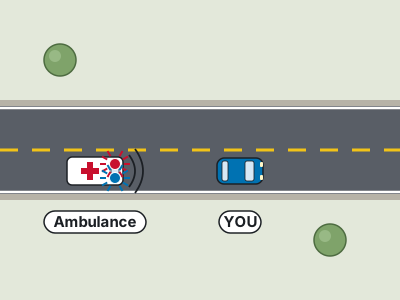
1. When an authorized emergency vehicle activates its siren or flashing lights, where should other drivers stop?
- Anywhere in the lane if the driver turns on hazard lights
- In the center of the nearest intersection
- Along the left edge, facing oncoming traffic
- As close as possible to the right edge or curb, clear of intersections
Show answer
As close as possible to the right edge or curb, clear of intersections. Nebraska requires other drivers to yield, move parallel and as close as possible to the right edge or curb, and stop clear of intersections unless an officer directs otherwise. Stopping in an intersection can block the emergency route, while the left edge usually moves a vehicle toward rather than away from the approaching path. Hazard lights do not replace the required positioning. After stopping, remain there until the emergency vehicle has passed and check for additional emergency vehicles before reentering traffic.
Study this in the handbook: Emergency vehicles and the Move Over law
2. What is the minimum age for a Nebraska School Learner's Permit, or LPE?
- 14
- 13
- 15
- 16
Show answer
14. A School Learner's Permit requires the applicant to be at least 14, and the manual says an application cannot be made before the 14th birthday. The age 13 option belongs to a different farm permit circumstance, while 15 and 16 describe later permit or license stages. When studying graduated licensing, identify the permit name before recalling the number. LPE is the school practice permit, so its threshold is separate from the Learner's Permit and Provisional Operator's Permit ages.
Study this in the handbook: School learner's, school and learner's permits
3. What does Nebraska prohibit a driver from doing with a handheld wireless communication device while operating a motor vehicle?
- Reading, typing, or sending written communication
- Using a dashboard-mounted navigation display
- Listening to a passenger give directions
- Looking at the road while holding the steering wheel
Show answer
Reading, typing, or sending written communication. Nebraska makes it illegal to use a handheld wireless communication device to read, type, or send written communication while operating a motor vehicle. The rule targets active written communication, not every conversation or every dashboard display. A mounted navigation screen may still create a distraction, but that option does not state the prohibited handheld conduct. Listening to a passenger is not the described device use. The useful driving cue is to finish messages before moving, silence the device, and secure it where you will not reach for it during travel.
Study this in the handbook: Distracted, aggressive and drowsy driving
4. What two factors does Nebraska use as the basis for assessing points for speeding?
- Vehicle age and fuel type
- Time of day and number of passengers
- Miles per hour over the posted limit and the type of road
- Weather and the driver's insurance company
Show answer
Miles per hour over the posted limit and the type of road. Nebraska assesses speeding points based on how many miles per hour the driver exceeded the posted limit and the type of road involved. Vehicle age, fuel type, passenger count, and insurance company are not the two factors named in the points guidance. The road category can change the point result for the same numerical excess, so do not memorize a single speeding value without checking both parts. Start by comparing the driver's speed with the posted limit, then identify the roadway type.
Study this in the handbook: The point system and license revocation
5. How long does a new Nebraska resident with a valid out-of-state license have to obtain a Nebraska license?
- 10 days
- 30 days
- 60 days
- 90 days
Show answer
30 days. A new Nebraska resident who already holds a valid license from another state has 30 days to obtain a Nebraska license. The 10, 60, and 90 day options change the deadline and therefore would leave the driver outside the manual's stated window. A useful arrival-day cue is to start the countdown as soon as Nebraska becomes the driver's new residence, rather than waiting until the out-of-state credential nears expiration. The rule concerns obtaining the Nebraska license, so keeping the old credential valid does not extend the 30 day period.
Study this in the handbook: Graduated licensing restrictions for teens
6. After checking cross traffic at a Nebraska Yield sign, what should a driver do before entering the roadway?
- Enter without checking if the signal is on
- Stop for a fixed ten seconds
- Merge into a safe gap while adjusting speed
- Accelerate into the nearest vehicle
Show answer
Merge into a safe gap while adjusting speed. After checking cross traffic and yielding to vehicles close enough to cause a conflict, the driver should find an opening, merge, and adjust speed. Nebraska does not require a fixed ten-second pause at every Yield sign. A turn signal communicates intent but cannot replace checking the roadway, and accelerating toward the nearest vehicle creates the conflict the rule is meant to avoid. Treat the sign as a request to manage space carefully: scan, wait when needed, then enter at a speed that fits the available gap.
Study this in the handbook: Right of way at intersections
7. Which roadway receives Nebraska's 70 MPH default speed category under the manual?
- Expressways or super-two highways and state-system freeways
- Residential districts
- Any gravel roadway outside a city
- Every four-lane divided highway
Show answer
Expressways or super-two highways and state-system freeways. Nebraska assigns a 70 MPH default to expressways, super-two highways, and freeways that are part of the state highway system. Residential districts have a 25 MPH default, and gravel roads have a 50 MPH default. A four-lane divided highway is not automatically in this tier because the manual separately lists one that is not part of the state system at 65 MPH. Confirm the road's design and system classification, then check posted signs. Even a 70 MPH road requires a reasonable speed when weather or traffic makes that necessary.
Study this in the handbook: Yield signs, driveways and pedestrians
8. In Nebraska, who is prohibited from consuming or possessing an open alcoholic beverage inside a vehicle on a public roadway or public parking area?
- Both drivers and passengers
- Only passengers under 21
- Only the driver
- Only the vehicle owner
Show answer
Both drivers and passengers. Nebraska's open container rule covers both drivers and passengers inside a vehicle on a public roadway or public parking area. It is not limited to the person holding the steering wheel, and it does not depend on ownership of the vehicle or the passenger's age. The question's location matters too: the manual specifically names public roadways and public parking areas. Keep the two parts together as a cue, who is covered and where the vehicle is. A sober driver cannot make an open alcoholic beverage lawful for everyone else in the vehicle.
Study this in the handbook: Alcohol limits, implied consent and revocation
9. If a Nebraska driver cannot move one lane away from a stopped vehicle with flashing lights, what must the driver do?
- Stop in the current lane and wait for police
- Pass on the shoulder at the original speed
- Reduce speed and maintain a safe speed past the stopped vehicles
- Turn on hazard lights and continue without changing speed
Show answer
Reduce speed and maintain a safe speed past the stopped vehicles. Nebraska's Move Over rule requires the driver to reduce speed and maintain a safe speed past the stopped vehicles when traffic or another condition prevents moving one lane away. Stopping in the lane can create a new hazard, while using the shoulder or keeping the original speed does not provide the required buffer. The sequence matters: first look for a safe lane change, then slow and pass carefully when a lane change cannot be made. Flashing lights are the cue to begin that decision early.
Study this in the handbook: Emergency vehicles and the Move Over law
10. In Nebraska, how far must a parked vehicle be from a crosswalk at an intersection?
- At least 10 feet
- At least 20 feet
- At least 30 feet
- At least 50 feet
Show answer
At least 20 feet. Nebraska prohibits parking or stopping within 20 feet of a crosswalk at an intersection, and parking on the crosswalk itself is also forbidden. Ten feet is too close. Thirty feet applies to stop signs, yield signs, and flashing signals, and 50 feet applies to railroad tracks. The same list also bars parking on a sidewalk or within an intersection, and in front of a public or private driveway. Fifteen feet is the separate fire hydrant distance.
Study this in the handbook: Parking and railroad crossings
11. By how much does text messaging increase crash risk, according to studies cited in the Nebraska manual?
- Twice
- No measurable change
- 23 times
- Half
Show answer
23 times. Studies reveal that text messaging increases a driver's crash risk by 23 times, and sending or receiving a text takes the eyes off the road for an average of 4.6 seconds, a football field at 55 mph driven blindfolded. The fine for texting and driving in Nebraska is $200 to $500. Hands free phones do not remove the distraction, because the conversation itself is the danger.
Study this in the handbook: Distracted, aggressive and drowsy driving
12. What does the eight-sided shape of a Nebraska roadway sign always mean?
- Yield
- Stop
- Warning
- No passing zone
Show answer
Stop. The octagon is reserved for the stop message, making it recognizable even when distance, weather, or the sign's lettering makes reading difficult. A yield sign uses a triangle, general warnings use a diamond, and a no-passing-zone sign uses a pennant. Shape recognition gives the driver an early cue to reduce speed and prepare for the required action. At an octagonal sign, make a complete stop at the stop line when one is present, or before the crosswalk or intersection as the surrounding roadway rules require.
Study this in the handbook: Sign colors and shapes
13. How long is a Nebraska juvenile court license impoundment for a first drug related offense by a driver 17 or younger?
- 90 days
- One year
- 10 days
- 30 days
Show answer
30 days. For a juvenile court conviction of a minor for drug related offenses, the permit or license will be impounded by the court for 30 days. The period grows with repeat offenses: 90 days for a second offense and 12 months for a third or subsequent offense. If the minor has no permit or license, he or she is barred from obtaining one for the same period. Ten days is not a period the manual lists for this offense.
14. How much pressure can a tire lose each month, according to the Nebraska manual?
- About 10 psi
- None if the valve is tight
- About 20 psi
- Up to 1 psi, so check all tires including the spare monthly
Show answer
Up to 1 psi, so check all tires including the spare monthly. Tires have been known to lose up to 1 psi every month, so the manual says to check all tires, including the spare, once a month or before a long trip. Buy a trusted pressure gauge, find the recommended psi on the sticker inside the driver's door or in the owner's manual, and check the tires cold, before driving or at least three hours after. The manual warns not to compare the reading to the psi printed on the tire itself. Ten or twenty psi a month, or no loss with a tight valve, does not match the stated figure.
15. What does a red circle with a slash on a regulatory sign indicate?
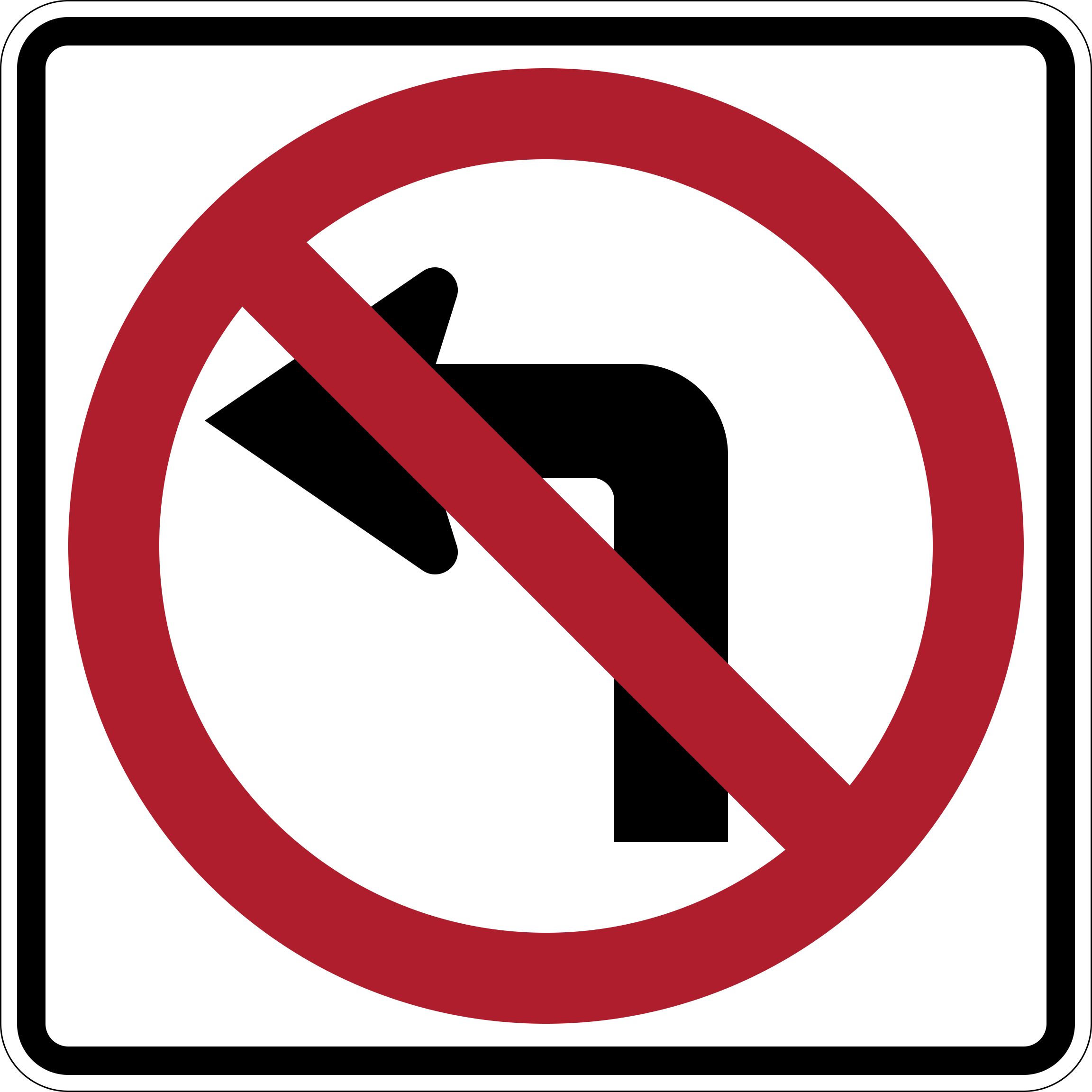
- The symbol shows a prohibited action
- The symbol shows a recommended action
- The sign marks a motorist service
- The sign gives the advisory speed for a curve
Show answer
The symbol shows a prohibited action. A red circle with a slash means no, and the pictured symbol identifies what is prohibited. For example, a slash through a turn symbol can prohibit that turn. It is not a recommendation, a service marker, or an advisory speed plaque. Read the symbol together with the surrounding sign and roadway layout so you understand the forbidden movement at that location. The visual cue is the slash: treat the displayed action as unavailable unless another lawful instruction changes the situation.
Study this in the handbook: Regulatory and warning signs
16. What does a two way traffic warning indicate?
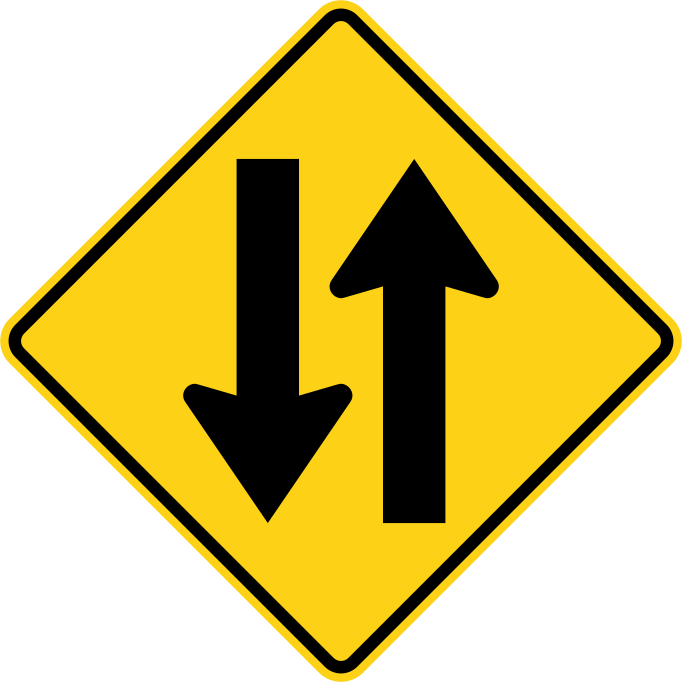
- A divided highway begins immediately
- All traffic will soon travel one way
- Traffic is moving in opposite directions on the roadway
- Passing is permitted in both directions
Show answer
Traffic is moving in opposite directions on the roadway. The two way traffic warning marks a roadway, or an upcoming portion of one, where vehicles move in opposite directions. Keep your vehicle in its lane and expect oncoming traffic. The sign does not authorize passing, announce one way operation, or mean a median will separate the streams. A useful visual cue is the pair of opposing arrows: they call attention to conflict from the other direction. Reduce speed if visibility is limited and reassess before attempting any maneuver.
17. When a warning sign shows traffic merging from the right, what should you do?

- Accelerate so merging traffic must wait
- Adjust speed and lane position to let traffic merge safely
- Move left without checking beside you
- Stop in your lane before the merge
Show answer
Adjust speed and lane position to let traffic merge safely. Nebraska describes a merge warning as a prompt to adjust both speed and lane position so entering traffic can join safely. Accelerating closes the available gap, while an unchecked lane move can create a side collision. Stopping in a through lane is also unnecessary unless another hazard requires it. Check mirrors, create space, and keep a steady path as the added traffic enters. The practical reminder is to cooperate with the merge instead of competing for the same piece of pavement.
Study this in the handbook: Regulatory and warning signs
18. Unless a sign says otherwise, what is the maximum speed in a Nebraska residential district?
- 20 MPH
- 55 MPH
- 50 MPH
- 25 MPH
Show answer
25 MPH. Nebraska sets the default residential district maximum at 25 MPH when no different limit is posted. The 20 MPH option belongs to business districts, while 50 MPH applies to gravel or other non-dustless roads and 55 MPH applies to certain paved roads outside the state highway system. A posted sign can establish another lawful limit, so scan for signs before relying on the district default. The practical cue is the land use named in the question: residential means 25, business means 20. That distinction prevents choosing a nearby roadway category simply because its number is familiar.
Study this in the handbook: Speed limits
19. How many points does a conviction for careless driving, described as inattentive, forgetful, or inconsiderate driving, add in Nebraska?
- Four points
- Six points
- Five points
- Three points
Show answer
Four points. Careless driving carries 4 points on the Nebraska chart. Reckless driving, described as rash, heedless, or dangerous, is 5 points, and willful reckless driving, described as deliberate and intentional, is 6 points. Negligent driving, described as indifferent, offhand, or neglectful, is 3 points. Matching the description in the question to the label on the chart is the key step. Leaving the scene of a crash, by comparison, is a 6 point violation, and 12 points in two years causes automatic revocation.
Study this in the handbook: The point system and license revocation
20. For maximum safety in an air bag equipped vehicle, which children does the Nebraska manual say should ride in the rear seat?
- Only children under age two
- Children age 12 and younger
- Only children in booster seats
- Children age 16 and younger
Show answer
Children age 12 and younger. Because a deploying air bag can injure children even in a low speed crash, the manual says children age 12 and younger should ride in the rear seat for maximum safety. Age two is the rear facing guideline, not the rear seat age. The advice is not limited to children in booster seats. Age 16 is not the figure in the air bag section.
Study this in the handbook: How alcohol impairs driving
QualitySpace is expanding to Nebraska
We are a California-based independent insurance brokerage working on licensing in more states. We cannot help with Nebraska insurance yet. Leave your email and we will let you know when we can.
Every question is written from the official Nebraska Driver's Manual. Need paper? Printable NE practice test with answer key.
Last verified 2026-10-05. How we check every question · Study all 220 as flashcards
Frequently asked questions
How many questions are on this Nebraska practice test?
This fixed set has 20 questions. It is test 4 of 11 from the 220 question Nebraska bank. The real NE exam asks 25 questions and you need 20 correct.
What is the passing score for the real Nebraska test?
80% minimum on all written tests; on the 25-question Class O test that means 20 correct (can miss 5) That figure comes from the official Nebraska source cited on the DMV facts page.
How does this fixed test relate to the full Nebraska bank?
Each numbered test is a fixed set of questions in a fixed order, so you can retake the same test later and compare. Every test mixes road signs and the other topics in about the same proportion as the full bank. Tests 1 to 11 together cover every question in the Nebraska bank once. The full practice page mixes the whole bank at random.
Last verified 2026-10-05. See the Nebraska DMV facts page for sourced state details.
Return to the full Nebraska practice test · Study road signs