
Test 1 of 11 · 20 questions · Free 2026
NE Permit Practice Test 1
Jump to the test ↓A fixed 20 question set from the Nebraska bank with answers and plain English explanations. The real NE exam is 25 questions, 80 percent to pass; take the full length version on the main practice page.
Question 1 of 20 · 0 right so far
All 20 questions in test 1
Every question below comes from the Nebraska question bank on this page. Open a question to see the correct answer and the explanation. Nothing here is hidden behind a signup.
1. What should a driver check immediately before changing lanes?
- The destination before using a turn signal
- Only the rearview mirror
- Mirrors, the shoulder blind spot, and other drivers moving into the lane
- The lane ahead without looking beside the vehicle
Show answer
Mirrors, the shoulder blind spot, and other drivers moving into the lane. Nebraska's lane-change sequence combines communication and observation. Signal, inspect the rearview and side mirrors, look over the appropriate shoulder for the blind spot, and watch for another driver moving toward the same lane. A mirror-only check misses the area that the mirrors cannot show, while looking only ahead ignores nearby vehicles. Keep the maneuver out of an intersection, where lane changes are prohibited. The practical habit is signal, mirror, shoulder, then move only after the intended lane remains open through the entire transition.
Study this in the handbook: Passing, signaling, lane changes and turns
2. How far before turning or moving right or left should a Nebraska driver signal?
- At least 25 feet before the movement
- Only after beginning the turn
- At least 100 feet before the movement
- Only when another vehicle is directly behind
Show answer
At least 100 feet before the movement. Nebraska's signaling guidance gives following drivers and other road users advance notice: signal at least 100 feet before turning or moving right or left. Waiting until the maneuver starts deprives others of time to react, while 25 feet understates the distance in the manual. The duty is not limited to situations where a vehicle is already behind you, because a pedestrian, bicyclist, or unseen driver may also need the warning. Make the signal part of the preparation sequence, before braking or changing position, and keep checking that the intended path is clear.
Study this in the handbook: Passing, signaling, lane changes and turns
3. On a multi lane controlled access highway, what is required near a stopped vehicle with flashing lights when a lane change is possible?
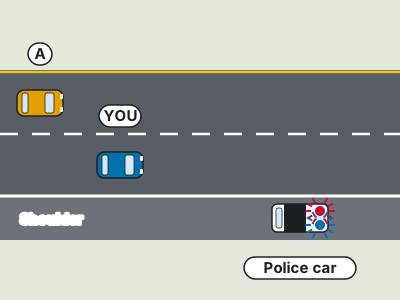
- Move at least one travel lane away from the stopped vehicle
- Stop in the lane next to the stopped vehicle
- Pass at the normal speed without changing lanes
- Use the shoulder to get around the stopped vehicle
Show answer
Move at least one travel lane away from the stopped vehicle. When several lanes are available on a controlled access highway, move at least one travel lane away from a stopped qualifying vehicle displaying flashing lights whenever conditions permit. The rule protects emergency, assistance, utility, highway maintenance, and collection workers. The shoulder is not a substitute for a safe lane change, and staying beside the vehicle at normal speed leaves too little separation. If traffic prevents moving over, reduce speed and maintain a safe speed past it.
Study this in the handbook: Yield signs, driveways and pedestrians
4. When is a driver approaching a school bus from the opposite direction not required to stop?
- When a median divides the roadway
- Whenever the bus is more than 100 feet away
- When the driver cannot see children
- Whenever the bus is stopped on a two-lane road
Show answer
When a median divides the roadway. The school-bus stopping rule has one stated opposite-direction exception: a roadway divided by a median. A simple painted centerline does not create that separation, so it is not enough to continue past a bus displaying its stop warnings. Distance from the bus and visibility of children also do not decide the issue. The cue is the physical roadway design. Look for an actual median dividing the opposing traffic paths, then still proceed cautiously because students and other road users may be nearby.
Study this in the handbook: School buses, snow plows and large trucks
5. What does the five-sided sign shown identify?

- A no-passing zone
- A school zone or school crossing
- A railroad crossing
- A recreational area
Show answer
A school zone or school crossing. Nebraska assigns the five-sided pentagon to SCHOOL AND SCHOOL CROSSING. The shape marks school zones and warns of school children crosswalks. A pennant, not a pentagon, indicates a no-passing zone; a crossbuck or circle identifies a railroad crossing; and recreation signs use a different category. When this sign appears, reduce speed, obey the posted instructions, and watch closely for children in or near the roadway. Shape recognition helps when lettering is distant or visibility is poor, but it should be paired with the sign's actual message and traffic conditions.
Study this in the handbook: Sign colors and shapes
6. What does a curve warning sign with a right arrow advise?

- A sharp left turn immediately ahead
- A mandatory right turn at an intersection
- A road closure requiring a detour
- A gradual curve to the right is ahead
Show answer
A gradual curve to the right is ahead. The curve warning describes a gradual bend to the right ahead and directs the driver to slow to the safe speed shown on any advisory plaque. It is not a command to turn at a junction and does not indicate a detour or a left bend. Reduce speed before entering the curve, then keep the vehicle controlled through the bend. The arrow shows roadway alignment, while a separate regulatory sign would state a mandatory movement. Read both the warning and any supplemental speed information.
7. What minimum liability coverage does Nebraska require for injury to or destruction of the property of others in any one crash?
- Ten thousand dollars
- Fifty thousand dollars
- Five thousand dollars
- Twenty five thousand dollars
Show answer
Twenty five thousand dollars. Nebraska requires $25,000 for property damage in any one crash, alongside $25,000 for bodily injury to or death of one person and $50,000 for two or more persons. The $50,000 amount is the multiple person injury limit, not property. The $5,000 and $10,000 amounts are below the required minimum. Having less than the required coverage and being involved in an at fault crash is itself a reason for license suspension or revocation.
Study this in the handbook: Crashes, deer and police stops
8. A Nebraska driver refused a chemical test and wants an Ignition Interlock Permit. How long after the temporary license expires must the driver wait to apply?
- 90 days
- No wait
- 15 days
- 45 days
Show answer
90 days. For a refusal, the offender must wait 90 days after the temporary license expires to apply for an Ignition Interlock Permit, and the permit is then valid for the balance of the one year ALR. First time offenders who failed a test can apply once the 15 day temporary license expires, with no added wait. Forty five days is the wait for subsequent offenders who failed a test. Refusing therefore delays legal driving longer than failing.
Study this in the handbook: The point system and license revocation
9. In Nebraska, you may not park within how many feet of a stop sign or flashing signal at the side of the roadway?
- 15 feet
- 20 feet
- 30 feet
- 50 feet
Show answer
30 feet. Nebraska prohibits parking or stopping within 30 feet of any flashing signal, stop sign, yield sign, or other traffic control device located at the side of the roadway. Fifteen feet is the fire hydrant distance and 20 feet is the distance from a crosswalk at an intersection. Fifty feet is the railroad track buffer. The same list also bars parking on a sidewalk, within an intersection, or on a crosswalk.
Study this in the handbook: Parking and railroad crossings
10. After a Nebraska officer confiscates a license for failing or refusing an alcohol test, how long is the temporary license valid?
- 30 days
- 15 days
- 90 days
- 180 days
Show answer
15 days. Under the ALR law, an officer can immediately confiscate the license of a driver who fails an alcohol test or refuses a chemical test, and the driver receives a temporary license that expires 15 days after it is issued. Thirty days is not the temporary license period. Ninety days is the wait after the temporary license expires before someone who refused a test can apply for an ignition interlock permit. One hundred eighty days is the ALR length for a first time offender who fails a test.
Study this in the handbook: Alcohol limits, implied consent and revocation
11. What penalty does Nebraska list for violating the child passenger restraint law?
- A warning for the first offense
- A $200 fine and 3 points
- A 30 day license impoundment
- A $25 fine plus court costs and 1 point
Show answer
A $25 fine plus court costs and 1 point. A child restraint violation carries a $25 fine plus court costs, and 1 point is assessed against the operator's driving record. That makes it different from the adult occupant protection violation, which carries the $25 fine without a point. The $200 and 3 point figures belong to phone and texting rules, not child restraints. The manual lists no warning or license impoundment for this violation.
Study this in the handbook: Air bags, seat belts and child restraints
12. A driver holding a Provisional Operator's Permit wants to carry a nonfamily passenger younger than 19. What limit applies during the first six months?
- Any number if the trip is during daylight
- No more than one such passenger
- No more than three such passengers
- Only a passenger who is at least 21
Show answer
No more than one such passenger. For the first six months, a POP holder may carry one passenger younger than 19 who is not an immediate family member. The daylight condition does not erase the passenger limit, and three passengers exceeds it. The age 21 option confuses the passenger rule with supervised driving requirements. Before starting the trip, count the passengers who fit the under 19 and nonfamily description. A simple cabin check prevents an otherwise avoidable violation and the associated one point assessment on the driving record.
Study this in the handbook: Graduated licensing restrictions for teens
13. How many points does Nebraska assess for passing a school bus that has its stop arm out and red lights flashing?
- One point
- Three points
- Six points
- Twelve points
Show answer
Three points. Violating a school bus crossing, with the arm out and red signal lights flashing, is a 3 point violation in Nebraska. One point is the value for general traffic violations not listed separately. Six points applies to offenses such as DUI or leaving the scene, and 12 points to motor vehicle homicide or third offense drunk driving. Separately, the manual makes it unlawful to pass a stopped school bus with its stop lights on and arm extended, except in the opposite direction on a road divided by a median.
Study this in the handbook: The point system and license revocation
14. What should a driver do when approaching a roundabout?
- Slow down and yield to vehicles approaching on the left already in the roundabout
- Accelerate and enter before any vehicle on the left
- Stop in the circle until every approach is empty
- Yield only to vehicles approaching from the right
Show answer
Slow down and yield to vehicles approaching on the left already in the roundabout. At a roundabout, reduce speed and yield to vehicles approaching on the left that are already in the circle. Entering aggressively can interfere with traffic that has priority, while stopping inside the circle creates a new obstruction. The rule is not based on yielding only to the right. Scan left, choose a safe gap, and follow the circular roadway without cutting across another vehicle's path.
Study this in the handbook: Regulatory and warning signs
15. When does the Nebraska manual say travel on roads posted 40 mph or more is not recommended?
- When it is raining at all
- When the temperature is below freezing
- When visibility is less than a quarter mile
- At night
Show answer
When visibility is less than a quarter mile. Nebraska's fog guidance is to use low beam headlights, reduce speed, and proceed with extreme caution. The manual adds that travel on a roadway with posted speeds of 40 mph or more is not recommended when visibility is less than one quarter of a mile. Rain alone, freezing temperatures, or nighttime are not the condition the manual names for this advice. The cue is the combination of a 40 mph or faster road and visibility under a quarter mile, which is the point where the manual recommends not traveling at all.
Study this in the handbook: Night driving, rain, fog, wind and floods
16. In a Nebraska work zone, what should a driver be prepared to do at any time?
- Drive faster than surrounding traffic
- Accelerate sharply whenever cones appear
- Ignore signs after entering the zone
- Stop when conditions or traffic control require it
Show answer
Stop when conditions or traffic control require it. Work zones can narrow the driving area and remove escape space, so the manual tells drivers to remain ready for a stop at any time. That does not mean braking immediately whenever cones appear. Stay alert, obey signs and other traffic control devices, keep movement predictable, and avoid abrupt speed changes that could cause a rear end crash. The acceleration choice adds risk near workers, while ignoring signs removes the instructions that organize the zone. Use a simple cue: expect changing conditions, leave room, and be prepared to stop when the roadway or a flagger requires it.
Study this in the handbook: Work zones, school zones and speeding fines
17. How many points accumulated within two years cause automatic revocation of a Nebraska operator's license?
- 6 points
- 8 points
- 10 points
- 12 points
Show answer
12 points. Nebraska provides for automatic revocation when a driver accumulates 12 points in a two-year period. The listed revocation lasts six months. Six points belongs to a separate rule affecting some drivers under 21, while eight and ten points are not the threshold stated here. Keep the number and time span together when studying: twelve points within two years triggers this action. A point total without the two-year period is incomplete, because the manual defines the consequence by both the amount accumulated and the time in which it occurs.
Study this in the handbook: The point system and license revocation
18. At a two-way stop, what must a driver do after stopping and before proceeding into the intersection?
- Check only the left lane
- Look in all directions and wait for conflicts to clear
- Proceed immediately after stopping
- Rely on the first vehicle to wave
Show answer
Look in all directions and wait for conflicts to clear. At a two-way stop, the driver must make a full stop before entering, look in all directions for approaching pedestrians and vehicles, and wait until all conflicting pedestrians and vehicles have cleared. Checking only one side leaves an unseen approach unprotected. Stopping alone is not permission to move, and another driver's wave cannot replace a complete safety check. Use a three part cue: full stop, scan everywhere, then wait for the conflict to clear. That sequence applies before entering the intersection, not merely before crossing the first lane.
Study this in the handbook: Yield signs, driveways and pedestrians
19. What information do blue and white service signs direct motorists to?
- Services such as hospitals, gas, food, and lodging
- No passing zones and lane restrictions
- Upcoming curves and slippery pavement
- County boundaries and route mileage only
Show answer
Services such as hospitals, gas, food, and lodging. Blue and white service signs direct motorists to useful services, including hospitals, gas, food, and lodging. They help locate assistance or amenities and do not establish a no passing restriction or warn about a curve. Yellow warning signs handle unexpected conditions, while a pennant shape identifies a no passing zone. Route markers and guide signs serve different navigation purposes. Use the blue service color as a quick cue that the sign points toward a facility or traveler service.
Study this in the handbook: Guide, service and work zone signs
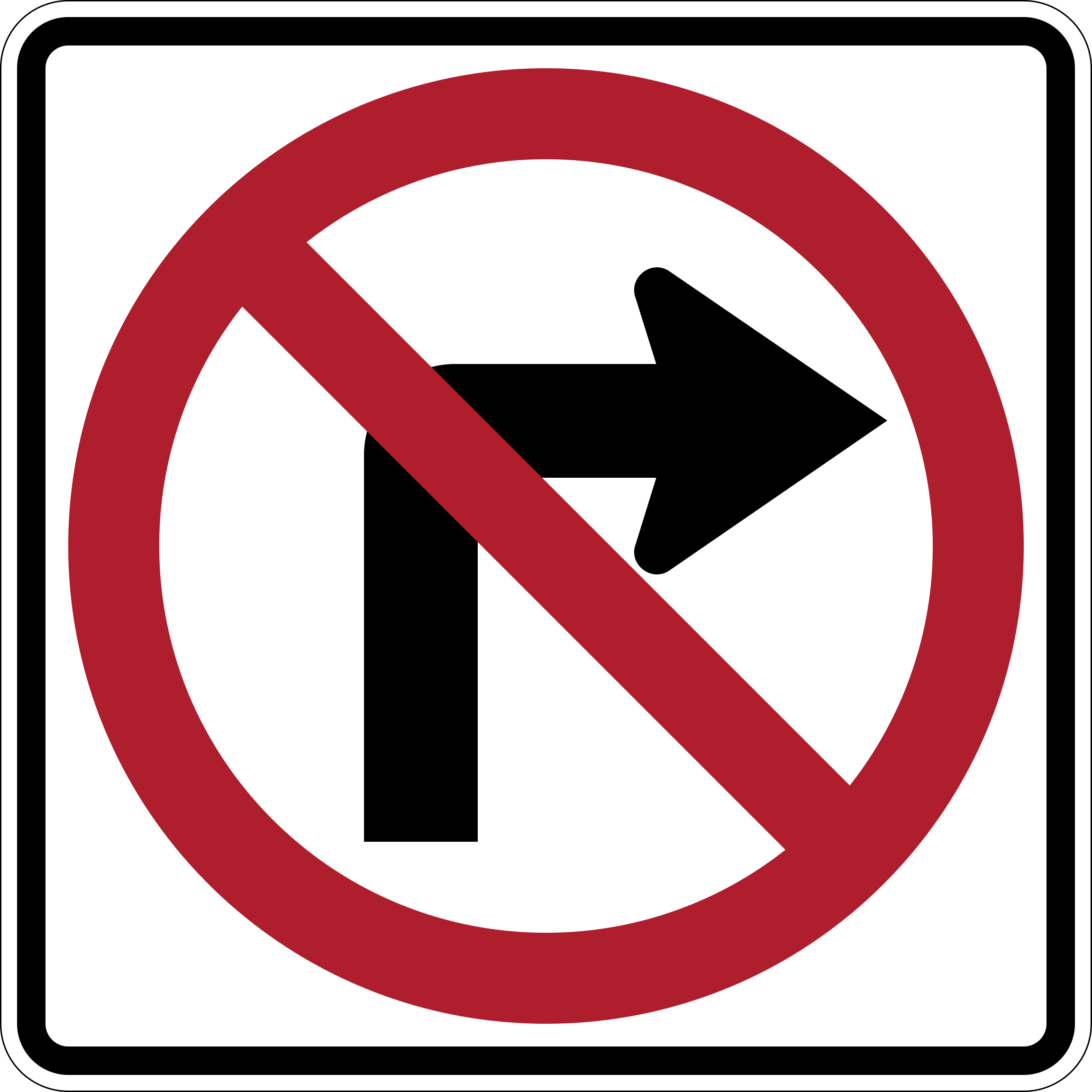
20. What movement is prohibited by the crossed right-turn arrow shown?
- Turning left
- Making a U-turn
- Turning right
- Driving straight ahead
Show answer
Turning right. The crossed right-turn arrow means NO RIGHT TURN, which Nebraska defines as right turn prohibited. The sign does not prohibit left turns, U-turns, or straight travel unless another sign, signal, or rule does so. Its symbol identifies one particular movement, so do not broaden the restriction to the entire intersection. A driver approaching it should select a permitted path and obey any accompanying signal. If a right turn would otherwise be allowed on red, this regulatory sign still blocks that movement because the prohibition applies to the turn itself.
Study this in the handbook: Regulatory and warning signs
QualitySpace is expanding to Nebraska
We are a California-based independent insurance brokerage working on licensing in more states. We cannot help with Nebraska insurance yet. Leave your email and we will let you know when we can.
Every question is written from the official Nebraska Driver's Manual. Need paper? Printable NE practice test with answer key.
Last verified 2026-10-05. How we check every question · Study all 220 as flashcards
Frequently asked questions
How many questions are on this Nebraska practice test?
This fixed set has 20 questions. It is test 1 of 11 from the 220 question Nebraska bank. The real NE exam asks 25 questions and you need 20 correct.
What is the passing score for the real Nebraska test?
80% minimum on all written tests; on the 25-question Class O test that means 20 correct (can miss 5) That figure comes from the official Nebraska source cited on the DMV facts page.
How does this fixed test relate to the full Nebraska bank?
Each numbered test is a fixed set of questions in a fixed order, so you can retake the same test later and compare. Every test mixes road signs and the other topics in about the same proportion as the full bank. Tests 1 to 11 together cover every question in the Nebraska bank once. The full practice page mixes the whole bank at random.
Last verified 2026-10-05. See the Nebraska DMV facts page for sourced state details.
Return to the full Nebraska practice test · Study road signs