
Test 11 of 11 · 20 questions · Free 2026
NE Permit Practice Test 11
Jump to the test ↓A fixed 20 question set from the Nebraska bank with answers and plain English explanations. The real NE exam is 25 questions, 80 percent to pass; take the full length version on the main practice page.
Question 1 of 20 · 0 right so far
All 20 questions in test 11
Every question below comes from the Nebraska question bank on this page. Open a question to see the correct answer and the explanation. Nothing here is hidden behind a signup.
1. Until what point should a Nebraska child ride rear-facing in a safety seat?
- Until age two or the seat's upper height or weight limit is reached
- Until age eight in every case
- Only until the child can walk
- Until age twelve regardless of the manufacturer's limits
Show answer
Until age two or the seat's upper height or weight limit is reached. Nebraska says children should ride rear-facing up to age two or until they reach the upper height or weight limit allowed by the car-seat manufacturer. Either condition can end the rear-facing period, so age two is not an automatic requirement when the seat's limit is reached earlier. Walking ability and the general rear-seat recommendation for older children are unrelated standards. Check the label on the particular seat and compare the child's measurements with its stated limits. That practical check prevents a one-number answer from replacing the full rule.
Study this in the handbook: Air bags, seat belts and child restraints
2. Why should drivers be alert for steering corrections when meeting a large truck or bus in high wind?
- Large vehicles are allowed to cross the centerline in wind
- Sudden wind changes can affect both vehicles
- Wind makes trucks stop instantly
- The truck's headlights make the road narrower
Show answer
Sudden wind changes can affect both vehicles. Large trucks and buses present a substantial profile to moving air, and the wind can change suddenly as vehicles meet or pass. Nebraska warns drivers to be alert for steering corrections in that situation. The rule does not give a large vehicle permission to disregard lane boundaries, and wind does not improve braking. Leave lateral space, keep both hands ready for a smooth correction, and avoid lingering beside the larger vehicle. The central cue is the combination of a high-profile vehicle and changing airflow, especially in an exposed stretch of roadway.
Study this in the handbook: Night driving, rain, fog, wind and floods
3. What happens to a Nebraska driver under 21 convicted of refusing an alcohol test?
- A $25 fine
- The license is impounded for 90 days and the conviction stays on the record for 120 days
- A 30 day impoundment and 90 days on the record
- Nothing for a first refusal
Show answer
The license is impounded for 90 days and the conviction stays on the record for 120 days. For an underage .02 percent conviction the court impounds the license for 30 days and the conviction stays on the driving record for 90 days, but for an underage refusal the court impounds the license for 90 days and it becomes part of the record for 120 days before being deleted. Refusing the test therefore costs more than failing it.
Study this in the handbook: Alcohol limits, implied consent and revocation
4. At what BAC does the Nebraska manual say impairment begins when a driver must choose among several possible responses?
- .03%
- .08%
- .10%
- .15%
Show answer
.03%. Simple reaction time is impaired at .04% BAC, and when a driver must choose among a number of responses, called choice reaction, impairment begins even lower, at .03%. The .08% level is the general legal limit, and the manual stresses that most people show significant impairment well below it. The .10% and .15% figures are higher still; .15 is the BAC level whose DUI penalties match those for refusing a test.
Study this in the handbook: Alcohol limits, implied consent and revocation
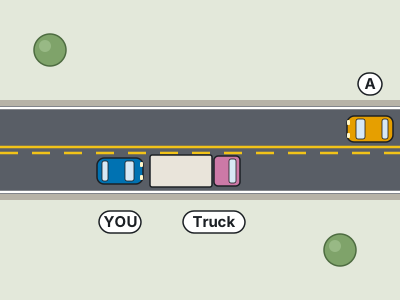
5. When a broken yellow center line is on the driver's side, when may passing occur?
- At any time, because a broken line gives unlimited permission
- Whenever the driver is below the posted speed limit
- Only after an approaching vehicle has entered the shoulder
- When the way ahead is clear and the pass can be made with care
Show answer
When the way ahead is clear and the pass can be made with care. A broken yellow center line permits passing on the left only when the way ahead is clear. The driver must still account for oncoming traffic, sight distance, speed, and any other restriction. Being under the speed limit does not make an unsafe pass lawful. A broken line is permission under a condition, not an invitation to cross whenever desired. Check far enough ahead for vehicles and obstructions, signal, and return to the proper lane without forcing another road user to react.
Study this in the handbook: Passing, signaling, lane changes and turns
6. How far before a turn or lane change should a driver signal an intention?
- At least 500 feet in every situation
- At least 25 feet
- Only after beginning the movement
- At least 100 feet
Show answer
At least 100 feet. Nebraska's defensive driving guidance says to signal intentions at least 100 feet before planning to change direction. Signaling after the movement begins gives surrounding drivers no useful warning, and 25 feet is too late for many approaches. The manual does not require 500 feet in every situation. Activate the signal while still traveling predictably, check mirrors and blind spots, then move only when the path is clear. A useful habit is to signal before braking for the turn, not as the steering wheel starts moving.
Study this in the handbook: Passing, signaling, lane changes and turns
7. Which Nebraska sign shape marks school zones and warns of school children crosswalks?
- Circle
- Pennant
- Pentagon
- Octagon
Show answer
Pentagon. Nebraska uses the five-sided pentagon shape to mark school zones and warn about school children crosswalks. A pennant marks a no-passing zone, a circle is associated with railroad warnings, and an octagon identifies a stop sign. Shape recognition helps when a sign is partly hidden, viewed from an angle, or seen before its lettering can be read. Slow down near the pentagon and look for children, crossings, or traffic-control directions. The shape provides the first warning, while the posted message supplies any additional instruction.
Study this in the handbook: Sign colors and shapes
8. What must a POP holder do when driving between midnight and 6 AM?
- Stop driving at 10 PM every night
- Drive only with the interior light on
- Drive freely if no passengers are present
- Avoid driving unless traveling to or from school activities or work
Show answer
Avoid driving unless traveling to or from school activities or work. A holder of a Provisional Operator's Permit may not drive from midnight to 6 AM unless the trip is to or from school activities or work. Passenger-free driving does not create a general exception, and the manual does not set a 10 PM cutoff. The interior light has no bearing on this restriction. Plan the route and timing before leaving, especially when an activity may run late. The time window is the key cue: midnight starts the restricted period and 6 AM ends it.
Study this in the handbook: Graduated licensing restrictions for teens
9. How close to a fire hydrant may you park in Nebraska?
- No closer than 15 feet
- No closer than 5 feet
- No closer than 10 feet
- No closer than 30 feet
Show answer
No closer than 15 feet. Nebraska prohibits parking or stopping within 15 feet of a fire hydrant. Five and ten feet are closer than the manual allows. The 30 foot distance applies to flashing signals, stop signs, yield signs, and other traffic control devices at the side of the roadway, not hydrants. Keep the list separate: 15 feet for hydrants, 20 feet for a crosswalk at an intersection, 30 feet for traffic control devices, and 50 feet for railroad tracks.
Study this in the handbook: Parking and railroad crossings
10. If a vehicle is traveling below normal traffic speed, where should it generally be driven?
- On the shoulder whenever the roadway has two lanes
- In the far left lane to avoid merging traffic
- In the right lane available for traffic
- In whichever lane has the fewest vehicles behind it
Show answer
In the right lane available for traffic. A vehicle moving slower than normal traffic should use the right lane available for traffic, or stay as close as practical to the right curb or edge. The exceptions include overtaking and passing in the same direction or preparing for a left turn. The left lane is not a refuge from merging traffic, and the shoulder is not a substitute travel lane. A useful cue is slower traffic keeps right, while the driver still plans ahead for a lawful turn or pass.
Study this in the handbook: Right of way at intersections
11. If a vehicle stalls on railroad tracks, what should the occupants do first?
- Wait for a crossing gate to rise before opening the doors
- Remain inside while trying to restart the engine
- Push the vehicle farther along the tracks before exiting
- Get everyone out and off the tracks immediately
Show answer
Get everyone out and off the tracks immediately. A stalled vehicle on a crossing puts everyone in immediate danger, so all occupants should get out and move off the tracks without delay. Do not stay inside trying to restart the engine, push the vehicle along the rails before escaping, or wait for a gate to rise. Move in the direction the train or on-track equipment is expected. If none is seen immediately, call the 1-800 number on the crossing sign to try to stop it. If a train or on-track equipment is coming, stay clear of the tracks and call 911.
Study this in the handbook: Parking and railroad crossings
12. At what age may a person apply for a Nebraska Provisional Operator's Permit, with issuance on or after that birthday?
- 14
- 16
- 15
- 17
Show answer
16. Nebraska sets the minimum age for a Provisional Operator's Permit at 16, and the permit may be applied for 60 days before that birthday but issued only on or after the 16th birthday. Fourteen is associated with the School Learner's Permit, 15 with the Learner's Permit, and 17 with a Class O operator's license. The age and issuance distinction matters: early application does not authorize early issuance. Use the permit name as the cue, then separate the application window from the date the credential can actually be issued.
Study this in the handbook: Provisional Operator's Permit and Class O license
13. What does a right lane ends warning require the driver to anticipate?

- A left turn into a center lane
- A second lane opening on the right
- A mandatory stop at the shoulder
- A required merge into the remaining lane
Show answer
A required merge into the remaining lane. A lane ends sign means the marked lane will disappear and a merging maneuver will be required. The driver should look early for a safe gap, signal, and move when appropriate rather than wait beside a solid obstruction. It does not promise another lane, call for a shoulder stop, or direct a turn into a shared center lane. Watch the pavement markings and nearby vehicles together. Seeing the sign early provides time to merge without forcing another driver to brake.
Study this in the handbook: Regulatory and warning signs
14. What is the minimum age for a Nebraska School Permit, and how long must a learner's permit be held first?
- 16 years, with no permit required
- 15 years, after six months
- 14 years and two months, after holding a learner's permit for at least two months
- 13 years, after one month
Show answer
14 years and two months, after holding a learner's permit for at least two months. The minimum age for a School Permit is 14 years and two months, and the applicant may not apply until he or she has held a School Learner's Permit or Learner's Permit for at least two months. Before applying, the applicant must also complete a DMV approved driver safety course or a 50 hour certification form. The permit allows unsupervised driving only on the most direct route to and from school, and passengers are limited to family members who live with the holder.
Study this in the handbook: School learner's, school and learner's permits
15. How much clearance must a motorist leave when overtaking a bicycle, when applicable?
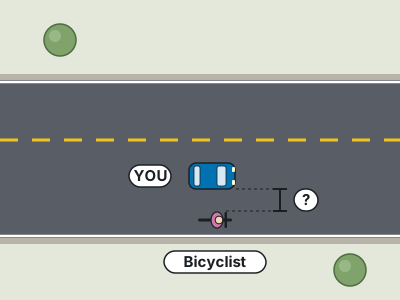
- No less than three feet
- No less than one foot
- Exactly six inches
- At least ten feet in every situation
Show answer
No less than three feet. Nebraska requires a motorist overtaking a bicycle in the same direction to leave a safe distance of no less than three feet when applicable and to keep that clearance until safely past. One foot and six inches leave too little room for a wobble or roadway hazard. Ten feet is not the stated universal minimum. If three feet cannot be provided safely, reduce speed and wait to pass. Check the opposing lane, signal as needed, and remember that the clearance must continue throughout the overtake.
Study this in the handbook: Motorcycles and bicycles
16. Before applying for a POP, how long must a Nebraska teen have held a learner or school permit, and what point limit applies to that period?
- At least six months, without accumulating three or more points in that period
- At least 30 days, with no point limit
- At least one year, without any points at all
- At least three months, without accumulating six or more points
Show answer
At least six months, without accumulating three or more points in that period. A POP applicant must have held an LPE, SCP, or LPD for at least six months and must not have accumulated three or more points during the six month period immediately before the application. Thirty days is far too short and ignores the point condition. One year with zero points overstates the requirement; one year is the POP holding period needed later for a Class O license. The six point figure belongs to the under 21 driver improvement course rule, not POP eligibility.
Study this in the handbook: Graduated licensing restrictions for teens
17. How long do traffic convictions remain on a Nebraska driving record, and how long do their points count?
- Convictions stay two years and points count five years
- Convictions stay five years, but points stop counting two years after the violation
- Both stay for ten years
- Both are removed after one year
Show answer
Convictions stay five years, but points stop counting two years after the violation. Convictions remain on the Nebraska record for five years, but the points no longer count two years after the date of the violation. Saying convictions stay two years and points count five years reverses the two figures. Ten years and one year are not stated anywhere in the point section. Because points count for two years, they line up with the rule that 12 points in a two year period causes automatic revocation.
Study this in the handbook: The point system and license revocation
18. After failing three successive Class O drive tests, what must an applicant do before reapplying?
- Wait 30 days without another requirement
- Retake only the vision test
- Complete an approved driver training course or hold an LPD for at least 90 days
- Apply for a commercial license instead
Show answer
Complete an approved driver training course or hold an LPD for at least 90 days. Three successive Class O drive test failures create a reapplication condition. Before trying again, the applicant must show successful completion of a DMV approved driver training course or have held a Learner's Permit (LPD) for at least 90 days. A 30 day wait and a vision retest do not address the repeated drive test failures, while changing to a commercial license is unrelated. Study this as two available routes rather than one mandatory sequence: approved training is one route, and the 90 day LPD period is the other.
Study this in the handbook: Tests, renewal and address changes
19. What basic standard does Nebraska apply when deciding whether a driver's speed is lawful under current roadway conditions?
- The speed must match the fastest nearby vehicle
- The speed must be reasonable and safe
- The speed must be exactly 5 mph below the limit
- The speed must stay under 40 mph everywhere
Show answer
The speed must be reasonable and safe. Nebraska's speed rule is built around a reasonable and safe speed for the conditions that exist at the time. That standard still matters when a driver is below the posted maximum, because weather, traffic, visibility, or roadway hazards may require additional caution. Matching the fastest vehicle ignores safety, and subtracting 5 mph or using a universal 40 mph ceiling is not the state's general rule. Before focusing on a posted number, scan the road and adjust so the vehicle can respond safely to what is actually ahead.
Study this in the handbook: Yield signs, driveways and pedestrians
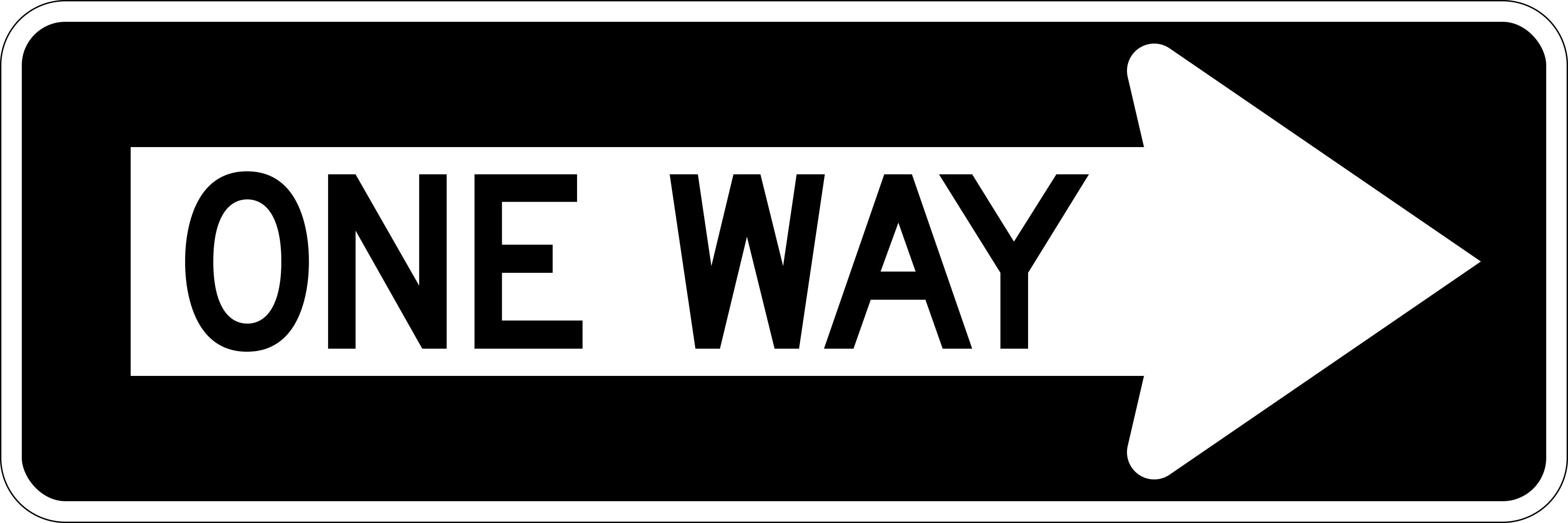
20. What does the ONE WAY sign shown indicate about traffic flow?
- Only buses may use the arrow's direction
- Traffic may travel either way outside rush hour
- Traffic flows only in the arrow's direction
- The arrow marks a temporary detour only
Show answer
Traffic flows only in the arrow's direction. The ONE WAY sign restricts traffic to the direction shown by its arrow. It is not a time-based permission that changes outside rush hour, and it does not reserve the street for buses. The arrow is also not automatically a temporary detour marker. Before entering, compare your intended movement with the sign and roadway markings. If the direction conflicts, do not proceed simply because the road appears open. The short memory cue is literal: one way means one permitted direction, and the arrow identifies which direction that is.
Study this in the handbook: Regulatory and warning signs
QualitySpace is expanding to Nebraska
We are a California-based independent insurance brokerage working on licensing in more states. We cannot help with Nebraska insurance yet. Leave your email and we will let you know when we can.
Every question is written from the official Nebraska Driver's Manual. Need paper? Printable NE practice test with answer key.
Last verified 2026-10-05. How we check every question · Study all 220 as flashcards
Frequently asked questions
How many questions are on this Nebraska practice test?
This fixed set has 20 questions. It is test 11 of 11 from the 220 question Nebraska bank. The real NE exam asks 25 questions and you need 20 correct.
What is the passing score for the real Nebraska test?
80% minimum on all written tests; on the 25-question Class O test that means 20 correct (can miss 5) That figure comes from the official Nebraska source cited on the DMV facts page.
How does this fixed test relate to the full Nebraska bank?
Each numbered test is a fixed set of questions in a fixed order, so you can retake the same test later and compare. Every test mixes road signs and the other topics in about the same proportion as the full bank. Tests 1 to 11 together cover every question in the Nebraska bank once. The full practice page mixes the whole bank at random.
Last verified 2026-10-05. See the Nebraska DMV facts page for sourced state details.
Return to the full Nebraska practice test · Study road signs