
Test 7 of 10 · 20 questions · Free 2026
MI Permit Practice Test 7
Jump to the test ↓A fixed 20 question set from the Michigan bank with answers and plain English explanations.
Question 1 of 20 · 0 right so far
All 20 questions in test 7
Every question below comes from the Michigan question bank on this page. Open a question to see the correct answer and the explanation. Nothing here is hidden behind a signup.
1. What distinction does Michigan claim from 1955 in driver education?
- It abolished driver education
- It raised the driving age to 21
- It became the first state to require teens under 18 to take driver education
- It issued the first license
Show answer
It became the first state to require teens under 18 to take driver education. In 1955 Michigan became the first state to require teens under age 18 to take driver education, and the state's graduated driver licensing still builds on that requirement. Segment 1 begins at 14 years and 8 months with parental permission and requires classroom and behind the wheel instruction. Earlier, in 1934, the Automobile Club of Michigan worked with school systems to develop the nation's first high school driver education class.
Study this in the handbook: Permits, tests, probation and renewal
2. How should you respond to a flashing red traffic light?
- Slow down but continue without stopping
- Come to a full stop, then proceed when the road is clear
- Stop only if a pedestrian is present
- Treat it as a green arrow
Show answer
Come to a full stop, then proceed when the road is clear. A flashing red light requires the same first action as a stop sign: bring the vehicle to a full stop. After stopping, check the intersection and proceed only when the road is clear. Merely slowing does not satisfy the rule, and a flashing red indication does not authorize a turn or movement associated with a green arrow. Look for cross traffic, pedestrians, and vehicles already entering the intersection before moving. The memory cue is stop first, then scan, then go when clear.
Study this in the handbook: Pavement markings and traffic signals
3. What is the required response when an emergency vehicle approaches with flashing red or blue lights and a siren?
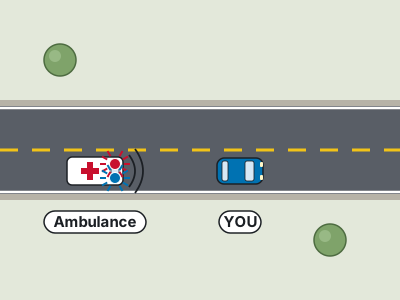
- Continue straight because the emergency vehicle can pass anywhere
- Move close to the right edge, clear the intersection, and stop
- Turn left across traffic to create a wider gap
- Stop immediately in the middle of the intersection
Show answer
Move close to the right edge, clear the intersection, and stop. The driver should move as close as possible to the right edge or curb, get clear of the intersection, and stop until the emergency vehicle passes or an officer signals that movement may resume. Continuing straight can block the response path, and stopping in the intersection leaves the vehicle where cross traffic and the emergency vehicle may need to travel. A sudden left turn across traffic creates a new conflict instead of clearing one. Check mirrors, signal the move when possible, and keep the vehicle stopped until the response has passed. More than one emergency vehicle may be following, so do not move at the first opening.
Study this in the handbook: Emergency vehicles, Move Over and school buses
4. Unless posted otherwise, what is the speed limit in a Michigan platted subdivision or condominium complex?
- 15 mph
- 35 mph
- 25 mph
- 45 mph
Show answer
25 mph. Michigan's standard limit in platted subdivisions and condominium complexes is 25 mph. Fifteen mph is the limit for mobile home parks and some municipal parks. Thirty-five mph is not a default in the Michigan Vehicle Code summary, and 45 mph is the posted work zone limit. Drivers should still watch for posted signs in school and hospital zones and near parks, where limits vary.
Study this in the handbook: Phones, seat belts and child passengers
5. A Michigan teen holds a Level 2 Intermediate License. During which hours is driving prohibited unless an exception applies?
- Between midnight and 6 a.m.
- Between 10 p.m. and 5 a.m.
- Between 9 p.m. and 6 a.m.
- Between 11 p.m. and 5 a.m.
Show answer
Between 10 p.m. and 5 a.m.. Level 2 drivers may not drive from 10 p.m. to 5 a.m. The exceptions are narrow: a parent, guardian or designated licensed adult age 21 or older rides along, or the teen is driving for work, to or from work, or to or from an authorized activity. Midnight, 9 p.m. and 11 p.m. start times do not match the hours the Michigan manual lists for the Level 2 curfew. A trip home from a friend's house at 10:30 p.m. with no adult aboard is not covered by any exception.
Study this in the handbook: Graduated Driver Licensing for teens
6. What is the normal lane position for a Michigan driver on a multi-lane road?
- The left-hand lane whenever it has the clearest pavement
- Any lane chosen by the driver without regard to traffic direction
- The center lane at all times to avoid merging
- The right-hand lane, except for listed situations such as passing or obstacles
Show answer
The right-hand lane, except for listed situations such as passing or obstacles. Michigan directs drivers to use the right-hand lane except when a listed reason requires another position, such as passing, an obstacle, a divided road with three or more lanes, or an approaching stopped emergency vehicle. The left lane is not a default cruising lane, and the center lane is not universally safe. Choose the exception first, then return right when the reason ends.
Study this in the handbook: Passing, lane use and turns
7. How close to the nearest rail of a railroad crossing may a Michigan driver park?
- No closer than 15 feet
- No closer than 50 feet
- No closer than 20 feet
- No closer than 100 feet
Show answer
No closer than 50 feet. Michigan prohibits parking within 50 feet of the nearest rail of a railroad crossing. Fifteen feet is the hydrant rule and also the closest a driver may stop when a train is coming, and 20 feet is the marked crosswalk rule. One hundred feet is the no passing distance for an intersection or railroad crossing, a different rule. When approaching any railroad crossing, the manual says to slow down and look both ways, because a train is closer and moving faster than it appears.
8. How long does a conviction for impaired driving stay on a Michigan driving record?
- Two years
- Seven years
- Ten years
- Permanently
Show answer
Permanently. A conviction for impaired driving, like a conviction involving a fatality, stays on the Michigan record permanently. Most other convictions stay for at least seven years, and certain convictions and licensing actions stay at least 10 years. Two years is how long points count from the conviction date, which is different from how long the conviction itself appears. Confusing points with the record is a common test trap.
Study this in the handbook: Your driving record, points and implied consent
9. How often must a Michigan driver renew the license in person at a Secretary of State office?
- Every 12 years
- Every 4 years
- Every 8 years
- Only when the driver moves to a new address
Show answer
Every 12 years. Michigan lets many drivers renew without visiting an office, using mail, the online service at Michigan.gov/SOS, or a self-service station at places such as some grocery stores. That convenience has a limit. The manual says a driver's license must be renewed every 12 years at a Secretary of State office, where a vision screening is given and a new photograph is taken. The in person visit keeps the photo current and confirms the driver still sees well enough to drive.
Study this in the handbook: Permits, tests, probation and renewal
10. How many lives do seat belts save each year, according to NHTSA figures in the Michigan manual?
- About 500
- About 100,000
- About 2,000
- More than 13,000
Show answer
More than 13,000. The National Highway Traffic Safety Administration reports that seat belts save more than 13,000 lives each year and that buckling up is the single most effective thing you can do to protect yourself in a crash. Michigan requires belts for all front seat occupants and passengers under 16, and children under 4 ride in the rear seat when one is available.
Study this in the handbook: Phones, seat belts and child passengers
11. How should following space change when rain makes the pavement wet?
- Increase it because wet pavement requires more stopping time and space
- Reduce it because rain cools the brakes
- Keep exactly one car length at every speed
- Follow more closely so spray cannot enter the gap
Show answer
Increase it because wet pavement requires more stopping time and space. Wet pavement needs more stopping time and space, so the driver should increase the following interval. Reducing the gap or following closely makes it harder to react to sudden braking, spray, standing water, or a loss of traction. One car length is not a reliable measurement at every speed because the distance covered changes with speed. Rain may change braking and visibility conditions, but it does not justify keeping the same short space. Slow as needed, look farther ahead, and add room before the vehicle ahead begins braking. Extra space is especially important during the first part of rainfall, when the road can be slick.
Study this in the handbook: Bad weather, stopping distance and night driving
12. What is the only thing that sobers a person after drinking alcohol?
- Coffee
- A cold shower
- Fresh air
- Time
Show answer
Time. Michigan explains that time is the only thing that sobers a person after drinking alcohol. Many people mistakenly believe that coffee, a cold shower, exercise or fresh air can sober them up, but none of those is what the manual names. Consuming even one drink can impair driving, slow reaction time, dull concentration and cause visual problems. Select a designated driver ahead of time, or ask someone else for a ride, call a taxi, use public transportation or seek other assistance.
Study this in the handbook: Alcohol, drugs and marijuana
13. What roadway change does this warning sign announce?

- The divided highway is ending and traffic will become two lanes
- A divided highway is beginning around a new median
- A U-turn is required across the median
- A three-way junction is ahead
Show answer
The divided highway is ending and traffic will become two lanes. This sign announces that a divided highway is ending and will turn into two lanes of traffic. Prepare for opposing traffic, identify the center line, and keep your vehicle in the proper lane as the separation disappears. It does not tell you that a median is beginning, require a U-turn, or identify a three-way junction. Reduce speed if the lane transition is busy or confusing, and follow arrows and pavement markings through the merge into the two-lane roadway.
Study this in the handbook: Traffic sign shapes and colors
14. Which turn is prohibited at the location shown?
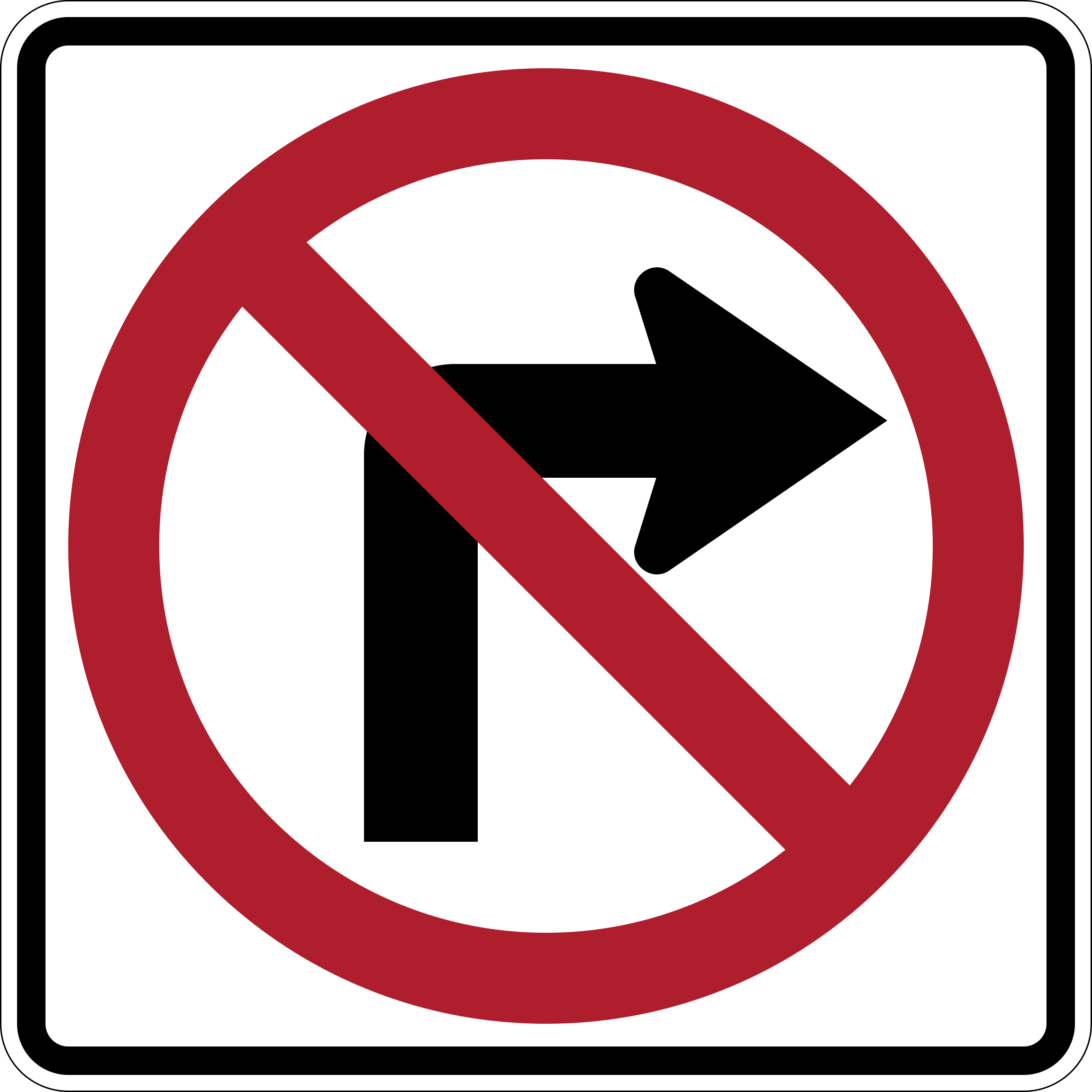
- A right turn
- A U-turn at a railroad crossing
- A turn into a marked parking space
- A left turn from a center lane
Show answer
A right turn. The crossed right-pointing arrow prohibits right turns at the posted location, including a right turn that a driver might otherwise consider on red. It does not automatically ban a left turn, a U-turn, or pulling into a marked parking space. Those actions may have their own signs or rules elsewhere. Identify the arrow’s direction before moving from the lane, and wait for a route that allows you to continue without making the pictured turn. The sign regulates the specific movement it displays.
Study this in the handbook: Traffic sign shapes and colors
15. What does a yield sign require a driver to do before entering the path of crossing traffic?
- Stop for exactly five seconds at the sign
- Accelerate to claim the intersection first
- Slow down and let vehicles crossing your path go by
- Yield only when a signal is also present
Show answer
Slow down and let vehicles crossing your path go by. A yield sign tells the driver to give the right of way to vehicles crossing the intended path. Slowing down creates time to assess the opening, and stopping may be necessary if traffic is present. The sign does not prescribe a five-second pause or reward acceleration into the intersection. A separate traffic signal is not needed for the yield command to apply. Look left, right, and ahead before entering.
Study this in the handbook: Traffic sign shapes and colors
16. When must headlights be turned on under Michigan's nighttime driving guidance?
- Only after midnight on roads outside cities
- Only during rain, never during snow or fog
- Only when another driver flashes headlights
- From one-half hour after sunset until one-half hour before sunrise and when visibility is reduced
Show answer
From one-half hour after sunset until one-half hour before sunrise and when visibility is reduced. The manual calls for headlights from one-half hour after sunset until one-half hour before sunrise, plus other times when visibility is reduced. It specifically advises low beams in daytime fog, rain, or snow. Midnight is not the trigger, and waiting for another driver ignores the visibility hazard. If you are having trouble seeing vehicles, they may also have trouble seeing you, so turn the lights on rather than delaying.
Study this in the handbook: Bad weather, stopping distance and night driving
17. Who has the right of way while traveling inside a Michigan roundabout?
- Vehicles waiting to enter
- Vehicles in the roundabout
- The vehicle approaching fastest
- Vehicles stopped on the shoulder
Show answer
Vehicles in the roundabout. Vehicles already in a Michigan roundabout have the right of way over vehicles waiting to enter. Entering traffic must slow at the yield line, look left, and merge only when a suitable gap appears. The approaching vehicle’s speed does not create priority, and a shoulder stop has no bearing on circulation. Once inside, keep right of the center island and avoid stopping unless necessary to prevent a collision or another danger. This sequence prevents an entering vehicle from cutting across the established counterclockwise flow.
Study this in the handbook: Right of way, pedestrians and roundabouts
18. Traffic is backed up near a Michigan railroad crossing. How much room must your vehicle have past the far side of the tracks before you cross?
- Enough to clear the near rail only
- Enough to clear by at least 1 foot
- Enough to clear the far side by at least 6 feet
- Enough to clear by at least 50 feet
Show answer
Enough to clear the far side by at least 6 feet. The manual says never to cross unless the vehicle can completely clear the far side of the tracks by at least 6 feet. A train is wider than the rails, so clearing only the near rail or by one foot leaves the car in danger. Fifty feet is the rule for how close you may park to a crossing, not how much room you need beyond it. If traffic will not let you clear, wait before the tracks.
Study this in the handbook: Railroad crossings
19. On a Michigan freeway with a 70 mph limit, what speed restriction applies to school buses and trucks?
- They are restricted to 65 mph
- They may travel 70 mph like passenger cars
- They are restricted to 55 mph
- They must remain below 45 mph
Show answer
They are restricted to 65 mph. On a freeway posted at 70 mph, school buses and trucks have a separate 65 mph restriction. The general freeway maximum therefore does not apply to those vehicle categories. The 55 mph choice belongs to freeways whose posted limit is less than 70 mph, while 45 mph is not the figure in this rule. Identify both parts of the scenario before selecting a limit: first determine whether the freeway is posted at 70 mph, then apply the special school bus and truck restriction.
Study this in the handbook: Phones, seat belts and child passengers
20. How does Michigan treat fines for failing to stop for a school bus?
- They are the same as any moving violation
- They are waived for a first offense
- They are double the normal moving violation fine
- They are replaced by a warning letter
Show answer
They are double the normal moving violation fine. Fines for failing to stop for a school bus are double what would normally be assessed for a moving violation, and violations that cause injury or death can bring larger fines and jail. The claim that the fine is the same as any moving violation misses the doubling. No first offense waiver or warning letter replaces the fine. The violation also adds three points to the driving record.
Study this in the handbook: Emergency vehicles, Move Over and school buses
QualitySpace is expanding to Michigan
We are a California-based independent insurance brokerage working on licensing in more states. We cannot help with Michigan insurance yet. Leave your email and we will let you know when we can.
Every question is written from the official What Every Driver Must Know (Michigan). Need paper? Printable MI practice test with answer key.
Last verified 2026-10-05. How we check every question · Study all 218 as flashcards
Frequently asked questions
How many questions are on this Michigan practice test?
This fixed set has 20 questions. It is test 7 of 10 from the 218 question Michigan bank.
How does this fixed test relate to the full Michigan bank?
Each numbered test is a fixed set of questions in a fixed order, so you can retake the same test later and compare. Every test mixes road signs and the other topics in about the same proportion as the full bank. Tests 1 to 10 together cover 200 of the 218 questions in the Michigan bank, each once. The full practice page mixes the whole bank at random.
Last verified 2026-10-05. See the Michigan DMV facts page for sourced state details.
Return to the full Michigan practice test · Study road signs