
Test 6 of 10 · 20 questions · Free 2026
MI Permit Practice Test 6
Jump to the test ↓A fixed 20 question set from the Michigan bank with answers and plain English explanations.
Question 1 of 20 · 0 right so far
All 20 questions in test 6
Every question below comes from the Michigan question bank on this page. Open a question to see the correct answer and the explanation. Nothing here is hidden behind a signup.
1. At a Michigan intersection where two vehicles arrive and stop at the same time, which vehicle yields?
- The vehicle on the right yields to the vehicle on the left
- Both vehicles proceed together
- The larger vehicle yields
- The vehicle on the left yields to the vehicle on the right
Show answer
The vehicle on the left yields to the vehicle on the right. When two vehicles reach and stop at an intersection at the same time, Michigan directs the vehicle on the left to yield to the vehicle on the right. This priority does not depend on engine size, lane width, or which driver feels more confident. Stop first, identify the other vehicle’s position, and allow the right-side vehicle to proceed before entering. The practical cue is to look across the intersection after stopping: if another vehicle is on your right, wait and watch its path before moving.
Study this in the handbook: Right of way, pedestrians and roundabouts
2. What traffic pattern does this sign establish?
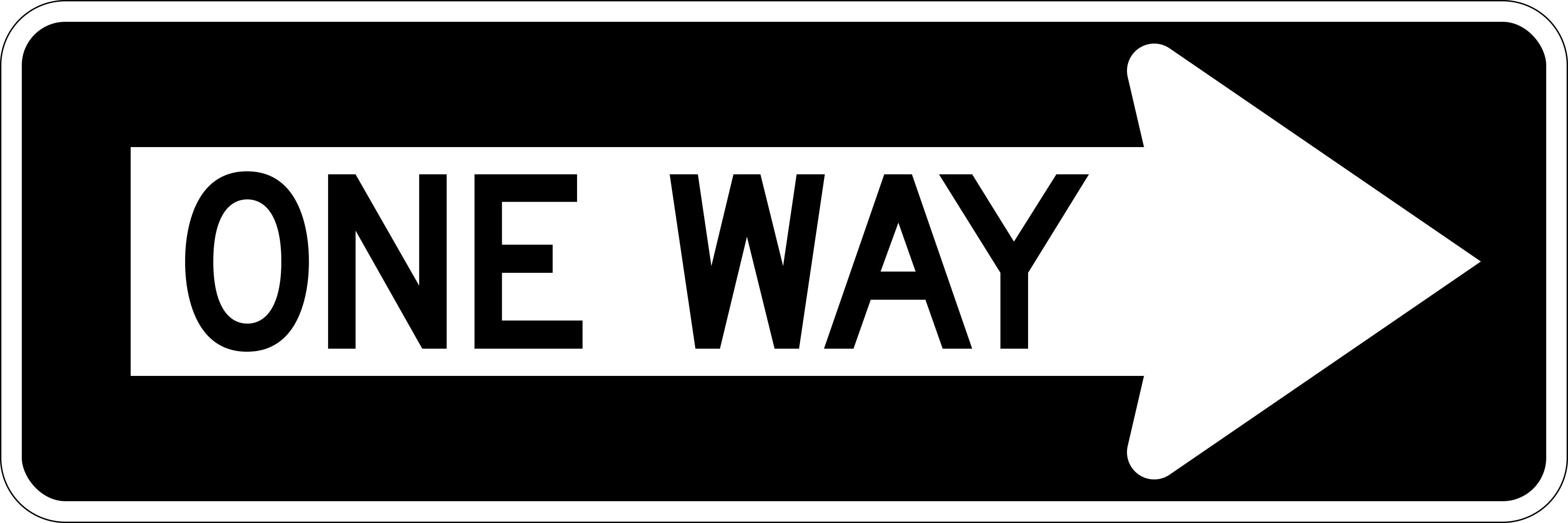
- Traffic alternates direction by time of day
- Traffic travels in the same direction in every lane
- Traffic may travel only toward a railroad crossing
- Traffic must turn around at the next intersection
Show answer
Traffic travels in the same direction in every lane. ONE WAY means every lane on that roadway carries traffic in the same direction shown by the arrow. It does not describe alternating traffic, a railroad approach, or a required turnaround. Before turning onto such a street, confirm that your entry follows the arrow and watch for pedestrians and cross traffic. A driver who enters against the indicated flow can meet vehicles head-on, even when the pavement looks wide enough for two directions. The arrow describes the roadway’s movement, not a temporary preference.
Study this in the handbook: Traffic sign shapes and colors
3. What action is prohibited by this sign?
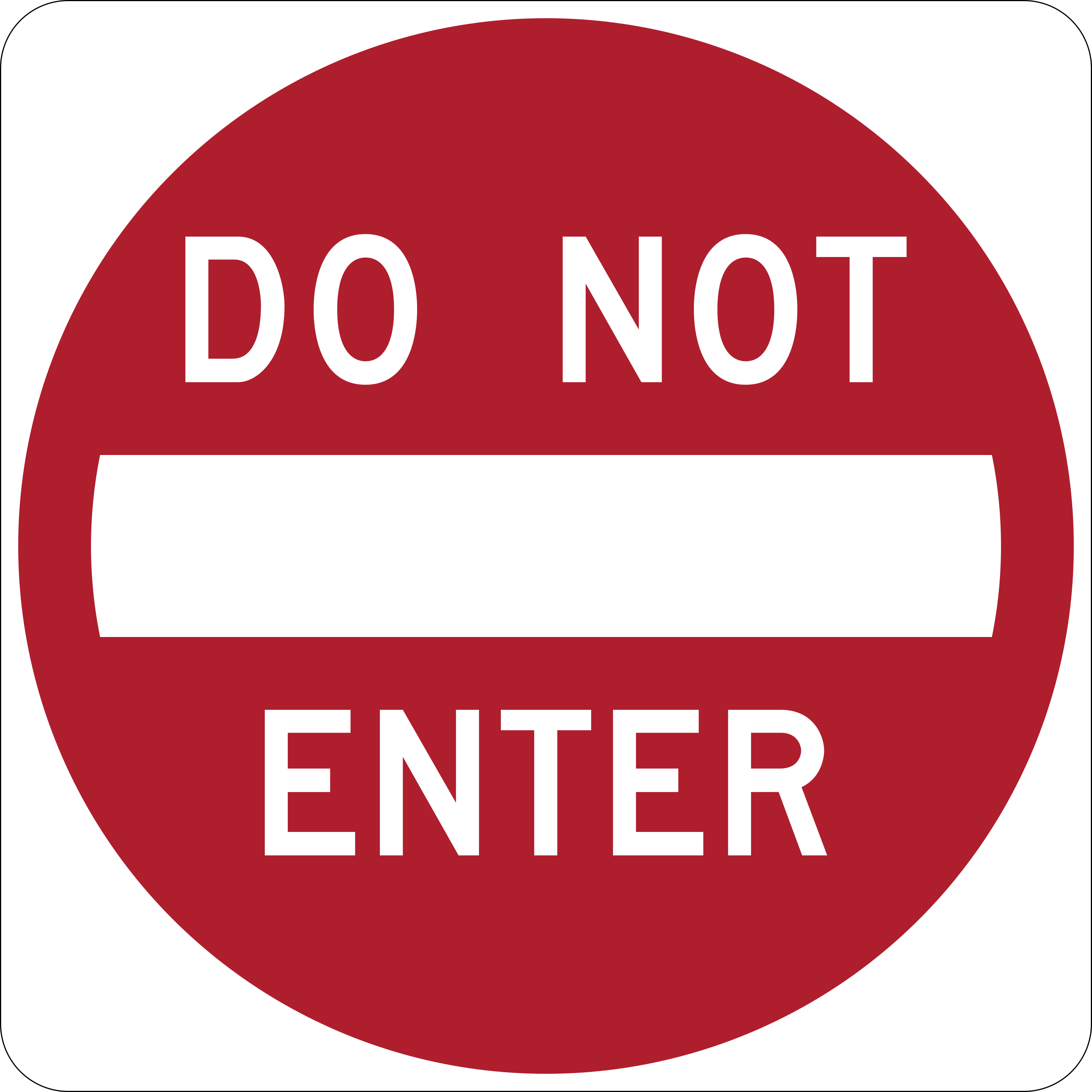
- Entering the posted area
- Stopping before you reach the sign
- Taking a different route
- Slowing down as you approach
Show answer
Entering the posted area. Michigan's sign chart describes DO NOT ENTER this way: you are not allowed to enter areas where this sign is posted. That is the only action the sign forbids. Stopping before the sign, slowing as you approach, and choosing another legal route are exactly what a driver should do when this sign appears. The same chart describes the separate WRONG WAY sign, which tells a driver who has already entered a lane of oncoming traffic to get out the safest and quickest way possible.
Study this in the handbook: Traffic sign shapes and colors
4. How long must a Michigan teen hold a Level 1 Learner's License before applying for driver education Segment 2?
- At least 30 days
- At least six months
- At least three consecutive months
- At least one year
Show answer
At least three consecutive months. Segment 2 enrollment needs two things: a log of at least 30 supervised hours with 2 at night, and a Level 1 license held for at least three consecutive months. Six months is the wait before the driving skills test and the Level 2 license, so it belongs to a later step. Thirty days is the minimum practice period for an adult temporary instruction permit, and one year is not a Michigan GDL waiting period. Segment 2 itself adds at least 6 hours of classroom instruction.
Study this in the handbook: Graduated Driver Licensing for teens
5. How far from a stop sign, traffic light or flashing beacon must a Michigan driver stay when parking?
- At least 30 feet
- At least 10 feet
- At least 15 feet
- At least 50 feet
Show answer
At least 30 feet. Parking within 30 feet of a stop sign, traffic light or flashing beacon, including a warning sign, is prohibited. A parked car closer than that can hide the sign or signal from approaching drivers. Fifteen feet is the hydrant distance and 50 feet is the railroad crossing distance, so those belong to other items on the list. Ten feet is well inside the 30 foot zone, so it does not meet the rule for these traffic control devices.
6. You reach a Michigan intersection with a Michigan Left. How do you turn left there?
- Turn left directly at the intersection on a green arrow
- Make a U-turn in the middle of the intersection
- Drive straight through the intersection, or turn right, then make a U-turn at a median crossover
- Turn left from the right lane after signaling
Show answer
Drive straight through the intersection, or turn right, then make a U-turn at a median crossover. A Michigan Left, also called an indirect left turn, does not allow the traditional left turn at the intersection. To turn left, you drive straight through the intersection, or turn right, and then make a U-turn at a median crossover. From the main highway that means continuing past the intersection and turning left into the crossover, then turning onto the other side of the highway. A single-lane crossover is meant for one vehicle at a time, and an unmarked median crossover should always be treated as a single-lane crossover.
Study this in the handbook: Pavement markings and traffic signals
7. Outside a work zone, how many points does Michigan assess for driving 16 mph or more over the legal speed limit?
- 2
- 3
- 6
- 4
Show answer
4. On the regular point chart, 16 mph or more over the limit is a four-point offense. Speeding 11 to 15 mph over costs three points, and six to 10 mph over costs two, so those amounts belong to smaller overages. Six points are for the most serious violations such as reckless driving and OWI. In a work zone the scale is higher, with five points for more than 15 mph over. Points stay on the record for two years.
Study this in the handbook: Your driving record, points and implied consent
8. Your light has just turned green, but vehicles are still in the intersection. What must you do?
- Go immediately, because green gives you the right of way
- Yield to the vehicles still in the intersection before proceeding
- Sound your horn so they clear the intersection faster
- Go only if the vehicles are turning left
Show answer
Yield to the vehicles still in the intersection before proceeding. A green light does not let you drive into vehicles that are still clearing the intersection. Michigan says that if vehicles are still in the intersection when the light changes, you must yield to them before proceeding. The handbook also describes a green light as permission to proceed with caution after checking for pedestrians and vehicles, so pulling out the instant the light changes skips that check. Honking does not create a right of way. Wait until the intersection is clear, then go.
Study this in the handbook: Right of way, pedestrians and roundabouts
9. A driver cuts through a corner store's parking lot to avoid waiting at a red light. Is this legal in Michigan?
- No, it is illegal to cross property to avoid a traffic-control device
- Yes, as long as the driver does not stop in the lot
- Yes, because the parking lot is private property
- Only if the store is closed
Show answer
No, it is illegal to cross property to avoid a traffic-control device. Michigan makes it illegal to drive across public or private property, such as a store parking lot, to avoid a traffic-control device. Cutting through a lot to skip a red light is exactly the situation the handbook describes, so the driver breaks the law whether or not the car stops in the lot. Private ownership of the lot does not make the shortcut legal, and the store's hours do not matter either. Traffic signals regulate the flow of traffic, so wait for your light.
Study this in the handbook: Pavement markings and traffic signals
10. What clean driving record must a Michigan teen have for GDL Level 3 eligibility?
- Six consecutive months with no parking ticket of any kind
- Twelve consecutive months without a moving violation, at-fault crash, suspension, or GDL restriction violation
- Twenty-four months with no insurance claim
- Three consecutive months with no nighttime driving
Show answer
Twelve consecutive months without a moving violation, at-fault crash, suspension, or GDL restriction violation. Michigan requires a teen seeking GDL Level 3 eligibility to drive for 12 consecutive months without a moving violation, an at-fault crash, a license suspension, or a violation of any GDL restriction. The six-month choice confuses the minimum time held at Level 2 with the separate clean-record period. Parking tickets, nighttime driving, and insurance claims are not the four conditions named in this requirement. Read the rule as a checklist: count twelve uninterrupted months, then check each listed event. A single event in one of those categories breaks the clean period described by the manual.
Study this in the handbook: Graduated Driver Licensing for teens
11. What happens to fines for moving violations committed in a Michigan work zone?
- They are doubled
- They are reduced by half
- They stay the same as outside the zone
- They are waived for the first offense
Show answer
They are doubled. Michigan doubles fines for all moving violations committed in work zones. The increased penalty applies to the moving violation, so it is not waived for a first offense, cut in half, or left unchanged merely because the driver is outside the active lane. Drivers should slow as directed, watch for workers and equipment, and follow the signs and traffic-control instructions around the work area. The cue is the marked construction zone: once inside it, treat ordinary impatience or speeding as carrying an enhanced financial consequence.
Study this in the handbook: Speed limits and work zones
12. Who must sit in the front seat beside a Michigan Level 1 learner driver?
- A licensed parent, guardian, or designated licensed adult age 21 or older
- Any passenger who has held a license for at least one year
- A driving instructor under age 18
- No accompanying adult is required after sunset
Show answer
A licensed parent, guardian, or designated licensed adult age 21 or older. A Level 1 learner may drive only with a licensed parent, guardian, or designated licensed adult who is at least 21 seated in the front seat. The general licensed-passenger choice leaves out the required relationship or age. Sunset does not remove supervision, and a teenager cannot substitute for the designated adult merely by having some driving experience. Picture the qualified adult beside the learner before the vehicle moves.
Study this in the handbook: Graduated Driver Licensing for teens
13. An adult in Michigan who has never been licensed gets a temporary instruction permit. How long must the person practice before the driving skills test?
- At least 7 days
- At least 90 days
- At least 180 days
- At least 30 days
Show answer
At least 30 days. Holders of a temporary instruction permit must complete at least 30 days of practice driving before taking the driving skills test. The permit itself is valid for 180 days, so 180 is the permit's life, not the practice minimum. Seven days is too short, and 90 days is not the stated period. Adult learners are also encouraged, though not required, to take an adult driver education course.
Study this in the handbook: Permits, tests, probation and renewal
14. A school bus has red overhead lights flashing on a divided highway. When is stopping not required?
- When your vehicle is traveling below 15 mph
- Whenever you are more than 20 feet away
- When a barrier separates the opposing traffic flows
- Whenever children are not visible
Show answer
When a barrier separates the opposing traffic flows. On a divided highway, a driver traveling on the opposite side does not have to stop when a barrier such as a concrete or grass median, island, or other structure separates the traffic flows. Vehicles traveling on the same side as the bus must stop at least 20 feet away when the red lights flash. Distance alone, low speed, or the absence of visible children does not remove the duty. Identify the physical divider first, then determine which side of the roadway your vehicle occupies.
Study this in the handbook: Emergency vehicles, Move Over and school buses
15. What must a driver do when a moving emergency vehicle displays flashing warning lights and sounds a siren?
- Pass it quickly before it reaches the next intersection
- Never pass it unless directed by the emergency vehicle driver or a law enforcement officer
- Follow it closely so other traffic can see you
- Stop beside it and wait for the siren to turn off
Show answer
Never pass it unless directed by the emergency vehicle driver or a law enforcement officer. Michigan prohibits passing a moving emergency vehicle that displays flashing warning lights unless the emergency vehicle driver or a law enforcement officer directs the driver to do so. Passing quickly is still passing and does not create an exception. Following closely can interfere with the emergency response, while stopping beside the vehicle creates another hazard. Reduce speed, keep a safe distance, and follow any lawful direction from the responder. The practical cue is to leave the emergency vehicle a clear path rather than trying to get around it.
Study this in the handbook: Emergency vehicles, Move Over and school buses
16. What does a solid yellow line on your side of the centerline require before passing?
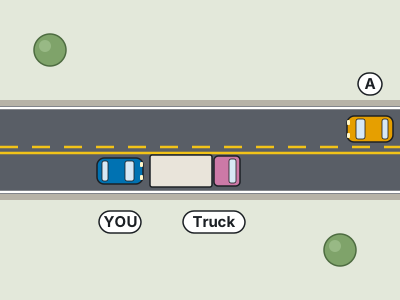
- Use it as a lane for turning left only
- Cross it whenever the road ahead is clear
- Do not cross it to pass
- Treat it as a broken white lane divider
Show answer
Do not cross it to pass. A solid yellow line on the driver’s side of the centerline marks a no-passing condition. The line is not an invitation to cross whenever a gap appears, and it is not equivalent to a broken white line, which separates same-direction lanes. A center lane reserved for left turns has its own markings and purpose. The important visual cue is the solid yellow line nearest your lane. Stay on your side until passing is permitted by the markings and roadway conditions. Do not confuse the limited situations for crossing a double yellow line, such as turning into a driveway, with permission to pass.
Study this in the handbook: Pavement markings and traffic signals
17. What should a driver do when approaching children near a school-zone crosswalk?
- Use the horn to make children leave the crosswalk
- Keep the posted speed and assume children will wait
- Yield and be especially cautious because children may dart into the street
- Pass a stopped vehicle that is yielding to the children
Show answer
Yield and be especially cautious because children may dart into the street. Drivers must yield to children near or in a school-zone crosswalk when school is in session and should be especially cautious because children may unexpectedly dart into the street. Maintaining speed assumes behavior that the manual warns you not to assume. A horn is not a substitute for yielding, and passing a vehicle stopped for a child can put you into the child's path. Slow early, scan around parked vehicles, and wait until the crossing is clear.
Study this in the handbook: Right of way, pedestrians and roundabouts
18. How many deaths a year does NHTSA attribute to distracted driving, according to the Michigan manual?
- About 100
- At least 3,400
- About 50,000
- About 1,000
Show answer
At least 3,400. The National Highway Traffic Safety Administration estimates at least 3,400 deaths annually from distracted driving crashes in which drivers lost focus due to manual, visual or cognitive distractions. Michigan's general cell phone law makes it illegal to use a handheld phone while driving, and Kelsey's Law bars GDL Level 1 and 2 teens from using a phone while driving except for emergencies. Preset the radio and playlist before driving.
Study this in the handbook: Phones, seat belts and child passengers
19. What minimum amount of classroom instruction makes up Michigan driver education Segment 2?
- 24 hours
- 10 hours
- 4 hours
- 6 hours
Show answer
6 hours. Segment 2 comes after a teen has driven on the Level 1 Learner's License for at least three consecutive months and logged at least 30 hours of supervised driving. The manual describes Segment 2 as a minimum of 6 hours of classroom instruction, followed by a state exam that must be passed with at least 70 percent. It is far shorter than Segment 1, which needs 24 classroom hours, because Segment 2 builds on the experience the teen has already gained behind the wheel.
Study this in the handbook: Graduated Driver Licensing for teens
20. An oncoming driver at night does not dim the high beams. Where does the Michigan manual say you should look?
- Directly at the oncoming headlights
- At the center line beside the oncoming car
- Into the rearview mirror until the car passes
- At the right edge of the road ahead
Show answer
At the right edge of the road ahead. Glare from an oncoming driver's high beams can blind you for several seconds, and a dirty windshield makes it worse. The Michigan manual says that if oncoming drivers do not dim their headlights, keep your eyes on the right edge of the road ahead and do not look directly into the lights. Following the edge line keeps you in your lane while your vision stays usable. Do not answer with your own high beams, which is illegal within 500 feet of an oncoming vehicle.
Study this in the handbook: Bad weather, stopping distance and night driving
Every question is written from the official What Every Driver Must Know (Michigan). Need paper? Printable MI practice test with answer key.
Last verified 2026-10-05. How we check every question · Study all 218 as flashcards
Frequently asked questions
How many questions are on this Michigan practice test?
This fixed set has 20 questions. It is test 6 of 10 from the 218 question Michigan bank.
How does this fixed test relate to the full Michigan bank?
Each numbered test is a fixed set of questions in a fixed order, so you can retake the same test later and compare. Every test mixes road signs and the other topics in about the same proportion as the full bank. Tests 1 to 10 together cover 200 of the 218 questions in the Michigan bank, each once. The full practice page mixes the whole bank at random.
Last verified 2026-10-05. See the Michigan DMV facts page for sourced state details.
Return to the full Michigan practice test · Study road signs