
Test 9 of 10 · 20 questions · Free 2026
MI Permit Practice Test 9
Jump to the test ↓A fixed 20 question set from the Michigan bank with answers and plain English explanations.
Question 1 of 20 · 0 right so far
All 20 questions in test 9
Every question below comes from the Michigan question bank on this page. Open a question to see the correct answer and the explanation. Nothing here is hidden behind a signup.
1. What fine does a Michigan adult driver face for a first offense of using a hand-held phone while driving?
- $25
- $100
- $250
- $500
Show answer
$100. Michigan's hand-held phone law covers reading, texting, and making or answering a call. A first offense carries a $100 fine, and later violations rise to $250, so $250 is the repeat amount rather than the first. Twenty-five dollars is too low, and $500 is the maximum fine listed for operating under the influence, not for phone use. Calls to report a crash, crime or other emergency are allowed. The fine for a second or later offense is two and a half times the first, a jump worth remembering for the test.
Study this in the handbook: Phones, seat belts and child passengers
2. How many points does a Michigan conviction for having an open alcohol container in a vehicle add?
- 3 points on the record
- 4 points on the record
- 6 points on the record
- 2 points on the record
Show answer
2 points on the record. An open alcohol container in the vehicle is listed among the two point violations, with six to 10 mph over the limit, a young driver refusing a preliminary breath test, and failure to yield or show due caution for emergency vehicles. Three points cover careless driving and running a stop sign or signal. Four points apply to impaired driving and drivers under 21 with bodily alcohol content, and six points cover drunk driving and chemical test refusal. Points stay on the record for two years from the date of conviction.
Study this in the handbook: Your driving record, points and implied consent
3. In which seating positions does Michigan require passengers younger than 16 to be buckled up?
- Only in the front seat
- Only in the rear seat
- Only on freeways
- In all seating positions
Show answer
In all seating positions. All passengers younger than 16 must be buckled in every seating position, front and rear. The front seat rule is broader in one way, since every front seat occupant must be buckled regardless of age. The idea that the rule applies only in the front or back seat is wrong, and it is not limited to freeways. Children under 8 or shorter than 4 feet 9 inches need an approved car seat or booster seat as well.
Study this in the handbook: Phones, seat belts and child passengers
4. Where should you expect this crossbuck, and what hazard does it identify?
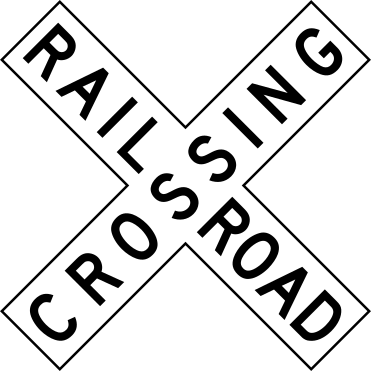
- At a freeway split with three exit lanes
- At a school crossing with three walking lanes
- At a railroad crossing with three train tracks
- At a work zone with three narrowed lanes
Show answer
At a railroad crossing with three train tracks. Michigan's sign chart describes this X-shaped RR Crossbuck as marking a railroad crossing consisting of three train tracks ahead. It is not a school, freeway, or construction marker. When you see devices that warn of railroad crossings and possible oncoming trains, slow down and be ready to stop. The manual adds that trains can take a mile or more to stop and that an approaching train is closer and moving faster than it appears, so never try to cross in front of one.
Study this in the handbook: Traffic sign shapes and colors
5. How many lives can one Michigan organ donor save, according to the manual?
- One life
- Up to 3 lives
- Up to 8 lives, and potentially heal up to 125 others
- Up to 50 lives
Show answer
Up to 8 lives, and potentially heal up to 125 others. Joining the Michigan Organ Donor Registry means that upon your death you agree to become an organ, eye and tissue donor to save up to 8 lives and potentially heal up to 125 others. The registration is a binding legal document known as first person authorization, so share your decision with loved ones. Up to 2,500 Michigan patients are waiting for a transplant.
6. A vehicle displays Michigan's slow-moving vehicle emblem. What does the emblem indicate?
- The vehicle must remain parked on the shoulder
- The vehicle is authorized to exceed the posted speed limit
- The vehicle is carrying hazardous materials
- The vehicle cannot move faster than 25 mph
Show answer
The vehicle cannot move faster than 25 mph. The orange triangle identifies a vehicle that travels no faster than 25 mph, including examples such as farm combines and other large agricultural or industrial vehicles. It is not a permit to drive above the limit, and it does not identify hazardous cargo. A driver approaching one should expect a substantial speed difference, reduce closing speed, and pass only when the roadway provides a legal and safe opportunity. Treat the emblem as an advance warning that the vehicle ahead may be slow and may need extra room to maneuver.
Study this in the handbook: Trucks, pedestrians, motorcycles and bicycles
7. Who is responsible for a parking ticket when a vehicle is parked illegally in Michigan?
- Only the person who was driving
- The nearest property owner
- The owner of the vehicle
- The vehicle manufacturer
Show answer
The owner of the vehicle. Michigan places responsibility for an illegal parking ticket on the vehicle owner. That remains true when the vehicle is leased, because the person leasing it is responsible in that situation. The driver-only choice overlooks the ownership rule, and a nearby property owner has no automatic responsibility for a vehicle parked on the street. The manufacturer is unrelated to a parking violation. When reviewing a parking citation, identify the vehicle owner or lessee rather than assuming the person who last moved the vehicle is always the liable party.
8. What does a red traffic light require before a Michigan driver proceeds?
- A complete stop
- A brief slowdown without stopping
- A lane change around the signal
- A turn through a parking lot to avoid it
Show answer
A complete stop. A red light requires the vehicle to come to a complete stop before proceeding. Slowing without stopping does not satisfy the signal, even if the intersection looks empty. Changing lanes cannot remove the duty to obey the traffic control, and crossing private property to avoid a signal is specifically identified as illegal. After stopping at the proper line or behind the crosswalk, check for the next lawful indication to move and watch for pedestrians and other traffic. The useful habit is to treat red as a firm stop command, not as a suggestion to reduce speed or find a route around the device.
Study this in the handbook: Pavement markings and traffic signals
9. According to the Michigan manual, what do a standard beer, wine, and whiskey serving have in common?
- They contain no alcohol when served with food
- Whiskey contains twice as much alcohol as beer
- They contain the same amount of alcohol
- Wine is the only serving that affects judgment
Show answer
They contain the same amount of alcohol. The manual compares a 12-ounce can of beer, a 5-ounce glass of wine, and a 1.5-ounce shot of whiskey and says each contains the same amount of alcohol. It adds that the effects of alcohol are the same whether you drink beer, wine or whiskey, and that a standard serving of any of these has the same effect on your body. Food does not make a serving alcohol-free, and the beverage type does not determine whether judgment is affected. Use the three portion sizes as a memory cue: can, glass, and shot.
Study this in the handbook: Alcohol, drugs and marijuana
10. What minimum age does Michigan set for a teen to apply for the driving skills test?
- 14 years, 9 months
- 16
- 17
- 15
Show answer
15. Michigan's graduated licensing ages are easy to confuse. A teen can start Segment 1 at 14 years and 8 months and get the Level 1 Learner's License at 14 years and 9 months. The driving skills test can be requested at age 15, provided the teen has completed Segment 2, logged 50 supervised hours with 10 at night, and held the Level 1 license for at least six months. The Level 2 Intermediate License then requires age 16, and the Level 3 Full License age 17.
Study this in the handbook: Graduated Driver Licensing for teens
11. How many points does Michigan add to a driving record for a drag racing conviction?
- 2 points
- 4 points
- 3 points
- 6 points
Show answer
4 points. Drag racing heads Michigan's four point list in the driving record chapter. Other four point offenses include impaired driving, a driver younger than 21 with any bodily alcohol content, and driving 16 mph or more over the legal speed limit. Because points stay on a record for two years and 12 points in that period can lead to a reexamination, a single drag racing conviction uses up a third of that total. Racing on public roads also endangers everyone nearby.
Study this in the handbook: Your driving record, points and implied consent
12. Once railroad crossing lights and gates activate, about how long does the Michigan manual say you have before the train arrives?
- About 5 seconds
- About 2 minutes
- About 20 seconds
- About 60 seconds
Show answer
About 20 seconds. Crossing lights, gates and a train's horn give only a short warning. The Michigan manual says that once the lights and gates activate, or you hear the horn of an approaching train, you have about 20 seconds before the train arrives. That is why you should never stop on the tracks. If your vehicle is stuck when the warning starts, those seconds are for getting everyone out and away from the tracks, not for restarting the engine.
Study this in the handbook: Railroad crossings
13. How many traffic crashes were reported in Michigan in 2023, and how many were fatal?
- 287,953 crashes, of which 1,021 were fatal
- About 1 million crashes, 5,000 fatal
- About 50,000 crashes, 100 fatal
- About 10,000 crashes, 50 fatal
Show answer
287,953 crashes, of which 1,021 were fatal. According to Michigan State Police Traffic Crash Facts for 2023, 287,953 traffic crashes were reported, of which 1,021 were fatal and 51,097 resulted in personal injuries. Of the fatal crashes, 272, or 26.6 percent, were alcohol involved, with at least one drinking operator, bicyclist, or pedestrian. The same list notes that licensed drivers ages 15 to 20 made up 6.6 percent of the driving population but 10.1 percent of drivers in all crashes. The manual places these facts before its safe driving chapters.
14. What does a yield line indicate at a Michigan mid-block crosswalk?
- The point where drivers may accelerate past pedestrians
- The place where parking becomes permitted
- The boundary where bicycles must leave the roadway
- The location where drivers should stop for pedestrians
Show answer
The location where drivers should stop for pedestrians. At a mid-block crosswalk, Michigan may use a yield line to show where drivers should stop for pedestrians in the crossing. The line marks a stopping location, not a place to speed up or a boundary for bicycles. It also does not create a parking area. Approach slowly, scan for people, and stop before the line when a pedestrian is crossing or preparing to cross. The practical cue is the white yield marking paired with the crosswalk: it identifies the point where the vehicle should wait and yield.
Study this in the handbook: Trucks, pedestrians, motorcycles and bicycles
15. Under Michigan’s Basic Speed Law, may a driver exceed the posted speed limit when conditions seem favorable?
- Yes, by up to 5 mph
- No, the careful speed is never faster than the posted limit
- Yes, if traffic is moving faster
- Only on a freeway
Show answer
No, the careful speed is never faster than the posted limit. Michigan’s Basic Speed Law does not turn favorable weather or a fast traffic stream into permission to exceed a posted limit. The manual says the careful speed is never faster than that posted limit, and it may need to be slower when visibility, pavement, or traffic conditions demand more control. The five-mph and faster-traffic choices invent an allowance, while the freeway choice incorrectly limits the rule to one road type. Treat a posted speed as an upper boundary, then reduce speed whenever stopping within the clear distance ahead would otherwise be difficult.
Study this in the handbook: Phones, seat belts and child passengers
16. According to the 2023 Michigan crash facts in the driver manual, how many crashes resulted from a driver, pedestrian or bicyclist using a cell phone?
- About 100
- 2,284
- About 500
- About 50,000
Show answer
2,284. In 2023 a total of 2,284 Michigan crashes resulted from a driver, pedestrian or bicyclist using a cell phone, and vehicle deer crashes injured 1,725 people and killed 19, eleven of them motorcyclists. Michigan bans handheld phone use for all drivers, and about 60,000 deer crashes happen each year, half of them likely unreported, so watch the road edges at dawn and dusk.
17. What must a driver do when facing a solid red left-turn arrow?
- Stop and wait until the signal changes
- Turn after yielding to oncoming traffic
- Continue straight through the turn lane
- Turn if the vehicle behind begins moving
Show answer
Stop and wait until the signal changes. A solid red left-turn arrow prohibits the turn until the signal changes. The driver must stop rather than treating the arrow like a permissive turn or relying on a gap in oncoming traffic. A vehicle behind you cannot authorize movement, and continuing straight from a turn lane is not the signal's instruction. Remain stopped, watch the signal head, and make the turn only when a permitted indication appears and the path is clear.
Study this in the handbook: Pavement markings and traffic signals
18. What does the narrowing lane symbol require you to anticipate?

- A new right lane will open for passing
- The right lane is ending and you should prepare to merge left
- The left lane is ending and all traffic must stop
- The right lane is reserved for emergency vehicles
Show answer
The right lane is ending and you should prepare to merge left. This warning identifies an ending right lane and tells you to prepare to merge left. It does not promise an added passing lane, end the left lane, or reserve the lane for emergency vehicles. Check the adjacent lane early, signal your intention, and merge only when a safe opening is available. Avoid waiting until the boundary disappears because late movements can force other drivers to brake. Continue obeying the lane markings and any temporary instructions posted near the narrowing roadway.
Study this in the handbook: Traffic sign shapes and colors
19. Unless signs say otherwise, which of these is a place where Michigan law says you must never park?
- On or under a bridge
- 25 feet from a fire hydrant
- 60 feet from the nearest rail of a railroad crossing
- On a residential street at night
Show answer
On or under a bridge. Michigan's list of no parking laws covers many places where a parked vehicle would block traffic or emergency access. One entry is on or under a bridge, unless a sign allows it, along with overpasses and tunnels, where a stopped car narrows the road and leaves drivers little room to avoid it. Distance rules on the same list are measured precisely, such as 15 feet from a hydrant and 50 feet from the nearest rail, so parking beyond those distances is allowed.
20. What does a Pass With Care sign mark?
- The end of a no-passing zone
- A school crossing for children
- A railroad crossing ahead
- A lane reserved for emergency vehicles
Show answer
The end of a no-passing zone. Michigan explains that the Pass With Care sign follows a Do Not Pass sign and marks the end of a no-passing zone. It indicates that passing may resume only when the maneuver is safe and lawful. It does not identify a railroad crossing, a school crossing, or an emergency-only lane. Even after the restriction ends, check sight distance, lane markings, and oncoming traffic before moving left. The sign gives the location of the zone’s end, not a command to pass immediately.
Study this in the handbook: Traffic sign shapes and colors
QualitySpace is expanding to Michigan
We are a California-based independent insurance brokerage working on licensing in more states. We cannot help with Michigan insurance yet. Leave your email and we will let you know when we can.
Every question is written from the official What Every Driver Must Know (Michigan). Need paper? Printable MI practice test with answer key.
Last verified 2026-10-05. How we check every question · Study all 218 as flashcards
Frequently asked questions
How many questions are on this Michigan practice test?
This fixed set has 20 questions. It is test 9 of 10 from the 218 question Michigan bank.
How does this fixed test relate to the full Michigan bank?
Each numbered test is a fixed set of questions in a fixed order, so you can retake the same test later and compare. Every test mixes road signs and the other topics in about the same proportion as the full bank. Tests 1 to 10 together cover 200 of the 218 questions in the Michigan bank, each once. The full practice page mixes the whole bank at random.
Last verified 2026-10-05. See the Michigan DMV facts page for sourced state details.
Return to the full Michigan practice test · Study road signs