
Key points
Trains can take a mile or more to stop, and an approaching train is closer and moving faster than it appears.
Source: Handbook p. 35
“Trains can take a mile or more to stop, and an approaching train is closer and moving faster than it appears.”
What Every Driver Must Know, Handbook p. 35If a train is coming, stop no more than 50 feet and no less than 15 feet from the tracks.
Source: Handbook p. 35
“If a train is coming, all vehicles must stop no more than 50 feet or less than 15 feet from the tracks.”
What Every Driver Must Know, Handbook p. 35Trains overhang the tracks by at least 3 feet on each side.
Source: Handbook p. 35
“Trains overhang the tracks by at least three feet on each side and may have cargo that extends even farther.”
What Every Driver Must Know, Handbook p. 35If there is a stop sign at the crossing, you must stop whether or not a train is in sight.
Source: Handbook p. 36
“If there is a stop sign at the crossing, you must stop whether or not a train is in sight.”
What Every Driver Must Know, Handbook p. 36Do not drive through, around or under any activated crossing system.
Source: Handbook p. 36
“Do not drive through, around or under any activated railroad crossing system.”
What Every Driver Must Know, Handbook p. 36Never cross unless your vehicle can clear the far side of the tracks by at least 6 feet.
Source: Handbook p. 36
“never cross the tracks unless there is enough space for your vehicle to completely clear the far side of the tracks by at least 6 feet.”
What Every Driver Must Know, Handbook p. 36Once lights and gates activate or you hear the horn, you have about 20 seconds before the train arrives.
Source: Handbook p. 36
“Once railroad crossing lights and gates are activated, or you hear the horn of an approaching train, you have about 20 seconds before the train arrives.”
What Every Driver Must Know, Handbook p. 36If you are stuck and a train is coming, get everyone out and far from the tracks, then call 911.
Source: Handbook p. 36
“If the crossing gates are activated, or a train is clearly approaching, IMMEDIATELY get everyone out of the vehicle and as far away from the tracks as possible. Call 911.”
What Every Driver Must Know, Handbook p. 36The blue Emergency Notification System sign lists a phone number and the crossing's US DOT number.
Source: Handbook p. 37
“An Emergency Notification System (ENS) sign, posted at or near a highway-rail grade crossing, lists a telephone number along with the crossing’s US DOT number”
What Every Driver Must Know, Handbook p. 37
Numbers to know
| Number | What it means | Manual |
|---|---|---|
| 15 to 50 feet | where to stop from the tracks when a train is coming | Handbook p. 35 |
| 3 feet | how far trains overhang each side of the tracks | Handbook p. 35 |
| 6 feet | clearance past the far rail before you cross | Handbook p. 36 |
| 20 seconds | warning time after lights, gates or horn | Handbook p. 36 |
| 911 | number to call when stuck on the tracks | Handbook p. 36 |
Recognize these signs

Railroad crossing ahead 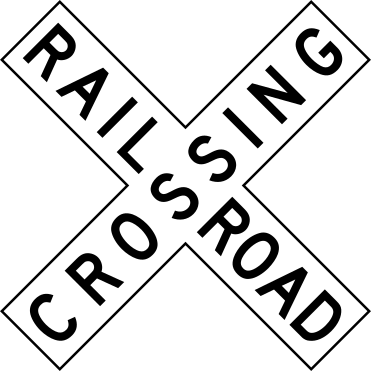
Railroad crossbuck
3 questions from the Michigan practice test
1. If a train is coming at a Michigan railroad crossing, where must vehicles stop?
- On the tracks until the train passes
- Exactly 10 feet from the nearest rail
- At least 100 feet from the crossing in every case
- No more than 50 feet and no less than 15 feet from the tracks
Show answer
No more than 50 feet and no less than 15 feet from the tracks. When a train is coming, Michigan places the stopping range between 15 feet and 50 feet from the tracks. Ten feet is too close, while 100 feet is not the stated universal requirement. Remaining on the rails is dangerous and unlawful. Slow as you approach, watch both directions, and stop within the marked safe range before the crossing. Never enter unless the vehicle can clear every track completely.
2. What should a Michigan driver do when seeing devices that warn of railroad crossings and possible oncoming trains?
- Speed up to cross before a train appears
- Slow down and be ready to stop
- Stop only when a gate is already down
- Ignore the devices if no train is visible
Show answer
Slow down and be ready to stop. The railroad warning is an early cue to reduce speed and prepare to stop. Waiting for a gate to lower or a train to become visible can leave too little time to respond, while speeding up increases the danger at the crossing. Ignoring the devices treats a warning as if it had no legal or safety purpose. Slow down, scan both directions, and obey any stop sign, flashing signal, or gate before entering the tracks.
3. What devices are used at passive railroad crossings to alert drivers to look for trains?
- Flashing lights and gates that activate for every approaching train
- Advance warning signs, pavement markings, and crossbuck signs with yield or stop signs
- Only green route markers and lane arrows
- A single emergency notification sign with no crossing control
Show answer
Advance warning signs, pavement markings, and crossbuck signs with yield or stop signs. Passive railroad crossings lack flashing lights and gates, so they use advance warning signs, pavement markings, and crossbuck signs with yield or stop signs. Those devices tell drivers to look for trains and to slow down or stop as needed. Flashing lights and gates describe active control systems, not passive ones. Route markers do not control a rail crossing, and an emergency notification sign is for reporting a problem rather than directing ordinary crossing movement. Check both directions and confirm every track is clear before proceeding.
Practice this topic
Lock it in with road signs questions from the free Michigan practice test. Every answer comes with a plain English explanation.
Source: the What Every Driver Must Know, Chapter 4: Traffic Laws. This lesson is a plain English summary, not the law itself; where it differs, the manual and the statute govern. Last checked 2026-09-27.