
Key points
When an emergency vehicle approaches with red and blue lights and siren, pull to the edge of the road clear of intersections, stop, and remain there until it has passed.
Source: Handbook p. 28
“Pull over to the edge of the roadway or highway, clear of intersections and stop. • Remain there until the emergency vehicle has passed.”
What Every Driver Must Know, Handbook p. 28For a stopped emergency vehicle, slow at least 10 mph below the limit and move over a lane if you can.
Source: Handbook p. 28
“The law requires you to slow down at least 10 mph below the posted speed limit and move over a lane if traffic and conditions allow.”
What Every Driver Must Know, Handbook p. 28Violating the Move Over law is a civil infraction, but a felony if you injure or kill emergency personnel.
Source: Handbook p. 28
“A civil infraction, unless you injure or kill emergency personnel, then the charge is a felony.”
What Every Driver Must Know, Handbook p. 28Stay at least 500 feet behind a moving emergency vehicle with flashing lights and siren.
Source: Handbook p. 28
“Stay at least 500 feet behind any moving emergency vehicle displaying flashing warning lights and sounding a siren.”
What Every Driver Must Know, Handbook p. 28Never pass a moving emergency vehicle with flashing lights unless its driver or an officer directs you to.
Source: Handbook p. 28
“Never pass a moving emergency vehicle displaying flashing warning lights unless directed to do so by the emergency vehicle driver or a law enforcement officer.”
What Every Driver Must Know, Handbook p. 28Stop at least 20 feet from a school bus with its red overhead lights flashing.
Source: Handbook p. 28
“Stop at least 20 feet from a school bus with its red overhead lights flashing; it is picking up or dropping off passengers.”
What Every Driver Must Know, Handbook p. 28You need not stop for a school bus on the other side of a highway divided by a barrier or median.
Source: Handbook p. 28
“It is not necessary to stop for a school bus stopped on the other side of a highway divided by a barrier such as a concrete or grass median”
What Every Driver Must Know, Handbook p. 28When a school bus's yellow hazard lights are flashing, proceed with caution.
Source: Handbook p. 29
“When the YELLOW hazard lights are flashing, proceed with caution.”
What Every Driver Must Know, Handbook p. 29Fines for failing to stop for a school bus are double the normal amount.
Source: Handbook p. 28
“Fines for failing to stop for a school bus are double what would normally be assessed for a moving violation.”
What Every Driver Must Know, Handbook p. 28
Numbers to know
| Number | What it means | Manual |
|---|---|---|
| 10 mph | how far below the limit to slow for a stopped emergency vehicle | Handbook p. 28 |
| 500 feet | distance to stay behind a moving emergency vehicle | Handbook p. 28 |
| 20 feet | minimum stopping distance from a school bus with flashing red lights | Handbook p. 28 |
Recognize these signs
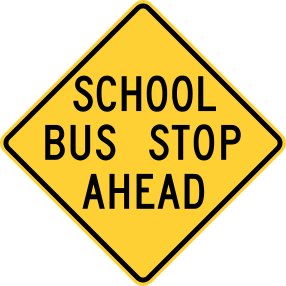
School bus stop ahead
3 questions from the Michigan practice test
1. What is the required response when an emergency vehicle approaches with flashing red or blue lights and a siren?
- Continue straight because the emergency vehicle can pass anywhere
- Move close to the right edge, clear the intersection, and stop
- Turn left across traffic to create a wider gap
- Stop immediately in the middle of the intersection
Show answer
Move close to the right edge, clear the intersection, and stop. The driver should move as close as possible to the right edge or curb, get clear of the intersection, and stop until the emergency vehicle passes or an officer signals that movement may resume. Continuing straight can block the response path, and stopping in the intersection leaves the vehicle where cross traffic and the emergency vehicle may need to travel. A sudden left turn across traffic creates a new conflict instead of clearing one. Check mirrors, signal the move when possible, and keep the vehicle stopped until the response has passed. More than one emergency vehicle may be following, so do not move at the first opening.
2. When passing a stopped emergency vehicle, what speed reduction is required if you cannot move over?
- At least 10 mph below the posted speed limit
- The full posted limit with hazard lights on
- Exactly 5 mph below the posted speed limit
- Any speed above the limit if the lane is clear
Show answer
At least 10 mph below the posted speed limit. If traffic or conditions prevent a lane change away from a stopped emergency vehicle, Michigan requires the driver to slow at least 10 mph below the posted limit and leave as much room as possible. Turning on hazard lights does not replace the speed reduction, and an open-looking lane does not permit exceeding the limit. The preferred response remains moving over when safe. If that cannot happen, ease off early, hold a predictable line, and give responders the widest practical buffer while passing.
3. A school bus has red overhead lights flashing on a divided highway. When is stopping not required?
- When your vehicle is traveling below 15 mph
- Whenever you are more than 20 feet away
- When a barrier separates the opposing traffic flows
- Whenever children are not visible
Show answer
When a barrier separates the opposing traffic flows. On a divided highway, a driver traveling on the opposite side does not have to stop when a barrier such as a concrete or grass median, island, or other structure separates the traffic flows. Vehicles traveling on the same side as the bus must stop at least 20 feet away when the red lights flash. Distance alone, low speed, or the absence of visible children does not remove the duty. Identify the physical divider first, then determine which side of the roadway your vehicle occupies.
Practice this topic
Lock it in with emergencies questions from the free Michigan practice test. Every answer comes with a plain English explanation.
Source: the What Every Driver Must Know, Chapter 4: Traffic Laws. This lesson is a plain English summary, not the law itself; where it differs, the manual and the statute govern. Last checked 2026-09-27.