
Test 10 of 10 · 20 questions · Free 2026
MI Permit Practice Test 10
Jump to the test ↓A fixed 20 question set from the Michigan bank with answers and plain English explanations.
Question 1 of 20 · 0 right so far
All 20 questions in test 10
Every question below comes from the Michigan question bank on this page. Open a question to see the correct answer and the explanation. Nothing here is hidden behind a signup.
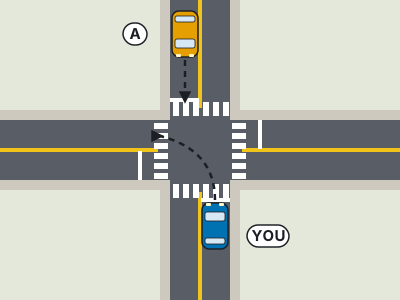
1. Before turning left on a green light, what must you wait for?
- Oncoming traffic to clear
- Every vehicle behind you to stop
- A flashing red signal to appear
- The road to become one-way
Show answer
Oncoming traffic to clear. A green light permits movement, but it does not give a left-turning driver priority over oncoming traffic. Michigan says the turn may be made once all oncoming traffic has cleared. Pedestrians and other traffic at the intersection also remain part of the safety check. Waiting for every vehicle behind you is unnecessary, while a flashing red signal or a one-way conversion is not required. Keep the front wheels straight while waiting, watch the opposing approach, and turn only when the path is open.
Study this in the handbook: Right of way, pedestrians and roundabouts
2. What should you do first if confronted by an aggressive driver?
- Make an angry gesture so the driver knows you are not intimidated
- Follow the driver closely to record the license plate
- Stop in the traffic lane and argue through the window
- Get out of the way, avoid eye contact, and ignore gestures or verbal attacks
Show answer
Get out of the way, avoid eye contact, and ignore gestures or verbal attacks. An encounter with an aggressive driver should be defused by creating space and refusing to participate in the confrontation. Move out of the way when possible, avoid eye contact, and ignore gestures or verbal attacks, and if it is safe to do so, call the police and report the driver. An angry response can provoke more dangerous behavior. Following closely keeps you involved and adds a collision risk, while stopping in a travel lane exposes you and other drivers to a rear end crash. Your first priorities are distance, control, and avoiding an exchange that can escalate.
Study this in the handbook: Aggressive driving, intersections and freeways
3. What maximum penalty can a Michigan driver face for a 3-point moving violation in a work zone that causes a person's death?
- Three points only
- A $100 civil fine and nothing more
- A felony with a fine up to $7,500, up to 15 years in prison, or both
- A 30 day suspension
Show answer
A felony with a fine up to $7,500, up to 15 years in prison, or both. Michigan law treats a moving violation carrying at least 3 points that causes a death in a work zone or school bus zone as a felony punishable by a fine of up to $7,500, up to 15 years in prison, or both. If the same violation causes injury rather than death, it is a misdemeanor with up to a $1,000 fine, up to 1 year in jail, or both. Fines for any moving violation in a work zone are doubled. Slow down, keep following distance, and merge as the signs direct when a lane closes.
4. What should you do when a steady yellow traffic light appears before you enter an intersection?
- Accelerate so the light cannot turn red first
- Stop, unless stopping cannot be done safely
- Continue at the same speed without checking traffic
- Reverse to the last intersection
Show answer
Stop, unless stopping cannot be done safely. A steady yellow signal warns that the light is about to turn red, so the normal response is to stop. If an abrupt stop would be unsafe because you are already too close, continue cautiously through the intersection without increasing speed. Accelerating turns a warning into a rushed maneuver, while reversing creates a new hazard. Look at your distance and speed, then choose the safe stopping response before the signal changes.
Study this in the handbook: Pavement markings and traffic signals
5. Before turning right, what should a driver look for behind the vehicle?
- Only a vehicle already stopped ahead
- Bicyclists riding from behind on the road shoulder or in a bike lane
- A vehicle parked on the opposite shoulder
- Only a pedestrian on the sidewalk
Show answer
Bicyclists riding from behind on the road shoulder or in a bike lane. Before a right turn, scan behind the vehicle for bicyclists on the shoulder or in a bike lane. A rider can be approaching from a position that is easy to miss, especially near a driveway or intersection. Looking only for a stopped vehicle or a person on the sidewalk leaves the bicycle conflict unchecked. If a bicyclist is present, yield and let the rider pass before turning. Signal, slow down, and make the turn only after the side and rear path are clear.
Study this in the handbook: Trucks, pedestrians, motorcycles and bicycles
6. If another driver tailgates you while you are using the left lane to pass, what is the safest response when possible?
- Move back into the right-hand lane and let the faster traffic move ahead
- Brake sharply so the other driver must stop
- Stay in the left lane and match the tailgater's speed
- Race the other driver to the next intersection
Show answer
Move back into the right-hand lane and let the faster traffic move ahead. Michigan's manual treats tailgating as an aggressive-driver behavior and advises moving back into the right-hand lane when it is safe, allowing faster traffic to move ahead. That gives the impatient driver space and reduces the chance of a risky passing maneuver around you. Sudden braking could cause a rear-end crash. Matching speed keeps the conflict beside or behind you, and racing adds another dangerous decision. The cue is to create separation, avoid proving a point, and let the aggressive vehicle get in front where you can see it.
Study this in the handbook: Aggressive driving, intersections and freeways
7. What does it cost to take Michigan's written knowledge test online at home?
- A $6.50 convenience fee
- $25
- It is free
- $50
Show answer
A $6.50 convenience fee. The written knowledge test is given at Secretary of State offices at no charge, and you also have the option of taking an online version at home on your own computer or laptop for a $6.50 convenience fee. After passing the written and vision tests and paying the fee, a temporary instruction permit valid for 180 days is issued for supervised practice.
Study this in the handbook: Permits, tests, probation and renewal
8. What does an orange Michigan traffic sign indicate?
- A route direction to a destination
- A railroad crossing is ahead
- Construction or maintenance crews are working in the area
- A service or hospitality location
Show answer
Construction or maintenance crews are working in the area. An orange sign warns that construction or maintenance crews are working in the area, so drivers should proceed with care and expect changing conditions. The railroad choice belongs to railroad warning devices, while route directions use a different sign purpose. Service or hospitality information also describes another color category. Orange should prompt a slower, more attentive approach, especially near lane shifts, workers, equipment, or temporary traffic controls. Read the full sign and follow any cones, flaggers, or posted instructions around the work area.
Study this in the handbook: Traffic sign shapes and colors
9. What does Michigan say about the color of a traffic sign?

- Its color identifies the nearest town
- Its color sets the vehicle’s tire pressure
- Its color carries meaning
- Its color tells drivers the sign’s installation date
Show answer
Its color carries meaning. Michigan says that a traffic sign’s color carries meaning. Color is one part of the sign’s message, alongside its shape, wording, and symbol. The color does not identify the nearest town, set tire pressure, or reveal when the sign was installed. Use color as an initial cue, then read the rest of the sign and respond to the rule or warning shown. For example, the manual associates red with stop or prohibited actions, green with directions and guidance, and yellow with caution or a general warning.
Study this in the handbook: Traffic sign shapes and colors
10. What change in traffic should you anticipate at this sign?

- Traffic merges from the right
- Traffic is prohibited from entering from the right
- Traffic must leave through the next right exit
- Traffic becomes two-way immediately
Show answer
Traffic merges from the right. The merging-traffic symbol warns that vehicles will join the roadway from the right. Give yourself time to check mirrors, adjust speed, and create a safe gap without blocking or cutting off the entering traffic. The sign does not require an exit, prohibit vehicles from the right, or announce two-way travel. A driver already on the road should remain predictable and cooperate with the merge. Watch for a changing lane boundary and follow any additional arrows, barrels, or pavement markings.
Study this in the handbook: Traffic sign shapes and colors
11. Under Michigan law, a child left in a vehicle is not left unattended if supervised by someone of what minimum age?
- 10
- 13
- 16
- 18
Show answer
13. It is illegal to leave a child younger than 6 unattended in a vehicle when the time or circumstances pose an unreasonable risk of harm. A parent is not violating the law if the child is supervised by someone age 13 or older who is not legally incapacitated. Ten is too young. Sixteen and eighteen set a higher bar than the law does. The manual still warns that it is never safe to leave children or pets alone in a car.
Study this in the handbook: Phones, seat belts and child passengers
12. A 19-year-old Michigan driver refuses a Preliminary Breath Test at the roadside. How many points does that refusal carry?
- Zero, because the test is voluntary
- Two points
- Four points
- Six points
Show answer
Two points. For a driver younger than 21, refusing the Preliminary Breath Test is a two-point violation. It sits in the same group as six to 10 mph over the limit and an open alcohol container. Six points apply to refusing the chemical alcohol test, a separate test from the roadside one. Four points apply to actually driving under 21 with any bodily alcohol content. Calling the refusal free of consequences is wrong, since the point chart lists it.
Study this in the handbook: Your driving record, points and implied consent
13. What minimum score must a Michigan student earn on the Segment 1 and Segment 2 state driver education exams?
- 70 percent
- 60 percent
- 80 percent
- 90 percent
Show answer
70 percent. Both Michigan driver education exams use the same pass mark: a minimum of 70 percent. Segment 1 also requires at least 24 classroom hours, six hours behind the wheel and four hours of observation, while Segment 2 adds six classroom hours. Sixty percent would be a failing score. Eighty and ninety percent are higher than the state requires, so a student who scores 75 percent still passes the segment exam.
Study this in the handbook: Graduated Driver Licensing for teens
14. What should a driver do when approaching a stopped road maintenance vehicle with flashing lights?
- Sound the horn and force the vehicle onto the shoulder
- Pass at the posted speed without changing position
- Stop in the opposing lane to wait for instructions
- Proceed cautiously and be ready to yield
Show answer
Proceed cautiously and be ready to yield. Highway workers and stopped maintenance vehicles create a changing hazard, so the driver must approach with caution and be ready to yield. Passing at the posted speed ignores the reduced space and possible workers, equipment, or traffic shifts around the vehicle. Stopping in the opposing lane can create a head-on hazard, and using the horn to force a path is not a safe substitute for slowing and observing. Reduce speed, scan around the vehicle, and follow signs, cones, or personnel directions. The flashing lights are a cue that ordinary lane assumptions may no longer describe the safe route.
Study this in the handbook: Right of way, pedestrians and roundabouts
15. Why must drivers allow more time and space when roads are covered with snow or ice?
- The posted limit automatically increases stopping distance by law
- Slippery conditions reduce available stopping power
- Dry pavement gives less control than ice
- Snow and ice make brakes work faster
Show answer
Slippery conditions reduce available stopping power. Snow and ice reduce traction, so a vehicle cannot stop as effectively as it can on dry, clear pavement. That loss of stopping power is why the driver should slow gradually, increase space, and avoid sudden steering or braking. The posted speed limit does not become a formula for stopping distance, and dry pavement generally provides more control than a slippery surface. Brakes do not work faster on ice. Begin slowing earlier than usual and leave enough room for the vehicle to continue sliding if traction is poor.
Study this in the handbook: Bad weather, stopping distance and night driving
16. Your vehicle is stuck on railroad tracks in Michigan and the crossing gates have come down. What should you do?
- Keep trying to restart the engine
- Stay inside with seat belts fastened
- Try to push the vehicle off the tracks
- Get everyone out at once, move far from the tracks, then call 911
Show answer
Get everyone out at once, move far from the tracks, then call 911. When gates are down or a train is clearly approaching, there may be only about 20 seconds left. The Michigan manual says to immediately get everyone out of the vehicle and as far away from the tracks as possible, then call 911. A vehicle can be replaced, people cannot. If the gates are not activated and no train is in sight, the manual still says to get everyone out first, then call the railroad emergency number on the blue Emergency Notification Sign.
Study this in the handbook: Railroad crossings
17. When may a Michigan GDL 1 or GDL 2 teen use a phone while driving?
- Only while stopped at a red light
- Whenever the phone is mounted to the dashboard
- Whenever the call lasts less than one minute
- Only for an emergency
Show answer
Only for an emergency. Kelsey's Law bars teens with a GDL 1 or GDL 2 from making or receiving non-emergency phone calls, so an emergency is the narrow exception described here. Mounting the device does not broaden that teen rule. A short call and a red light do not turn ordinary phone use into an emergency. For this question, identify the license level first, then apply the exception.
Study this in the handbook: Phones, seat belts and child passengers
18. When the area is marked, how far from a fire station driveway on the opposite side of the street must a Michigan driver stay when parking?
- 15 feet
- 20 feet
- 75 feet
- 50 feet
Show answer
75 feet. Fire engines leaving a station need room on both sides of the road, so Michigan sets two distances. On the same side as the station, parking within 20 feet of the driveway is not allowed. On the other side of the street, when the area is marked, the no parking zone extends to 75 feet from the driveway. Watch for signs or curb markings near fire stations, and remember that the opposite side distance is the larger of the two.
19. Outside a work zone, how many points does Michigan assess for driving 11 to 15 mph over the legal speed limit?
- 2 points
- 4 points
- 6 points
- 3 points
Show answer
3 points. Michigan's point schedule grows with the size of the speeding violation. Driving 6 to 10 mph over the legal limit adds two points, 11 to 15 mph over adds three points, and 16 mph or more over adds four points. The three point group also includes careless driving, disobeying a traffic signal or stop sign, failing to stop at a railroad crossing and failing to stop for a school bus. Points stay on the record for two years from the conviction date.
Study this in the handbook: Your driving record, points and implied consent
20. Under Michigan's implied consent law, what may follow a driver's refusal to submit to a chemical test?
- Automatic dismissal of the traffic stop
- A mandatory vehicle inspection only
- A warning with no licensing consequence
- A license suspension
Show answer
A license suspension. Michigan treats a refusal to submit to a requested chemical test as a licensing matter. The stated consequence is suspension of the driver license, separate from other evidence an officer may gather about impairment. Automatic dismissal is wrong because refusal does not end the traffic stop, and a warning alone understates the listed penalty. A vehicle inspection is unrelated to chemical testing. Remember the pairing for study: refusal concerns the driving privilege, while the underlying impairment investigation can continue through observations and other lawful evidence.
Study this in the handbook: Your driving record, points and implied consent
QualitySpace is expanding to Michigan
We are a California-based independent insurance brokerage working on licensing in more states. We cannot help with Michigan insurance yet. Leave your email and we will let you know when we can.
Every question is written from the official What Every Driver Must Know (Michigan). Need paper? Printable MI practice test with answer key.
Last verified 2026-10-05. How we check every question · Study all 218 as flashcards
Frequently asked questions
How many questions are on this Michigan practice test?
This fixed set has 20 questions. It is test 10 of 10 from the 218 question Michigan bank.
How does this fixed test relate to the full Michigan bank?
Each numbered test is a fixed set of questions in a fixed order, so you can retake the same test later and compare. Every test mixes road signs and the other topics in about the same proportion as the full bank. Tests 1 to 10 together cover 200 of the 218 questions in the Michigan bank, each once. The full practice page mixes the whole bank at random.
Last verified 2026-10-05. See the Michigan DMV facts page for sourced state details.
Return to the full Michigan practice test · Study road signs