
Test 5 of 10 · 20 questions · Free 2026
MI Permit Practice Test 5
Jump to the test ↓A fixed 20 question set from the Michigan bank with answers and plain English explanations.
Question 1 of 20 · 0 right so far
All 20 questions in test 5
Every question below comes from the Michigan question bank on this page. Open a question to see the correct answer and the explanation. Nothing here is hidden behind a signup.
1. How long do points remain on a Michigan driving record from the date of conviction?
- Six months
- Five years
- Two years
- Until the driver changes insurers
Show answer
Two years. Michigan keeps points on a driving record for two years from the date of conviction. Six months is shorter than the stated period, and five years extends it beyond the rule. Changing insurers has no effect on the Secretary of State driving record because insurance scoring is handled separately. For study questions about points, anchor the time period to the conviction date, not the date of the stop, ticket payment, or insurance renewal. That starting point is the cue that distinguishes the two-year record period from other timelines in the manual.
Study this in the handbook: Your driving record, points and implied consent
2. At a stop sign, where should you stop if there is no stop line or crosswalk?
- At a point where you can see approaching traffic
- Past the intersection so the front wheels are visible
- Beside the nearest parked vehicle
- Only at the edge of the pavement after turning
Show answer
At a point where you can see approaching traffic. When a stop line or crosswalk is absent, stop at a point that lets you see all approaching traffic without pulling into the intersection. Moving past the intersection or stopping beside a parked vehicle can place the car in another road user's path. Turning first also defeats the stop requirement. Make the full stop before entering the conflict area, improve your view only as safely permitted, then yield and proceed.
Study this in the handbook: Right of way, pedestrians and roundabouts
3. Where can a Michigan resident register to vote during the 14 days before an election?
- Online
- At any Secretary of State office
- Only at the city or township clerk's office
- By mail
Show answer
Only at the city or township clerk's office. When you apply for or renew a Michigan license or state ID you are automatically registered to vote unless ineligible or you decline. Except for the 14 days before an election, you may register at a city, township or county clerk's office, a Secretary of State office, a designated agency, online or by mail; during those 14 days and on election day, only the city or township clerk's office can register you.
4. At a steady red traffic signal in Michigan, where should you stop?
- Past the crosswalk so the front bumper is visible
- On the shoulder before the signal
- In the intersection if cross traffic has stopped
- Behind the crosswalk or stop line
Show answer
Behind the crosswalk or stop line. A red signal requires a stop, and the vehicle should remain behind the crosswalk or marked stop line. Stopping past the crosswalk can put the vehicle in the pedestrian path and may block people who are crossing. Entering the intersection merely because cross traffic appears stopped is also unsafe because another road user may still be approaching. The shoulder is not the normal stopping position for a signal. Look for the marked line first; if there is a crosswalk, keep it clear. Remain stopped until the signal permits movement and the intersection can be entered safely.
Study this in the handbook: Pavement markings and traffic signals
5. According to the Michigan manual, how far does a car at 65 mph travel in the quarter second the brain needs to shift attention between tasks?
- About 6 feet
- About 95 feet
- About 240 feet
- About 24 feet
Show answer
About 24 feet. The Michigan manual uses this figure to show why multitasking behind the wheel is risky. Studies show the brain cannot give full attention to more than one activity at a time, and switching attention between two tasks takes an estimated quarter of a second. At 65 mph a car covers 24 feet in that time, with nobody fully watching the road. Even simple tasks like tuning a radio can be dangerous, especially in bad weather or heavy traffic, so settle them before driving.
Study this in the handbook: Phones, seat belts and child passengers
6. Which activity is prohibited by Michigan's hand-held phone law while driving?
- Calling to report a crime
- Reading a text message
- Calling to report a crash
- Calling to report another emergency
Show answer
Reading a text message. Michigan says using a hand-held phone while driving is illegal, and this includes reading, texting, or making or answering a call. Exceptions are in place for reporting crashes, crimes or other emergencies, so each of the other choices describes a permitted call. Reading a text message is ordinary phone use that the law names directly. Drivers face a fine of $100 for a first offense and $250 for subsequent violations. Keep the phone out of your hand unless you are making one of the listed emergency reports.
Study this in the handbook: Phones, seat belts and child passengers
7. A Michigan driver is caught going 18 mph over the limit in a construction zone. How many points apply?
- Five points
- Three points
- Four points
- Six points
Show answer
Five points. Work zone speeding carries heavier points than ordinary speeding. The work zone scale is three points for 10 mph or less over, four for more than 10 but not more than 15 over, and five for more than 15 over. At 18 over, the driver falls in the top tier, so five points apply. Four would be right for the same speed outside a work zone. Six points are not on the work zone speeding scale. Fines are also doubled for moving violations in work zones.
Study this in the handbook: Speed limits and work zones
8. When changing into Michigan's left lane, what check should the driver make before moving?
- Turn without a signal if the lane looks open
- Check only the right mirror and move quickly
- Use the shoulder without checking traffic
- Check traffic behind and on the left, signal, and move carefully
Show answer
Check traffic behind and on the left, signal, and move carefully. For a move into the left lane, Michigan calls for checking traffic behind and on the left, performing a head check, using the left-turn signal, and moving carefully. A right-mirror-only glance can miss a vehicle in the left-side blind area. The shoulder is not a substitute lane, and an open-looking gap still requires a signal and a head check. Use the sequence as a cue: mirror, head check, signal, then a controlled lane change after confirming that the space remains clear.
Study this in the handbook: Passing, lane use and turns
9. What does a steady green arrow mean for a turning driver?
- The driver must wait for a flashing red signal
- Oncoming traffic is stopped and the driver may turn in the arrow's direction
- All pedestrians lose their right of way
- The driver may turn in either direction
Show answer
Oncoming traffic is stopped and the driver may turn in the arrow's direction. A steady green arrow provides a protected movement in the direction shown because oncoming traffic is stopped. The driver must still proceed with caution and yield to people in the crosswalk. It does not permit turns in the opposite direction, and pedestrians do not lose their protection. Waiting for a flashing red indication would misunderstand the signal sequence. Follow the arrow, check the intended path and crosswalk, and complete only the movement the arrow authorizes.
Study this in the handbook: Pavement markings and traffic signals
10. Michigan's driver manual still describes a six-month license suspension for a drug conviction even when the person was not driving. What is the current status of that automatic suspension law, MCL 257.319e?
- It still applies, with a six-month suspension for a first conviction
- It was repealed by 2020 Public Act 376, effective October 1, 2021
- It now applies only to drivers under 21
- It was expanded to a two-year suspension
Show answer
It was repealed by 2020 Public Act 376, effective October 1, 2021. MCL 257.319e, which required the Secretary of State to suspend a license automatically after certain convictions, including drug offenses unrelated to driving, was repealed by 2020 Public Act 376 effective October 1, 2021. The manual text describing six-month and one-year suspensions reflects the old law. Drug-impaired driving is still a separate offense under Michigan's operating while intoxicated law, with license sanctions and six points.
11. What must you do when a stopped emergency vehicle is on the shoulder and traffic conditions allow a lane change?
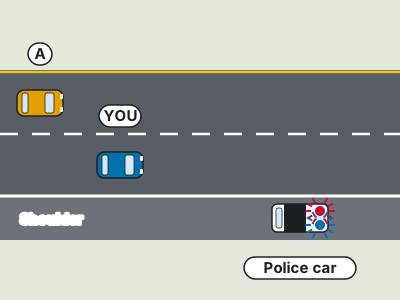
- Stop beside it and wait for a signal
- Pass it on the shoulder at the same speed
- Turn off your headlights and continue normally
- Move over one lane away from it
Show answer
Move over one lane away from it. Michigan's move-over rule calls for changing lanes away from a stopped emergency vehicle when traffic and conditions make that possible. The maneuver still requires a safe gap and an appropriate signal. If changing lanes cannot be done, the driver must slow at least 10 mph below the posted limit and leave as much space as possible. Stopping beside the vehicle or using the shoulder as a passing lane increases exposure for responders. See the vehicle early, check mirrors, create room, and pass with caution.
Study this in the handbook: Emergency vehicles, Move Over and school buses
12. What kind of traffic sign is the pictured speed limit sign?
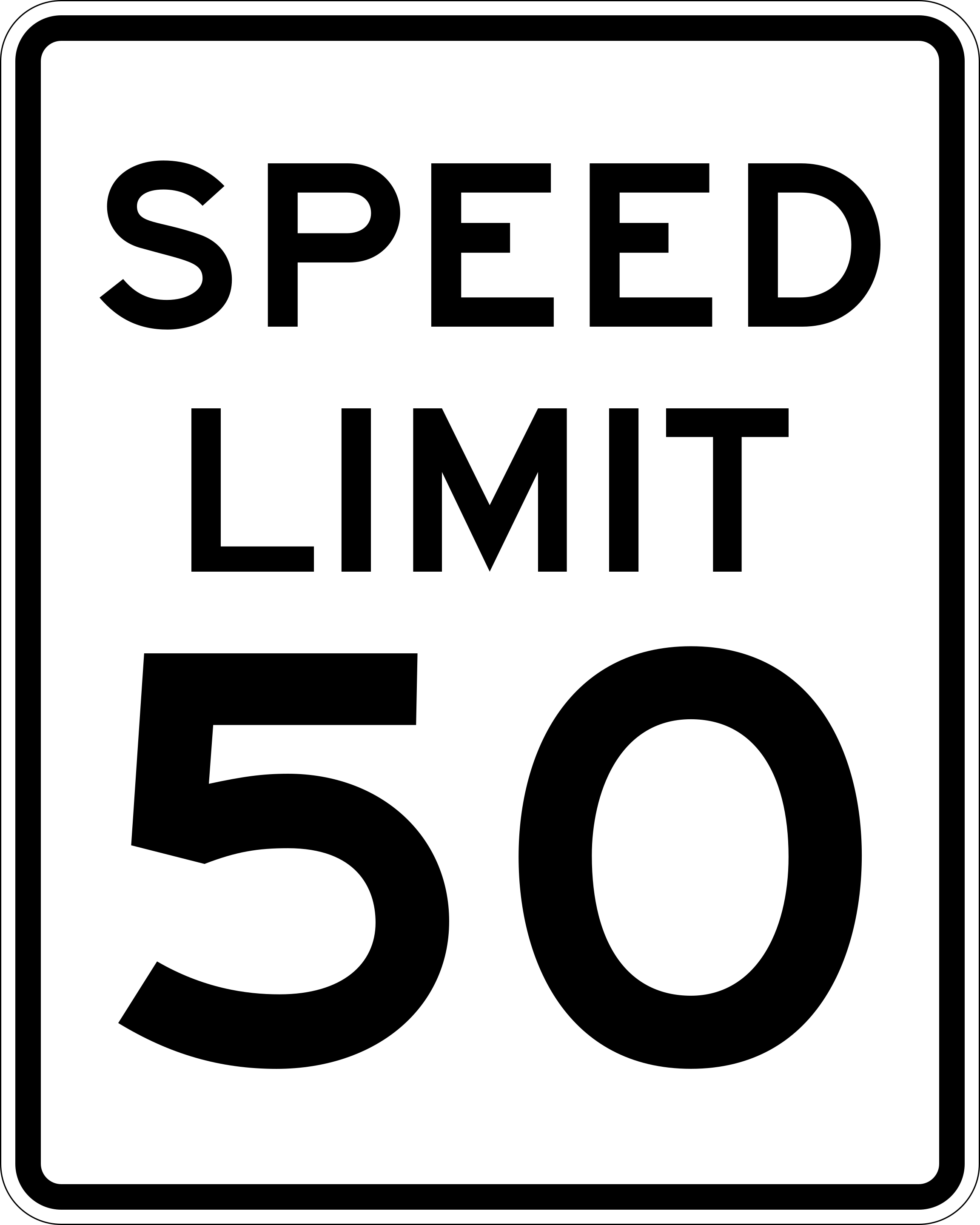
- A warning sign about a road hazard
- A recreational sign identifying a destination
- A regulatory sign stating a legal limit
- A service sign for fuel or lodging
Show answer
A regulatory sign stating a legal limit. A speed limit sign is regulatory because it communicates a legal rule governing traffic movement. It is not a warning about a hazard, a recreation marker, or a service sign. The number sets the posted maximum under the applicable conditions, but a driver may need to travel more slowly for weather, visibility, traffic, or roadway conditions. Treat the sign as an instruction that affects speed immediately, especially when entering a different road segment or leaving a lower-speed area.
Study this in the handbook: Traffic sign shapes and colors
13. What does the red slash on this movement sign communicate?
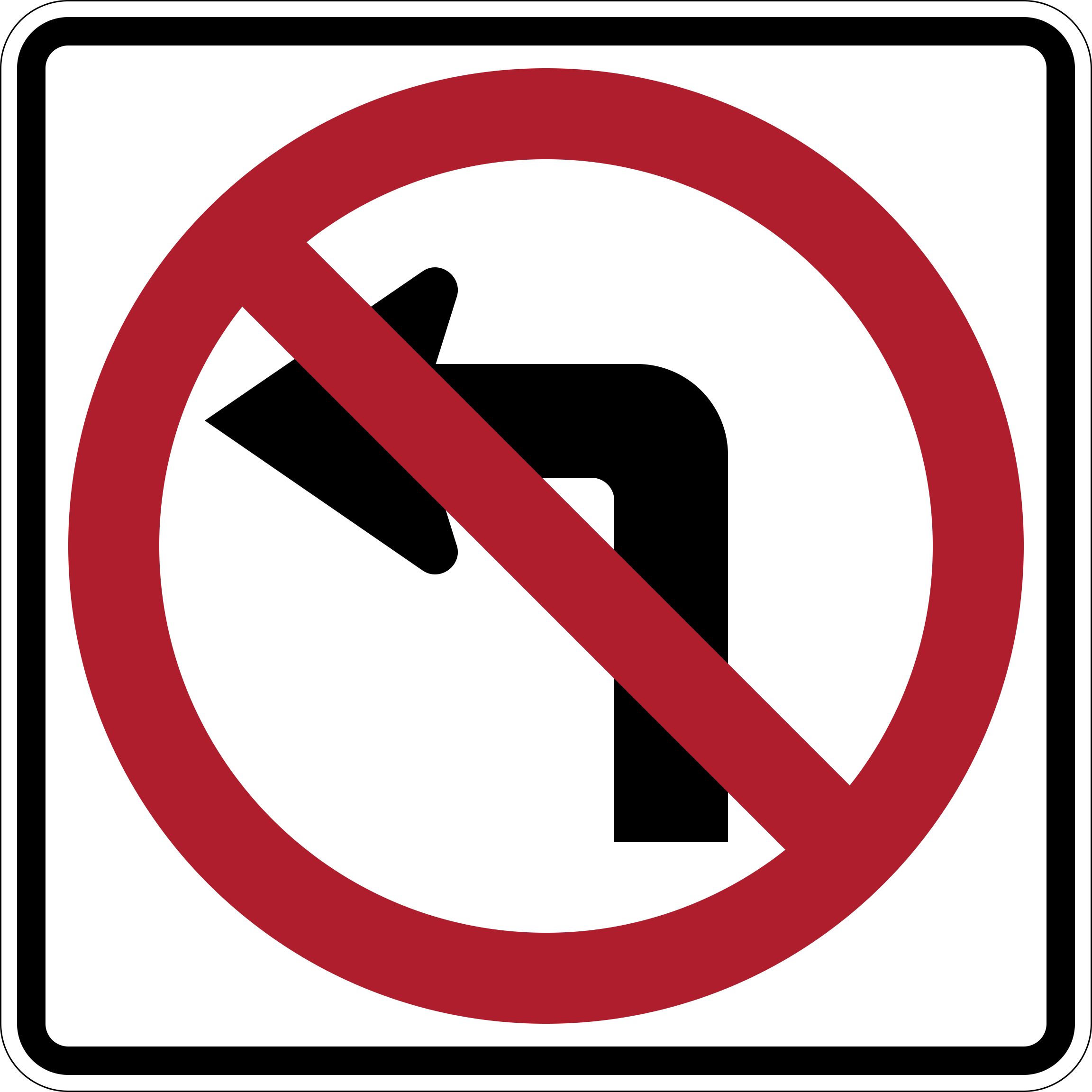
- The pictured movement is recommended during daylight
- The pictured movement is required at the next signal
- The pictured movement is permitted only for buses
- The pictured movement is prohibited by law
Show answer
The pictured movement is prohibited by law. Michigan's sign color key says red means stop, prohibited, or forbidden, and regulatory signs tell you about specific laws that regulate the speed and movement of traffic. The red circle and slash across the left-turn arrow therefore forbid the pictured left turn where the sign is posted. It is not a daylight recommendation, a bus-only exception, or a required movement. Read the sign before entering the turn lane, then follow another available route that does not need the pictured turn.
Study this in the handbook: Traffic sign shapes and colors
14. What does Michigan's general cell phone law prohibit while a vehicle is operating on a public road?
- Using a permanently installed vehicle navigation screen
- Listening to directions from a passenger
- Looking at a mounted dash camera that continuously records video
- Holding or using a mobile electronic device, such as a phone or tablet
Show answer
Holding or using a mobile electronic device, such as a phone or tablet. Michigan's general law prohibits holding or using a mobile electronic device while operating a motor vehicle on a public road, street, highway, or other public venue. The dash-camera and permanently installed-system choices describe listed exceptions or integrated equipment, not the core prohibition. A passenger giving directions is not device use by the driver. Keep the device out of the driver's hand while the vehicle is operating.
Study this in the handbook: Phones, seat belts and child passengers
15. On a Michigan freeway posted below 70 mph, what speed are school buses and trucks restricted to?
- 45 mph
- 60 mph
- 55 mph
- 65 mph
Show answer
55 mph. School buses and trucks drop to 65 mph on 70 mph freeways, but on freeways with limits below 70 mph they are held to 55 mph. That makes 65 mph the answer only for the 70 mph case. Forty-five mph is the work zone figure, and 60 mph is not listed. Car drivers sharing these roads should expect heavy vehicles to travel slower than the posted limit.
Study this in the handbook: Phones, seat belts and child passengers
16. How close to a fire hydrant may a Michigan driver park?
- No closer than 5 feet
- No closer than 10 feet
- No closer than 15 feet
- No closer than 30 feet
Show answer
No closer than 15 feet. Michigan's no parking list bars parking within 15 feet of a fire hydrant, so 15 feet is the closest legal spot. Five and ten feet are too close. Thirty feet is the distance for a stop sign, traffic light or flashing beacon, not a hydrant. The same list uses 20 feet for a marked crosswalk and for a fire station driveway on the same side of the street.
17. How much space does Michigan law require between your vehicle and a bicyclist you are passing?
- At least 3 feet
- At least 1 foot
- At least 5 feet
- At least 10 feet
Show answer
At least 3 feet. Michigan requires at least 3 feet of space when passing a bicyclist. If that is impractical, the driver must pass at a safe distance and speed, which may mean using another lane or waiting. One foot is dangerously close. Five and ten feet are more room than the 3 foot minimum the manual states, so neither is the required figure. A driver may pass a bicyclist in a no passing zone when it is safe.
Study this in the handbook: Trucks, pedestrians, motorcycles and bicycles
18. After a Michigan crash with no injuries, above what amount of property damage must the police be notified?
- $1,000
- $250
- $500
- $2,500
Show answer
$1,000. Drivers in a crash must exchange names, addresses, license numbers, registration and insurance information, and notify the police if anyone is injured or property damage exceeds $1,000. Two hundred fifty and five hundred dollars are below the Michigan threshold. Twenty-five hundred dollars is too high. Keep the two duties separate: the information exchange applies after the crash itself, while the call to police turns on injuries or damage above the $1,000 figure.
Study this in the handbook: Crashes, deer and roadside emergencies
19. Within what distance of an intersection or railroad crossing does Michigan prohibit passing?
- 50 feet
- 100 feet
- 200 feet
- 500 feet
Show answer
100 feet. A driver may not pass within 100 feet of an intersection or railroad crossing, or when the view is blocked within 100 feet of a bridge, viaduct or tunnel. Two hundred feet is the distance by which a passing driver must be back in the lane before an oncoming vehicle, a separate rule. Fifty and 500 feet are not the passing limits. The same no passing list includes a hill or curve that blocks the view of oncoming traffic and a vehicle stopped at a crosswalk for a pedestrian.
Study this in the handbook: Passing, lane use and turns
20. What is the youngest age at which a Michigan teen can apply for a GDL Level 1 Learner's License?
- 14 years, 9 months
- 14 years, 8 months
- 15 years, 6 months
- 16 years
Show answer
14 years, 9 months. The Level 1 Learner's License requires the applicant to be at least 14 years and 9 months old, visit a Secretary of State office with a parent or legal guardian, and bring the Segment 1 certificate and identity documents. The 14 years and 8 months figure is the minimum age to start Segment 1 driver education, one month earlier. Sixteen is the Level 2 age, and 15 years 6 months is not the age the manual gives for Level 1. Finishing Segment 1 comes before the Level 1 application.
Study this in the handbook: Graduated Driver Licensing for teens
QualitySpace is expanding to Michigan
We are a California-based independent insurance brokerage working on licensing in more states. We cannot help with Michigan insurance yet. Leave your email and we will let you know when we can.
Every question is written from the official What Every Driver Must Know (Michigan). Need paper? Printable MI practice test with answer key.
Last verified 2026-10-05. How we check every question · Study all 218 as flashcards
Frequently asked questions
How many questions are on this Michigan practice test?
This fixed set has 20 questions. It is test 5 of 10 from the 218 question Michigan bank.
How does this fixed test relate to the full Michigan bank?
Each numbered test is a fixed set of questions in a fixed order, so you can retake the same test later and compare. Every test mixes road signs and the other topics in about the same proportion as the full bank. Tests 1 to 10 together cover 200 of the 218 questions in the Michigan bank, each once. The full practice page mixes the whole bank at random.
Last verified 2026-10-05. See the Michigan DMV facts page for sourced state details.
Return to the full Michigan practice test · Study road signs