
Test 16 of 25 · 20 questions · Free 2026
MI Permit Practice Test 16
Jump to the test ↓A fixed 20 question set from the Michigan bank with answers and plain English explanations.
Question 1 of 20 · 0 right so far
All 20 questions in test 16
Every question below comes from the Michigan question bank on this page. Open a question to see the correct answer and the explanation. Nothing here is hidden behind a signup.
1. Why must you avoid honking or revving your engine near a horse on a Michigan road?
- Loud noises can startle horses and cause danger
- The noise violates city noise ordinances only
- Drivers must sound the horn to warn the rider before passing
- The rider may not hear other traffic afterward
Show answer
Loud noises can startle horses and cause danger. Sudden loud sounds can startle a horse, which may jump sideways into traffic or throw its rider. A horn blast meant as a warning therefore creates the very hazard you hoped to avoid. Keep the engine quiet, hold a steady slow pace, and let the rider settle the animal. Your patience protects the horse, the rider, and your own vehicle from a panicked move you cannot predict.
Study this in the handbook: Trucks, pedestrians, motorcycles and bicycles
2. Why should you leave room when a large truck signals a right turn at a Michigan intersection?
- The truck may swing wide to the left before turning right
- The truck must stop twice before any right turn
- The truck driver cannot use mirrors during turns
- The truck will back up before completing the turn
Show answer
The truck may swing wide to the left before turning right. A big rig often swings wide to the left so its trailer can clear the corner during a right turn. That leftward drift looks like a lane change, and drivers who sneak along the right side get trapped against the curb. Hold back when you see the signal, and never crowd the space beside the trailer. Wait until the whole vehicle straightens into its new lane before moving up.
Study this in the handbook: Trucks, pedestrians, motorcycles and bicycles
3. What towing setup requires a Michigan Recreational Double R endorsement?
- A pickup pulling any single camping trailer behind it on the highway
- A motorhome pulling a small utility trailer to a nearby campground
- A pickup towing a fifth-wheel built for recreational living, plus a second trailer
- A passenger car pulling a boat trailer to a lake on a weekend trip
Show answer
A pickup towing a fifth-wheel built for recreational living, plus a second trailer. The Recreational Double R endorsement covers a pickup towing a fifth-wheel recreational trailer that itself pulls a second trailer. A single camping trailer behind a pickup needs no such endorsement, which makes the double-trailer arrangement the key detail. A knowledge test is required before you attempt that long combination. Practice turns and backing in an empty lot first, since two pivot points react very differently from one.
4. A Michigan left-turn only center lane may not be used for which purpose?
- Waiting to turn left
- Entering from either direction
- Making a left turn into a business
- Passing another vehicle
Show answer
Passing another vehicle. The center lane with solid yellow outer edges and broken yellow inner edges exists so drivers can wait for a gap before turning left. Michigan warns that using it to pass another vehicle or as a merge lane is illegal and dangerous, because a driver in that lane may be pointed toward oncoming traffic. Waiting for a gap, entering from either direction, and turning into a business are proper uses. The cue is to enter the lane only when you intend to turn, keep your wheels straight while waiting, and never treat the center lane as a shortcut around slower traffic.
Study this in the handbook: Pavement markings and traffic signals
5. Two lanes merge into one in a Michigan construction zone. How should you handle the merge?
- Use the shoulder to pass the queue
- Merge at the first barrel you reach
- Wait until the lane ends, then force your way in
- Follow the signs that say when and how to merge
Show answer
Follow the signs that say when and how to merge. Michigan work zones use barrels and signs to announce the merge point, and the manual directs drivers to follow those instructions about when and how to merge. Moving over at the first barrel can leave the closed lane empty when the site plan expects traffic to use it, while forcing in at the last moment creates the conflict the signs are meant to prevent. Driving on the shoulder is not a merge. Watch the orange signs and the pavement markings together, choose the open lane when the sign directs it, and leave a gap rather than racing to the taper.
Study this in the handbook: Speed limits and work zones
6. What commonly causes skids on slippery pavement?
- Checking the brakes lightly before traveling
- Driving slowly and braking gradually
- Turning too quickly or stopping suddenly
- Allowing extra following distance
Show answer
Turning too quickly or stopping suddenly. Michigan warns that most skids happen when a driver turns too quickly or stops suddenly on slippery pavement. Those abrupt inputs can exceed the tires’ available traction and make the vehicle slide. Driving slowly, braking gradually, and checking the brakes lightly are protective habits rather than causes. Extra following distance also gives more time to respond without a panic stop. When snow, ice, or another slick surface is present, reduce speed early and use smooth steering and braking. The key cue is sudden input on low-traction pavement.
Study this in the handbook: Bad weather, stopping distance and night driving
7. What behaviors mark an aggressive driver on Michigan roads?
- Running signs, speeding and tailgating
- Driving exactly at the limit in the right lane
- Using turn signals well before each turn
- Yielding the right of way at four-way stops
Show answer
Running signs, speeding and tailgating. Aggressive drivers run stop signs and red lights, speed, tailgate, weave through traffic, pass illegally on the right, and make improper gestures. Shouting, horn abuse, and headlight flashing often join that pattern. Answering in kind can escalate a clash into road rage where a weapon or the vehicle itself becomes a tool of assault. Back off, let the driver go, avoid eye contact, and report the behavior to police when you can do so safely.
Study this in the handbook: Aggressive driving, intersections and freeways
8. After stopping at a red light, what must you check before proceeding on green or turning right on red?
- Only the vehicle directly behind you
- Whether your headlights are set to high beam
- Check cross traffic and pedestrians
- The posted speed limit on the cross street
Show answer
Check cross traffic and pedestrians. Before rolling on a fresh green or turning right on red, check for cross traffic and pedestrians still in the intersection. Drivers running a late yellow and walkers finishing a crossing both linger after your light changes. That pause also protects bicyclists filtering beside stopped cars. Look left, right, then left again, and move only when every path through the junction is genuinely empty, not merely legally yours.
Study this in the handbook: Pavement markings and traffic signals
9. Where may air bags be located inside a modern Michigan vehicle cabin?
- Beneath the front seats under the floor covering
- Inside the front seat head restraints of the car
- In the steering wheel, dashboard, roof columns and door panels
- Inside the dashboard glove compartment on the right
Show answer
In the steering wheel, dashboard, roof columns and door panels. Depending on make and model, air bags may sit in the steering wheel, dashboard, roof columns, and door panels. Sensors judge crash type and severity before deciding which bags deploy. Bags add protection but never replace a belt, and belts remain strongest in rollover, side impact, and rear-end crashes. Sit with the lap belt over your hips, shoulder belt across your chest, and at least ten inches from the steering wheel center.
Study this in the handbook: Phones, seat belts and child passengers
10. Before a person who has been drinking gets behind the wheel, what must be true?
- The person feels alert after drinking coffee
- Drivers are completely sober before driving
- The person ate a large meal an hour earlier
- The person drives only within the neighborhood
Show answer
Drivers are completely sober before driving. Anyone who has been drinking must be completely sober before driving, with no shortcut that speeds the process. Food and caffeine can mask sleepiness while impairment in judgment, vision, and reaction time continues underneath. Michigan urges groups to pick a designated driver ahead of time who skips drinking altogether. If plans fall apart, public transportation, taxis, or a sober friend remain safer than trusting how sober someone claims to feel.
Study this in the handbook: Your driving record, points and implied consent
11. What happens to impaired-driving penalties in Michigan when minors are riding in the vehicle?
- Penalties stay the same as a solo offense
- The driver receives a warning instead of points
- Points are transferred to the vehicle owner
- There are heightened penalties with minors present
Show answer
There are heightened penalties with minors present. Michigan raises impaired-driving penalties when minors ride in the vehicle with the impaired driver. Children cannot choose a safer ride, so the law treats endangering them as an added wrong beyond the driving itself. Base penalties already include jail time, fines, suspension, and six points, and enhancements build on that foundation. Adults should treat any trip carrying young passengers as demanding absolute sobriety, with a sober backup driver planned in advance.
Study this in the handbook: Your driving record, points and implied consent
12. Which statement describes a Michigan bicyclist riding with traffic?
- The rider must stay at the lane's right edge
- The rider may use the lane's center but not its edges
- The rider must leave the lane when traffic approaches
- The rider may use any part of the lane while traveling with traffic
Show answer
The rider may use any part of the lane while traveling with traffic. A bicyclist riding with traffic may use any part of the lane. The rule does not confine the rider to the curb, the center, or the shoulder. A rider may need space away from a door zone, drain, rough pavement, or another hazard. Drivers should expect a bicycle to move within the lane and should wait for a safe opportunity to pass without squeezing the rider. Approaching traffic does not require the bicyclist to leave the lane.
Study this in the handbook: Trucks, pedestrians, motorcycles and bicycles
13. Where may Michigan commercial drivers between ages 18 and 21 operate?
- Across all states bordering Michigan freely
- Only in Michigan until age twenty-one
- Only within their home county limits
- Anywhere if carrying an adult passenger
Show answer
Only in Michigan until age twenty-one. Drivers aged eighteen through twenty may run commercial vehicles only inside Michigan borders. Crossing state lines or hauling placarded hazardous material requires waiting until twenty-one. That boundary surprises young drivers hired by firms near state lines, where a routine delivery can cross into Ohio or Indiana. Dispatchers and drivers share the duty to check age limits before accepting any load that leaves Michigan territory.
14. While passing on a Michigan two-lane road, when must you be back in your lane?
- After you get within 100 feet of oncoming vehicles
- After the passed vehicle honks
- Before you get within 200 feet of oncoming vehicles
- Only after reaching the next hill
Show answer
Before you get within 200 feet of oncoming vehicles. Finish the pass early enough that you are settled in your own lane before closing to within 200 feet of traffic coming toward you. Waiting for a honk wastes the margin you need, since sound gives no distance guarantee. Judge the gap by the oncoming headlights growing larger: if that space shrinks fast, abandon the pass, ease back, and try again where the road offers a longer clear stretch.
Study this in the handbook: Passing, lane use and turns
15. As you approach a parking space in Michigan, what should you do before starting to back in?
- Turn off your mirrors to avoid distraction
- Signal and check your mirrors for traffic behind you
- Honk twice to warn drivers behind
- Open the driver door to look back
Show answer
Signal and check your mirrors for traffic behind you. Signal as you near the space and check the mirrors for traffic following you, so the driver behind understands you are about to slow and reverse. Opening the door to look back puts you in the lane and still misses much of the scene. A clear signal plus mirror checks warn others early. Then brake smoothly, shift to reverse, and keep scanning while the vehicle swings toward the curb.
Study this in the handbook: Railroad crossings
16. Which action does Michigan require before making a turn?
- Use the horn instead of a signal.
- Use your turn signal before turning.
- Turn without signaling if no traffic is nearby.
- Signal only when a traffic light controls the turn.
Show answer
Use your turn signal before turning.. Michigan requires drivers to use a turn signal when turning. A horn does not substitute for the required signal, and the requirement does not disappear when nearby traffic is absent. It also applies to turns not controlled by a traffic light, so signaling only at signal-controlled turns is too narrow. The rule covers the turning movement itself. The tested requirement is to signal before every turn.
Study this in the handbook: Passing, lane use and turns
17. You must cross the center line to pass a stopped vehicle or obstacle. What must you do first?
- Yield to any oncoming traffic before leaving your lane
- Flash your high beams and proceed at once
- Honk twice and cross at slow speed
- Turn on hazard lights and cross immediately
Show answer
Yield to any oncoming traffic before leaving your lane. Before leaving your lane to cross the center line around a stopped vehicle, crash, or obstacle, yield to any oncoming traffic. The right-hand lane rule relaxes for such obstructions, but the opposing lane still belongs to its drivers. Signal, wait for a genuine gap, and pass the blockage with maximum care. The same yielding applies when crossing the center to enter an alley, private road, or driveway for a left turn.
Study this in the handbook: Passing, lane use and turns
18. What can result from a Michigan school bus stop violation that injures or kills someone?
- Only a doubled fine with no other penalty
- Increased fines and imprisonment may result
- Automatic loss of the vehicle to the state
- A warning letter from the school district
Show answer
Increased fines and imprisonment may result. A school bus violation causing injury or death can bring increased fines and imprisonment in Michigan, beyond the doubled fine that already applies to failing to stop. Stopping at least twenty feet from flashing red lights is a small price against a child crossing to the bus. Divided highways separated by a barrier excuse opposite traffic, but same-side drivers must always stop. Stay put until lights go dark or the bus rolls again.
Study this in the handbook: Emergency vehicles, Move Over and school buses
19. When passing a stopped emergency vehicle, what speed reduction is required if you cannot move over?
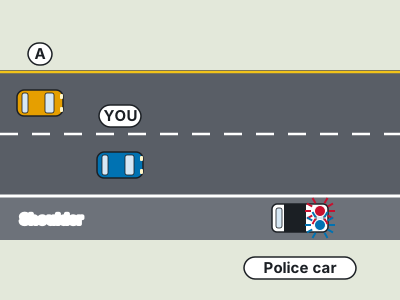
- At least 10 mph below the posted speed limit
- The full posted limit with hazard lights on
- Exactly 5 mph below the posted speed limit
- Any speed above the limit if the lane is clear
Show answer
At least 10 mph below the posted speed limit. If traffic or conditions prevent a lane change away from a stopped emergency vehicle, Michigan requires the driver to slow at least 10 mph below the posted limit and leave as much room as possible. Turning on hazard lights does not replace the speed reduction, and an open-looking lane does not permit exceeding the limit. The preferred response remains moving over when safe. If that cannot happen, ease off early, hold a predictable line, and give responders the widest practical buffer while passing.
Study this in the handbook: Emergency vehicles, Move Over and school buses
20. On a steep Michigan downgrade, what does the warning example tell large trucks to do?
- Use the runaway ramp at the top of the hill
- Check brakes and gear down if necessary before descending
- Turn off the engine to save the brakes
- Pass slower vehicles before the grade begins
Show answer
Check brakes and gear down if necessary before descending. Large trucks should verify their brakes work properly and gear down when needed before a long descent. Riding service brakes downhill overheats them until they fade, leaving a heavy rig with little stopping power. Lower gears hold speed with the engine instead, preserving brakes for true stops. Car drivers should give descending trucks extra room, avoid cutting in ahead of them, and never linger beside a rig whose brakes may be heating up.
Study this in the handbook: Traffic sign shapes and colors
Every question is written from the official What Every Driver Must Know (Michigan). Need paper? Printable MI practice test with answer key.
Last verified 2026-10-05. How we check every question · Study all 500 as flashcards
Frequently asked questions
How many questions are on this Michigan practice test?
This fixed set has 20 questions. It is test 16 of 25 from the 500 question Michigan bank.
How does this fixed test relate to the full Michigan bank?
Each numbered test is a fixed set of questions in a fixed order, so you can retake the same test later and compare. Every test mixes road signs and the other topics in about the same proportion as the full bank. Tests 1 to 25 together cover every question in the Michigan bank once. The full practice page mixes the whole bank at random.
Last verified 2026-10-05. See the Michigan DMV facts page for sourced state details.
Return to the full Michigan practice test · Study road signs