
Test 1 of 10 · 20 questions · Free 2026
MI Permit Practice Test 1
Jump to the test ↓A fixed 20 question set from the Michigan bank with answers and plain English explanations.
Question 1 of 20 · 0 right so far
All 20 questions in test 1
Every question below comes from the Michigan question bank on this page. Open a question to see the correct answer and the explanation. Nothing here is hidden behind a signup.
1. How long is a Michigan temporary instruction permit valid?
- 180 days
- 30 days
- One year
- Two years
Show answer
180 days. A temporary instruction permit, or TIP, is valid for 180 days and allows you to practice driving with a licensed adult before taking the driving skills test; it is issued to people who have never been licensed. A motorcycle TIP is also good for 180 days, requires constant visual supervision by a licensed motorcycle operator at least 18, and bars night riding and passengers.
Study this in the handbook: Permits, tests, probation and renewal
2. Which color pattern is listed for Michigan regulatory signs?
- Blue and green only
- White and black, red, white and black, or red and white
- Fluorescent pink and brown
- Yellow and orange only
Show answer
White and black, red, white and black, or red and white. Michigan lists several color patterns for regulatory signs: white and black, red, white and black, or red and white. The other choices describe combinations not listed in this section. Color is a useful recognition cue, but it does not replace reading the sign because regulatory signs communicate specific laws about traffic speed and movement. If a sign has one of the listed patterns, look for the speed, lane, turn, or other instruction it imposes. Treat the visible color scheme as a prompt to slow your scan and confirm the exact rule before proceeding.
Study this in the handbook: Traffic sign shapes and colors
3. What traffic directions do yellow lines separate?
- A bicycle lane from a sidewalk
- Traffic lanes moving in the same direction only
- Traffic lanes moving in opposite directions
- A parking area from a driveway
Show answer
Traffic lanes moving in opposite directions. Yellow lines separate traffic lanes moving in opposite directions. They help a driver recognize that the roadway carries opposing traffic, unlike white lane lines that generally divide lanes traveling the same way. The bicycle-lane and sidewalk choice describes a different marking context, and a parking area is not identified by the general yellow-line rule. Look at the line color and the traffic direction before changing position. A yellow center marking should prompt an opposing-traffic check, even when the roadway appears lightly traveled.
Study this in the handbook: Pavement markings and traffic signals
4. At what age may a Michigan teen begin Segment 1 driver education?
- 16 years
- 14 years and 8 months, with a parent's or guardian's permission
- 15 years and 6 months
- 13 years
Show answer
14 years and 8 months, with a parent's or guardian's permission. To apply for Segment 1 driver education you must be at least 14 years and 8 months old and have your parent's or guardian's permission. Segment 1 includes at least 24 hours of classroom instruction and six hours behind the wheel, after which the Level 1 learner's license allows supervised practice. The driving skills test comes at 15 after Segment 2 and 50 logged hours.
Study this in the handbook: Graduated Driver Licensing for teens
5. What record must a Michigan driver have before operating commercial motor vehicles?
- A chauffeur's license only
- Any clean record for 6 months
- Age 21 with no requirements
- Age 18 and suspension free for 36 months before applying, with the proper CDL group designation
Show answer
Age 18 and suspension free for 36 months before applying, with the proper CDL group designation. Before you can operate commercial motor vehicles you must be at least age 18, have been suspension free for 36 months before the date of application, and have the appropriate Michigan CDL group designation on your license. A chauffeur's license is a separate credential with a minimum age of 16, so holding one does not replace the CDL group designation. Six months of clean driving and a starting age of 21 do not match the requirements the manual lists.
6. What does a green traffic light permit after the driver checks the intersection?
- Proceed without checking because green removes all hazards
- Turn in any direction without following lane markings
- Stop and wait for a flashing red indication
- Proceed with caution after checking for pedestrians and vehicles
Show answer
Proceed with caution after checking for pedestrians and vehicles. A green traffic light permits movement only after the driver checks for pedestrians and vehicles. Green does not erase the need to scan the crosswalk, confirm that the intended lane is open, and watch for a road user who may disregard the signal. A full stop is associated with a different indication, and a green light does not authorize arbitrary turns across lane markings. Ease forward with visibility and control, then proceed when the intersection is safe. The cue is green plus a check, not green plus automatic priority.
Study this in the handbook: Pavement markings and traffic signals
7. How do Michigan drivers ages 15 to 20 compare with their share of the driving population in crash statistics?
- They are 6.6 percent of drivers but 10.1 percent of drivers in all crashes and 8.2 percent in fatal crashes
- They crash less than average
- They are half of all crashes
- They are 6.6 percent of crashes
Show answer
They are 6.6 percent of drivers but 10.1 percent of drivers in all crashes and 8.2 percent in fatal crashes. Licensed drivers ages 15 to 20 represented 6.6 percent of Michigan's driving population, yet they represented 10.1 percent, or 49,041, of drivers in all crashes and 8.2 percent, or 136, of drivers in fatal crashes. Inexperience is the reason Michigan pioneered driver education in 1955 and uses graduated licensing for drivers under 18, adding privileges only as skill and a clean record are shown.
8. What should a driver do when a Michigan school bus has yellow overhead lights flashing?
- Pass immediately before the red lights begin
- Stop at least 100 feet away and turn around
- Be prepared to stop
- Ignore the lights if no children are visible
Show answer
Be prepared to stop. Flashing yellow overhead lights mean a driver should be prepared to stop because the bus is approaching its passenger-loading or unloading phase. Passing before red lights appear defeats that warning, while a 100-foot turnaround is not the instruction. Children may be hidden by parked vehicles or other traffic, so visibility is not a reason to disregard the signal. Ease off the accelerator and anticipate the required stop.
Study this in the handbook: Emergency vehicles, Move Over and school buses
9. Outside a work zone, how many points does a Michigan conviction for driving 6 to 10 mph over the legal limit add?
- 1 point
- 3 points
- 2 points
- 4 points
Show answer
2 points. The lowest speeding step in Michigan's general point schedule covers driving six to 10 mph over the legal limit, and it adds two points. The same two point group lists an open alcohol container in the vehicle, most other moving violations, refusal of a Preliminary Breath Test by anyone younger than 21, and failure to yield or show due caution for emergency vehicles. Speeding in a construction zone is handled under a separate, higher schedule, so this figure applies away from work zones.
Study this in the handbook: Your driving record, points and implied consent
10. What information is listed on a Michigan Emergency Notification System sign at a railroad crossing?
- The train engineer's name and the next train's speed
- The road's speed limit and the nearest gas station
- Only the local police station address
- A telephone number and the crossing's U.S. DOT number
Show answer
A telephone number and the crossing's U.S. DOT number. An Emergency Notification System sign lists a telephone number and the crossing's U.S. DOT number, allowing a crossing emergency or warning-device malfunction to be reported to the railroad. It is not a schedule board, speed display, or ordinary police-directory sign. If a vehicle is stuck or the warning system fails, use the posted railroad contact and provide the crossing identification information.
Study this in the handbook: Railroad crossings
11. How close to a fire station driveway on the same side of the street may a Michigan driver park?
- No closer than 10 feet
- No closer than 20 feet
- No closer than 75 feet
- No closer than 500 feet
Show answer
No closer than 20 feet. Fire trucks need a clear path out of the station. Michigan's list of places where you must never park includes within 20 feet of a fire station driveway on the same side of the street. When the area is marked, the limit grows to 75 feet from the driveway on the opposite side of the street. These rules sit beside other distances on the same list, such as 15 feet from a hydrant and 500 feet from a fire or crash.
12. How does Michigan's Basic Speed Law apply when weather or another condition makes the posted speed unsafe?
- You must drive more slowly when conditions require it
- The rule applies only on freeways
- You may exceed the limit to maintain traffic flow
- The posted limit guarantees a safe speed in every condition
Show answer
You must drive more slowly when conditions require it. Michigan's Basic Speed Law requires a careful and prudent speed that allows the driver to stop within the clear distance ahead. That can mean traveling below the posted limit when rain, ice, fog, traffic, or another condition reduces safety. A posted number is a ceiling, not a promise that the roadway is safe at that speed. Do not exceed it to keep pace with traffic. Let visibility and stopping room set the practical speed.
Study this in the handbook: Phones, seat belts and child passengers
13. What should a driver expect from a yellow diamond sign showing that the road curves sharply left and then right?

- A mandatory left turn at the next street
- The end of a no-passing zone
- A railroad crossing with three tracks
- A sharp curve sequence requiring reduced speed and care
Show answer
A sharp curve sequence requiring reduced speed and care. The sign warns that the roadway curves sharply first to the left and then to the right. It is a warning, so the driver should reduce speed before entering the curve and be ready for changing alignment. It does not command a turn onto another street, mark the end of a no-passing zone, or identify railroad tracks. A yellow diamond communicates caution rather than a regulatory instruction. Scan beyond the first bend, keep the vehicle under control, and avoid entering at a speed that would require hard braking or sudden steering. The curve sequence is the key detail that distinguishes this warning from a single-turn sign.
Study this in the handbook: Traffic sign shapes and colors
14. A Michigan driver under 21 is convicted of driving with any bodily alcohol content. How many points are posted?
- Four points
- Two points
- Six points
- None, if the level is below 0.08
Show answer
Four points. Michigan assigns four points when a driver younger than 21 has any bodily alcohol content, a zero tolerance rule that does not wait for an adult legal limit. That puts it with drag racing and impaired driving. Six points are reserved for operating while intoxicated and chemical test refusal. Two points apply to an open container or to a young driver refusing the preliminary breath test. The idea that nothing happens under an adult limit is wrong for drivers under 21.
Study this in the handbook: Your driving record, points and implied consent
15. What is the minimum age for a Michigan GDL Level 3 Full License?
- 16
- 18
- 21
- 17
Show answer
17. A teen can reach Level 3 at 17, after holding the Level 2 Intermediate License for at least six months and driving 12 consecutive months with no moving violation, at-fault crash, suspension or GDL violation. Sixteen is the Level 2 age. Eighteen is when GDL ends entirely, so it is not the entry age for Level 3. Twenty-one relates to supervising adults and passenger limits, not to the full license. Parents may ask the state to delay the upgrade if the teen is not ready.
Study this in the handbook: Graduated Driver Licensing for teens
16. What should a Michigan driver do when seeing devices that warn of railroad crossings and possible oncoming trains?

- Speed up to cross before a train appears
- Slow down and be ready to stop
- Stop only when a gate is already down
- Ignore the devices if no train is visible
Show answer
Slow down and be ready to stop. The railroad warning is an early cue to reduce speed and prepare to stop. Waiting for a gate to lower or a train to become visible can leave too little time to respond, while speeding up increases the danger at the crossing. Ignoring the devices treats a warning as if it had no legal or safety purpose. Slow down, scan both directions, and obey any stop sign, flashing signal, or gate before entering the tracks.
Study this in the handbook: Railroad crossings
17. What share of pedestrian crash deaths from 2014 to 2018 involved a roadside emergency, according to the Michigan manual?
- About 1 percent
- About 50 percent
- About 10 percent
- About 90 percent
Show answer
About 10 percent. During the five year period from 2014 to 2018, about 10 percent of all pedestrian related traffic crash fatalities involved a roadside emergency, which is why the safest thing to do in a breakdown is generally to stay in your car with the seat belt buckled until help arrives. Move the car off the road if you can, use the flashers, and call for assistance.
Study this in the handbook: Bad weather, stopping distance and night driving
18. A pedestrian signal begins flashing while you are already in the crosswalk. What should you do?
- Stop in the crosswalk until the signal becomes steady
- Complete the crossing without starting a new crossing
- Return to the curb you left
- Run diagonally to the nearest traffic lane
Show answer
Complete the crossing without starting a new crossing. A flashing pedestrian display warns that the remaining time to cross safely is nearly over. A person already in the crosswalk should finish getting to the other side. The flashing indication is not a command to stop in the roadway, and returning to the original curb would increase exposure to traffic. Running diagonally toward a traffic lane abandons the marked crossing and creates another hazard. Keep moving calmly along the crosswalk, remain alert for turning vehicles, and remember that the display is different for someone who has not started crossing.
Study this in the handbook: Pavement markings and traffic signals
19. What traffic control should you expect after seeing this symbol?
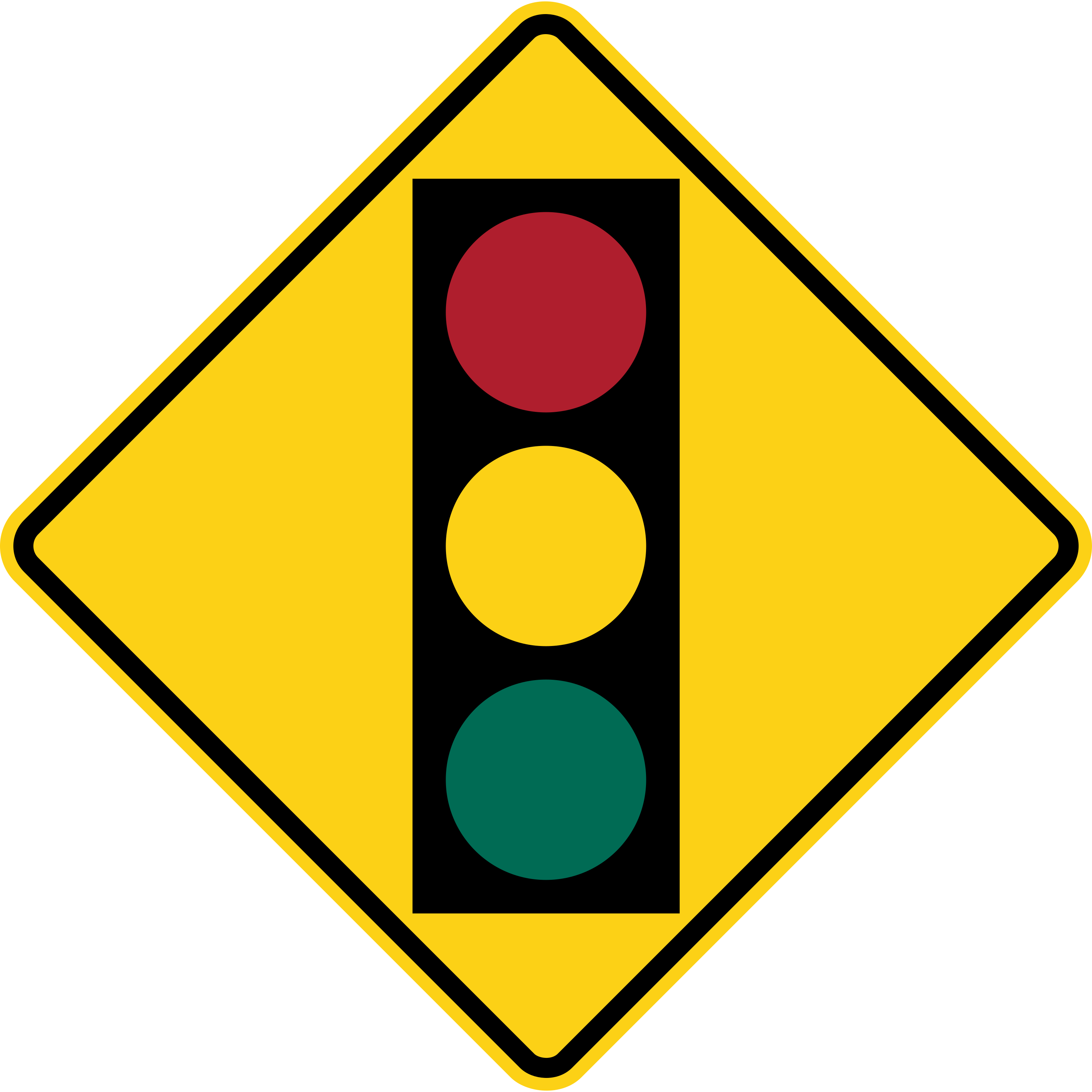
- A railroad crossing that requires a train inspection
- A private parking lot used to bypass traffic
- A service station with a signal for fuel prices
- A traffic signal that regulates the flow of traffic
Show answer
A traffic signal that regulates the flow of traffic. The signal symbol warns that a traffic signal is ahead. Traffic signals regulate the flow of traffic, so prepare to adjust speed and follow the upcoming indication rather than treating the sign as a destination marker. A railroad crossing, private parking lot, or fuel station would require different information. Begin looking for the signal early, especially if a curve, hill, weather, or other obstruction may make it hard to see. Continue checking for pedestrians and vehicles as you approach the controlled intersection.
Study this in the handbook: Pavement markings and traffic signals
20. What is the proper way to follow a horse and rider or a horse-drawn buggy?
- Reduce speed to 15 to 20 mph, keep at least 20 feet back, and never honk or rev
- Follow at the posted speed and sound the horn before passing
- Move within five feet so the horse sees you sooner
- Rev the engine briefly to make the rider move aside
Show answer
Reduce speed to 15 to 20 mph, keep at least 20 feet back, and never honk or rev. Michigan gives a specific approach for horses: reduce speed to 15 to 20 mph and maintain at least 20 feet between your vehicle and the rider or buggy. Loud sounds can startle an animal, so the manual prohibits honking or revving the engine. Passing should wait until it can be done cautiously and safely. Following at the posted speed ignores the special hazard, and moving closer reduces the rider's time to react. The cue is low speed, a generous gap, and quiet vehicle operation.
Study this in the handbook: Trucks, pedestrians, motorcycles and bicycles
QualitySpace is expanding to Michigan
We are a California-based independent insurance brokerage working on licensing in more states. We cannot help with Michigan insurance yet. Leave your email and we will let you know when we can.
Every question is written from the official What Every Driver Must Know (Michigan). Need paper? Printable MI practice test with answer key.
Last verified 2026-10-05. How we check every question · Study all 218 as flashcards
Frequently asked questions
How many questions are on this Michigan practice test?
This fixed set has 20 questions. It is test 1 of 10 from the 218 question Michigan bank.
How does this fixed test relate to the full Michigan bank?
Each numbered test is a fixed set of questions in a fixed order, so you can retake the same test later and compare. Every test mixes road signs and the other topics in about the same proportion as the full bank. Tests 1 to 10 together cover 200 of the 218 questions in the Michigan bank, each once. The full practice page mixes the whole bank at random.
Last verified 2026-10-05. See the Michigan DMV facts page for sourced state details.
Return to the full Michigan practice test · Study road signs