
Test 4 of 10 · 20 questions · Free 2026
MI Permit Practice Test 4
Jump to the test ↓A fixed 20 question set from the Michigan bank with answers and plain English explanations.
Question 1 of 20 · 0 right so far
All 20 questions in test 4
Every question below comes from the Michigan question bank on this page. Open a question to see the correct answer and the explanation. Nothing here is hidden behind a signup.
1. How far does a passenger vehicle at 55 mph need to stop compared with a commercial vehicle, according to the Michigan manual?
- About 400 feet for both
- About 50 feet and 100 feet
- About 130 feet for a car and about 400 feet for a commercial vehicle
- About 1,000 feet for the truck
Show answer
About 130 feet for a car and about 400 feet for a commercial vehicle. A passenger vehicle traveling at 55 mph can stop in about 130 feet, while a commercial vehicle at the same speed takes about 400 feet to stop. Keep a safe distance behind a commercial vehicle, do not draft off it, and never cut in front and brake. Slow moving vehicles, which cannot exceed 25 mph, need extra patience as well.
Study this in the handbook: Trucks, pedestrians, motorcycles and bicycles
2. Unless posted otherwise, what is the speed limit on a Michigan highway that is not a designated freeway?
- 45 mph
- 65 mph
- 70 mph
- 55 mph
Show answer
55 mph. Unless another limit is posted, Michigan streets that are not designated freeways, and all highways, default to 55 mph. Seventy mph is the freeway maximum, and 65 mph is the cap for school buses and trucks on a 70 mph freeway. Forty-five mph is the posted work zone limit. The Basic Speed Law still requires a slower speed whenever weather, traffic or road conditions make 55 unsafe.
Study this in the handbook: Phones, seat belts and child passengers
3. How far behind a moving emergency vehicle with flashing lights and a siren must a Michigan driver stay?
- At least 100 feet
- At least 500 feet
- At least 200 feet
- At least 1,000 feet
Show answer
At least 500 feet. Drivers must stay at least 500 feet behind any moving emergency vehicle that is showing flashing warning lights and sounding a siren. Following closer can put a car in the path of a sudden stop or turn by the responder. The 100 and 200 foot figures appear elsewhere in the manual for passing rules, not for following emergency vehicles. One thousand feet is more than the law requires. Drivers should also never pass such a vehicle unless the responder or an officer directs it.
Study this in the handbook: Emergency vehicles, Move Over and school buses
4. What should a driver do when approaching a YIELD sign?
- Slow down, check for traffic, and be prepared to stop
- Stop only after entering the intersection
- Accelerate so other traffic must yield
- Proceed without checking if the lane appears open
Show answer
Slow down, check for traffic, and be prepared to stop. A yield sign calls for a controlled approach: reduce speed, look for conflicting traffic, and be ready to stop. Accelerating would make it harder to give way, while stopping after entering the intersection could place the vehicle in the path of traffic or pedestrians. An apparently open lane still requires a check because another road user may be approaching from a less visible direction. Yielding is not an automatic full stop every time, but it is also not permission to continue without observation. Use the sign as a prompt to slow early, scan the conflict area, and stop if the situation requires it.
Study this in the handbook: Right of way, pedestrians and roundabouts
5. For an adult age 21 or older, what amount of marijuana may Michigan law allow the person to transport?
- 5 ounces or less
- 2.5 ounces or less
- Only 15 grams total
- Any amount if sealed
Show answer
2.5 ounces or less. The manual says a person who is 21 or older may transport 2.5 ounces or less of marijuana. The separate 15 gram figure applies to how much of that amount may be marijuana concentrate, so it is not the total transport allowance. Sealing the material does not turn an unlimited quantity into a permitted one. This possession rule also does not authorize impaired driving. Before traveling, keep the amount within the stated limit and remember that operating a vehicle under the influence remains prohibited regardless of whether the marijuana was lawfully possessed.
Study this in the handbook: Your driving record, points and implied consent
6. If fog becomes so thick that a Michigan driver cannot see at all, what is the safest response?
- Continue at the posted speed with high beams on
- Stop in the travel lane and turn off all lights
- Pull off the road, turn on four-way flashers, and wait
- Follow the vehicle ahead more closely for guidance
Show answer
Pull off the road, turn on four-way flashers, and wait. When visibility disappears in dense fog, the driver should leave the traveled portion of the roadway, activate the four-way emergency flashers, and wait for conditions to improve. Continuing at the posted speed assumes the posted limit is safe for the available sight distance, which it is not. High beams can worsen glare, and stopping in a live lane leaves the vehicle exposed to traffic that may not see it. Following another vehicle closely removes the space needed to react. The useful cue is a complete loss of forward visibility: get fully off the road, make the vehicle conspicuous, and wait rather than guessing at the lane path.
Study this in the handbook: Crashes, deer and roadside emergencies
7. While traveling in a Michigan roundabout, where should a driver keep the vehicle relative to the center island?
- To the right of the center island
- To the left of the center island
- On the center island
- Outside the roundabout on the shoulder
Show answer
To the right of the center island. The Michigan manual's steps for approaching a roundabout say to slow down and stay to the right of the roundabout's center island. Traffic in a roundabout travels counterclockwise around that central island, so keeping the island on your left keeps you moving with the flow. Driving on the island itself or on the shoulder outside the circle is not part of the described path. Entering traffic yields to vehicles approaching from the left, and drivers leave the roundabout by making a right turn onto the desired road, signaling the exit as they go.
Study this in the handbook: Right of way, pedestrians and roundabouts
8. What following interval should a Michigan driver use as a general rule on dry or wet pavement?
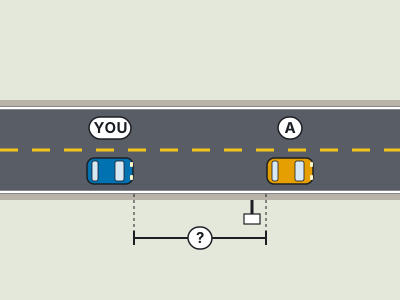
- Three to four seconds
- Exactly ten car lengths
- A half second when traffic is light
- One second at every speed
Show answer
Three to four seconds. Michigan's general rule for dry or wet pavement is a 3 to 4 second following distance. When the rear of the vehicle ahead passes a sign or any other stationary point, count the time it takes you to reach the same spot; you are following too closely if you pass the mark before you finish counting for 3 seconds. One second or a half second is far too short, and the manual states the rule in seconds rather than car lengths. When speeds increase or conditions are adverse, increase following distance up to 6 seconds or more.
Study this in the handbook: Bad weather, stopping distance and night driving
9. What roadway pattern begins where this two-arrow sign is posted?
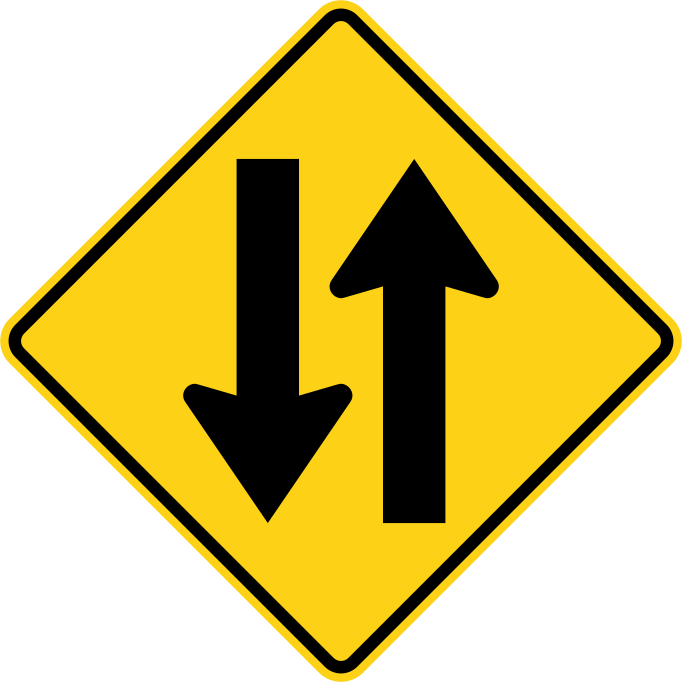
- A divided highway begins with a center median
- Passing is allowed in both directions
- All traffic must use the left lane
- Two-way traffic begins, so keep to the right
Show answer
Two-way traffic begins, so keep to the right. Michigan's sign chart says the Two-Way Traffic sign means two-way traffic begins, so keep to the right side of the roadway. The sign does not announce a divided highway, grant permission to pass, or move all traffic into the left lane. The chart lists Divided Highway Ends as a separate sign, which warns that a divided highway will turn into two lanes of traffic. Be ready for vehicles approaching from the opposite direction and stay to the right of the center line.
Study this in the handbook: Traffic sign shapes and colors
10. What does a single broken yellow centerline usually indicate on a two-way Michigan roadway?
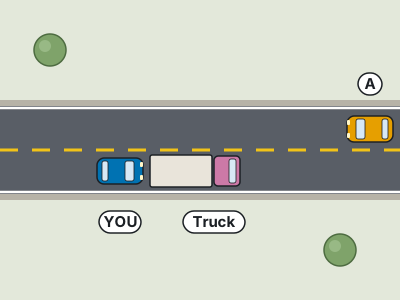
- Passing is prohibited in both directions
- Passing may be done when it is safe
- Traffic moves only in the opposite direction
- The lane is reserved for left turns only
Show answer
Passing may be done when it is safe. A single broken yellow line normally divides traffic moving in opposite directions and permits a driver to pass when the roadway is clear enough to do so safely. The option saying passing is prohibited in both directions confuses this marking with a double solid yellow line or a solid yellow line on your side. The centerline does not mean traffic travels only one way, and it does not by itself create a left-turn-only lane. Before crossing, check for oncoming vehicles, signs, hills, curves, and any other condition that could make the maneuver unsafe. Treat the broken line as permission to consider passing, never as a command to pass.
Study this in the handbook: Pavement markings and traffic signals
11. When may a Michigan child under 4 ride in the front seat?
- Only when all available rear seats are occupied by children under 4
- Whenever the child is in a car seat
- Never
- When the air bag is turned off
Show answer
Only when all available rear seats are occupied by children under 4. Children younger than age 4 must be positioned in a rear seat if the vehicle is equipped with one. Only if all available rear seats are occupied by children under 4 may the child be placed in the child restraint system in the front seat, and a child in a rear facing seat may ride in front only if the front passenger air bag is deactivated. A car seat alone does not make front seating lawful, and a child under 4 may not simply ride in front because the air bag is off when a rear seat is free.
Study this in the handbook: Phones, seat belts and child passengers
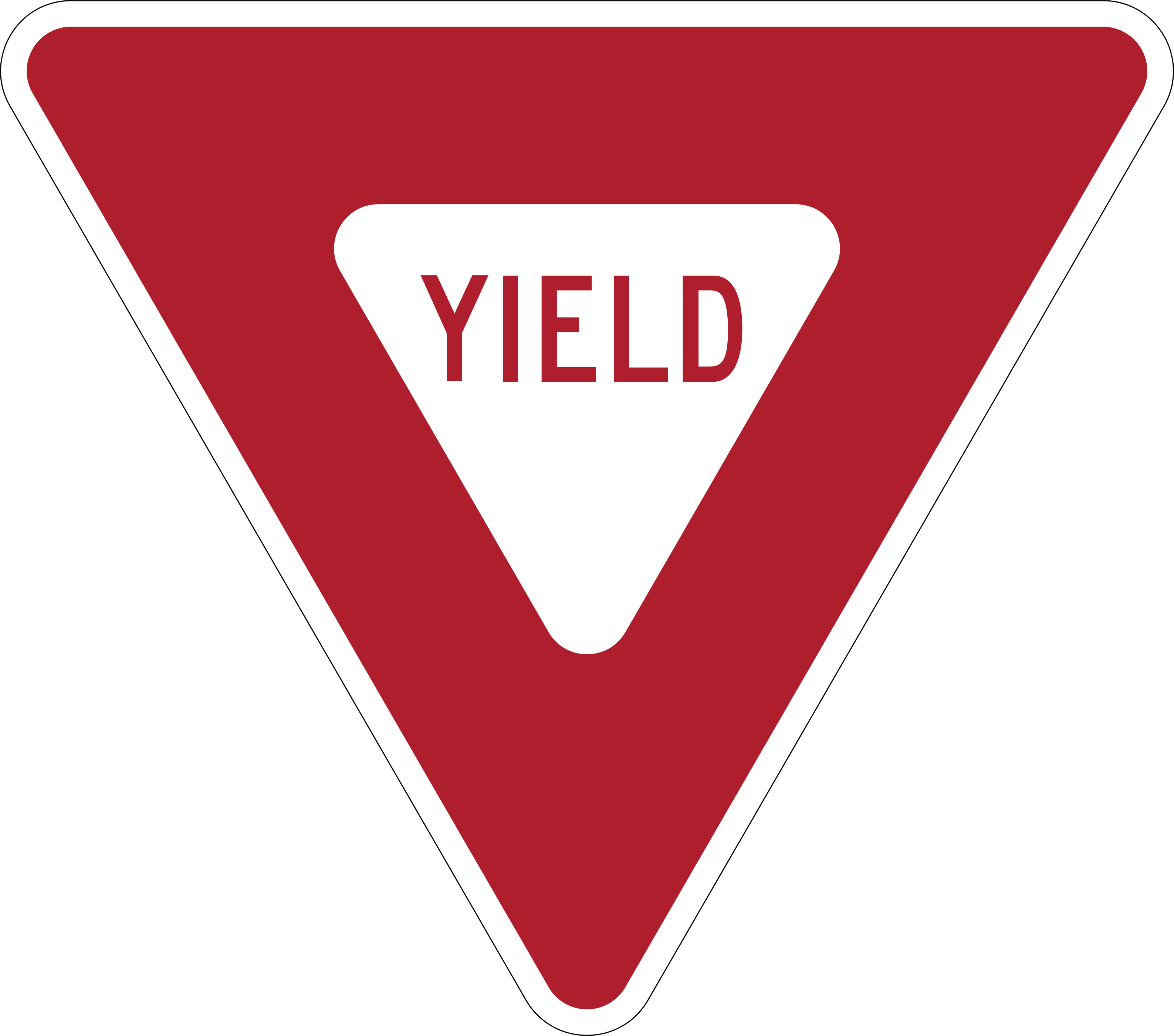
12. What should Michigan drivers learn about the nine basic traffic sign shapes?
- Only their height above the roadway
- The names of nearby streets
- Which vehicles manufactured them
- What they mean
Show answer
What they mean. The manual tells drivers to recognize nine basic traffic sign shapes and understand what those shapes mean. This is a visual classification skill, not a measurement exercise or a way to identify nearby streets or vehicle manufacturers. A driver can use the shape as an early interpretation cue, then confirm the message through the sign’s color, symbol, or wording. Remember representative pairings: octagon means STOP, triangle means YIELD, diamond means WARNING, and pentagon identifies SCHOOL. Learning the meaning attached to each shape supports faster recognition at roadway speed.
Study this in the handbook: Traffic sign shapes and colors
13. When must a Michigan child use an approved car seat or booster seat?
- Until age 10 regardless of height
- When younger than 8 or shorter than 4 feet 9 inches
- Only until age 4 regardless of height
- Whenever seated in the front seat, regardless of age or height
Show answer
When younger than 8 or shorter than 4 feet 9 inches. Michigan law requires all children younger than age 8 or under 4 feet, 9 inches tall to be in an approved child-safety seat or booster seat, in all seating positions. The age ten option extends the law beyond the stated threshold, and age four belongs to a different rule that places children younger than 4 in a rear seat when the vehicle has one. The requirement is not limited to the front seat. Check both the child's age and height against the rule before switching to a seat belt alone.
Study this in the handbook: Phones, seat belts and child passengers
14. What should you do when a traffic signal shows a flashing yellow light?
- Stop completely and wait for a green light
- Proceed carefully through the intersection and scan both directions
- Treat it as a red light and turn around
- Accelerate through before cross traffic can move
Show answer
Proceed carefully through the intersection and scan both directions. A flashing yellow signal allows you to continue, but it requires a careful check before entering the intersection. Scan across traffic in both directions and watch for vehicles, bicycles, and pedestrians that may have priority or be difficult to see. A complete stop is associated with a flashing red signal, so that choice applies the wrong signal rule. Accelerating removes the caution the display demands, and turning around has no connection to the indication. Slow enough to see the whole intersection, confirm that the path is open, and proceed only after that scan.
Study this in the handbook: Pavement markings and traffic signals
15. How do Michigan's marijuana-impaired driving penalties compare with alcohol-impaired driving penalties?
- They apply only when marijuana was sold illegally
- They are limited to a written warning
- They are the same
- They apply only to drivers under age 21
Show answer
They are the same. Michigan states that penalties for operating under the influence of marijuana are the same as penalties for operating under the influence of alcohol. The comparison concerns impaired operation, not whether the substance was legally obtained or whether the driver is young. A written warning understates the consequences, and the rule is not limited to an under-21 driver. The manual lists possible results such as jail, a fine, license suspension, and points, with heightened penalties when minors are in the vehicle. Treat marijuana-impaired driving as an alcohol-impaired driving offense for penalty purposes.
Study this in the handbook: Alcohol, drugs and marijuana
16. Besides 12 points in two years, which history can lead Michigan to call a driver in for reexamination?
- Three or more crashes with injury or property damage in two years
- One parking ticket in a year
- Renewing the license by mail
- Changing insurance companies twice
Show answer
Three or more crashes with injury or property damage in two years. Reexamination grounds include three or more crashes resulting in personal injury or property damage over the past two years, 12 or more points in two years, and conviction for violating license restrictions. Parking tickets are not moving violations and do not add points. Renewing by mail and switching insurers are routine actions that say nothing about driving risk. GDL and probationary drivers can be called in after only one or two violations.
17. When is it illegal to use or flash high-beam headlights for an oncoming vehicle?
- Only within 50 feet of the oncoming vehicle
- Only after the other driver flashes first
- Never, because high beams are always permitted
- Within 500 feet of the oncoming vehicle
Show answer
Within 500 feet of the oncoming vehicle. Michigan prohibits using or flashing high beams within 500 feet of an oncoming vehicle. The purpose is to prevent glare that can blind the approaching driver, so waiting for the other driver to react is too late. Fifty feet is not the stated threshold, and high beams are not always permitted merely because the road is dark. Dim early, keep the vehicle under control, and use low beams as the vehicles approach each other. The cue is a generous 500-foot buffer, not a last-second change.
Study this in the handbook: Bad weather, stopping distance and night driving
18. A fire engine is working a house fire on a Michigan street. How close to the fire may you park?
- No closer than 50 feet
- No closer than 100 feet
- No closer than 1,000 feet
- No closer than 500 feet
Show answer
No closer than 500 feet. Parking within 500 feet of a fire or a crash is prohibited. Onlookers who park close crowd the scene and can block hoses, ambulances and more fire trucks. Fifty and 100 feet are much shorter distances that apply to other rules. One thousand feet is not the stated distance. The same 500 foot figure appears in the rule for following a moving emergency vehicle.
19. How much space does the Michigan manual recommend between a driver's breastbone and the center of the steering wheel?
- At least 4 inches
- At least 6 inches
- At least 10 inches
- At least 24 inches
Show answer
At least 10 inches. Air bags give extra protection in a crash, but the manual also advises sitting as far back as practical from the air bag in the steering wheel. Among its air bag safety tips, the Michigan manual recommends at least 10 inches of space between the center of the breastbone and the center of the steering wheel. The same list encourages seating children 12 and younger in the rear seat. Adjust the seat and wheel before driving so this distance is kept while still reaching the pedals comfortably.
Study this in the handbook: Phones, seat belts and child passengers
20. What minimum amount of classroom instruction does Michigan driver education Segment 1 require?
- At least 6 hours
- At least 12 hours
- At least 24 hours
- At least 50 hours
Show answer
At least 24 hours. Segment 1 is the first of two driver education stages in Michigan's graduated licensing system. The manual lists several minimums for it: at least 24 hours in the classroom, at least six hours behind the wheel, at least four hours observing in a training vehicle, and a score of 70 percent or better on the Segment 1 state exam. Students easily mix up the classroom hours with the behind-the-wheel hours, so remember that the classroom part is the larger number, 24 hours.
Study this in the handbook: Graduated Driver Licensing for teens
QualitySpace is expanding to Michigan
We are a California-based independent insurance brokerage working on licensing in more states. We cannot help with Michigan insurance yet. Leave your email and we will let you know when we can.
Every question is written from the official What Every Driver Must Know (Michigan). Need paper? Printable MI practice test with answer key.
Last verified 2026-10-05. How we check every question · Study all 218 as flashcards
Frequently asked questions
How many questions are on this Michigan practice test?
This fixed set has 20 questions. It is test 4 of 10 from the 218 question Michigan bank.
How does this fixed test relate to the full Michigan bank?
Each numbered test is a fixed set of questions in a fixed order, so you can retake the same test later and compare. Every test mixes road signs and the other topics in about the same proportion as the full bank. Tests 1 to 10 together cover 200 of the 218 questions in the Michigan bank, each once. The full practice page mixes the whole bank at random.
Last verified 2026-10-05. See the Michigan DMV facts page for sourced state details.
Return to the full Michigan practice test · Study road signs