
Test 2 of 10 · 20 questions · Free 2026
MI Permit Practice Test 2
Jump to the test ↓A fixed 20 question set from the Michigan bank with answers and plain English explanations.
Question 1 of 20 · 0 right so far
All 20 questions in test 2
Every question below comes from the Michigan question bank on this page. Open a question to see the correct answer and the explanation. Nothing here is hidden behind a signup.
1. What does the Michigan manual advise about changing gears at a railroad crossing?
- Shift to a lower gear while on the tracks
- Shift into neutral and coast across
- Avoid changing gears while crossing the tracks
- Change gears just before the far rail
Show answer
Avoid changing gears while crossing the tracks. A stall on railroad tracks can be deadly, and a missed shift is an easy way to stall. The Michigan manual's railroad crossing tips include avoiding gear changes while crossing the tracks, so choose your gear before you reach the crossing and keep a steady speed across it. The same list says that when snow covers the road, proceed over the tracks with enough speed to avoid getting stuck. Always expect a train and look both ways before crossing.
Study this in the handbook: Railroad crossings
2. How many points does a Michigan driver receive for failing to stop for a school bus?
- Two points
- Three points
- Four points
- Six points
Show answer
Three points. Failure to stop for a school bus, like disobeying a school crossing guard or failing to stop at a railroad crossing, is a three-point offense. Two points are for lesser moving violations, four for drag racing and large speeding overages, and six for the gravest offenses such as reckless driving. Michigan also doubles the fine for passing a stopped school bus with red lights flashing, and injuries raise the penalties further.
Study this in the handbook: Your driving record, points and implied consent
3. If your vehicle becomes disabled on the roadway, what should you do?
- Pull as far off the traveled portion as possible, activate four-way flashers, and stay belted
- Stand beside the vehicle to direct traffic yourself
- Walk along the freeway to find assistance
- Leave the vehicle in the travel lane with the engine running
Show answer
Pull as far off the traveled portion as possible, activate four-way flashers, and stay belted. For a disabled vehicle, Michigan advises pulling as far off the traveled portion as possible, activating the four-way emergency lights, and staying inside with the seat belt securely fastened. The goal is to separate occupants from moving traffic while making the vehicle visible. Leaving the car in a travel lane increases collision risk. Standing beside it places a person close to passing vehicles, and walking on a freeway is dangerous and illegal. If leaving becomes unavoidable, move directly to a safe location far from the traveled portion and obtain professional help.
Study this in the handbook: Crashes, deer and roadside emergencies
4. What clue does a Michigan traffic sign’s shape provide?
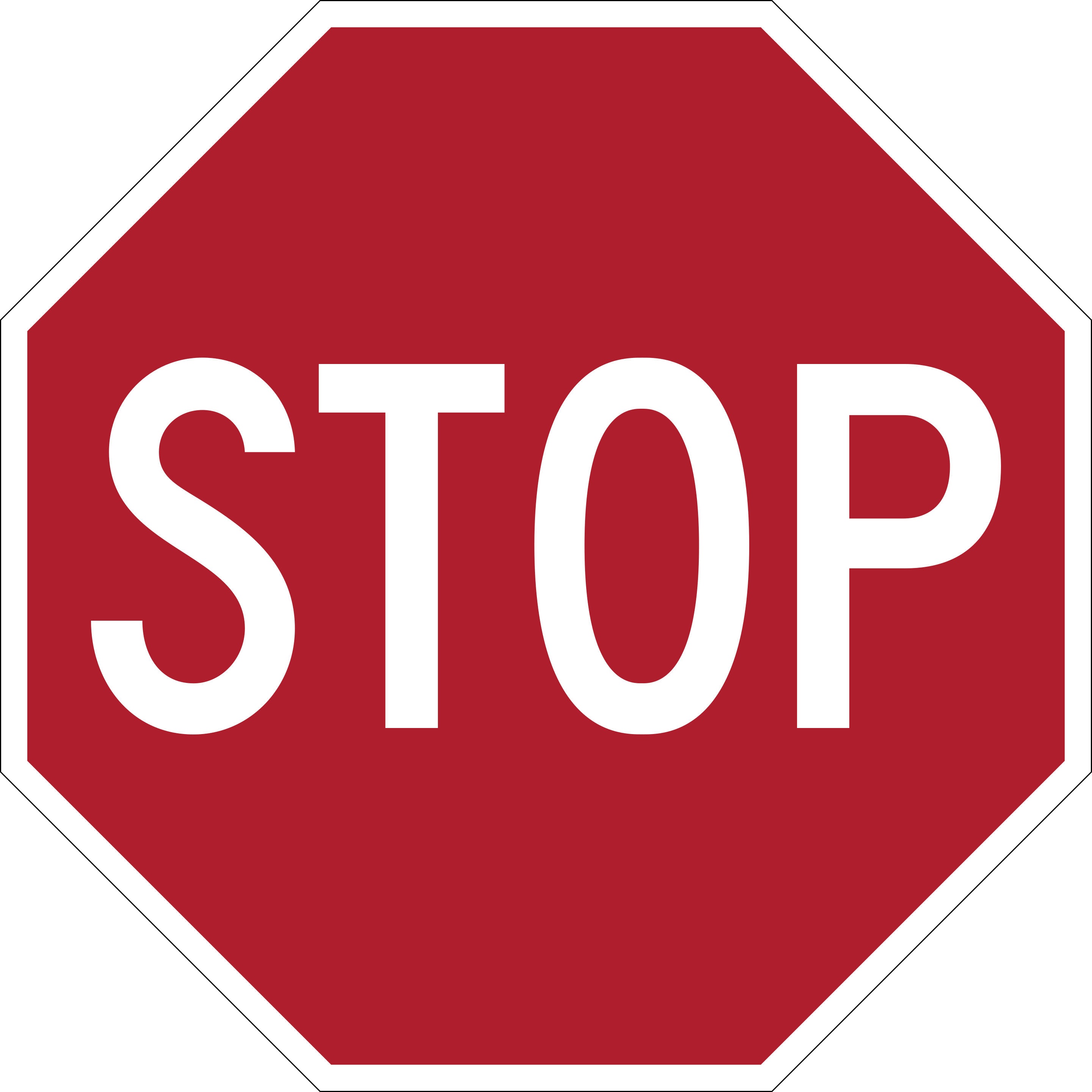
- The exact distance to the next gas station
- Its meaning and purpose
- The age of the pavement beneath it
- The color of the vehicle that must obey it
Show answer
Its meaning and purpose. Michigan explains that a traffic sign’s shape provides a clue about its meaning and purpose. Shape recognition helps a driver interpret a sign quickly, even before reading every word or symbol. The shape does not identify the pavement’s age, calculate a distance to a gas station, or describe a vehicle color. Study the basic shapes together with their functions, such as octagon for STOP, triangle for YIELD, diamond for WARNING, and pentagon for SCHOOL. That visual association gives the driver an early cue when approaching a sign in traffic.
Study this in the handbook: Traffic sign shapes and colors
5. At a T-intersection without signals or signs, which traffic has the right of way?
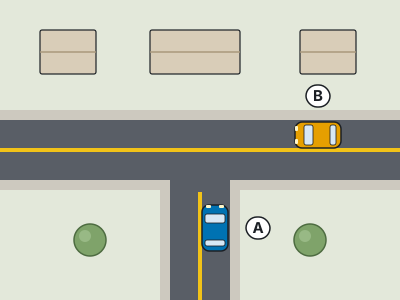
- Vehicles entering from the terminating road
- The vehicle traveling fastest
- The vehicle that sounds its horn
- Vehicles on the through road
Show answer
Vehicles on the through road. At a T-intersection with no signs or signals, the road that continues through has priority over a driver entering from the road that ends. The entering driver must yield rather than assume that reaching the junction first or sounding the horn creates permission to proceed. Slow before the meeting point, scan both directions, and wait for a safe gap in the through traffic. This rule matters because the terminating roadway may seem to continue visually, but its traffic must still give way at the T.
Study this in the handbook: Right of way, pedestrians and roundabouts
6. When may a rear-facing child restraint be placed in Michigan's front seat?
- Whenever the child is under age four
- Only when the vehicle is traveling below 25 mph
- Only when the front passenger air bag is deactivated
- Whenever the rear seat has a lap belt
Show answer
Only when the front passenger air bag is deactivated. A child in a rear-facing child-restraint system may be placed in the front seat only if the front passenger air bag is deactivated. The child's age alone does not authorize that position, and speed or the type of rear-seat belt does not change the air-bag condition. The manual also encourages parents to seat all children ages 12 and younger in the rear seat to avoid potential injury from an air bag in a crash. Before placing the restraint in front, verify the passenger air bag is off.
Study this in the handbook: Phones, seat belts and child passengers
7. What should you do when passing a large commercial vehicle at highway speed?
- Drive beside the truck as long as possible to block its view
- Use one hand so the other can signal continuously
- Keep both hands on the steering wheel and allow for strong air flow
- Move sharply in front of the truck before its cab is visible
Show answer
Keep both hands on the steering wheel and allow for strong air flow. Large commercial vehicles create strong air flow and draft at high speeds, so the manual says to keep both hands on the steering wheel while passing. That steady control helps you handle the air movement and maintain a predictable path. Remaining beside the truck extends your time in a blind area. One-handed driving reduces control, and moving in front before you can see the entire cab risks cutting off the truck. A useful cue is to pass decisively, keep both hands engaged, and leave enough distance for a safe return to your lane.
Study this in the handbook: Trucks, pedestrians, motorcycles and bicycles
8. When yellow hazard lights on a school bus are flashing, what should a driver do?
- Proceed with caution
- Ignore the bus because only red lights matter
- Stop in the travel lane immediately
- Accelerate to clear the school zone
Show answer
Proceed with caution. Michigan's school bus signals section says that when the yellow hazard lights on a school bus are flashing, you should proceed with caution. Keep these separate from the bus's yellow overhead lights, which mean be prepared to stop, and its red overhead lights, which require you to stop at least 20 feet from the bus. Ignoring the bus, stopping abruptly in the travel lane, or accelerating to clear the school zone are not the stated response. Slow down, watch for children near the bus and the roadway, and be ready for the bus to change its signals.
Study this in the handbook: Emergency vehicles, Move Over and school buses
9. A deer suddenly enters your lane and a collision cannot be avoided. What should you do?
- Swerve sharply into the opposite lane
- Brake firmly and keep the vehicle in your lane
- Accelerate so the deer clears the roadway first
- Release the steering wheel before impact
Show answer
Brake firmly and keep the vehicle in your lane. When impact with a deer is unavoidable, the manual advises staying in your lane, braking firmly, holding the steering wheel with both hands, and coming to a controlled stop. A sharp swerve can send the vehicle into opposing traffic, a ditch, or another obstacle and may be more dangerous than the animal. Acceleration gives the driver less time and distance to reduce the impact. The cue to remember is do not veer for deer: maintain control, slow decisively, and stop safely off the roadway when possible.
Study this in the handbook: Crashes, deer and roadside emergencies
10. What should you anticipate beyond this pedestrian warning sign?

- Pedestrians may be in the area
- Pedestrians must use a bicycle lane
- Pedestrians are prohibited from crossing
- Pedestrians have a separate traffic signal only at night
Show answer
Pedestrians may be in the area. The pedestrian warning sign tells drivers that pedestrians may be in the area, so careful driving is required. It does not remove pedestrians from the roadway, force them into a bicycle lane, or create a nighttime-only signal rule. Reduce speed enough to react, look toward sidewalks and crossing points, and be ready to yield. The warning is especially important near places where a person may enter the road unexpectedly. Keep scanning after passing the sign because the risk continues through the nearby area.
Study this in the handbook: Traffic sign shapes and colors
11. Michigan law makes it illegal to leave a child of what age unattended in a vehicle when the time or circumstances pose an unreasonable risk?
- Younger than 6 years old
- Younger than 4 years old
- Younger than 13 years old
- Younger than 16 years old
Show answer
Younger than 6 years old. Michigan protects young children left in parked vehicles. Under state law, a child younger than 6 years old may not be left unattended when the length of time or the circumstances create an unreasonable risk of harm or injury. A parent or guardian does not violate the law if the child is left with someone age 13 or older who is not legally incapacitated. The manual adds that it is never safe to leave children or pets alone in a vehicle, since heat and other dangers build quickly.
Study this in the handbook: Phones, seat belts and child passengers
12. How far ahead does the Michigan manual tell drivers to look down the road?
- 2 to 4 seconds
- 5 to 10 seconds
- 20 to 30 seconds
- Only to the vehicle directly ahead
Show answer
20 to 30 seconds. Scanning far ahead gives you time to act instead of react. The Michigan manual tells drivers to look down the road 20 to 30 seconds, which means watching well beyond the vehicle in front to spot hazards such as stopped traffic, merging cars or pedestrians early. The manual calls this a defensive driving technique and a higher level visual skill. It works together with a three to four second following gap, which protects you if the vehicle ahead stops suddenly.
Study this in the handbook: Bad weather, stopping distance and night driving
13. Before a Michigan teen may take the driving skills test, how much logged supervised driving is required?
- At least 30 hours, including 2 hours at night
- At least 40 hours, including 6 hours at night
- At least 50 hours, including 10 hours at night
- At least 60 hours, including 15 hours at night
Show answer
At least 50 hours, including 10 hours at night. Michigan uses two supervised driving checkpoints. To enter Segment 2, a teen shows a log of at least 30 hours, with at least 2 at night. To apply for the driving skills test, the log must reach at least 50 hours of supervised driving time, including 10 hours at night, and the teen must also be at least 15, have completed Segment 2, and have held the Level 1 Learner's License for at least six months. The completed driving log is presented at the test.
Study this in the handbook: Graduated Driver Licensing for teens
14. A Michigan driver is caught going 8 mph over the posted limit in a construction zone. How many points apply?
- 2 points
- 1 point
- 4 points
- 3 points
Show answer
3 points. Michigan raises the stakes for speeding where road work is under way. Fines double for moving violations in work zones, and speeding in a construction zone carries its own point schedule: three points for 10 mph or less over the posted limit, four points for more than 10 but not more than 15 mph over, and five points for more than 15 mph over. Going 8 mph over therefore adds three points, one more than the same speed would earn elsewhere.
Study this in the handbook: Speed limits and work zones
15. What devices are used at passive railroad crossings to alert drivers to look for trains?
- Flashing lights and gates that activate for every approaching train
- Advance warning signs, pavement markings, and crossbuck signs with yield or stop signs
- Only green route markers and lane arrows
- A single emergency notification sign with no crossing control
Show answer
Advance warning signs, pavement markings, and crossbuck signs with yield or stop signs. Passive railroad crossings lack flashing lights and gates, so they use advance warning signs, pavement markings, and crossbuck signs with yield or stop signs. Those devices tell drivers to look for trains and to slow down or stop as needed. Flashing lights and gates describe active control systems, not passive ones. Route markers do not control a rail crossing, and an emergency notification sign is for reporting a problem rather than directing ordinary crossing movement. Check both directions and confirm every track is clear before proceeding.
Study this in the handbook: Railroad crossings
16. What do solid white lines mark at the right edge of the road?
- Opposing traffic moving in different directions
- A railroad track from the nearest travel lane
- Only lanes reserved for emergency vehicles
- The right edge of the road
Show answer
The right edge of the road. Solid white lines have two roadway uses described in the Michigan manual. They can mark the right edge of the road, and they can separate lanes carrying traffic in the same direction. They are not the usual divider for opposing traffic, which is identified with yellow lines. A solid white line also does not automatically designate an emergency-only lane or mark a railroad track. Watch for these lines at road edges, lane boundaries, sharp curves, and other places where crossing may be dangerous, and avoid crossing them casually.
Study this in the handbook: Pavement markings and traffic signals
17. How many vehicle deer crashes happen in Michigan each year, and what does the average one cost?
- About 500, averaging $200
- About 5,000, averaging $10,000
- About 1 million, averaging $50
- About 60,000, averaging $2,100 in damage and $130 million statewide
Show answer
About 60,000, averaging $2,100 in damage and $130 million statewide. About 60,000 vehicle deer crashes happen in Michigan each year, officials suspect as many as half go unreported, and the average crash results in $2,100 in damage, usually to the front end, for an estimated $130 million statewide. If you hit a deer, report it to local police, the county sheriff or the state police. Brake firmly and do not swerve.
Study this in the handbook: Crashes, deer and roadside emergencies
18. When parallel parking in Michigan, how far from the curb should the vehicle be positioned at most?
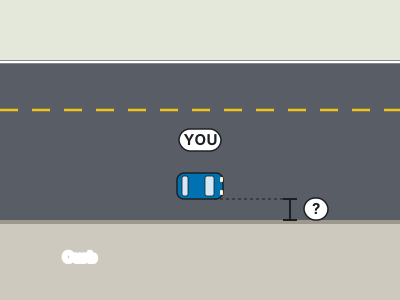
- 12 inches
- 6 inches
- 24 inches
- 36 inches
Show answer
12 inches. The manual directs drivers not to park more than 6 to 12 inches from the curb, so the maximum distance in this question is 12 inches. Two or three feet would leave the vehicle too far into the lane and is not the stated parking position. After backing into the space, straighten the vehicle, adjust its position, and check traffic before opening the door. The concrete cue is one foot: if the curb is more than a foot away, move closer when it is safe and legal to do so.
Study this in the handbook: Railroad crossings
19. What does this winding-road warning indicate?

- A single bump is ahead with no speed guidance
- A high-wind area begins at the next intersection
- A railroad crossing is hidden behind a hill
- A winding curve is ahead and the limit speed is 35 mph
Show answer
A winding curve is ahead and the limit speed is 35 mph. The winding-road sign identifies a winding curve ahead and gives a 35 mph limit speed for that condition. It does not describe one bump, wind, or a hidden railroad crossing. Reduce speed before the first bend and maintain control through the series rather than accelerating between curves. Look well ahead, stay in your lane, and allow for an approaching vehicle that may be close to the center line. The number on the warning is part of the message and should not be ignored.
Study this in the handbook: Traffic sign shapes and colors
20. What share of Michigan's 2023 fatal crashes involved alcohol?
- 5 percent
- 26.6 percent, or 272 of 1,021
- 75 percent
- 50 percent
Show answer
26.6 percent, or 272 of 1,021. Of the 1,021 fatal crashes that occurred in Michigan in 2023, 272, or 26.6 percent, were alcohol involved, with at least one drinking operator, bicyclist or pedestrian. Even one drink can impair driving, slow reaction time, dull concentration and cause visual problems, and operating under the influence of marijuana carries the same penalties as alcohol, including jail, fines, suspension and six points.
QualitySpace is expanding to Michigan
We are a California-based independent insurance brokerage working on licensing in more states. We cannot help with Michigan insurance yet. Leave your email and we will let you know when we can.
Every question is written from the official What Every Driver Must Know (Michigan). Need paper? Printable MI practice test with answer key.
Last verified 2026-10-05. How we check every question · Study all 218 as flashcards
Frequently asked questions
How many questions are on this Michigan practice test?
This fixed set has 20 questions. It is test 2 of 10 from the 218 question Michigan bank.
How does this fixed test relate to the full Michigan bank?
Each numbered test is a fixed set of questions in a fixed order, so you can retake the same test later and compare. Every test mixes road signs and the other topics in about the same proportion as the full bank. Tests 1 to 10 together cover 200 of the 218 questions in the Michigan bank, each once. The full practice page mixes the whole bank at random.
Last verified 2026-10-05. See the Michigan DMV facts page for sourced state details.
Return to the full Michigan practice test · Study road signs