
Test 8 of 10 · 20 questions · Free 2026
MI Permit Practice Test 8
Jump to the test ↓A fixed 20 question set from the Michigan bank with answers and plain English explanations.
Question 1 of 20 · 0 right so far

All 20 questions in test 8
Every question below comes from the Michigan question bank on this page. Open a question to see the correct answer and the explanation. Nothing here is hidden behind a signup.
1. What upcoming control does this warning sign identify?
- A yield sign has ended
- A stop sign is posted ahead
- A no-stopping zone begins immediately
- A traffic signal is permanently out of service
Show answer
A stop sign is posted ahead. STOP AHEAD warns that a stop sign is posted farther along the road. Use the advance warning to begin reducing speed and to prepare for a complete stop at the actual stop sign. It does not announce the end of a yield, create a no-stopping zone, or say that a signal is out of service. Look for the stop line, crosswalk, and intersecting traffic as you approach. Do not stop at the warning sign unless another condition requires it, but do arrive ready to stop.
Study this in the handbook: Traffic sign shapes and colors
2. What does this pennant-shaped sign mark?
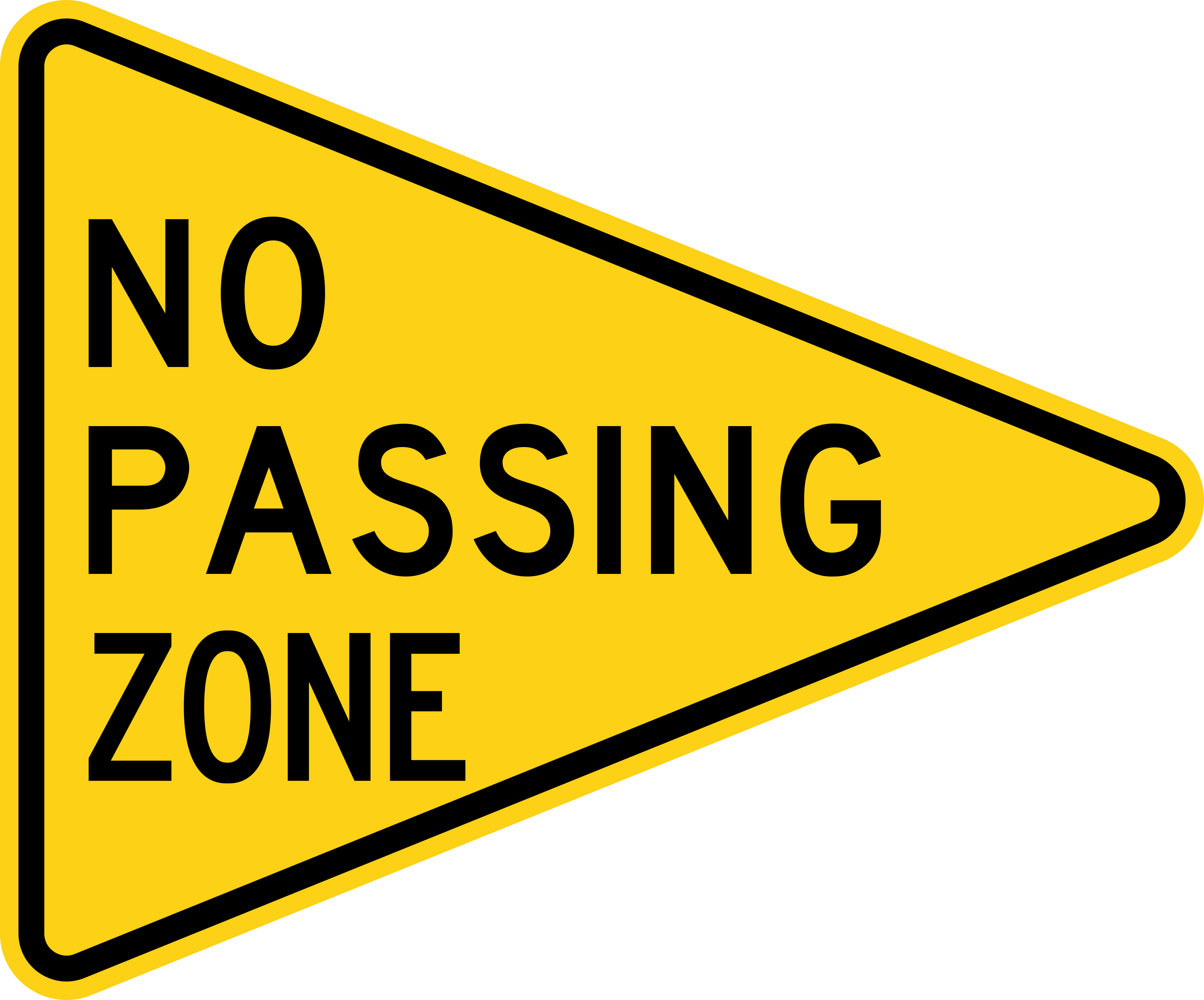
- The end of a no-passing zone
- A no-passing zone where passing is hazardous
- A recreational picnic area
- A lane where passing is required
Show answer
A no-passing zone where passing is hazardous. The yellow pennant marks a no-passing zone on the left side of the roadway. It warns that conditions make passing hazardous, so remain behind the vehicle ahead until the restriction ends and a legal safe opportunity exists. The sign does not mark the end of the zone, a recreation area, or a place where passing is required. Its unusual sideways shape helps distinguish the warning from other yellow signs. Continue watching lane markings and additional signs after passing it.
Study this in the handbook: Traffic sign shapes and colors
3. Under Michigan's Basic Speed Law, how should a driver choose a speed?
- Use a careful and prudent speed for the conditions
- Always drive at the posted maximum
- Drive exactly 5 mph below the sign
- Match the fastest nearby vehicle
Show answer
Use a careful and prudent speed for the conditions. Michigan’s Basic Speed Law calls for a careful and prudent speed in all driving conditions. The posted number is a ceiling, not a promise that the same speed is safe in rain, ice, congestion, darkness, or a work area. Matching the fastest nearby vehicle is also not a legal measuring stick. A driver should select a speed that allows stopping within the clear distance ahead and should be ready to reduce it when conditions worsen. The road surface and visibility are the cue to reassess, even when the sign has not changed.
Study this in the handbook: Speed limits and work zones
4. What does Michigan's implied consent law mean when you apply for or renew a driver license?
- You are considered to have agreed to a chemical test
- You may refuse every chemical test without a license consequence
- You must carry a breath-testing device in your vehicle
- You consent only after an officer proves impairment in court
Show answer
You are considered to have agreed to a chemical test. By applying for or renewing a Michigan driver license, a driver is treated as having consented to a chemical test when circumstances warrant one. The refusal choice is risky because the manual says refusal results in a license suspension. This is a licensing condition, not a requirement to keep testing equipment in the car. Remember the trigger: the officer requests the test under circumstances indicating it is warranted.
Study this in the handbook: Your driving record, points and implied consent
5. After pulling over for an approaching emergency vehicle, how long must a Michigan driver remain stopped?
- Until the siren can no longer be heard
- Until the emergency vehicle has passed
- For exactly 30 seconds
- Until another driver begins moving
Show answer
Until the emergency vehicle has passed. After an approaching emergency vehicle causes a driver to pull over and stop, Michigan requires the driver to remain there until that emergency vehicle has passed. The siren becoming quiet is not the stated stopping endpoint, and the manual gives no 30-second timer or permission to move when another driver starts. Stay clear of intersections, keep the vehicle stopped, and remain alert because more than one emergency vehicle may be responding. Once the response vehicles have passed, check traffic and roadway conditions before reentering the lane. The cue is simple: wait for the vehicle, not merely the sound, to clear.
Study this in the handbook: Emergency vehicles, Move Over and school buses
6. When does a Michigan driver's license expire for a driver under 21?
- Four years after issue
- At age 18
- At age 25
- On the driver's 21st birthday
Show answer
On the driver's 21st birthday. A Michigan license is usually valid for four years and expires on your birthday in the year shown, but if you are under age 21 your license expires on your 21st birthday. The Secretary of State sends a renewal notice well in advance of the expiration date, and that notice goes to the address listed on department records. The manual also warns not to let a license expire unless you will no longer be driving, because driving without a valid license is illegal.
Study this in the handbook: Permits, tests, probation and renewal
7. Why should a driver look 20 to 30 seconds down the road?
- To spot hazards and avoid last-second reactions
- To keep the eyes fixed on one distant point
- To estimate the vehicle's fuel consumption
- To replace mirror checks during lane changes
Show answer
To spot hazards and avoid last-second reactions. Looking 20 to 30 seconds ahead helps the driver detect developing hazards before they become immediate emergencies. That extra view supports a controlled speed change or lane decision instead of a last-second reaction. It does not mean staring at one point, estimating fuel use, or abandoning mirror checks. Sweep the roadway and keep checking near and far areas so the vehicle remains positioned safely while the driver plans ahead.
Study this in the handbook: Bad weather, stopping distance and night driving
8. A passenger age 21 or older wants to smoke marijuana inside a vehicle on a Michigan public road. What does Michigan law say?
- It is allowed if the driver does not smoke
- It is prohibited for drivers and passengers alike
- It is allowed as long as the windows are open
- It is allowed because the passenger is 21 or older
Show answer
It is prohibited for drivers and passengers alike. Michigan prohibits drivers and their passengers from smoking marijuana within the passenger area of a vehicle on a public way, so a passenger cannot smoke even when the driver stays sober. Open windows do not create an exception, and being 21 or older does not either, because adult legal use stops at the passenger area of a vehicle on a public road. The manual lists this beside the rule that no one may consume marijuana while operating or in physical control of a vehicle, and Michigan's marijuana law, MCL 333.27954, contains the same limit. The manual also notes it is illegal to transport marijuana into Canada.
Study this in the handbook: Your driving record, points and implied consent
9. Under Kelsey's Law, what can a Michigan Level 2 driver face for using a phone while driving in a non-emergency?
- An automatic one-year license revocation
- A felony charge with jail time
- A civil infraction with fines and/or community service
- No penalty, because the law only applies to Level 1
Show answer
A civil infraction with fines and/or community service. Kelsey's Law bars GDL drivers from using a phone while driving except for emergencies, and it covers Level 2 as well as Level 1. A violation is a civil infraction that can bring fines, community service or both. A felony charge and an automatic one-year revocation overstate the stated consequence. The claim that only Level 1 drivers are covered is wrong, because the manual repeats the ban in the Level 2 restrictions. A hands-on call to a friend is not an emergency.
Study this in the handbook: Graduated Driver Licensing for teens
10. What does a flashing yellow arrow allow a driver to do?
- Turn left without yielding to anyone
- Treat the arrow exactly like a solid red arrow
- Proceed straight from any lane
- Turn left after oncoming traffic is clear and pedestrians are safe
Show answer
Turn left after oncoming traffic is clear and pedestrians are safe. A flashing yellow arrow allows a left turn, but it is permissive rather than protected. Oncoming traffic may have a green light, so the turning driver must wait for an adequate gap and check for pedestrians and bicyclists in the crossing. The arrow does not remove the yield duty, and it is not the same as a solid red arrow. Confirm the path is clear before beginning the turn, then continue with care.
Study this in the handbook: Pavement markings and traffic signals
11. If you cannot stop safely on a yellow light, what should you avoid doing?
- Checking the crosswalk before continuing
- Continuing cautiously when a safe stop is impossible
- Speeding up to get through the intersection
- Watching for vehicles entering from the side
Show answer
Speeding up to get through the intersection. When a yellow light appears, a driver should stop if stopping can be done safely. If the vehicle is too close or conditions make a safe stop impossible, Michigan says not to speed up; continue through the intersection cautiously instead. Speeding up is the unsafe action to avoid, while checking the crosswalk and watching for side traffic remain prudent. Do not reverse into a following vehicle to manufacture a stop. The cue is yellow demands a safety judgment, never a rush to beat the red.
Study this in the handbook: Pavement markings and traffic signals
12. Michigan requires a physician's statement when the Secretary of State believes an applicant had a seizure or blackout within what period?
- The preceding 30 days
- The preceding 12 months
- The preceding six months
- At any point in the applicant's life
Show answer
The preceding six months. Medical conditions can affect safe driving, so Michigan can ask an applicant for a physician's statement. The manual says one is required if the Secretary of State has reason to believe the applicant had a fainting spell, blackout, seizure or other loss of consciousness in the preceding six months. A stricter rule applies to chauffeur and commercial licenses: those applicants must have had no blackouts, fainting spells or seizures within the last 12 months. The statement must describe the condition and medications accurately.
13. What right-of-way rule applies when an ambulance approaches from any direction with flashing warning lights?
- Maintain speed because a multi-lane road has room
- Follow it closely to get through traffic
- Pass it before it reaches the intersection
- Yield to it and clear its path
Show answer
Yield to it and clear its path. Michigan drivers must yield to an authorized emergency vehicle approaching from any direction with its warning lights flashing. On a multi-lane road, extra lanes do not remove the duty to yield, because the emergency vehicle may need to cross lanes, turn, or use the intersection. Following closely can interfere with the response, and passing before the ambulance reaches the intersection is dangerous. Reduce speed, clear the vehicle’s path, and stop when necessary. Watch for additional responders after the first vehicle. The key cue is the active flashing warning equipment, not the number of lanes or the apparent amount of open pavement.
Study this in the handbook: Emergency vehicles, Move Over and school buses
14. Who must take a Michigan motorcycle rider education course?
- All riders regardless of age
- Only riders over 50
- Teens ages 16 to 17, and adults who fail the motorcycle skills test twice
- No one, the course is optional for everyone
Show answer
Teens ages 16 to 17, and adults who fail the motorcycle skills test twice. To earn a motorcycle endorsement you complete a rider education course or pass the written knowledge and skills tests, and the course is required for teens ages 16 to 17 and for adults who fail the motorcycle skills test twice. A restricted three wheel endorsement is available after a three wheel skills test. A chauffeur's license also requires age 16.
15. When must Michigan headlights be on because daylight is insufficient?
- Only after midnight
- Only when another driver flashes headlights
- Whenever there is not enough daylight to see people and vehicles clearly at 500 feet
- Only when the vehicle is parked on a shoulder
Show answer
Whenever there is not enough daylight to see people and vehicles clearly at 500 feet. Michigan requires headlights whenever available daylight is insufficient to see people and vehicles clearly at 500 feet. The rule is based on visibility, not the clock, so midnight is not the only trigger and a signal from another driver is not required. Parking on a shoulder is unrelated to the visibility requirement. Do not substitute parking lights when headlights are required. As daylight fades or weather limits contrast, turn on the headlights early enough for other road users to see the vehicle and for the driver to see hazards. Use the 500-foot visibility standard as the practical test rather than guessing by time of day.
Study this in the handbook: Bad weather, stopping distance and night driving
16. What does a red octagonal STOP sign require before a driver proceeds?
- A rolling slowdown if no vehicle is visible
- A stop only when a police officer is present
- A lane change around the sign
- A complete stop and yielding to traffic and pedestrians
Show answer
A complete stop and yielding to traffic and pedestrians. The STOP sign requires a complete stop, followed by yielding to traffic and pedestrians before proceeding. A rolling slowdown does not satisfy that command, even when the intersection appears empty. Police presence is not required, and going around the sign changes the path without removing the obligation. Stop at the marked line, crosswalk, or appropriate point, then check all directions and continue only when the way is safe.
Study this in the handbook: Traffic sign shapes and colors
17. How far from a marked crosswalk must a Michigan driver park?
- At least 10 feet
- At least 30 feet
- At least 50 feet
- At least 20 feet
Show answer
At least 20 feet. Parking within 20 feet of a marked crosswalk is prohibited, and where there is no crosswalk the rule is 15 feet from the intersection. Thirty feet is the stop sign and signal distance, and 50 feet is the railroad rail distance. Ten feet is too close. Keeping cars back from the crosswalk lets drivers see pedestrians who are about to step into the street.
18. If a Michigan traffic signal is not working and no officer is directing traffic, what must a driver do?
- Stop completely and yield to vehicles already at the intersection
- Continue through if the road appears clear
- Yield only to vehicles on the left
- Wait for a green light that may never appear
Show answer
Stop completely and yield to vehicles already at the intersection. A nonworking traffic signal becomes a stop-and-yield situation when no officer or other traffic-control device is present. Michigan directs the driver to make a complete stop and yield to vehicles already at the intersection. Continuing because the pavement looks clear skips the required stop. If vehicles arrive at the same time, yield to the vehicle on your right. The useful cue is to treat a dark signal as an uncontrolled intersection with a full stop, not as permission to maintain speed or wait for an absent green indication.
Study this in the handbook: Right of way, pedestrians and roundabouts
19. Unless posted otherwise, what maximum and minimum speeds does Michigan summarize for freeways?
- 65 mph maximum and 45 mph minimum
- 55 mph maximum and 35 mph minimum
- 75 mph maximum and 60 mph minimum
- 70 mph maximum and 55 mph minimum
Show answer
70 mph maximum and 55 mph minimum. For freeways unless signs say otherwise, Michigan summarizes a 70 mph maximum and a 55 mph minimum. The maximum is a ceiling, not a speed every driver must maintain, and the minimum does not excuse driving faster than conditions safely allow. The 65 mph figure belongs to school buses and trucks on a freeway posted at 70 mph, so it is not the general pair for passenger vehicles. Check the posted sign first, then account for weather, traffic, visibility, and pavement. The Basic Speed Law can require a speed below the posted maximum when conditions make that prudent.
Study this in the handbook: Phones, seat belts and child passengers
20. Before returning to the right lane after passing, what must a Michigan driver be able to see?
- Only the passed vehicle's front bumper in a side mirror
- The entire vehicle being passed in the rearview mirror
- The next intersection at least 500 feet away
- The driver's own rear tire in the passenger mirror
Show answer
The entire vehicle being passed in the rearview mirror. Michigan says not to cut back into the right lane until the entire vehicle being passed is visible in the rearview mirror. Seeing only a bumper in a side mirror leaves the pass incomplete and risks crowding the other vehicle. The driver's own tire and a distant intersection are unrelated checks. Wait until the full vehicle appears, then move back with adequate space and a clear path.
Study this in the handbook: Passing, lane use and turns
QualitySpace is expanding to Michigan
We are a California-based independent insurance brokerage working on licensing in more states. We cannot help with Michigan insurance yet. Leave your email and we will let you know when we can.
Every question is written from the official What Every Driver Must Know (Michigan). Need paper? Printable MI practice test with answer key.
Last verified 2026-10-05. How we check every question · Study all 218 as flashcards
Frequently asked questions
How many questions are on this Michigan practice test?
This fixed set has 20 questions. It is test 8 of 10 from the 218 question Michigan bank.
How does this fixed test relate to the full Michigan bank?
Each numbered test is a fixed set of questions in a fixed order, so you can retake the same test later and compare. Every test mixes road signs and the other topics in about the same proportion as the full bank. Tests 1 to 10 together cover 200 of the 218 questions in the Michigan bank, each once. The full practice page mixes the whole bank at random.
Last verified 2026-10-05. See the Michigan DMV facts page for sourced state details.
Return to the full Michigan practice test · Study road signs