
Test 3 of 10 · 20 questions · Free 2026
MI Permit Practice Test 3
Jump to the test ↓A fixed 20 question set from the Michigan bank with answers and plain English explanations.
Question 1 of 20 · 0 right so far
All 20 questions in test 3
Every question below comes from the Michigan question bank on this page. Open a question to see the correct answer and the explanation. Nothing here is hidden behind a signup.
1. If a train is coming at a Michigan railroad crossing, where must vehicles stop?
- On the tracks until the train passes
- Exactly 10 feet from the nearest rail
- At least 100 feet from the crossing in every case
- No more than 50 feet and no less than 15 feet from the tracks
Show answer
No more than 50 feet and no less than 15 feet from the tracks. When a train is coming, Michigan places the stopping range between 15 feet and 50 feet from the tracks. Ten feet is too close, while 100 feet is not the stated universal requirement. Remaining on the rails is dangerous and unlawful. Slow as you approach, watch both directions, and stop within the marked safe range before the crossing. Never enter unless the vehicle can clear every track completely.
Study this in the handbook: Railroad crossings
2. When must a Michigan driver yield to a pedestrian at a crosswalk?
- Only when the pedestrian is already halfway across
- Only at an intersection with a stop sign
- At a marked crosswalk, even when the traffic light is green for the driver
- Never when the driver has a green light
Show answer
At a marked crosswalk, even when the traffic light is green for the driver. Michigan requires drivers to yield to a pedestrian in a marked crosswalk, including when the driver's traffic light is green. Waiting until the person is halfway across is unsafe and adds a condition the rule does not use. A stop sign is not necessary for the crosswalk duty. Scan both sides before moving through a green signal and let the pedestrian clear the path.
Study this in the handbook: Right of way, pedestrians and roundabouts
3. If your vehicle begins hydroplaning on a wet road, which condition can contribute to the loss of control?
- Worn tires or low tire pressure
- A properly adjusted rearview mirror
- A full fuel tank and working turn signals
- A clean windshield and dry brakes
Show answer
Worn tires or low tire pressure. Hydroplaning happens when the tires ride on top of the water on a wet road, which the Michigan manual says can result in a loss of control. It names worn tires, low tire pressure, and driving too fast as contributors. A clean windshield, a mirror adjustment, or a full fuel tank has nothing to do with it. The useful warning cue is a wet roadway combined with worn tread, underinflation, or a speed that is too high for the water present. The manual also notes that brakes may become wet in heavy rain, so test them gently afterward.
Study this in the handbook: Aggressive driving, intersections and freeways
4. What must a driver generally pay after being convicted of a Michigan traffic violation?
- Certain court fines and costs
- No charge if points are assessed
- A mandatory fuel tax
- Only a vehicle registration fee
Show answer
Certain court fines and costs. A traffic conviction creates a financial obligation in addition to any point entry on the driving record. Michigan says the driver must pay certain court fines and costs, while points may be posted separately. The registration fee choice concerns keeping a vehicle legally registered, not the ordinary consequence named here. The no-charge choice incorrectly treats points as a substitute for court costs. When reviewing a ticket, separate the court payment from later record consequences, since one does not cancel the other. The exact amount can depend on the violation and court handling, but the general payment requirement remains part of the conviction process.
Study this in the handbook: Your driving record, points and implied consent
5. A Michigan driver collects 12 points within two years. What does the Secretary of State require?
- An automatic lifetime revocation
- Nothing, because points expire after 12 months
- A driver assessment reexamination
- Only a letter from the insurance company
Show answer
A driver assessment reexamination. Twelve or more points within a two-year period, or six or more one-point violations in that time, triggers a driver assessment reexamination. At that meeting an analyst can restrict, suspend or revoke the license, but revocation is not automatic for life. Points stay on the record for two years from the date of conviction, not 12 months. Insurance company points are a separate system and do not satisfy the state requirement.
6. What road condition does the skidding-car symbol warn about?

- A racing course begins after the next curve
- A gravel surface is required for the next mile
- Road conditions may become slippery in bad weather
- The road is closed to vehicles with traction control
Show answer
Road conditions may become slippery in bad weather. The skidding-car warning means road conditions can become slippery in bad weather. Slow down, leave more room, and use smooth steering and braking rather than treating the symbol as a race-area or gravel-road message. It does not close the road to vehicles with traction control. Fresh rain, snow, or ice can reduce grip before the surface looks dangerous, so let the warning change your driving before the first slick patch. Keep watching for related weather and roadway clues.
Study this in the handbook: Traffic sign shapes and colors
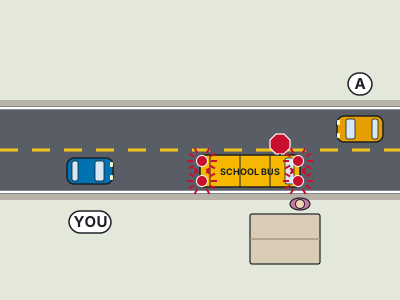
7. How far from a school bus must Michigan drivers stop when its red overhead lights are flashing?
- At least 5 feet
- At least 20 feet
- Exactly 100 feet
- At least 50 feet
Show answer
At least 20 feet. When a school bus’s red overhead lights are flashing, Michigan requires a driver to stop at least 20 feet from the bus. The vehicle must remain stopped until the red lights turn off or the bus resumes travel. Five feet would leave too little separation, and 50 or 100 feet are not the stated stopping distance. The key visual cue is the red overhead signal, which marks the loading or unloading condition and changes the normal traffic obligation. Watch the bus, not just the road ahead, before moving again.
Study this in the handbook: Emergency vehicles, Move Over and school buses
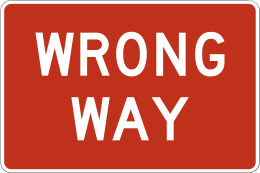
8. If this sign is facing you, what traffic problem are you in?
- A temporary construction detour
- A lane reserved for trucks
- A lane of oncoming traffic
- A road where passing is encouraged
Show answer
A lane of oncoming traffic. Michigan's sign chart says WRONG WAY means you have entered a lane of oncoming traffic, and the instruction is to get out the safest and quickest way possible. A truck-only lane or construction detour would be marked with a different sign; the chart lists No Trucks Allowed separately. Passing is especially dangerous here because the central problem is the direction of traffic itself. Treat the message as urgent and leave the lane by the safest and quickest route available.
Study this in the handbook: Traffic sign shapes and colors
9. What does a red upraised hand or the words DONT WALK mean at a pedestrian signal?
- Cross quickly before vehicles receive a green light
- Cross only after looking over your shoulder
- Cross if the nearest lane appears empty
- Do not cross the roadway
Show answer
Do not cross the roadway. The red upraised hand and the words DONT WALK both tell a pedestrian not to cross the roadway. An empty-looking lane does not cancel the signal because traffic can approach from another direction or turn across the crossing. The signal also does not authorize a rushed crossing before vehicles change phases. Looking over a shoulder is a useful awareness habit, but it cannot turn a prohibited movement into a permitted one. Wait for the walking person symbol or WALK indication before starting, and continue yielding to traffic as needed.
Study this in the handbook: Pavement markings and traffic signals
10. When proceeding on a steady green arrow, what must you do at the intersection?
- Assume pedestrians must wait because the arrow gives absolute priority
- Yield the right of way to pedestrians in the intersection
- Stop before the intersection until the arrow changes to yellow
- Yield only to vehicles coming toward you
Show answer
Yield the right of way to pedestrians in the intersection. A steady green arrow permits movement in the arrow's direction, but it does not remove the duty to watch for people in the intersection. Pedestrians still have the right of way, so check the crosswalk and yield before proceeding through their path. The idea that the arrow gives absolute priority ignores that pedestrian protection remains in force. Waiting for yellow would defeat the indication, and yielding only to oncoming vehicles overlooks the specific hazard named by the rule. Treat the arrow as permission to proceed cautiously, not as permission to stop scanning.
Study this in the handbook: Pavement markings and traffic signals
11. What do warning signs in construction and maintenance areas look like?
- Round, with white lettering on a blue background
- Diamond-shaped, with black lettering on an orange or yellow background
- Vertical rectangles with green lettering
- Octagons with red lettering on a white background
Show answer
Diamond-shaped, with black lettering on an orange or yellow background. Construction and maintenance warning signs use a diamond shape, with black lettering placed on an orange or yellow background. The round blue choice describes neither the prescribed shape nor the work-area colors. Green belongs to directions and guidance, while an octagon is associated with a stop sign rather than this warning category. As you approach a work area, use the diamond outline and orange or yellow field as a cue to scan for workers, equipment, lane shifts, and temporary instructions.
Study this in the handbook: Phones, seat belts and child passengers
12. How close to an oncoming vehicle may a Michigan driver still be completing a pass?
- You must return to your lane before getting within 200 feet of any oncoming vehicle
- Within 50 feet
- Within 500 feet
- There is no distance rule
Show answer
You must return to your lane before getting within 200 feet of any oncoming vehicle. When passing, do not cut back into the right lane until you can see the entire vehicle you passed in your rearview mirror, and you must return to your lane before you get within 200 feet of any oncoming vehicle. Do not pass more than one vehicle at a time, and do not pass when oncoming traffic is close enough that trying to pass would place you and other vehicles in danger of crashing. Never pass where a solid yellow line is on your side.
Study this in the handbook: Passing, lane use and turns
13. Which road users have the right of way when you encounter a funeral procession?
- Ordinary traffic approaching from a side street
- The funeral procession, except for fire trucks, ambulances, and police vehicles
- Only the first vehicle in the procession
- Any driver who reaches the intersection first
Show answer
The funeral procession, except for fire trucks, ambulances, and police vehicles. Michigan gives funeral processions the right of way over all other vehicles, except fire trucks, ambulances, and police vehicles. Ordinary traffic should therefore remain out of the line and allow the group to continue. The side-street choice reverses that priority, while limiting priority to the first vehicle ignores the procession as a whole. Reaching an intersection first does not override the special rule. The manual also makes cutting through the procession a civil infraction, so the practical cue is to wait, avoid entering the line, and let the procession pass safely.
Study this in the handbook: Right of way, pedestrians and roundabouts
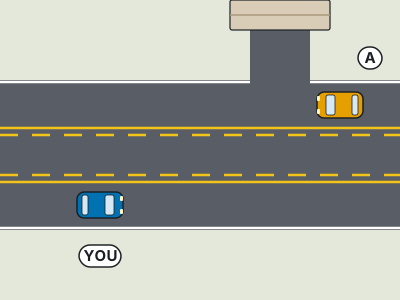
14. What is the primary purpose of a left-turn-only center lane?
- Providing a passing lane for faster traffic
- Providing a designated lane for left turns
- Providing a parking lane for waiting vehicles
- Providing a through lane around congestion
Show answer
Providing a designated lane for left turns. A left-turn-only center lane provides a designated space for left-turn movements and helps traffic flow smoothly. It is not a passing lane, a shortcut around congestion, or a place to park while waiting. Michigan also warns that using this lane to pass or merge is illegal and dangerous. Enter it only when preparing for the left turn, watch for vehicles approaching from the opposite direction, and leave it through the intended turn path. The yellow borders and turn arrows are the visual cue that this lane has a special purpose rather than ordinary through travel.
Study this in the handbook: Pavement markings and traffic signals
15. What share of traffic fatalities does NHTSA estimate are caused by aggressive driving, according to the Michigan manual?
- 66 percent
- 5 percent
- 25 percent
- 95 percent
Show answer
66 percent. The exact number of crashes caused by aggressive drivers is unknown, but the National Highway Traffic Safety Administration has estimated that 66 percent of all traffic fatalities are caused by aggressive driving behaviors. The manual describes aggressive drivers as running stop signs and red lights, speeding, tailgating and weaving. If you meet one, get out of the way, avoid eye contact, and call the police to report the driver if it is safe to do so. Ask yourself whether your own habits match the aggressive driver checklist.
Study this in the handbook: Aggressive driving, intersections and freeways
16. If a vehicle must stop on a Michigan freeway because of an emergency, what should the driver do?
- Back along the shoulder to the previous exit
- Stop in the travel lane with headlights off
- Use hazard flashers, slow gradually, and pull fully off the pavement
- Leave the vehicle immediately in the traffic lane
Show answer
Use hazard flashers, slow gradually, and pull fully off the pavement. A freeway stop is reserved for an emergency. Once stopping is unavoidable, turn on the emergency hazard flashers, reduce speed gradually, and move all the way off the pavement as soon as it can be done safely. Stopping in a travel lane exposes the vehicle to fast traffic, while backing on the shoulder creates another collision risk and may surprise drivers entering the area. Leaving the vehicle in the lane is especially dangerous. Signal the problem clearly and reach a fully off-road position.
Study this in the handbook: Aggressive driving, intersections and freeways
17. How many Michiganders are registered organ donors, according to the manual?
- Fewer than half
- About 100,000
- About 1 million
- A majority, 4.6 million
Show answer
A majority, 4.6 million. A majority of Michiganders, 4.6 million, are registered organ donors. Up to 2,500 patients in Michigan and over 100,000 nationally are waiting for a transplant, most major religions support donation, there is no cost to the donor's family, and donation is considered only after every effort to save the patient's life. You can sign up when applying in person or online.
18. What penalties does Michigan list for operating under the influence of alcohol or marijuana?
- A $50 fine
- A warning for a first offense
- Two points only
- Up to 93 days in jail, up to a $500 fine, license suspension and six points, with more if minors are aboard
Show answer
Up to 93 days in jail, up to a $500 fine, license suspension and six points, with more if minors are aboard. The penalties for operating under the influence of marijuana are the same as for alcohol and can include up to 93 days in jail, up to a $500 fine, license suspension, six points on the driving record and more, with heightened penalties when minors are in the vehicle. Even one drink impairs reaction time, concentration and vision, and refusing a preliminary breath test under 21 adds points.
Study this in the handbook: Your driving record, points and implied consent
19. What speed limit does Michigan set for mobile home parks and some municipal parks?
- 15 mph
- 10 mph
- 20 mph
- 25 mph
Show answer
15 mph. The Michigan Vehicle Code summary sets 15 mph for mobile home parks and some municipal parks. Twenty five mph is the limit for platted subdivisions and condominium complexes, a different setting. Ten and twenty mph are not listed defaults. The manual adds that drivers should watch for posted signs in school and hospital zones, because posted speed limits vary there. A posted sign can still set a different speed, and the Basic Speed Law always calls for a careful and prudent speed.
Study this in the handbook: Phones, seat belts and child passengers
20. When headlights are required in Michigan, what does the law say about driving with only parking lights on?
- It is allowed in city traffic with streetlights
- It is allowed below 25 mph
- It is allowed for the first 30 minutes after sunset
- It is illegal
Show answer
It is illegal. Parking lights are dim and are meant to mark a stopped vehicle, not to light the road or make a moving car easy to see. Michigan requires headlights whenever there is not enough daylight to see people and vehicles clearly at 500 feet, and the manual states plainly that using only parking lights at those times is illegal. Turn on the full headlights at dusk, in rain or fog, and any time visibility drops, so other drivers can judge your position and speed.
Study this in the handbook: Bad weather, stopping distance and night driving
QualitySpace is expanding to Michigan
We are a California-based independent insurance brokerage working on licensing in more states. We cannot help with Michigan insurance yet. Leave your email and we will let you know when we can.
Every question is written from the official What Every Driver Must Know (Michigan). Need paper? Printable MI practice test with answer key.
Last verified 2026-10-05. How we check every question · Study all 218 as flashcards
Frequently asked questions
How many questions are on this Michigan practice test?
This fixed set has 20 questions. It is test 3 of 10 from the 218 question Michigan bank.
How does this fixed test relate to the full Michigan bank?
Each numbered test is a fixed set of questions in a fixed order, so you can retake the same test later and compare. Every test mixes road signs and the other topics in about the same proportion as the full bank. Tests 1 to 10 together cover 200 of the 218 questions in the Michigan bank, each once. The full practice page mixes the whole bank at random.
Last verified 2026-10-05. See the Michigan DMV facts page for sourced state details.
Return to the full Michigan practice test · Study road signs